A response to Bowman’s post. Read other letters to new teachers which are cataloged here.
***
Dear person about to enter the classroom as a fulltimeteacher,
I love you. Okay, fine, not quite true — maybe respect, like, or lurve is more appropriate — but you have a passion for something and you’re following it. I don’t know if that passion is for the subject you teach, or for working with kids, or the deeply interesting intellectual puzzle of how to get someone to understand something, or for (in the booming Wizard of Oz voice) the Betterment of All Mankind. Regardless, this thing that brings you to the classroom is wonderful, because it puts you in the same ranks as those wonderful teachers that loom large in your past who inspired you and who helped you recognize that what they do has some worth. (Unfortunately, it also means you’ll probably have a bank account similar to those teachers. Sigh. Yeah, that will continue to suck, newteacher.)
Now some background on me. I was only a first year teacher once, at a school that is in all likelihood not your school. And my kids are are certainly not your kids. And all of this colors my thoughts. So take everything with a grain of salt, and I’d say if anything resonates with you in your gut, maybe that’s the thing that worth listening to. So you have some context, my school is an independent (read: private) school in Brooklyn. The class sizes are small (usually 12-16, rarely more), and the kids are fairly well-behaved. I have been here for five years, and it’s the only school I’ve known as a non-student-teacher teacher. Still, if this doesn’t sound similar to where you’re going to be starting and your gut tells you to stop reading, first: just for now, ignore what I said about going with your gut. Second, there are truisms for all schools and all students, which is why I have had so many awesome conversations with zillions of colleagues in all parts of the world in all sorts of schools.
Introductions over, and let more be added to the heap of unsolicited advice you’ve already gotten. There is something to be said for the fact that so many people are giving you unsolicited advice. Let’s talk about going out on your first date. It’s awkward and uncomfortable and when you tell your friends/parents/strangers/stuffed-animal you’re nervous, they all want to stroke your hair calm your nerves and tell you how they know everything is going to be alright. And then, to show you that they know everything is going to be alright, they’ll tell you some awkward and embarrassing story to make you feel better — because the hidden truth that they’re trying to say without saying it is: it won’t go at all the way you have pictured it a thousand times in your mind, and you’ll be too self-conscious, and the illusion of that perfect date will shatter. And they give you a ton of unsolicited advice. But they say this because they care, and because alright means you’ll survive. And you will. (And in case this wasn’t clear, that is what your first year will be like. It’s an analogy simile analogy-simile-metaphor-thingie.)
You: “How annoying! Yet another jerk telling me that the first year of teaching is going to be hard and is going to suck. Hooray, thanks for that.” But what I want to say is: everyone is saying the same thing, which means that everyone went through it, and everyone is saying it to you out of lurve because they totally want you to succeed. We all do. And we don’t even know you. So I’ve said it now officially. The first year of teaching is hard.
Unsolicited and Probably Unhealthy Tiny Piece of Advice #1: Work a lot.
It pays off. Seriously. The more time you put into your lesson planning, the better your lessons will be. The better your lessons will be, the more respect you’ll get from your students (and colleagues). I don’t know if this is healthy advice or not, but I’m giving it anyway. I remember working everyday until 9pm or 10pm each night. I thought that was normal. (I had three different courses to prepare for, and had very little material given to me, so I don’t know if I had much of a choice, honestly.) But it paid off with relatively good student behavior and a fairly productive classroom. I learned that students reserve respect for teachers who constantly demonstrate that they care about student learning. And there is no way to better demonstrate this care than by planning good classes. And more importantly, I had learned to create two curricula on my own. And there is almost nothing that will throw you into the deep end, and have you coming out of the other side stronger, than doing that. It was also super intellectually stimulating, and I thoroughly enjoyed doing it. The best part: the next year I had a lot less work to do because I had created some strong core materials, and I was able to stop working so late.
Of course I don’t want you to burn out, so find some balance. But push yourself, and recognize that it will pay off in the short-term and in the long term.
Unsolicited Tiny Piece of Advice #2: Be passionate, even when you’re not.
I don’t care if you’re teaching what you consider the most useless and boooooring topic in the universe (rational root theorem, anyone?). Go into class with a smile, with energy, and be excited about this really cool thing about polynomials. Fake it, if you can’t make it. One of the pieces of feedback that I continually get from students is that my passion and excitement for mathematics comes through, and some students even say it is infectious. Um, honestly, the quadratic formula or the y-intercept do not an excited Mr. Shah make. I mean I know these things and have for years… yawn. But your students don’t, and you can capitalize on that freshness!
And if you aren’t someone who is naturally good at showing excitement, one thing you can do: inflect your voice. Modulate it. If you don’t know what I mean: say “this is a really exciting sentence” in monotone. Then say it again but raising and lowering your pitch randomly. THIS IS HUGE (even if I called it a tiny piece of advice). It is the difference between having students hang onto your every work, and having students with their heads on their desks. At first, this faux passion might seem like you’re not being yourself. Get over yourself. You can be a better self, at least when teaching.
Unsolicited and Important Piece of Advice #3: Don’t make a mountain out of a molehill
If you’ve gotten this far, good on me! I figure now everything is solicited, because the browser tab is not closed. Anyway, I wrote more about this before, so read it. And actually, here’s a follow-up post.
Solicited and Important Piece of Advice #4: VENT
I wrote about this before too, but I’m going to copy and paste it here. I don’t know why I didn’t do that for #3, but I’m too lazy to fix it.
Okay, I think venting is one of the most important thing you can do as a new teacher. You’re going to be facing a lot of things and you’re going to get frustrated. With students, with administration, with other teachers. I mean, you have to keep it professional, but you should find a few trustworthy friends (preferably new-ish teachers) and complain your heart out.
Not conventional wisdom, I know. But one of the things that happens to first year teachers is that there are periods when you get dejected. You feel like you suck. Heck, you may even suck. (I feel that way all the time, and I totally crash and burn often enough.) And kids are getting to you. Maybe one in particular. And the pressure is building up. And your systems that you so carefully thought out aren’t working. The worst thing you can do is keep all this inside. It’ll start eating you up. You’ll start crashing and burning, and feeling trapped and alone.
The best thing you can do is VENT to some close friends. Because as soon as you say it aloud, it stops being your private shame. Think about it. When something bad happens, like you go to the mall and you try on pants and realize, oh! that size doesn’t fit you anymore. You can either internalize it, be ashamed, and go about your business obsessing over it. Or you can make a joke about it and tell your friend who you’re shopping with. (As long as your friend isn’t a judgmental jerk.) It stops being this horrible thing, and it just starts being this thing. Okay, not a terribly good analogy. But trust me on this: venting is healthy. Keeping things to yourself, going it alone, being afraid to talk about problems, is the foundation for failure, methinks.
(Just a caveat: vent with those you trust who aren’t judgmental jerks, and be somewhat professional when you vent.)
Completely Stolen Advice #5: Think About Why
Approximately Normal has advice for student teachers, which I think is superuberamazeballs… even though it is for student teachers, the ultimate message about understanding hidden norms in the classroom is key. And figuring out how to make your own (hidden) norms is important. You are cultivating an atmosphere, a small culture. You should think intentionally about the culture you want.
Observe, observe, observe. You might be thinking, “DUH…” but it’s more than that. If you begin student teaching after the first days of school, there are hidden norms in the classroom than an unobservant person might miss. Don’t think about what YOU’RE going to be doing for lunch, or after school, or the coming weekend. PAY ATTENTION TO EVERYTHING!!! How do students enter the class? Are they “bookin’ it” to get there on time or is it more like, “meh, whatevs – be thankful I showed up”. Does the MT have a “do now”/”bell activity”, but more importantly, WHAT KIND? How is it done? Is it review or a challenge to get them thinking? Is it multiple choice? Do kids start right away or socialize before it’s started and how do they complete it? What happens when students are late? What if a kid has to use the pencil sharpener? Is talking during class allowed? And if so, under what circumstances? How do kids let the MT know a bathroom/water break is needed? Are kids allowed to “zone out”? How does the teacher let kids know when they’re doing what he/she wants? Or more importantly, what he/she DOESN’T want? How does the lesson flow? Are there “brain breaks” for students to collaborate? If there is technology (calculators, voters, etc.) available to students, how is it distributed to the students and collected? What is the attitude with kids about learning? Is it engaging or the attitude “whatever – just tell me what to write down”? Do kids talk when the MT is talking? Are kids trying to sneak text? Do kids pack up before the bell rings? This is just a fraction of the things you need to look out for before it’s YOUR turn to take over.
So I said you should think about the culture you want in your classroom. The question you should have is how? And you know I can’t answer that. It’s so specific to your school and your kids. But I can tell you how you can answer that question. Find a couple teachers in your school that you look up to. Invite them out to coffee (on you! and let them get a pastry too, okay?) and ask them. They’ll let you know. Who can say no to coffee?
Short Linked Advice #6: Beg, Borrow, and Steal Curricular Materials
Obvious Advice #7: Don’t Try to be Kate Nowak…
… because she broke the mold. (Bonus points, Kate? EXTRA CREDIT?)
You want to be amazing all the time. You have a crush on Shawn, Bowman, Kate, Dan, whoever. You are a polyblogist. I get it. Me too. Me too.
But I want you to know that your lessons don’t all have to be interactive and flashy and you don’t need to do projects for every unit. People post their best stuff on blogs a lot, and you think they’re all amazing, but you don’t see what’s really going on in their classrooms. I’ve talked with enough bloggers to know that for most of us, we lecture a lot. I personally sometimes feel like a fraud because if people came into my classroom and saw what I did on a daily basis, it wouldn’t compute with what they read on the blog. Not because I’m trying to deceive, but most of what I do isn’t flashy or innovative. I probably lectured exclusively for the first three years of teaching. My sister (who is also a teacher, and is extraordinary at what she does) gave me some good advice whenever I would call her telling her how I felt like I didn’t measure up. “Go small, make baby steps. Decide you’re going to try to do one interactive thing in one of your classes each week.” I liked her philosophy of baby steps. Whenever I feel boring, I get out of my rut by actually making a small baby-step goal and doing it. It works.
Advice #8: Ignore the Echoing Voice
A kid says something offhanded. Mutters something under his or her breath. I remember in my first two years of teaching, I took everything personally. A student would say something, and it would bounce around in my head for hours. I can’t even tell you the number of nights I couldn’t fall asleep because my mind would wander back to this or that remark.
I don’t have a solution for you, if you experience this like I did. Ambien? For me, the only solution was time. After two years of teaching, I realized that almost everything that a kid said that I took personally was not about me. It took me a long time to grow a thick skin. It went hand in hand with my realization that being liked is not the same as being respected. And you can’t do nada in the classroom if you aren’t respected.
Important Advice #9: Be Consciously Building Your Reputation At School
You made it down here, which means you get my most shiny gems. Here is one of them. You want to be thinking very consciously about how you act in your first year.
I’m not only talking about how you teach in the classroom. I’m talking about everything else. Whether you think about it or not, everyone you work with (this includes maintenance staff!) is going to have to file you away in some category in their brains. Decide what you want to be known for, and then go for it. If you want to be considered reliable, then be don’t only do what’s asked of you but do a little bit more. If you want to be considered kindhearted, randomly bring in cookies for people — just because. If you want to be considered friendly, make sure to make eye contact with people when walking in the hallway and make a sincere “hello! how are you?” and then listen to the answer without interrupting and making it about you. (You jerk.)
In the classroom, if you want to be considered organized and prepared, have everything ready everyday you enter the room. If you want to be considered approachable, reach out to students early on. If you want to be considered funny, build jokes into your lesson (if you aren’t good off-the-cuff… I’m terrible off-the-cuff).
First impressions are important. Cultivate good impressions in your first year, and you will reap the rewards every year hence. (Did I just use the word “hence?” Thine brayne needs to reste soon, anon and all that.) Your reputation is all the capital you have at your school. That is so important that I will repeat and italicize that: your reputation is all the capital you have at your school. And it gets pretty firmly set in your first year.
I love what I do because I love what I do. But I also have come to love going to work each day because I have colleagues who have become friends, and we have so much fun twirling around in our chairs, singing Sound of Music, and laughing at all our daily mishaps and adventures.
My Final Advice Gem #10: You’re Going To Have Problems, Lots and Lots of Problems
I’m coming full circle year. I started out by saying teaching in your first year is hard. I noted that everyone who is going to give you advice is saying the same thing. People talk about “surviving” their first year, and then a couple years later, how they can’t imagine leaving the classroom.
What can you do to have a smooth first year?
Nothing.
Here’s why. In your first year, you’re going to be in reactive mode. You don’t know what the problems are going to be, so you can’t anticipate them and fix them. You don’t know if you’re going to have an issue with students not bringing pencils to class, or not doing their homework consistently, or cutting class, or whatever. You don’t know what problems to expect so you can’t prepare for them. You’ll be reacting. And I promise you that you’ll be asking everyone around you for help and advice and that is good.
But I can also promise you (okay, not like I’ll put money on it, because as I pointed out, I don’t have much, but you know what I’m saying) that your second year will go better, and your third year will be infinitely better. You won’t be reacting, but you’ll be proactive. You’re not only going to be able to anticipate the problems, but you also will have a repertoire of moves you can make to deal with them.
Conclusion
I’m not a gloom and doom type. I lurve you and all that, remember? I can honestly say that I thoroughly enjoyed my first year of teaching. I have hilarious memories of my classes and my kids. I remember when I was teaching my first 7th grade class and I held up a notebook as an example of what they should have for class, and I got three questions: “Does it have to be red?” “Does it have to be xx pages?” “Does it have to be from Staples?” How cute was that last question? But I who had never taught thought that my sweet 7th graders were mocking me! Ha! (They weren’t! They were just that clueless.) Or when the skylight in the hot small room my calculus class was crammed into had the sun shine on the bottom of the SmartBoard screen, and slowly crept up, making part of the SmartBoard unusable? That was fun, because each day we had a race with how much I could cover before I had to switch to the whiteboard. And the student who wanted to become a teacher, and did her final project creating and teaching a lesson in class. I have great memories. I also have some painful ones, which included taking a student into my office and yelling at him. I… I don’t yell, and I yelled at him how I cared about him but he didn’t care about himself, and that I didn’t know what else to do.
So not to pull a Dan Savage on you, but It Gets Better… even when you think it’s going well. And when it isn’t going well (and there will be times when you will feel dejected and like a failure), It (too) Gets Better.
Teaching rocks. You will rock.
Remember why you came to the classroom, because it’s easy to forget in the day-to-day. Let that guide you.
Lurve,
Sam Shah
Unsolicited Advice Giver and Unicorn Enthusiast



 and have no idea how to solve that. Or they might not know how to find
  . Or they might cancel out the -1s in
  to get
  . It depends on where they are coming from, but I can pretty much guarantee you that every calculus teacher says the same thing to their classes on the first day: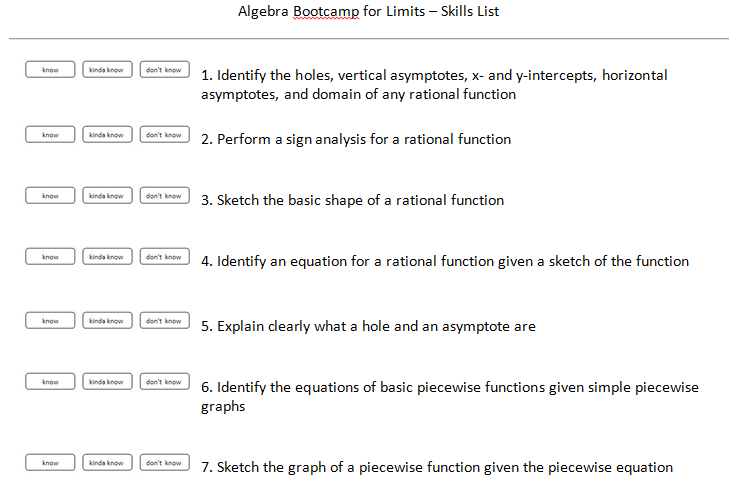
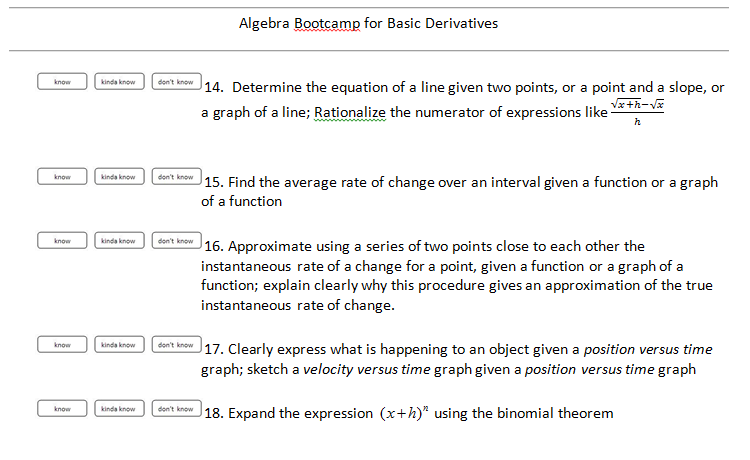
 using the binomial theorem. Very specific things that they should know that they are going to be using in the following unit. It’s kind of funny because it is a hodgepodge of little (and often unconnected) things, and they have no idea why we’re doing a lot of what we’re doing (why are we rationalizing the numerator? why are we doing the binomial theorem?) and I don’t tell them. I say “it’s our bootcamp… once training is over you’ll see why these tools are useful.”
 ,
,  , and
, and  in my course anymore [1], because I wasn’t trying to test them on their knowledge of trigonometry. Doing these bootcamps coupled with standards based grading has forced me to keep my eye on what I really care about. Students deeply understanding the fundamental concepts of calculus. And I think you can do that without knowing how to integrate
  just fine. [2]
 for the derivative of
  .
. Continuous Everywhere but Differentiable Nowhere