I’m soon going to embark on teaching the chain rule in calculus. I have found ways to help kids remember the chain rule (“the outer function is the mama, the inner function is the baby… when you take the derivative, you derive the mama and leave the baby inside, and then you multiply by the derivative of baby”), ways to write things down so their information stays organized, and I have shown them enough patterns to let them see it’s true. But I have never yet found a way to conceptually get them to understand it without confusing them. (The gear thing doesn’t help me get it… Although I understand the analogy, it feels divorced from the actual functions themselves… and these functions have a constant rate of change.)
I think I now have a way that might help students to get conceptually understand what’s going on. I only had the insight 10 minutes ago so I’m going to use this blogpost to see if I can’t get the ideas straight in my head… The point of this post is not to share a way I’ve made the chain rule understandable. It’s for me to work through some unformed ideas. I am not yet sure if I have a way to turn this into something that my kids will understand.
So here’s where I’m starting from. Every “nice” function (and those are the functions we’re dealing with) is basically like an infinite number of little line segments connected together. Thus, when we take a derivative, we’re pretty much just asking “what’s the slope of the little line segment at 
Now here’s the magic. In my class, we’ve learned that whatever transformations a function undergoes, the tangent line undergoes the same transformations! If you want to see that, you can check it out here.
For a quick example, let’s look at 

We see that 

Let’s look at the tangent line to 

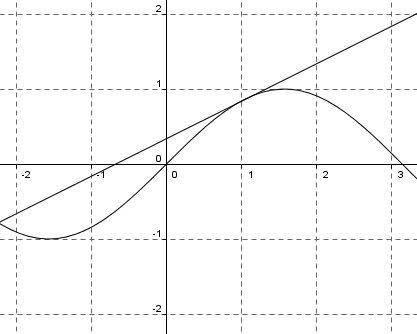
Now let’s put that tangent line through the transformations:
Vertical Stretch of 2:

Horizontal shrink of 1/5:

Shift up 1:

Now let’s plot
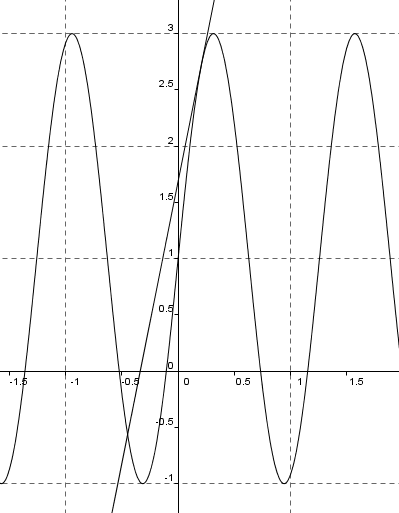
Yay! It worked! (But of course we knew that would happen.)
The whole point of this is to show that tangent lines undergo the same transformations as the functions — because the functions themselves are pretty much just a bunch of these infinitely tiny tangent line segments all connected together! So it would actually be weird if the tangent lines didn’t behave like the functions.
My Thought For Using This for The Chain Rule
So why not look at function composition in the same way?
We can look at a composition of functions at a point as simply a composition of these little line segments.
Let’s see if I can’t clear this up by making it concrete with an example.
Let’s look at 
And so we can be super concrete, let’s try to find 


I’m going to argue that just as 

Let’s start with the 
Now let’s start with the square root function. We have to be thoughtful about this. We are dealing with 


So now we have our two line segments.
We have to compose them.
![y_{composed}=\frac{1}{6}[12x-15]+\frac{3}{2}](https://s0.wp.com/latex.php?latex=y_%7Bcomposed%7D%3D%5Cfrac%7B1%7D%7B6%7D%5B12x-15%5D%2B%5Cfrac%7B3%7D%7B2%7D&bg=ffffff&fg=333333&s=0&c=20201002)
This simplifies to:

Let’s look at a graph of
![yup]](https://samjshah.com/wp-content/uploads/2013/12/yup.png)
Yup!
Where did we ultimately get the slope of 2 from? When we composed to two lines together, we multiplied the slope of the inner function (12) by the slope of the outer function (1/6). And that became our new line’s slope.
Chain rule!
How we generalize this to the chain rule
For any composition of functions, we are going to have an inner and an outer function. Let’s write 

We are going to have to find the little line segment of the inner function and compose that with the little line segment of the outer function, both at 
The line segment of the inner function is going to be

The line segment of the outer function is going to be

I am going to keep those terms blah1 and blah2 only because we won’t really need them. Let’s remember we only want the derivative (the slope of the tangent line), not the tangent line itself. So our task becomes easier.
Let’s compose them:
![y_{composed}=o'(i(x_0))[i'(x_0)x+blah1]+blah2](https://s0.wp.com/latex.php?latex=y_%7Bcomposed%7D%3Do%27%28i%28x_0%29%29%5Bi%27%28x_0%29x%2Bblah1%5D%2Bblah2&bg=ffffff&fg=333333&s=0&c=20201002)
This simplifies to

And since we only want the slope of this line (the derivative is the slope of the tangent line, remember), we have:

Of course we chose an arbitrary point

Which is the chain rule.
 . Why? Because even though I could teach them that (and I have in the past), I would rather spend my time doing less work on moving through algebraic hoops, and more work on deep conceptual understanding.
 as
as  ?
? at
at  and
and 
 . But we talked about how
  wasn’t a good second point, and how
  also wasn’t a good second point. But if they trusted me on using this variable thingie, they will see how our problems would be resolved.
 , it means what blah gets infinitely close to if




 . Thus we can say:
 gets infinitely close to 6.
 at
at 
 at
at 
 at
at  (why it is allowed to be “cancelled” out), and then what happens as
  and they will be able to. They will see there is a jump at
  . I don’t need more than that.

 , then

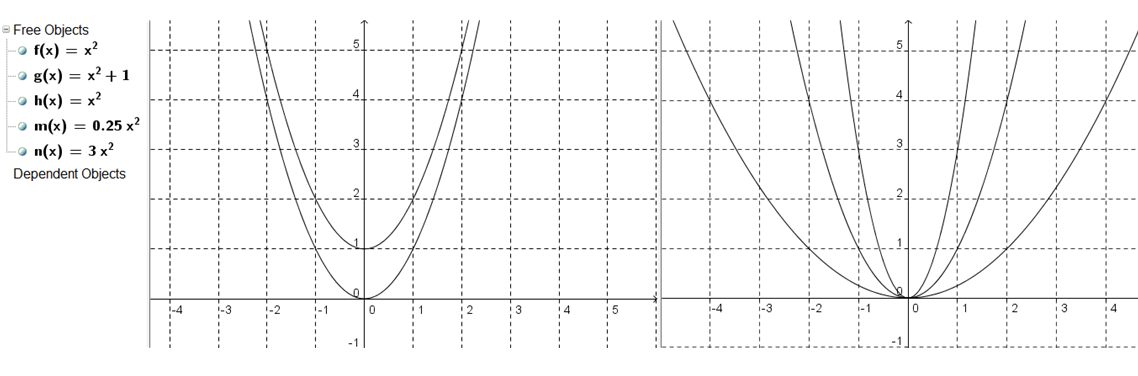
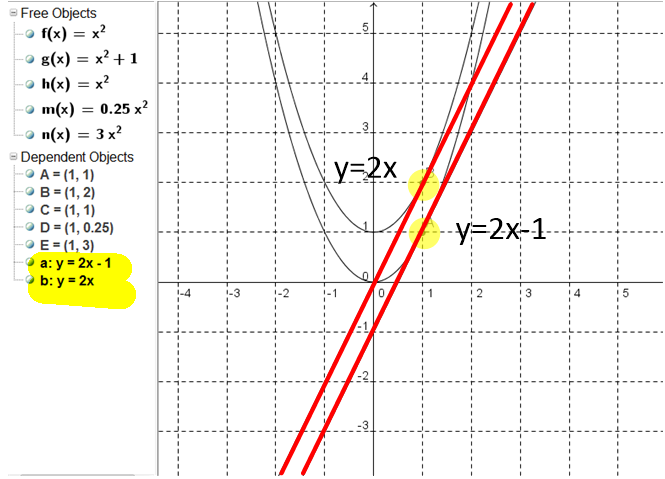
 . When the function moved up one unit, we see the tangent line simply moved up one unit too.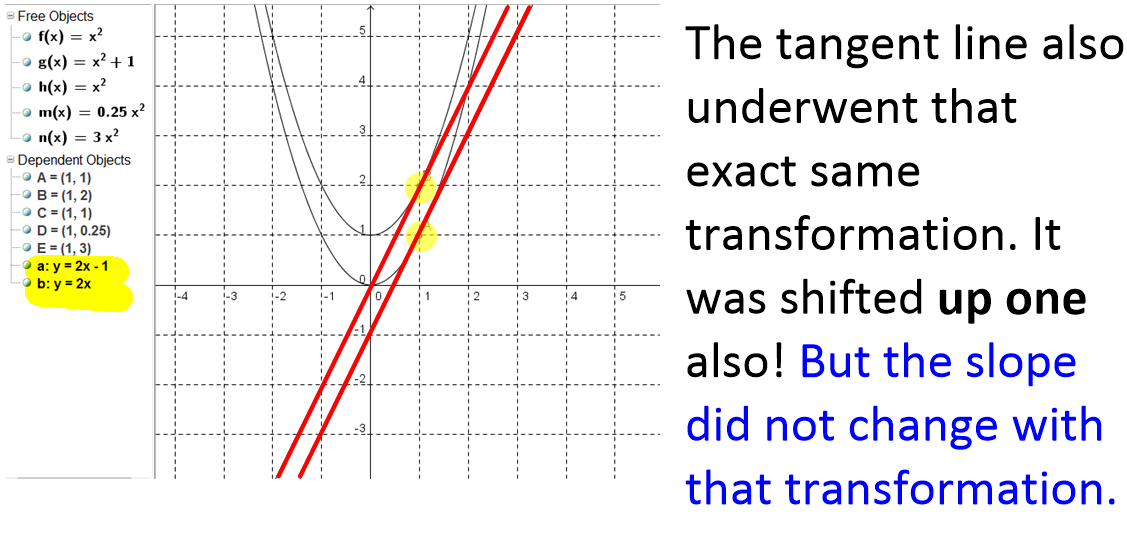
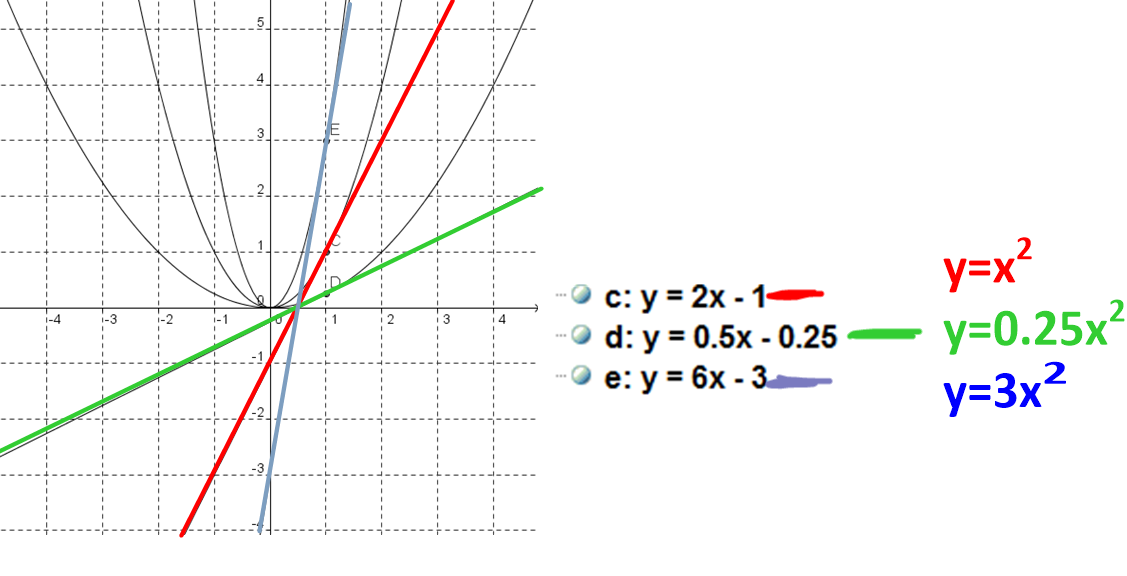
 (because you are multiplying all y-coordinates by 1/4. And that simplifies to
  . Yup, that’s what Geogebra said the equation of the tangent line was!
 . And yup, that’s what Geogebra said the equation of the tangent line was.
 , so I show them what Wolfram Alpha gives them.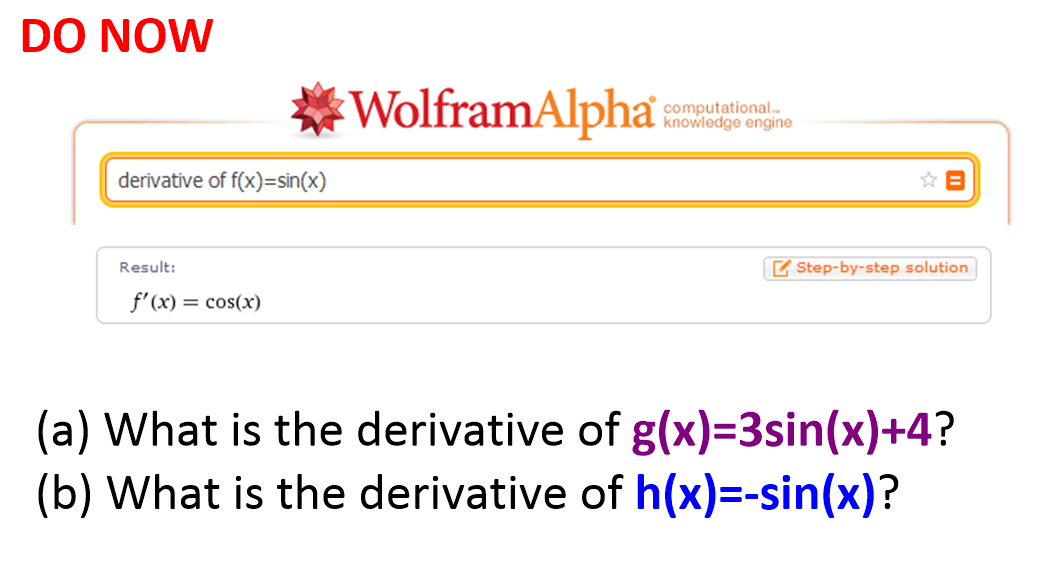
 and for (b),
  .
. , then we know that the slope of the transformed function is
  .
. .
. is, they immediately think (or at least can understand) that we get
  , because…
 which has derivative (aka slope of the tangent line)
  … Thus the transformed function
  is going to be a vertical stretch, so all the tangent lines are going to be stretched vertically by a factor of 9 too… thus the derivative of this (aka the slope of the tangent line) is



 Continuous Everywhere but Differentiable Nowhere