Author: samjshah

Aimless Wanderings

I suppose this will have to be a meandering post. I don’t have anything specific to say, so I’ll just do a little free form.

I feel bad that this year I haven’t created any seriously new resources to share. I realized that when @cheesemonkeysf  wrote about how she’s using my “completing the square” worksheets in her class. I remember making them, and how happy I was when I saw my kids finally latch onto the process. I’m sad that I haven’t been playing around with making more resources. The SBG thing has been taking up a lot of time.

Recently in calculus, I have been teaching my students the formal definition of the derivative, and we’ve been chugging through that. I really emphasize this type of work. As one student wrote a year or two ago:

“Mr. Shah likes to go the long way, the real building block method. First you learn the theory, then you learn the original (prehistoric) way, then (then!) you’ll learn the quick fun way. And later still you learn that you could have done it on your calculator all along.”

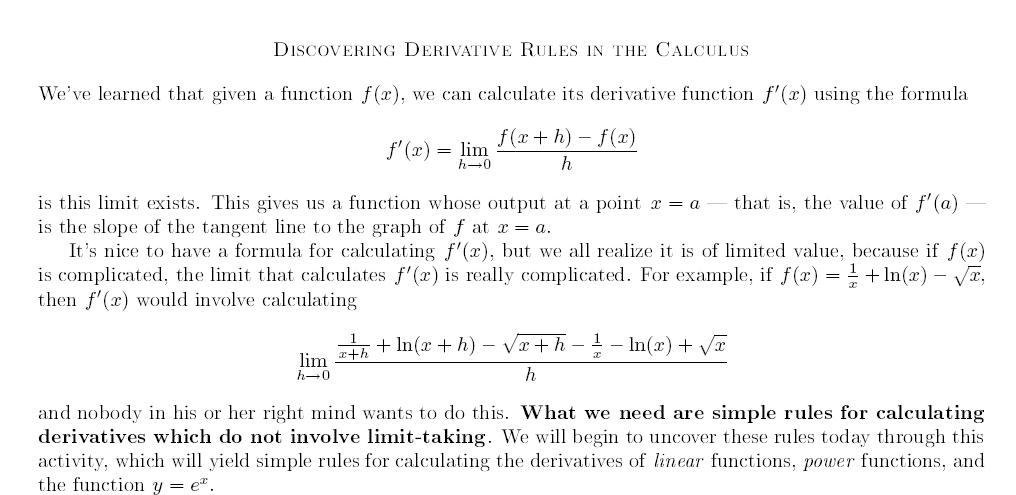
I take pride in that. And love that the student recognized it. Anyway, in calculus we finally got to the point where I’m having them explore and find some basic derivative rules/patterns on their own. They’re doing this using Wolfram|Alpha. I didn’t write the packet (only slightly modified it), so I can’t share it here. [UPDATE: Here it is, online!] But it is amazing, because it works to get students to understand why \frac{d}{dx}[x^{25}]=25x^{24}. Instead of showing it works for a few cases, it leads students to see why the power rule for derivatives will always work. (Well, the packet only does it for positive integers, but that’s good enough for me.) I also like that I am formally introducing students to Wolfram|Alpha. Two excerpts from the packet are below.

My second favorite quotation from class: “If Google and Wikipedia had a baby that was good at math, it would be Wolfram|Alpha.” (My first was: “Mr. Shah, I hate it when you secretly make us learn things!”)

Something else that has been taking up a lot of my time has been running the Student Faculty Judiciary Committee. That’s my school’s disciplinary committee. Each case probably takes me 3-4 hours of work, and in addition to that, there is a lot of behind the scenes work. I organize each hearing, I write up announcements for student representatives make to their classmates, I plan our monthly meeting, I meet monthly with the Head of the Upper School, and I have a few larger goals for the committee that I want to work towards. Recently there have been a good number of cases, and I work hard to get the cases “closed out” as soon as I can.

Last Thursday, I left school early to attend the wedding of a high school friend. I got to meet up with my besties, from way long ago, in our hometown. I saw my old house, and visited some old haunts, and marveled at the fact that I was still close with these people. I remember the awkwardness of going to a new school (my family moved after freshman year) and the fear (and slight thrill) of not knowing anyone. And the overarching question: will I make friends? That snapshot juxtaposed with the snapshot of me being silly with them at this wedding — priceless.

While at this wedding, I had my multivariable calculus students read the awful section in the textbook on Kepler’s laws. Then I had them read the paper that my multivariable calculus students wrote two years ago. What was cool was that one of my students this year told me when they looked at the paper, they were intimidated by all the equations and didn’t think they’d be able to figure out what was going on. However, they were able to read and totally understand it. HOLLA! I wish I had the email addresses of the four students who originally wrote that paper so that our class now could write them saying they found their paper useful. Heck, I’m sure I can find the addresses somehow… Also when I was gone, I had my calculus students work on the WebQuest that I wrote last year (http://whoinventedcalculus.wordpress.com/). I’m excited to read what they came up with. I got one batch today, and will get the other batch on Friday. I will read them all en masse over Thanksgiving break.

Over Thanksgiving break, I am also going to be completing my applications for two summer programs. One is the Park City Math Institute (PCMI), the unbelievable three week program I attended last year. The second is the Klingenstein Summer Institute for Early Career Teachers , a two week program that many people I respect have attended and have spoken highly about. It is weird, having to ask people to write you letters of recommendation and compose essays. The Klingenstein program even asks for college and grad school transcripts! I get a small taste of what my seniors are going through with their college applications. If there are any summer programs for math teachers that you love attending/participating in, throw them in the comments. (Two years ago, I attended the Exeter math conference, which was very good.)

I guess I’ll leave letting you know of a math book that I recently finished and thought was very good. Duel at Dawn. Be warned: it is an academic book, meant for a specific audience. In other words, it can be dry if you aren’t used to reading that sort of stuff. But it makes a few pretty interesting historical claims by tying large-scale cultural movements (the Enlightenment and Romanticism) to the development of modern mathematics.

With that, I’m out.

Frame it! Stat!

Below is a reflection one of my Calculus students wrote at the end of the first quarter. My initial reaction: I am going to frame this. (That will happen next week.) My second reaction: there is no better rationale for SBG than this. My third reaction: I’ve supported my kids pretty well. And my fourth and most lasting reaction: how gosh dang awesome are my kids?

***

1. I like the way that even though I was falling rapidly into a hole, and it felt almost impossible to get out, once you talked to me I became proactive and tried my best to do better. I like to continue meeting with you. I also like to continue to participate in class and asking questions. I think asking questions in class was the biggest way for me to better understand the topics.

2. I wish I would have started from the first day of school in this attack math mentality. I was acting very passive and like ‘oh I don’t get it now, but I will later,’ which honestly was the worst thing I could have done. I also wasn’t used to the class setting and the grading system. But once you emailed me and I met with you and I know that this is a class that I have to be in it 100%, and that your method is one that helps us actually learn, it was just beneficial. I needed that scare and wake up class because I was in serious denial. I became more on top of things. However, I had to dig myself out of a huge hole that I put myself in, but eventually the rhythm has become one that I used to. And I’m almost in a weird way glad that I learned the hard way because now I truly understand Math.

Coriolis Whaa?

So I’m a teacher that usually overprepares. I have my lesson set up beforehand. Very little is set up for “free form.” This is even true for my Multivariable Calculus class of 5 students.

To be fair, though, in that class we do generally take a 20 minute tangent here or there. Like today we were resolving the acceleration vector of a vector valued function into normal and tangental components — and we spent 15 minutes deriving them because I just decided we should. Spur of the moment thing. Or a few weeks ago, I gave my student 50 minutes to come up with how to convert between rectangular, cylindrical, and spherical coordinates, with no help. But generally, the lessons are carefully planned out. Here’s an example of my introduction to triple integrals (which we do way later in the year) so you can get a sense:

slideshare id=1597835&doc=mvcalculustripleintegrals-090617102556-phpapp01

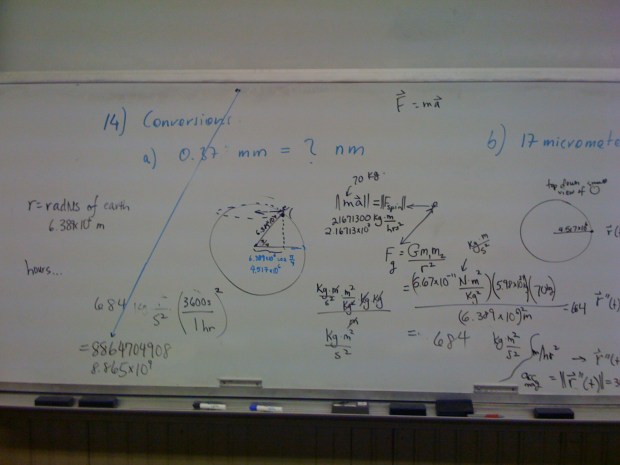
A few days ago, we had gone over the homework and somehow got on the topic of us being on the earth. I honestly can’t remember what prompted it. But we started talking about the force of gravity, which we feel because the earth is so massive. Then I had an insight — a direction we could take the conversation.

We are also spinning: “Does that change anything?”

I stopped class. I paused for 15 seconds, told the students to hush while I considered whether to go down this route. I felt this pang of deviating from my preplanned lesson. We were going to be behind. Do I really want to possibly come to a dead end?

I almost pushed it off. I was going to “leave it as an exercise to the reader” — tell my students they could think about it independently. But just as I was about to brush it off, I thought: WTFrak. Tangents are more interesting and more memorable, when the kids are interested in them.

My kids seemed interested.

So I threw away the lesson I had planned completely, and we went off the cuff, without a known destination in sight.

So back to the spinning earth. I didn’t know. I hadn’t thought about that kinda obvious fact before — we’re spinning, so that should have some consequences

We learned in our previous class that if something is spinning at a constant velocity in a circular motion, it must have an acceleration pointing inward to the center of the circle. So since we are spinning, once around our latitude every day, we must also feel a force pulling us to the center of the circle.

If we model the earth as a sphere, not tilted, and put us at an angle 45 degrees from the equator… we feel a force pulling us to the center of the earth (from gravity), and also a force pulling us directly inwards (centripetal – from rotating) :

But I don’t feel that centripetal force. I jump up, I come down. I don’t feel like I’m being pulled in any other direction.

So we decided to calculate the magnitude of the two forces, and figure out what’s going on.

Awesome.

I left giddy. We figured that the centripetal force was about 1/400 the force of gravity. Afterwards, I did a few more calculations, and realized that actually some of this centripetal force will be in the direction of gravity, so it will feel even less powerful.

I’m leaving for a wedding tomorrow, so I’m having my kids do a formal writeup of what they found. I can’t wait to see it. I am going to show it to their AP Physics teacher.

(As an aside,  I think I’ve found the physics term for what we discovered: the Coriolis force. If anyone knows anything about it, or any good resources on it, let me know!)

Square Roots and Cube Roots

I’ve posted a lot about Calculus this year, and a bit about Multivariable Calculus too. But I’m not saying too much about Algebra II. Sorry. This year something is off, and the students aren’t as successful as in years past. I’m not exactly sure what to do. I’ve asked the student-led tutoring program to lead an Algebra II study group (we’ll see if anyone signs up). I also might change my teaching practice to allow more time for students to work problems in class — because I need to see more of them working and catch their errors in thinking earlier — before they go and practice the material wrongly at home.  We’ll get through less curriculum though if I do that, and that itself is a problem, since we’ve pared down the curriculum so much.

Anyway, that’s generally where I am with Algebra II.

Specifically, I just wanted advice on how you guys teach cube roots (and fourth roots and fifth roots, etc.).

My ordering usually goes:

1. Turn to your partner, and explain to them what \sqrt{5} means to someone who doesn’t know anything about square roots.

Students generally say that it’s the number that when multiplied by itself will give you 5. I then say “if the person doesn’t know anything about square roots, you might want to give them an easier example, like \sqrt{25}… and explain how that is 5. But that \sqrt{5} isn’t a perfect square so you’d get some number between 2 and 3. Yadda Yadda. I also then talk about the geometric interpretation (the side length of a square with area 5). Then I go back to the “it’s the number that when multiplied by itself will give you 5.”

I do not talk about there being two answers to “the number when multiplied by itself gives you 5” and the principal square root business. Because I want to use this to capitalize on their understanding of cube roots.

2. Then I put up \sqrt[3]{8} and say this is 2. And to think about what this funny \sqrt[3]{} symbol means. They get it. I put up a bunch more, and they usually can solve them. I put some negatives under the cube root symbol too.

3. I then ask them what \sqrt[3]{} means, and they say “the number that when multiplied by itself three times gives you the value under the cubed root sign.”

4. I then throw up a bunch of problems, and three of these include \sqrt{49} and \sqrt{-49} and -\sqrt{49}.

This is where the trouble comes in.

Some students now say \sqrt{49} is \pm 7. Because 7 and -7 are numbers when multiplied by itself which equals 49.

Here’s where I use the whole: “Don’t lose what you already know! Would you say \sqrt{49} is -7 ten minutes ago? No. You’re right, that there are two numbers which, when multiplied by themselves, give you 49. So we can tell them apart, we say \sqrt{49} is the positive one and -\sqrt{49} is the negative one. So don’t lose what you know. When you see a radical sign, it just represents a single number. If there’s a negative in front of it, it represents a negative number. If not, it’s a positive number. Just like what you’ve always known.”

Okay, now I know the idea of “principal square roots” and all that. And I honestly don’t want to have this whole discussion about principal square roots with them, because every time I do, they come out more confused.

So here’s my question.

How do you introduce cube (and higher) roots? How do you engage with this idea of principle square roots so that students don’t leave confused? I just can’t get it totally right.

And just so I am being clear, I know the properties of square roots and cube roots and all that. I’m not looking for someone to explain that to me. I want a way to teach my KIDS these without confusing them all up. And I bet crowdsourcing is a good way to get ideas for next year.

Where do I go from here?

Today in one of my two calculus classes today, we got on the topic of 0.\overline{9}.

I think it came up when we were talking about how to approximate the instantaneous rate of change in a problem: we had a function v=20\sqrt{T}, and we wanted to estimate the instantaneous rate of change when T=300.

So a student said let’s pick another point, such as T=299.99. And we found an approximate instantaneous rate of change. Of course I asked “how could I get this answer more precise?” and someone said “add more 9s!”

So we realized we could pick a closer point, such as T=299.9999999.

Of course, then we had some precocious youngster say: “why not get it super duper exact and plug in T=299.\overline{9}?”

Ah hah. Many of them thought that 299.\overline{9} was SUPER close to, but definitely not equal to, 300.

I went through the whole standard argument, which usually convinces most kids:

Let x=299.\overline{9}.  Then 10x=2999.\overline{9}.

So 10x-x=2700. Which means 9x=2700. Which means x=300.

I thought I had them. One student said I was breaking her worldview.

Ha.

But then, THEN, they asked me an awesome question.

One said, and the others jeered: “Isn’t 299.\overline{9} kinda breaking the rules of what you’ve been saying. How infinity is a concept? How this decimal goes on forever? And you said we couldn’t mix concepts with numbers. We can’t write 6(\infty) or \infty+6 because we’re mixing concepts and numbers. So  why can we talk about a number with a decimal that goes on FOREVER? Aren’t we mixing concepts and numbers? Isn’t this thing totally nonsensical?”

Okay, okay, they got me there. And they’re thinking deeply. And they’re getting me to think deeply.

So then I said: “okay, you have a point. So let’s see if we can mathematize this in a way that works with our understanding of things.” So I made a list:

299.9=299+\frac{9}{10}.

299.99=299+\frac{9}{10}+\frac{9}{100}

299.999=299+\frac{9}{10}+\frac{9}{100}+\frac{9}{1000}

so

299.\overline{9}=299+\sum_{N=1}^{\infty} \frac{9}{10^N}

But then I noticed we are still mixing infinity (as a concept) with these numbers because we’re adding an infinite number of them… so then below it I wrote:

299.\overline{9}=299+\mathop{\lim}\limits_{M \to \infty}\sum_{N=1}^{M} \frac{9}{10^N}

Now we’ve written this decimal as what it truly is: a limit as the number of terms gets large without bound. And the limit has a definite value — the sum is getting closer and closer to 1, as close as we want to 1, infinitesimally close to 1, so we can conclude the limit of the sum is 1. So we can conclude that this sum is 300.

And then, sadly, I moved on.

The kids were interested in this conversation, and I think it could get at the heart of what we’re doing with limits (and then relating it to derivatives), and how infinity is a concept (for us) and not a number. But I don’t know what to do from here, where to go from here.

I didn’t convince everyone, and I don’t want to go too far afield with this unless someone out there can suggest a good idea. I mean, this idea of the limit, two things infinitesimally close together, is powerful [1]. So is there a way to extend this discussion meaningfully? Philosophically? Anyone have any good activities out there, any good worksheets out there, any good readings out there, any good videos out there? I’m not even sure what sort of end goal I have. Just something that acknowledges the weirdness of repeating decimals, relating them to limits, and the concept of infinity…

For context for the class, this is the non-AP calculus class, where my kids are at very different levels of understanding.

[1] From my historical understanding, both Leibniz and Newton (and their followers) were still plagued with the idea that you would be kinda-ish dividing by zero when calculating the derivative, because they didn’t have the concept of limits in their formulation of calculus. This division by zero was unsettling for a number of contemporaries. And it wasn’t until Cauchy came along with his limit concept that he was able to give derivatives a solid philosophical foundation to rest upon.