Author: samjshah

Ideas for my 2009/2010 Calculus Project

Two years ago in calculus, when I only had one section and only 7 students were in that section, I had each student work on an individual project during the 4th quarter.  I helped each student choose a project based on their own interests and then they had a few weeks to work on them, and I would sometimes give them classtime to work on them.

Last year, I was given two calculus sections with many, many more students in it — and I couldn’t come up with a feasible way to ramp up this project idea. That year was devoted to trying to figure out how I could effectively teach to so many more students, who were all so varied in ability. (I did, however, had my kids do some amazing multivariable calculus projects.)

This year I still am teaching two calculus sections, but I feel like I have the course content way more codified. And my algebra boot camps are really working! [1] So I’m already contemplating what a final project would look like for my kids.

I think I will have students pick a partner and work on the project in a pair. And unless they come to me with a specific topic they are dying to investigate, I am going to give them a list of 3 or 4 projects they can choose from. I’ve been wondering what these projects might be, and I am leaning towards a few things that might appeal to those who are more artsy farsy. (Okay, who knows, I might give them 15 project ideas and have them make their own rubric.)

Some ideas that have popped in my mind (clearly they need to be really fleshed out):

1a. Write and illustrate a children’s book explaining calculus to someone in lower school (or, if you want, middle school). You then will present/read your story to actual lower school or middle school students

1b. Write and illustrate an “ABC”s of calculus book (e.g. L=Leibniz! Limit! L’Hopital!), explaining each term graphically or visually.

1c. Write a cogent response (with graphics) to this metafilter post. Be literary.

2. Research the uses of calculus in (architecture, physics, electrical engineering, chemistry, statistics, etc.). Interview someone who uses calculus in their work. Present your findings.

3a. Knowing what you know about calculus now, re-design the course. Explain what order you would teach things in, how you would introduce each unit, what sorts of assessments you would have and why, would you would expand upon, what you would reduce, etc.

3b. Rewrite a 3 day unit from the course. Make the smartboards, handouts, and assessments.

4. Create a visual map tracing the course from our origins (limits) to the end (surface area of revolutions). Explain in your map how various ideas and skills connect.

5. Now that you know more about calculus, revisit the ideas you briefly encountered studying the history of calculus. Do a more thorough and scholarly investigation of Newton and Leibniz and write a short paper explaining the similarities and differences in their philosophical approach to calculus.

6. Create video tutorials for 5 topics you found the most challenging in the course. You may use the SmartBoard. (This harks back to my Algebra II video project from two years ago.)

The point of this blog is for me to jot down ideas. (Some of them are terrible! But that’s brainstorming!) Let’s hope I can get a calculus project actually happening this year!

[1] How I know this first semester of calculus has been a success? I gave my kids their midterm last week, and the grades were way higher than expected. I was shocked that so many students were getting As. Good job kids! Good job!

SmartBoard Notes

David Cox recently wrote an interesting post on an internal debate he’s been having: to post his SmartBoard notes or not. He frames the issue as follows:

I have always taken a “students gotta take responsibility for their notes and review them regularly” kind of approach which has prevented my from exporting and posting the chicken-scratch covered slides from class. But if posting them is going to help them learn, should I care about the personal responsibility they take on (or don’t take on) in regards to their own note taking?

I totally identify, and I believe note taking is a valuable skill that has to be taught — not just something we expect students to learn. We model it every day with what we write on the board, and how we write on the board.

But enough of that. I have firmly come down on the side of “post the darn notes every day, if you have SmartBoard!” (Although I had the same reservations before I started posting my notes daily.) Why? Because it helps students learn math and makes my life way easier. Absent students know what they missed and try to work things out on their own. (Just today I met with a student who was absent, and had already looked at the missing day’s material and asked me specific questions!) It provides yet another resource for students to go to if they are stuck, or didn’t have time to copy all the notes from the board. And I’ve noticed that some students really do well watching and processing — instead of furiously scribbling all the time and not really following what’s going on.

How do I know my kids are using our digital notes?

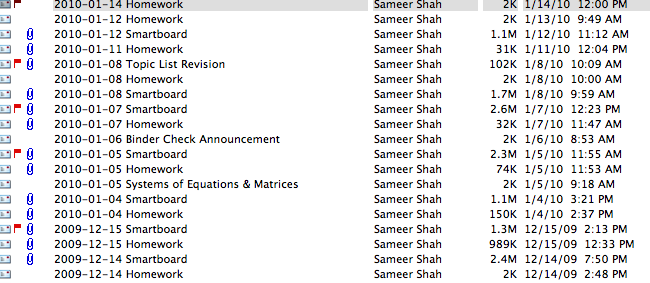
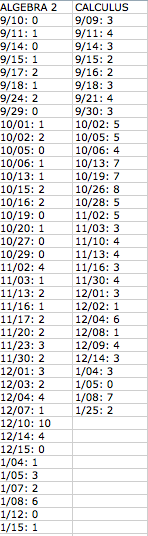
I have the ability to see who has downloaded my notes, and when. You can see some quick data I compiled. Below are two of my classes. The Algebra II class has 17 students in it. The Calculus class has 11 students in it. The dates are the dates I posted the class notes. The number after the semi colon is the number of different students who downloaded the notes.

I found the data surprising.

My Algebra II class uses the electronic notes sparingly. (Probably because a lot of the work we do is on worksheets — so they have those to refer to.) It seems like it is mainly used by students if they are absent. My Calculus class (which is overall incredibly strong) regularly use the notes. To be totally frank, I didn’t think any of my calculus students used them! So I’m really glad I looked at the data. Some downloaded the notes the day we went over them, some waited until before an assessment, and some used them to study for the midterm. But clearly they are being used — a lot! Remember there are only 11 kids in this class.

But the point is: I put it up there, and it is being used. Differently by different people in different classes. But it’s doing some good. So I’m happy.

Idea etched on a receipt

This past weekend I went out with some friends to a new favorite haunt. When I was there, I somehow mentioned that I was using Twitter, and to the one new person I hadn’t met before, I said as an aside, “I only twitter with math teachers.” Of course, it was one of those comments made in such a moment in such a way that brought on wave after wave of laughter. To the point where one of my friends felt compelled to write it down for posterity.

Indeed, my friends like to mock me at all turns. (But that’s okay, because I give as much mock as I get.)

She jokingly said she was going to get me a t-shirt made with that on it. Of course I thought that was an awesome idea. I made a sketchup (with various colors). I’m almost tempted to get one printed.

Hm. Maybe the little twitter bird should be added to the upper right hand corner. Or on a sleeve.

UPDATE: A #needaredstamp shirt should be designed:

Reinventing the Self

Because I’m going back to LA for a wedding in a week and some days, I have been looking through an old now-defunct blog I kept in LA. I found this post dated May 15, 2007 — near the time I was leaving LA for NYC — that I think deserves a place on this blog.

May 15, 2007

It is about time to start thinking about packing up my apartment. I don’t move until the end of June, but it takes time to ship the flotsam and jetsam that I’ve accumulated. More painfully, it will take time to decide what can go with me and what must be jettisoned because of the exorbitant cost of transportation. My desktop computer, kitchen utensils, my plastic lobster, curtains, and lamps? And what of my sewing machine, unique vases, and stationary? Thinking about what stays and what goes is more than just a question of replacing consumer goods or evaluating sentimental value. It goes deeper, to who comes to New York.

At the end of attending ninth grade in Illinois where I had been born and raised, my parents gave me some shocking news:

The whole family was moving to New Jersey.

Of course, there was the requisite fight (as if I had a choice in the matter), some cold-shouldering, and recurring thoughts that my life was over. (At that age, hyperbole and reality conflated.) The transition from eighth grade to high school would have to be re-enacted all over again, but this time, in an even more severe way, because there were no familiar faces bobbing among the masses herding along in the hallways. I was leaving familiarity behind.

A few weeks before the actual move itself, I saw the other side of the coin. I was leaving my life behind, yes, but I was leaving my life behind. Bluntly put, I was always at the periphery of my social group. I wasn’t a complete outcast, but I never really felt like I belonged. Being among the same people since kindergarten was constrictive; once you were pegged, you were stuck. Loser. If you were unlucky, you would start believing it. Looking back, I know that I did, walking around the hallways always looking down at my feet. And if you were really unlucky, you would recognize your complicity in this role. Which I did too. Early in ninth grade, I saw myself playing this person, and suddenly realized “that’s not who I am.” And indeed, I wasn’t. I started walking eyes forward in the hallway, gaining self-confidence and a sense of humor. By the end of ninth grade, I was a completely different person—the person I wanted to be. I even worked up the courage to run for student council; in my school of over 4,000 students, the student council positions were popularity contests. I thought my new persona – my real persona – would get me noticed. But no one noticed. I was still treated the same, not quite in and not quite out of any social group. My yearbook, even though I had told people I was moving, was filled with repeated instantiations of “Have a great summer! See you next year!” It was awful.

And it was then I realized that even though I was leaving my life behind, I could leave a large part of me behind. That person wasn’t me and I had a wide-open vista to redefine myself based on who and what I saw myself as.

Holding firm to that thought, I moved to New Jersey and started a new life, consciously. The transition was one of fits and starts, but I held firm to the thought that I get to be whoever I want to be, that there are no lingering childhood ghosts circling me, that I am the master of my own destiny. And that person turned out to be – in my opinion — incredibly successful, not just academically, but socially. At the end of twelfth grade, I would be able to read my yearbook signings and grin, not grimace.

Of course since then there have been two more moves: from high school to college and then from college to grad school. In both these moves, I have taken the opportunity to redefine myself – leave an old iteration of me behind and rebuild a new me to move forward with.

Right now, when deciding what pieces of my apartment to leave behind, I am concurrently making decisions about what parts of myself I want to cast overboard. I’ve changed my personality almost wholesale since coming to grad school, and I don’t know why or how it occurred without me being fully aware of it happening. I just know “That’s not who I am.” I play a pale shadow, a cardboard cutout, of who I am; I’ve somehow been complicit in pegging myself an academic and playing the associated role.

Now it’s time to stop looking down. All I can tell you at the moment about who will be arriving on that plane to La Guardia is that he won’t be the same person writing this now.

Looking in a Mirror

A little backstory:

I do all my work in Algebra II on a SmartBoard. I always post PDFs of each day’s notes for students to download if they want to refer to something. A few times a week, a student will ask me — when I’m moving to a new page of the SmartBoard — to go back so they could finish writing their notes. I’d say almost every time I go back and let them finish. But sometimes I have to move on in the lesson, and the student asking decided to write things down after the material has been on the screen for a few minutes already — right when we’re done with that material. In those cases, I say “I’m sorry I’m going to go forward, but remember, I always post the SmartBoard.”

Now the story.

Yesterday I was in Algebra II and we were working on optimization word problems (find the maximum volume of box with some constraints on the sides, find the minimum cost to make a box). I realized I had been up at the SmartBoard too much recently, so I called on a student to be “Teacher.” I told the student that she had total control — so she needed to ask questions, answer questions, and keep all our miscreant compatriots in order.

She started working, and doing a fabulous job. She fielded questions like a champ. At one point, she moved from one page to the next, and someone asked if she could go back to the previous page.

She looked at me, at the student, at me again, got the smallest smile on her face and said:

“I’m sorry I am moving on. But I post the SmartBoard every night.”

The whole class broke into laughter. I laughed. And laughed. I couldn’t stop laughing for like an entire 60 seconds. Classic.

I like that class a whole lot.

(And indeed, after the laughter subsided she didn’t go back to the previous SmartBoard page, but kept on working.)

Binder Checks

In Algebra II, I am trying something that I find is working pretty darn successfully that I’m going to replicate it in all my classes next year. One of the things that aggrieves me more than anything is asking a student to take out a recent worksheet or assessment, and they reach in their backpacks and dig around — their hand burrowing and further crumpling piles of papers from all subjects. It’s always miraculous when they do find what they were looking for, but you all know what it looks like.

Crumpled. Torn. Smudged.

In other words, terrible.

What’s clear is that students haven’t yet learned the skills to keep themselves organized. So this year I thought I would integrate that explicitly into the course. In the process of doing this, I’ve also found a way for kids to do homework and test corrections as part of their routine. No longer is homework something that students do at home, come to class and ask questions, and then forget about. Let me explain.

BINDER CHECKS

Materials: Each student is required to have a binder and a folder. The folder is to be brought to and from each class, while the binder can stay in their lockers unless instructed to bring them to class. The binder has one divider in it, to separate “homework” and “assessments.”

Implementation: Each day, students keep their homework in their folder, organized chronologically. They date everything — textbook homework, worksheet homework — with the date these things were assigned. We make sure to be very consistent with our labeling — especially because we only meet 4 days a week because of our rotating schedule. I also post the homework (and daily notes) on something called a course conference (for those of you familiar with first class) — also organized by the date assigned.

Each night that homework is assigned, students are expected to work assiduously on it. And if it is from the textbook, they are required to check the odd answers in the back — and mark the right answers on their papers if they get something wrong. At the start of class, I always display the even answers to textbook problems (or the answers to any worksheet we did), and I go over questions. At this time, students are expected to correct their work on their homework. They are expected to write down the correct answer. They are expected to ask me (or their colleagues) questions. And if they don’t have enough time to finish all their corrections (I expect them to show work to get the right answer, not just the right answer), they have to finish it at home.

In other words, there is no reason that my kids should have anything less than perfectly completed and corrected homework assignments. (And similarly, when they get tests back, they are required to correct them too.)

For this to happen, I had to talk about this a lot at the beginning of the year. I reminded them constantly about correcting their homework. About dating their work religiously. About writing down the correct answers if they’re getting something wrong — and figuring out why they got something wrong.

And at the end of each unit, students file away all the homework and all the assessments in their binders. They start fresh with an empty folder.

Why would they do all this for me?

Because half of their homework grade is based on this. On binder checks. I sell it to them by letting them know there is one certainty in this course: it is totally ridiculous if they don’t get 100% on the binder checks — it’s me giving them free points, in essence. Just for being organized and checking their work. That’s all!

When

We scheduled 2 binder checks in the first quarter, and then we only have 1 at the end of each of the three remaining quarters. We wanted to do 2 in the first quarter, so students could learn from the first one. We assumed (pretty rightly) that some kids would just bomb the first one because they wouldn’t take it as seriously as they needed to.

What they look like

On announced binder check days, students come into the classroom with their binders, and see a note on the board saying to have only their binders on their desk… Nothing else, no writing utensils, no papers, nothing [1]. When all their compatriots arrive and are set, I hand everyone a red pen. I also hand them the binder check which might look like this [2]:
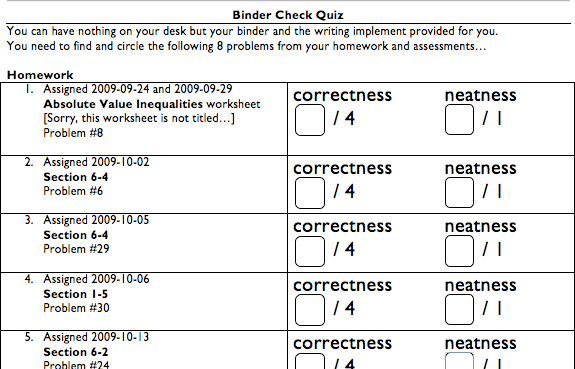
They are given 5-10 minutes to flip through their binders, and circle their work and answer for the problems asked for. That’s all. It doesn’t take very long at all, especially since their binders are organized chronologically.

I collect them, and we go on with our lesson.

How I Grade Them

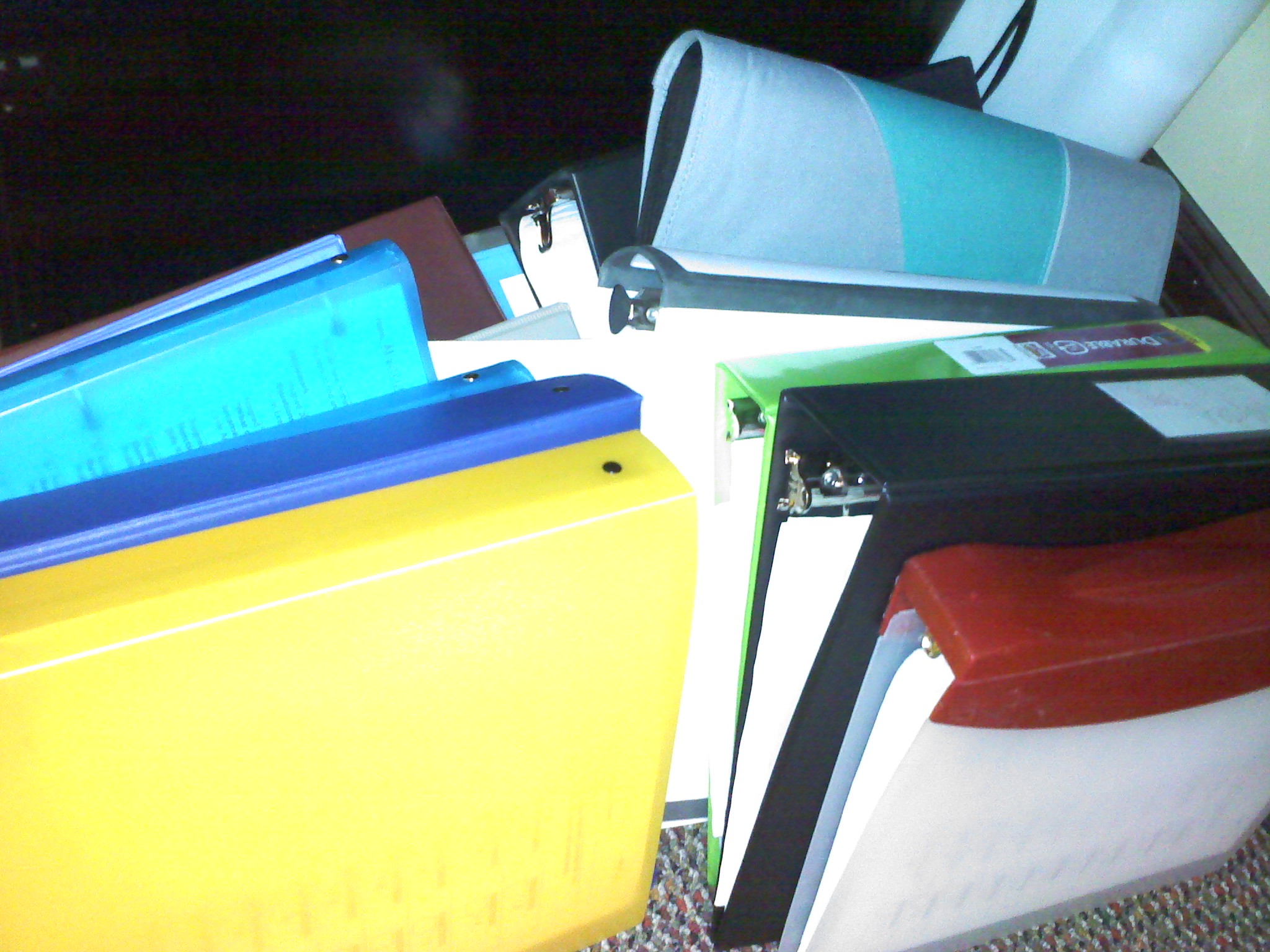
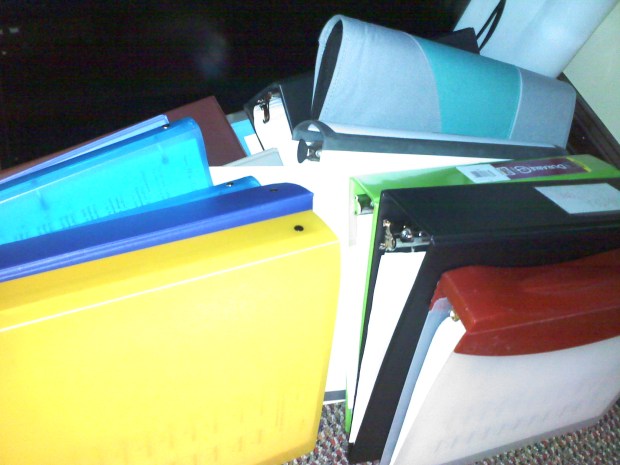
Each time I collect them, I get a nice stack of binders that I store under my desk, like I had today:
I pick up a binder, and look for all the circled questions. If the student was neat, and had the correct answer originally, they get full credit for that problem (5 points). If the student messed up but had the corrections (and new correct work), they get full credit for that problem (5 points). However, if the student messes up and has a wrong answer, the student only earns 1 point (or none, if they aren’t neat). I go through the whole binder this way.

Clearly I care about students getting things right. And I love this binder check because it can do so much work for me. I don’t have the time to collect and grade homework everyday. I don’t want homework to be graded for correctness the day after a student learns new material. (They could go home and be totally lost!) However, I do want students to eventually have things right. To work on correcting what they don’t get. Be proactive about what they don’t know. Ask questions. Figure things out.

The stack of binders above looks daunting, right? But let me tell you, I can get through a stack of binders for my class in 2 hours. It surprises me how quickly grading those goes. Seriously!

How I Pick the Questions

It’s no secret here. I pick questions for the binder quiz that span a number of homework assignments, and require some deeper thought and written work. I usually try to pick questions that students get wrong, or asked about in class.

What I’ve Noticed?

My kids now check their odd answers in the back of the book, they are really attentive at the beginning of class checking their even answers (or their worksheet answers), they ask questions so they can make the corrections, and they are much, much, much, much more organized.

You can see the learning curve my kids had with this. On the first binder check, the average grade was in the 70s. On the second binder check, the average grade was in the mid 80s. (And the standard deviation went from 18 to 11.) Almost every student improved, some drastically. Which is all the more impressive because I graded more harshly on the second one because students knew exactly what to expect.

Other Benefits

There are three major other benefits I see from these binders.First, I can collect the binders before parent teacher conferences, so I can show parents the totality of their child’s work.Second, when I write narrative comments on my students, I can use these as a reference to be more specific. Third, when it comes time for cumulative assessments (e.g. midterms, finals), my students will have all their tests organized in one place, to study from.

Overall, I see this initiative as a TOTAL SUCCESS.

P.S. Things to note:

There needs to be a place for students to write the “Date Assigned” on each homework assignment. If it is something from their textbook, they need to write a clear and consistent header. If it is a worksheet I create, I always make sure to put a “Date” section.

Everything handed out needs to be hold punched. You can’t expect students to use the binder if you don’t make it super easy for them to use.

[1] The reason for this is that I don’t want students using pencil to fix up answers to questions they didn’t correct. What they come to class with in their binder is what they get.

[2] For the 2 binder checks in the first quarter, there were about 8-10 things students needed to circle, including not only problems from homework, but also problems from assessments.

Culture of Math Contests

My school does not have a culture of math contests. But I’m on a mission to change that.

This year we signed up for the New York Math League contests, which actually seem to be getting a dedicated small set of students taking them. (I think the biggest problem with getting a sizable number of students in our  school to take these contests is that our kids are so busy that not many kids can take the exam after school on the day we administer it. They have sports and other commitments.)

However I’ve taken it upon myself to make a huge push to have more students take the AMC 10/ AMC 12 math contests this year. How?

  • I’ve spoken individually to the other 6 math teachers about speaking to their classes about the contest, and I gave them some sample problems to give their kids if they want more information. I’ve convinced a few to offer some incentive for their kids if they take the exam (example: I’m giving extra credit, which I almost never offer, and another teacher is giving a homework pass).
  • The math club student leaders are making a facebook group (their idea!).
  • I’m having students “register” for the contest (basically fill in the blank on a sheet which says “My name is _________, I am in the ____ grade, and I am awesome because I am going to take the AMC!”). I’m going to use this list of students to send a reminder email to the kids. I’m also going to send a letter to their parents explaining the contest, and why we in the math department are really happy that their kid is going to take it. Basically, I want to get the word out to as many people about the contest, in a few different ways.
  • I’m trying to get some money so we can order  pizza for the kids after they take the exam.

I think last year we had 10 or 15 students who took the exam. I really want to ramp it up this year. And if we can do this for a few years, we might be able to develop a culture where taking the AMC is a “normal” thing to do — where kids in the accelerated track all want to take it and interested kids in the regular track are encouraged to take it. I’m trying to slowly and consciously engineer a shift in school culture. It’s hard to figure out how one can create a culture shift.And I know, it’s a really small culture shift, but in my opinion, it’s really important for our department and for our kids.