Author: samjshah

How BlogBuddies became Friends

I’m not gonna rehash my “why twitter” post, but I have to say that twitter has added something new to my life, something I didn’t have before. Friends, who are online.

In the math office, it’s weird to say “I heard this great idea from this blog person I sort of interact with.” Do I call these people my colleagues? bloggers? twitterers? Wow, I can imagine the howls of execration my colleagues would cry if I said: “Oh I got this great idea from my tweep.” Twitter induces eyerolling and hatred for the masses. Trust me, I know.

But now I know what to call them.

Friends.

A few weeks ago I had one of the hardest I’ve ever experienced as a teacher — emotionally, physically, and mentally draining. I know it seems like we say that at the end of every week, but I really meant it that week. I had a total meltdown. And so early in that week I logged onto twitter, and posted something cryptic about having a terrible day, and got some really nice messages from people back. These are people I’ve shared materials with, my ideas with, and my everyday foibles with. I shot those who commiserated with me an email with more details.

When pressing “send” I did kind of wonder why I was doing that. Who really were these people that I’m sharing my frustrations with? But at the same time, it felt so natural. We talk to each other almost every day, about the things we’re doing at school. We share, tease, joke, and laugh with each other. And  I needed to get something off my chest — something I couldn’t really say to people in my school. These people have become not only my virtual support. They are also my very real support. And yes, we are friends because we go through the tough times together. We help each other out, be it a pedagogical question, or a math problem answer.

But we also just “get” each other.Like, yeah, we have fun joking together.

The moment I knew I could trust these people with my own problems was this exchange:

CLICK HERE TO WATCH THE MOMENT UNFOLD

As a threat in this exchange, @SweenWSweens said “Just you wait, Sam J Shah.” I did wait, and I was schooled. When Halloween came around, @SweenWSweens actually virtually dressed up in costume. AS ME!

samjshahcostume-polaIMG_2119-pola

And just today, @dcox21 posted a picture of his (totes adorable) newborn for us to oogle at, and @jimwysocki, @Fouss, @CarissaJuneK, @jbrtva and I decided we were going to start a school where all faculty break out in choreographed song and dance at least once a week.

If you’re reading this TWITTER TEACHER BLOGGER FRIENDS. Or shall I just say friends?

YOU ROCK.

Statistics, used improperly

I have been in a bit of a nostalgic mood tonight, and so I went back to look at the journal I kept in college. In it, I found an entry where I feel statistics was used improperly. Not by me, but by my Algebra professor.

here’s the data on the numbertheory exam i took on tuesday:
number of students taking exam: 10
mean (average): 23.8 (out of 40)
standard deviation: 6.596211034
median: 26.25
kurtosis: 1.333906232
geometric mean: 22.82177487
harmonic mean: 21.82918952
maximum score: 40 (by the lecturer), 32.5 (by one student)
first decile (i.e., 10% of scores are below): 15
second decile: 15.5
third decile: 16.5
fourth decile: 17.5
fifth decile: 24.5
sixth decile: 28
seventh decile: 28
eighth decile: 29.5
ninth decile: 31

i dont know what i got. i guess ill see tomorrow at 10ish.

Um. 10 students. Professor decides to publish deciles? Seriously? That’s an improper, terrible use of statistics if I ever saw one. Wow.

(more…)

Navier-Stokes Equations for the Layperson

Note: I wrote this years ago, to be precise on 7 January 2007 — so some of the links might be out of wack. At that point I still lived in LA and was a historian. But I thought since I haven’t been posting all of my current fabulousness, I would at least give you some of past fabulousness.


NAVIER-STOKES EQUATIONS

This quest was spurned on by a friend who was interested in learning more about the Navier-Stokes (N-S) equations. (They’re a system of equations, which is why they are referred to in the plural. All the equations together, describing the system in 3-linear dimensions and 1-time dimension, define how fluid flows.)

I learned about them in 18.354, a class devoted to the study of fluid dynamics at MIT. What are the N-S equations, you ask? As stated, the equations describe the way fluid flows – but fluid means more than just things like water, but almost anything from honey (very viscous) to a gas (well, a gas moving at speeds much less than the speed of sound). The only limitation is that the system has to abide by something called the “continuum hypothesis”. One website nicely puts it like this: “The basis for much of classical mechanics is that the media under consideration is a continuum. Crudely speaking, matter is taken to occupy every point of the space of interest, regardless of how closely we examine the material… it is well known that the standard macroscopic representation yields highly accurate predictions of the behavior of solids and fluids.”

So the N-S equations can answer some pretty cool questions about everyday life. Why does an airplane fly? The answer lies in how air flows around its wings. How long does it take for a stirred cup of coffee to become still? The answer lies in the effect of the cup on the coffee. (Believe it or not, the velocity of the coffee very very close to the edge of the cup — called a “boundary layer” — is actually zero. The coffee doesn’t move. And this layer, over time, eventually affects the rest of the coffee spinning until the coffee is totally still. Of course, to be totally precise, you need to take into account the effect of the bottom of the cup too.)

It’s hard to explain what makes the equations so neat. First is that even though they look complicated (see Wikipedia), they are actually pretty easy to derive from first principles (read: from scratch). Second is that they apply to so many phenomena — and much experimental work that has been done confirms it. Third is that they are still pretty mysterious. I’ll get back to that soon.

The N-S equations straddle the boundary between the pure and the applied. To be more accurate, perhaps, they do a good job of demolishing the myth that there is a “pure” and an “applied.” They are used as tools in a number of real-world problems. But at the same time, they represent a challenging problem of pure mathematics. This is what I meant by “mysterious.” They aren’t quite as well understood as mathematicians would like. Right now, the Clay Mathematics Institute has offered a $1 million prize to the first person to make some real headway into understanding the N-S equations: it is a millennium problem.

MILLENNIUM PROBLEM

For the laypeople, not us, the Institute describes the problem as such:

“Waves follow our boat as we meander across the lake, and turbulent air currents follow our flight in a modern jet. Mathematicians and physicists believe that an explanation for and the prediction of both the breeze and the turbulence can be found through an understanding of solutions to the Navier-Stokes equations. Although these equations were written down in the 19th Century, our understanding of them remains minimal. The challenge is to make substantial progress toward a mathematical theory which will unlock the secrets hidden in the Navier-Stokes equations.”

That’s a bunch of fluff. The way the problem is posed by the Clay Math Institute for mathematicians, it appears insanely complicated. But I am going to try to explain the problem for a population who wants more than fluff and less than incomprehensible jargon.

The N-S equations are something called “Partial Differential Equations” (often referred to as PDEs). You might remember seeing differential equations in calculus (e.g. dx/dt=2x). Well, a partial differential equation is like a regular differential equation you’ve seen, but with more variables (e.g. du/dx+du/dy=3). When you first learn to solve them, in your intro PDE class, you are given a hodge-podge of tricks to solve a limited set of those equations. But this isn’t bad teaching; it’s the nature of the beast.

Let me explain. Remember in calculus when you were given an integral, and you had to figure out how to simplify the problem in order to integrate? You couldn’t integrate everything put in front of you… even if you wanted to, you wouldn’t have been able to integrate (x*sin(x)*5^x)^x by hand, because there’s no good way to do that short of putting it in a computer and churning out an answer. So you could only solve by hand certain, easy integrals. The same thing goes for PDEs… they are really tough to solve by hand… sometimes they can be solved by computer… and sometimes there isn’t even a solution! (How could there not be a solution? Sometimes, no solution exists for a problem. For example, the equations “x+3y=7” and “3x+9y=4” can’t give you a solution for x and y. No x and y exist that satisfy both equations.)

So in an intro PDE class, you learn to solve only certain “classes” of PDEs that have solutions. Sometimes you’re lucky and you can do them by hand. Othertimes you can’t and you have to put them in a computer. But, as I said, sometimes there isn’t even a solution.

What the Millennium problem asks a mathematician to prove is “merely” that the N-S equations have a solution (this is called proving the “existence of a solution”). [1] What does this mean?

So say you’re given a fluid system (imagine, say, a really really big cube of water, so large that for our purposes, it is so huge that it fills the universe… in other words, all of space is filled with this fluid) and you are given the following pieces of information:

1. the fluid’s viscosity (in this case, the viscosity of the water; remember viscosity represents the internal frictional forces of the fluid), and

2. the initial conditions of the system (the velocity of the water at every point in the universe at a certain time t=0)… [The initial conditions you are given are “smooth”… continue reading to find out what this means.]

So you have this giant cube with liquid in it, and you know how the liquid is moving at the beginning. You let the liquid continue to move around, defined by the N-S equations which describes fluid flow. Liquid with a velocity pushing upwards, for example, will displace other liquid which will displace other liquid, etc., and the whole system is churning.

EXISTENCE: The millennium problem says that you have to be able to prove that a solution exists to the N-S equations. You don’t need to find the solution, but you need to prove that it exists. What does “a solution to the N-S equations” mean? What it means is that by solving the N-S equations, you can (1) give the pressure of the fluid at any point in the universe, and any time in the future, and also (2) give the velocity of the fluid at any point in the universe, and any time in the future. These two things (the pressure and the velocity) define the system; if you can find both of these, then you have the solution to the N-S equations.

But recall that the problem is abstract. So to solve the problem, you can’t merely say that for a single particular system, you can show a solution exists. It would be pretty easy to show, for example, that a universe filled with water which is at rest at time t=0 (the initial condition of the fluid is still) will never change. So you can say that a solution to this system exists. But you haven’t solved the millennium problem. What makes this problem hard is that you have to say for all systems, solutions exists; in other words, you want to say that for a universe filled with a fluid with ANY viscosity, given ANY initial conditions, a solution exists. That’s what makes the problem hard.

SMOOTHNESS: There is one thing I left out, but now I can add it in. The Millennium problem doesn’t just ask that you show the existence of a solution, but also that the solution is smooth. In math, “smooth” has a particular definition, but what you need to know is that in this problem, the desire for a “smooth” solution comes out of a physical concern. The system, at every point in time, must have a finite energy. (For those who care, mathematically, this is calculated by taking the integral of the square of the speed of all the points of the system, and showing that it is less than infinity.) [2]

COUNTEREXAMPLE: Of course, one easy way to solve the problem is to prove the opposite. I think mathematicians generally are fairly confident that there is a proof that can show the existence and smoothness of a solution to the N-S equations. But if you can come up with just a single system with smooth initial conditions, a particular viscosity, and smooth external forces acting on it (like gravity), and prove that that system DOESN’T have a solution, then you’ve also solved the problem. Because you’ve shown that no matter how hard mathematicians try, they can’t find a proof to the problem, because you’ve find a counterexample.

[1] To make the problem easier, the Millennium problem people even said that you don’t need to consider ANY external forces on the system (so, for example, in the universe, you don’t need to have any gravity). In the most general version of the N-S equations, these are incorporated.

[2] Recall, however, that the initial conditions have to be “smooth.” This fact should make it easier to show that the solution will be “smooth.”

PS. I’m aware that I probably got some of this wrong. Plus there’s the added difficulty of being 100% truthful mathematically while using words without just writing the math out, which pretty much defeats the purpose of me trying to do this. Feel free to correct.

UPDATE: I finally found a really nice explanation of the problem on this blog which attempts to explain a proposed (but now shown wrong) solution. Read up to but not including the paragraph beginning “So, how does Penny Smith’s analysis approximate this by a set of hyperbolic equations?”


Desk Banging in Calculus

I have two calculus classes, and one of them is deafeningly quiet. I know or have taught many of these kids before, and they are just a shy and reticent bunch. Enthusiasm and a lighthearted atmosphere has always worked in the past, as has groupwork, but not with these kids.

I normally can break through this, but so far it’s still a little weird. Today, though, I had a glimmer of hope. Just a glimmer, but that was enough encouragement!

Today, we were talking about average and instantaneous rate of change, and how these ideas relate to the slope of the secant and tangent lines. And of course I wanted to relate this to position/time graphs.

I wanted my kids to see that having a position of an object was so… powerful. I always assumed that my kids in years past understood the awesomeness that came out of understanding that knowing the position at all times tells you the velocity at all times. That knowing information about the position of an object was giving us information about the motion of the object.

Maybe to us this is obvious. It is an idea only truly half formed for them. They have an intuition about it, sure, but that’s about it. I really wanted to drive home the idea that we could see so much from a position versus time graph.

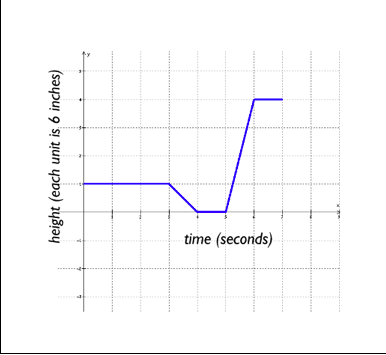
So I showed them this graph [1]

Picture 1

and I ask them where the object is at various times.

Then I say, let’s actually act this out.

I start banging my hand on the desk nearest to me, BANG BANG BANG BANG… I hold up my other hand in a fist 6 inches above the desk, and say “it starts out at 6 inches.”

As I did this, all my students joined in by banging on their desks. (I didn’t ask them to.) They all put their hands up. They all joined in. It was a true glimmer of life! of community!

For three BANGS we held our fist still, and then after three bangs, we moved it down to the desk and held it there for another bang, when all hands shot in the air and then stayed there for an extra bang.

We acted it out. And then I said: let me tell you what makes calculus so powerful. It allows us to look at this graph which gives us just the position an object — that’s all it gives us — and it lets us understand the MOTION of the object. What we have here is information about where the object is, but we now can find out how the object is moving. We could actually act out the MOTION of the object from that.  It seems so obvious, but the connection is so deep.

Then we constructed the velocity-time graph. And I pointed to the [4,5] interval and said “oh, negative. what does that mean?” (Our fist was going down.) And I pointed to the [5,6] interval and said “oh, positive. what does that mean?” (Our fist was going up.) And I pointed to the [6,7] interval and said “oh, zero, what does that mean?” (Our fist wasn’t moving. It was high in the air, but standing still.)

I’m building the concepts here. We do the math later.

[1] Pre-emptive footnote: Yes, we had a discussion about how this graph could not actually be representing something in the world, because of the sharp edges.

Writing in Algebra 2

One of my pushes this year is to get my Algebra II students to write math better. Last year I put “explain this” problems on a few exams and wasn’t so impressed with their responses. This year I am teaching my kids to write responses.

On their first assessment, I put a question similar to one we talked about in class:

Explain to someone who doesn’t know a lot about math why you can never find an x which would make |25x+5.1|-5=-6.

The responses were disappointing across the board. There were bits and pieces of gems, but nothing complete. Not a single student was able to construct a well-written response. Things I received included:

  • The other side of the equation is negative, leaving no possible solution to the problem.
  • You can never find x because the answer is negative and an absolute value problem with a negative after the equal sign is not possible.

So what I did was type up the following document and passed it out a few days after the assessment:

We talked about the vagueness of the responses, the use of pronouns like “it” and making references to “the other side of the equation,” and most crucial, the lack of reference in almost every solution to the original equation. How can you answer a question about an equation without even talking about the equation?

My favorite moment of the discussion this generated was when one student raised her hand and critiqued her own solution, and then said: “I wrote this and don’t even know what I meant.”

On the next assessment, without telling them I was going to do this, I threw the exact same question down. It was on. I saw my kids reread their responses after they wrote them, and really pay attention to their writing. Let me tell you: it all paid off. On this second round, most students got full marks. (On the first assessment, almost no one got full marks, or close to it, for that matter.)

Here are some random smatterings of their thoughtful answers:

  • You could never find an x to make the absolute value equation above true because you would have to subtract -5 from -6, which still gives you a negative number. |-25x+5.1|=-1. An absolute value equation cannot equal a negative number because absolute value is the distance from zero and is always positive [my correction: or zero].
  • In this absolute value equation there is no solution because any number in the absolute value has to be 0 or a positive number. And if you subtract 5 from 0 or a positive number, there is no possible way that can equal -6. So there is no solution to this equation.
  • An absolute value of anything can never be equal to a negative number, since it expresses a distance. When this equation is simplified, it becomes |-25x+5.1|=-1. If the ‘-1’ were replaced with a positive number, you could find the answer [for] x. But since it is a negative, you already know that is impossible.

I am continuing to ask them to express themselves through writing. On that same assessment where I asked them to repeat the absolute value problem, I also asked the following two questions, to which I got some really nice writups.

The following two questions build upon each other. The solution to part (a) will very much help you explain part (b).

(a) Explain why a^2a^4=a^6 without using your exponent rules. Explain it to someone so they can understand it simply!

(b) Explain why a^ma^n=a^{m+n} is true. You can assume m and n  are positive integers. Explain it to someone so they can understand it simply!

I still have to do more work with this, but I just wanted to say: it is worth it to talk with your kids about writing. One 15/20 minute conversation has already yielded great dividends for me.

NCTM, day 2

The second day was a disappointment. Of the four talks I went to, three of them were bad. If they were a smell, I would be passed out. So bad. I actually felt angered by two of them, because the description was so fascinating that I felt betrayed. Talks in sheeps clothing.

I feel bad listing the three terrible talks, so instead I thought I’d at least point to the one good talk:

#201: Linear Functions: Much More than y=mx+b

The major thesis of this talk was that we might want to invert our traditional way of teaching linear functions. We tend to teach:

1. y=3x+4
2. make  table of x-y values
3. plot
4. connect the points. oh my gosh! a line!

But students find the equation y=3x+4 to be the abstract part. The numbers and working with them is the easy part. So the speaker provided some ways to say let’s END with the equation and have it make sense to the kids, rather than START with the equation.

What was nice is that he started with some easy problems — that I couldn’t use in my classes — but then went to more advanced and more interesting problems — including one that would be great for an independent research project for a kid, and one that just blew my mind relating Pick’s Theorem to… systems of equations. Seriously.

But what was great is that he focused on student learning, and eschewed ed jargon and talked about why he made his choices for each lesson, and what his students got out of it. It was sweetness.

UPDATE: Commenter “m” below has prompted me to flesh things out a bit more. The easy part is with Pick’s Theorem… the speakers said he stole his connection to systems of equations from somewhere else… I suspect here! (He also showed a second way to derive Pick’s Theorem, which I am too lazy to do here. I remember first learning about this theorem in high school and spending days trying to prove it. I did eventually prove it and proudly showed my writeup to my math teacher.)

As for motivating simple linear functions, he basically had students engage in pattern recognition and play around with numbers.

blocktiles

White blocks in the first picture? The second picture? The third picture? What about the 5th picture? The 27th picture? He also talked about relating the blocks to tables to graphs really explicitly, as well as making explicit the connection between the “slope” (I put that in quotations because the speaker hates the term slope – he thinks it obfuscates) and the pattern, and the “y-intercept” and the pattern. His thesis was actualized: being explicit and very visual, and having students start with numbers and then come up with the equation out of these numbers provided a more natural and more deep way of motivating linear functions.

NCTM, day 1

So right now I am sitting in Hynes Convention Center – room 109. In case you aren’t in the know (for shame!), I am at the National Council for Teachers of Mathematics (NCTM) conference in Boston. I just finished Day 1. I spoke to a total of three strangers, one of them who I recognized (and who recognized me) from the Phillip Exeter conference from this past summer. I don’t do well with meeting new people, which is such a shame in such a math-teacher-rich environment. But hey, three isn’t bad.

The sessions I went to today were:

#14: Identifying and Remediating Misconceptions [about CAS/TI-Nspire and developing numerical intuition]
#46: Show me the Sign! [about using sign analysis effectively in 9th, 11th, and 12th grades]
#79: Helping Students Read Math [about how to teach students to read their textbooks]
#142: Discovering Trigonometry [on how Exeter uses problem solving to teach their courses, using trigonometry as the vehicle to talk about that]

This was my first NCTM conference. Let me put this one piece of information about me: I don’t like my time wasted, so I tend to be critical of speakers [1]. I expected to really appreciate one or two of the sessions, and politely sit through the others. I thought I’d be inspired maybe once or twice.

You can see where this is going. I really, really enjoyed all four sessions. The speakers were prepared, and focused – for the most part – on concrete things in the classroom. It wasn’t about giving us the most difficult but interesting mathematical problems to work on. In other words, it wasn’t about mathematics. It was about teaching mathematics. We talked about topics and skills we work with everyday, and the speakers spoke about their approaches. None of them were zealots, saying “you should do it my way because it is the best.” It was “this is what I do, this is why I do it, and maybe you can use bits and pieces of what you hear here in your own classrooms.” I appreciated that.

I don’t know if I will have time to post about each individual session, but I will hopefully post some interesting bits later. (I said that about things I learned at the Exeter conference this past summer, and never did, though. So I can’t promise.) But maybe if (when) I actually apply some of what I’m getting to the classroom, I’ll feel more inspired to write.

(FYI, if you feel like you just absolutely need to know more about one of the sessions I went to, throw that down in the comments. You know I can’t deny you.)

[1] Yes, yes, I know our kids feel the same way, and we should always keep this in mind when we enter a classroom.