Author: samjshah

ack! disaster in 7-1!

On October 21, 2007, I sent an email to the other accelerated 7th grade math teacher. The subject: “ack! disaster in 7-1!”

I had only been teaching for about a month and half. I hadn’t learned the “mountain vs. molehill” principle, which — when I figured it out — changed my life. I was filled with insecurities, even though I had started gaining my sea legs. But the event conveyed in this email below kept me up all night. I was freakin’ out.

Wanna read the email?
Thought so.

[Other 7-1 teacher],

A total disaster! So the test that I gave right after the fire drill? The students were making ALL sorts of careless errors and conceptual errors. I don’t know what it is — either it could be that it was Thursday last period, everyone was crazy after the fire drill, or students felt rushed. I told them they could finish the next day — and so I gave them an extra 12 minutes…

But once you see the grades, you’ll see why I’m freaking out:

[list of all students’ names and grades]

I don’t know if I messed up teaching it, or if they were just all flustered, or what. Even the best students were really mucking things up. The mistakes ranged from sign errors to not simplifying to conceptual errors. What I’m thinking of doing is having a “make-up test” for them this Thursday during lunch or after school (whichever they can make it to). Is that sort of thing allowed? If they took it during lunch, when would they get a chance to eat? Or do you think I should give them “test corrections” for extra points on the test?

As for if they are totally missing the boat or not, I don’t know how to fix that since we’re starting on new things! Maybe each day my Do Now will be stuff from the last chapter?

Best,
Sam

I sound reasonable in this email. But internally, I was an absolute mess. How could I be such a bad teacher? It was one of those “take stock of things” moments. And I was coming up short.

What brought this back was misscalcul8’s recent tweet:

Picture 2And it all felt so familiar. What’s great is that she has a support network with all our twitter buddies! Not that anyone can really help too much — I mean, we’re so far away from the situation we’re taking stabs in the dark on how to deal with it — but I can only imagine that the commiseration and advice was soothing.

I can just say that I didn’t have that on October 21, 2007. I was convinced that I was simply terrible, and that no other teacher had ever had a class bomb. No, seriously, I was so terrified that I believed that. (What a moron I was.)

I know I’ve grown a lot since those first few terrifying months, where I felt I was on trial — with the students, with the school, and most importantly, with myself.

As that first year went on, and I was exposed to some serious trial by fire, I found I slowly started to thrive. I dealt with a few (not many) challenging parent situations, had a few discussions with students who were acting out, actually sort-of yelled at a student when nothing else was getting through, coped with excessive absences of some students due to mono, and dealt with cheaters. A lot.

But as the year progressed, I got comfortable in my teacher skin. I gained my teacher voice. I learned to just lay my expectations and not try to justify everything or argue with students about them [1]. I learned not to be defensive.

But the only thing that does that is time.

So for anyone out there who might be new, and hitting their first major so-called-hurdle, just know that

(a) it probably isn’t as huge a hurdle as you think it is

(b) we’ve all probably gone through it too

and

(c) the best remedy is time and perspective.

If your teaching trajectory is anything like mine, I had a few bumps my first year, and my second year was smooth as silk. There wasn’t one major bump. I might have encountered the same problems again, but this time I knew what I needed to do when dealing with them.

Example? Last year my Algebra 2 students all bombed a take home quiz on quadratic applications. I knew they were going to. I rushed, taught it badly, and knew I was doing a bad job for the three days we worked on it. I wasn’t surprised by their (very low) quiz grades. So what did I do? I just fessed up. I told ’em I frakked up, and I knew it, and I couldn’t hold my mistakes against them. Quiz was wiped. We moved on from there. Not a huge deal. The previous year I wouldn’t have been nearly as mature as that.

[1] I’m requiring my Algebra II students to use a binder this year, and I got some pushback. “But I don’t like binders! Can I use something else?” “No.” “Why?” “Because I said so. But if you need, I’ll hold your hand when we use the binder, promise.”

First Day

My first day was underwhelming.

I could list all the things I would do differently, and all the things that were out of my control that affected things, and go on and on and on. But I won’t. I just don’t feel like it.

Instead I’ll just say that the biggest letdown for today was my own too-high expectations. I remember the community that we built in each of my four classes last year. By the end of the year, it was a crazy joy to go to each of my classes. I seriously cared about every single one of my students more than I thought I could. [1]  That’s my last memory of teaching. I forgot that I don’t get that at the beginning of the year. The class clown hasn’t come out. Students don’t know how they’re allowed to act in class, what I expect of them. I still don’t know what they expect from me. I’m having a real hard time reading them. That stuff comes with time.

I totally forgot. I totally forgot that it takes time for a group of individuals to become a class.

Sam

[1] Ah, selective memory and the idealization and whitewashing that comes with time!

From whence this came…

UPDATE: Here is my Advice from Algebra 2 Students Past, in full glory.

Today I was compiling and typing up my “advice from Algebra 2 students past” to hand out to my kids this year. And I forgot about a striking passage from one of my students:

It will behoove you to understand going into class what exactly Mr. Shah wants from you, which is an attentive, honest, and interested student. It has taken me six months to realize what Mr. Shah really wants from you; he wants you to ultimately be a good person in the world.

Where that came from, I have no idea. None of my other students wrote anything like it. It rang so sincere and specific in the way it was written that I know it wasn’t just a casual, flippant remark. Of course I glowed when I read it — because the student hit on something even I hadn’t been able to articulate. My primary goal is to get my students to understand and be able to do mathematics, but these kids are in the process of learning how to be adults. And whether my kids remember completing the square years down the road is ultimately less important than the person they forged through trying to learn how to complete the square. Not that I ever say that to them, really.

Which is why I’m  darn curious from whence this remark came from, though. Cuz I have no freakin’ clue.

Imagining the First Day of Calculus

At one point during my first class, I want to drive home a point. You guys know a lot, and I want this course to help it all hang together.

I’m going to ask them to spend a few minutes minutes solving the problem: 2x^2-56x+1=0

Then I’m going to go around and have students explain how they got their answer, why they think they’re answer is the answer, what they know about the question, whatever.

Who wants to bet that 100% of them graph it on their calculators or use the quadratic formula?

I’m counting on it. I will then show them an example of their graphing calculator lying to them (there are a million of ’em), and then say “why does the quadratic formula work? why are we allowed to use it?”

We’ll then take a moment and say “what do we need to know to solve this problem? I’ll start by throwing something out: we have to know what a variable is.”

So we’ll throw a bunch of things on the board: variable, number, exponent, addition, square roots, etc.

Then I’m going to reveal the big secret to mathematics, the secret that all teachers have kept from them until now: all we’re doing to solve problems is to turn something we don’t know into something we do know.

This is the rant I have playing in my head…

So when we first learned quadratics we didn’t know how to solve ’em. We had only seen baby linear equations. But guess what? When we learned to solve quadratics two years ago, we turned these horrible grossities (quadratics) into beautiful nice-ities (linear equations). Watch!

2x^2-56x+1=0

2x^2-56x=-1

x^2-28x=-\frac{1}{2}

x^2-28x+196=-\frac{1}{2}+196

(x-14)^2=\frac{391}{2}

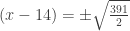
(x-14)=\pm \sqrt{\frac{391}{2}}

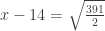
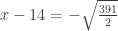
x-14=\sqrt{\frac{391}{2}} and x-14=-\sqrt{\frac{391}{2}}

I didn’t know how to solve the quadratic, but I do know how to solve (two) linear equations!

This procedure is completing the square. I know y’all remember it — vaguely. I know y’all hated doing it. But why did we evil math teachers foist it upon you? Because what this lengthy, arduous, annoying process did was took something gross, and turned it into something nice. The process wasn’t super nice, I know, but taking a step back and looking at the forest for the trees, it did that magic little math secret: turned what you didn’t know how to solve into something you did.

And look at all you needed to know about in order to make this happen. Numbers, addition, exponents, square roots, positive and negative, linear equations, variables. In that one equation

2x^2-56x+1=0

is a whole universe of knowledge! And you KNOW that knowledge. And in this class, we’re going to time and time again see equations that we might not think we know how to solve. They’ll look scary and unfamiliar like

\int_{-3}^{3} \sqrt{9-x^2}dx

But we’ll turn it into something we are more familiar with. Just don’t lose the forest for the trees. Don’t get stuck in the muck and mire of the procedure and not forget about why we’re embarking on that particular path, or what ground the path is built upon.

Our mantra: take what we don’t know and turn it into what we do. Math is an art. The creative aspect of it is finding the right path to turn what we don’t know into what we do know. Therein lies the puzzle, the beauty, and yes, the frustration.

PS. This post is basically a recap of this previous post. I just think it will be fun to talk about on the first day.

A Vacation From My Vacation, or a Toast to High School Friends

I need a vacation from my vacation within a vacation. (Translated: I need a week to recover from going to a high school friend’s wedding at the very tail end of my summer vacation.)

I just got back from Seattle, spending 5 days with high school friends, going to a wedding. What struck me is that we’ve known each other for over 13 years, and that these particular friends have actually grown closer to me with each passing year instead of more distant. High school can be extraordinarily important, socially. Heck, when I moved from my first high school (few friends) to my second high school (lots more friends), I felt free to be whoever I was, without the weight of years and hardened opinions of classmates weighing me down. I was able to become who I became — a colorful, irreverent, independent, overly dramatic personality — in high school.

Even though I very rarely commit anything about my personal life to this here blog, I just wanted to give a visual toast to those friends who forged the backbone of who I am today in that crucible that was high school.

(And I just know all y’all were dying to know what I look like. Hot, right?)

Fraud?

So I’m just going to throw it out there.

Sometimes blogging makes me feel like a fraud.

Here’s why. I’m not an amazing teacher. Most of my lesson plans aren’t exciting. I have lots of ideas but often no follow through to implement them. I plan almost 100% of my lessons the day before I teach them. I don’t use group work effectively. I rarely teach problem solving skills and don’t do honest investigation in anything other than my multivariable calculus class. I keep a teacher-centered classroom. My kids all have laptops and I never use them in class. I pretty much follow the same teaching pattern every day (warm up, homework questions, lecture, stop to practice, lecture, stop to practice). I’m afraid to give up control of the classroom to my kids.

Which are — frankly — all things I’m totally okay with, at this point. Some things I don’t want or care to change. Other things I wish I were farther along in my own personal development. And there are a number of things I know I do really well too. But there you are. That’s where I am at the moment. I’m pretty good, but I’m not amazing. (My own personal assessment, anyway.)

But here’s where feeling like a fraud comes in. Did you really think I led a teacher-centered class every day? Would you have expected me to describe myself as I did above? In other words, if you came to watch me teach, would you see what you expected?

I’m 100% certain (bets, anyone?) that the answer is no.

Two years ago, 328 posts ago, when I started blogging, I was blogging for me alone. But it struck me recently that in the past two years, I had inadvertently been constructing this online persona, post by post. Like: my online blog self is one person and my real life self another? Is it just me? Prolly.

But it’s bothering me that this online persona is so incomplete, possibly a idealized version of what kind of teacher I am in real life.

I honestly do write for me. This place has always been for me, but I know that as opposed to when I first started and I was my only reader, there are now like 5-10 people (oh! kind souls!) who read this blog in addition to me and my super awesome teacher sister. I don’t want to be a fraud to you as I continue to write here. So for you 5-10 people, in case I had somehow drawn myself into some sort of caricature teacher costume, let me just put it out there straight:

I’ve had two years in the classroom. I’m okay at what I do. I love what I strive to do.

New Year’s Resolutions

At the end of the calendar year we make (and quickly break) new year’s resolutions. But as teachers, I thought it might be fun to make — at the end of the summer and the end of the academic calendar — some resolutions. Okay, geez guys, maybe “fun” isn’t the right word. But inspirational maybe? Okay, okay, maybe just a lark.

In order for them to be effective, I’m throwing down three simple rules.

  • You should come up with at least 1 but at most 3 resolutions. This is so you don’t get overwhelmed.
  • They have to be easily doable and sustainable throughout the year. This is so you don’t get overwhelmed.
  • You need to publicly announce them – whether it be on your blog, on twitter, on the comments here. This is so you have some external accountability.

I will make mine here:

1. I read on someone’s blog (forgive me for not searching to find and link to it) an idea to keep students engaged. If students point out mistakes that I make, I will visibly tally them somewhere in the room. The student who caught the mistake will hopefully feel good about themselves and students will hopefully always be second guessing me. And after 30 mistakes are pointed out, the students get to have a “candy day” or something where I bring a little treat for them. I will do this in my Algebra 2 and Calculus classes.

2. I will do this random acts of kindness thank you card activity again in my Algebra 2 and Calculus classes.

3. I will decorate the classroom that I will be teaching 3 of my 4 classes in so it will be colorful and kitchy, but not elementary school-esque. I will have this done by… no, not the first day of school… by the end of the first quarter.

Signed,

B30089BABC910237E9DFD6CD067B5412

UPDATE: I am going to have to nix goal 3. Even though one day I would like to do this, apparently this year my rooms have been switched beyond recognition, so instead of teaching in 2 rooms, I’m teaching all 4 classes in 4 different rooms. I will be running around the school like a chicken with my head cut off. And although I’d like to decorate all 4 rooms, I honestly don’t have the energy to create and maintain something in 4 different rooms, and I won’t have “priority” in these rooms because other teachers will probably be teaching in them more and want to do something.