Author: samjshah

The sky is falling

Preface: Classes start tomorrow.

Things that went wrong today, while attempting to get organized and do some prep work.

(1) The printer in the math office at school decides it doesn’t want to work, so I can’t print stuff out at school. This is the number one worst thing ever for the day before classes start. Period.

(2) My printer at home is broken. Tonight I tried to fix it. I was unsuccessful. As a permanent reminder of this mechanical failure, I have ink all over my bedsheet.

(3) I was suffering from heat exhaustion at the end of the day. There isn’t any AC in our office, and with all the teachers there, working with a flurry of activity, I started to have hot flashes. Whoever said you have to be a woman to be afflicted is a crackpot.

(4) [In my school (as is usual in independent schools) students purchase their own textbooks. None of my multivariable calculus students seem to have a textbook. In theory, they should be able to use their calculus books from last year, since the multivariable sections are the last 5 chapters. However, apparently, the calculus teacher last year (he retired at the end of last year), told his students they didn’t need to buy a book. How he taught the class, I don’t know, but the consequence is: I’m screwed.

(5) As a consequence of this book disaster, an hour ago I decide to check to see if the book order for my regular calculus class went in the system — so students know which is the right book to order. Apparently the course is listed as “Calculus AB BC.” This is NOT an AP course. Luckily they have the right course number listed, along with my name. So there’s a chance students got the book.

What’s unfortunate was that I wasn’t nervous or anxious or anything about going back to school last month, last week, even yesterday. But now that all this has happened, I am having a mini-freak out. Sigh.

Many Eyes, Data Visualization

This site — Many Eyes — was touted in the New York Times today. It’s a data visualization site.

At an experimental Web site, Many Eyes, (www.many-eyes.com), users can upload the data they want to visualize, then try sophisticated tools to generate interactive displays. These might range from maps of relationships in the New Testament to a display of the comparative frequency of words used in speeches by Senators Hillary Rodham Clinton and Barack Obama.

[…]

Users can embed images and links to their visualizations in their Web sites or blogs, just as they can embed YouTube videos. “It’s great that people can paste in a YouTube video of cats” on their blogs, Dr. Viégas said. “So why not a visual that gives you some insight into the sea of data that surrounds us? I might find one thing; someone else, something completely different, and that’s where the conversation starts.”

Unfortunately when I tried to play around with it today, it was being a bit wonky. I attribute that to the traffic from the New York Times article. But if anyone does get it to work, holla if you think it’s as cool as it could in theory be.

A letter sent back in time

As last year was winding down, I realized that the kids I ended up with at the end of the year were very different than the kids I began with. I thought about where they were on the first day, and how much they had learned in the intervening months. Not only did I have to get used to them and their quirks, learning differences, personalities, but they had to acclimate themselves to my course, my personality, my quirks, my method of presentation.

And so, in the last week of classes, I asked each student to type a 1 page (double spaced) letter to themselves 9 months ago. I asked them to give themselves advice on how to succeed in this course. Things they know now which they wish they had known then.

And they gave me some pretty awesome reflective letters, full of advice useful to my classes this year. Instead of me telling them that doing their homework nightly is important, or that cramming at the last minute doesn’t work, they now have it from the horses mouths. From those who were forged in the crucible of my math class.

advice-for-algebra-ii-students

advice-for-calculus-students

What’s great about these documents, read in their entirety instead of just the snippets I provide here, is that I get glimpses of my class — and the way I am as a teacher — through the lens of a student.

After talking with my colleagues, I decided not to foist this upon my students in the first few days. There is too much information flying around and it’s too potentially useful to be flung into the “first day crud” pile. Better to wait two or three weeks, when they’ve had a chance to get to know me and my class, and I get a chance to know them and their class. Then I’ll have two or three histrionic kids read a few pieces of advice.

For students, by students.

Mountains, Molehills, and Growing Pains

The beginning of the last school year — my first school year as a full time teacher — was marked by fits and starts. Our meetings started today, and I got to talk more with a number of the new teachers. Some new to teaching, some new to my school.

Can I say, phew!

It’s such a relief not to be in that position again. Getting used to the school argot, learning and promptly forgetting the quirks about the school’s operation, struggling to fill out medical and retirement forms, and firing a mountain of questions to everyone around you while hoping that you aren’t annoying anyone. A totally overwhelming experience. Phew.

It’s kind of fascinating to think back to that time, though. In the first weeks of school, there were huge and small obstacles that I had to overcome. I often didn’t know the difference.

For example, in my school, each teacher signs up for a couple “duty periods” a week — where you proctor a study hall or sign kids out when they leave campus for lunch. I signed up for my duty periods, and then — way late in the game — realized that one of the duty periods I signed up for conflicted with my 10th grade adviser meeting. I freaked out. Full stop.I felt so anxious about it that I sent an email to this faculty list-serve we have asking if anyone could switch. (No one responded.) And I remember being just terrified and anxious to talk to the principal and tell her I had screwed up.

And looking back — even as soon as the day after it was quickly resolved — I realized that I made a mountain out of a molehill. It was a five second fix, and 72 hour freak out.

A second example: in my first two weeks of teaching, I was doing work in my apartment late one night, and realized I didn’t have the teacher’s edition of my Algebra II book with me. I swore I brought it home, so I tore apart the whole apartment. (You know, one of those frantic and desperate searches where you even peek in the freezer, because there’s that minuscule chance that you (a) opened the freezer door looking for a popsicle, (b) put the textbook down in the freezer while you reached for the popsicle, (c) closed the door with the book in the freezer, and then was (d) struck with temporary amnesia where you forgot that you went to get a popsicle and left the book in the freezer.)

I was so freaked out about this missing book that I hopped on the subway and went back to campus to check. At this point it was like 10pm at night and I was dead tired from all the work I had been doing. Plus the subway comes much less frequently at that time.

The book wasn’t anywhere. I returned home, dejected, and I tried to fall asleep. Thoughts kept running through my mind: had someone stolen it? Could I have put it anywhere else? Will everyone think I’m irreponsible?

The next day, after considerable querying and looking like a fool, it turned out one of the other math teachers had simply borrowed it and returned it in a different place.

I now know that losing a book — teacher’s edition or not — is not a huge deal.

More than not being a huge deal, these things weren’t even blips on anyone’s radar. I had made yet another mountain out of a molehill.

The problem was that at the time, I didn’t know what the school culture considered a mountain and what the school culture considered a molehill.

I’m glad I am familiar enough with the school culture so that I know when I can just say “whoops, oh well, time to move on,” and stop worrying. And honestly, almost everything I obsessed about last year were the small things.

This year I know I won’t be sweating the small stuff. (As much.)

Nothing more satisfying…

There is nothing more satisfying than going to your local school supply store and searching high and low for your perfect yearly planner/calendar. Nothing.

And that moment, after you’ve narrowed it down to three, after you’ve studied those finalists in great detail (“that one has room for me to put my after school activities, but this one doesn’t have the spiral which always gets messed up by the end of the year”), and you bring the winning planner to the cashier, well, let’s just say that I don’t even care that I’m spending my own money. [1]

Today I entered all the dates, and wrote in all the days off, shortened days, and important-to-know dates (e.g. Parents’ Night). And for the first quarter, I filled in my classes and all the meetings that I know about already.

And it felt soooooooo good. There is something robotic, yes, but comforting about filling in some of the planner. I was trying to pin my finger on exactly why — and I think I got it. There is so much to do in the beginning of the year that it can feel overwhelming. Filling in this planner not only is satisfying because its one more thing I can knock off my to-do list, but also because it forces me to think about the school year in manageable one day chunks, and not in these ambiguous terms like “unit.”

I now know what I need to do before school starts (namely: plan my first few lessons), and what I want to do before school starts (the list is too long to even contemplate retyping, but it includes things like “learn how to program in SAGE and create instructional packets for students” and “create a homework assignment sheet for each of my classes”– wishful thinking).

What I need to do is a lot, but you know what? I can do it!

So hooray for planners, my comfort in this time of turmoil as school quickly ramps up.

[1] The school actually provides us with planners, but I just don’t like them. I’m particular about certain things, and since my planner is my life at school, I spend my own money to get something I’m really happy with.

Come share in the internet bounty!

Here are some things I’ve seen on the internet that I thought might pique others’ interests.

  1. This video on learning styles — and how we as teachers can ignore all that we’ve heard about them.

    Both Casting Out Nines and Catching Sparrows have posted it too. Read the latter’s post for some solid analysis.
  2. A much needed middle finger directed towards Wong’s First Days of School book is on Stop Trying to Inspire Me.
  3. A must-read multi-page New York Times article on teacher David Campbell’s experiences teaching evolution in a classroom where a large proportion of the students are taught to question the teacher by their parents and churches.
  4. I Want To Teach Forever links to a edubabble random jargon creator. Some words I’ve created:
    >revolutionize research-based relationships
    >synergize metacognitive experiences
    >synthesize developmentally appropriate alignment
    > harness site-based goals
    Pure delicious, vague cant, that’s all it is.
  5. A great science teacher blog — trust me on this. I found it through another blog, but I can’t remember which one to give it credit. By the way, I totally thought that the title of the latest post — “Terminal Velocity of Mussels” — was such a random idea that I was sure that only at most 10 sites on google would come up when searching for that. I was proved wrong. Searching [Terminal velocity of mussels] yielded 18,300 sites. Searching [“Terminal velocity” of mussels] yielded only 431. Not to be too meta, but with this post that number will increase to 432. Rock on.
  6. Catching Sparrows goes on a screed about the problem with group work. The only thing is, even though I call it a screed, I agree.
  7. Sustainably Digital analyzes a commercial which is a metaphor for our educational system. I’m not sure I buy the metaphor. Maybe I’m linking to this because I like the commercial a lot. Because I do.
  8. I Want To Teach Forever gives a really great list of “am I ready for school to start?” which I will be going through. Probably next Tuesday evening, as I lie in bed, eyes shut, mind whirring about all the things I still have to do. (I will not, however, re-read Wong, as instructed by this otherwise unblemished list.)
  9. dy/dan’s videos about teaching are great and two of them in particular need to be seen by you, now.
Fin.

Neat TI-Calculator Trick #1

Inspired by Math Teacher Mambo’s “that super awesome functionality been on my calculator for YEARS and I never knew about it” post, I decided to post something that I learned this year which had a similar effect on me.

(You probably already know this if you teach statistics. Maybe everyone knows this.)

ENTERING REGRESSION EQUATIONS AUTOMATICALLY IN THE EQUATION LINE OF A TI-83/4

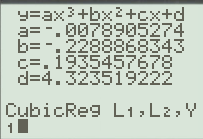
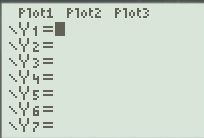
The short version: when doing any form of regression, you end up getting the coefficients displayed like this (below left). However if you wanted to graph that cubic, I had my students manually write down every coefficient on a piece of scrap paper, and then type it into the equation screen (bottom right). To make matters worse, you had to write down a good number of digits so you wouldn’t lose too much accuracy. I couldn’t find a way around it. What a pain, and students would make mistakes with all the copying, followed by typing the equation in Y1.

Of course you all knew that the “duh” moment came. The other Algebra II teacher taught me this simpler, foolproof way. It automatically enters the regression equation into Y1:

When you do the CubicReg command, you need to add the Y1 argument (above left). (You can get Y1 by following key sequence: VARS, Y-VARS, FUNCTION, Y1). Then it’s automatically entered in Y1 (above right).

I can’t believe no one ever told me that. I can’t believe I made my students write down the coefficients by hand.

I made a jing video of how to do this. Sorry about my voice. I hate hearing myself recorded. One of the many things that terrify me.

Vodpod videos no longer available.

more about “2008-08-21_1928“, posted with vodpod