Author: samjshah

The blog that will never be

Oh there are times when I want to share things with you, my (very) few loyal readers. Through my yearlong courtship with the independent school system, I’ve come to absolutely love what it has to offer, but there are also individual moments of supreme surrealism. Where you are confronted with something — be it an email, a conversation, a policy — that makes you do a double take and go “whaaa?

Today I had just one such moment, that made me take up a variation of the old man’s trope: “When I was in public high school, it would have been unthinkable for…”

And I have this blog, and I desperately want to share these moments with you, because… well, they’re really, really funny. Actually they’re usually a mixture of being comical and somewhat upsetting simultaneously. Because they reveal a world so different, full of people so different, that you sometimes wonder if you’ve wandered onto the wrong set, and you’re waiting for someone to say “cut. WHAT THE HECK IS THAT GUY DOING HERE?”

But unfortunately, a post on this blog beginning with “Even if you tried, with the help of a thousand monkeys on a thousand typewriters, you wouldn’t be able to predict what just happened today…” can never be. I vowed to myself to never write about specific students or specific situations — no matter how much the emotional side of me wants to. The reasonings are many and sound (I followed this story closely), and I’ve outlined them briefly before:

I think a lot of value can be had by sharing these stories, getting advice from others, and just commiserating about the difficult moments that come up in the day-to-day. But doing so publicly makes it harder, because specifics have to be pitched out the window. (I don’t want a student coming across my blog, knowing a post is about him or her, and feeling uncomfortable.)

It’s not fair to those you want to write about, because when push comes to shove, you don’t want them doing the same to you. I hate ratemyteacher.com. It’s the most malicious form of this.

But I’m sad about my self-imposed policy, especially with school ramping up, just days away. Because I love to vent. (I think venting is cathartic and healthy and absolutely necessary in teaching.) Because I love reading good teaching tales. (Some of my most favorite blogs are all about spinning good student yarns.) Because I think we can learn a lot about other schools, other teachers, and how to deal with our own situations, by hearing these stories.

And because yet another absurdity happened today.

On this blog, the farthest I’ll go on this is to make generalities about the performance of my classes as a whole, and consequently, I’ll be forced to take my own teaching tales to the local watering hole.

So yes, this post is a proxy of the one that I can’t write, but so desperately want to. In other words, I’m just giving myself a little reminder to stay true to the original purpose of this blog — a personal archive of my professional growth as a teacher, a form of communication with other teachers, and a place to reflect upon teaching practice.
Organizing!

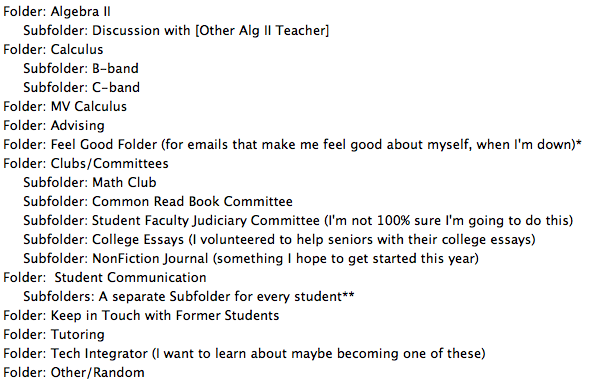
Today I spent a few hours organizing for next year — creating the appropriate folders and creating/updating mailing lists. The process is interesting, because I think that the way one organizes their desktop, or their mail folders, or anything, reveals a lot about the person. How they view their world, how they compartmentalize it.

For the following year, this is my email directory structure:

Clearly you can see that I save a lot of emails; I’m a packrat in the electronic world as well as the material world. I’m definitely a natural archiver, because I have no memory and I need things written down to refer to. But there’s another reason why archiving email is important: you have written proof that certain things got done.

“You never told us X,” a student or parent or dean or someone might say.
“Actually, I told you that! See this here?” I will respond.

(This actually happened last year, when a parent said they were never informed of their child’s poor performance; I had two archived emails that specifically were sent to inform the parents of that fact.)

Maybe this should be a meme. If you care too, share on your blog how you organize your school-related email? What do you save? Why do you save?

*This is a new addition! I read about it on some blog and thought it was a great idea.
**I did this last year, and it was super useful. Every email to and from a particular student gets put in their individual subfolder. Also every email about these students (communication with other teachers, with deans, with parents, with the SFJC) gets put in these folders. Then, when I need to pull up information on a student, I have not only my gradebook, but in this folder, a lot of other information about them. Sometimes, when writing my narrative comments on students, I would quote them if they said something relevant. (As my school is a laptop school, you can see that we get a lot of email to/from/about students.)

Open Math Problem: Bloxorz

Wow! I am totally on a blog posting roll. I think the end of the summer has me going out less, which has me putzing around the apartment more, which has me thinking about school and math more. (It doesn’t help that I don’t really get reception on my TV and I don’t have cable.)

In any case, MathTeacherMambo pointed me to this (warning: VERY ADDICTIVE) game:

BLOXORZ

For those who are starting their pre-start-of-classes meetings, I warn you that you might not ever make it to those meetings. Your principal will knock on your door, but you’ll be drooling and staring vacantly at your computer screen, cursing the day you ever reached level 11, 12, or n.

For those who are wisely taking my advice and holding off playing the game, here are a few examples:

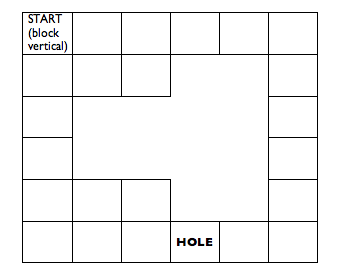
As you can see, the goal is to get the block in the hole.

I think this is a great open math problem ready to be attacked and solved by a high school student. Fundamentally, I think with a lot of work, a student should be able to answer the following question:

Given a particular floorplan and starting block position, can you decide whether the floorplan is solvable? Can you tell, without playing the game, whether there is a way to get the block in the hole? 

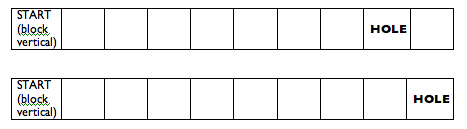
To illustrate, two simple examples of floorplans — the first one is obviously not solvable, the second one obviously is.

What about this third one?

The first two are easy to solve by inspection. Even the plan above is easy to solve by inspection — but you’ll notice it gets slightly harder. I want to know — even in the most crazy floorplan — is there a solution? If not, I want proof that there is no solution.

The game itself has a bunch of complicating elements — like transporters, and ways to get more floor to appear by having the block roll over a button. (See the second video above.) But I think the base case is hard enough — with none of that nonsense.

Once the initial problem has been solved, I think a great follow up question would be: what is the fewest number of moves you can solve a particular floorplan in? 

I have a student who approached me about doing an independent study of linear algebra or differential equations this year. I know I’m going to be overwhelmed, so I had to decline. However, I suggested that instead of having a formal course, we could work on an investigative problem together. I just emailed him this idea — but I don’t know if he’ll want to.

PS. I’m guessing a good starting place for this problem is looking at the work that has been done on the Lights Out game. (I’ve never played it, but it seems like it’s similar enough in nature that that solution can inform our approach.)

Anne of Green Gables: Story of a Green Teacher

Draw whatever conclusions you may, but my favorite movie growing up was Anne of Green Gables, the series with Megan Follows broadcast on PBS. My sister and I taped it from TV and watched them over and over and over again. With the recent $10 windfall that befell me (and another $40) I bought the DVD collection.

Tonight, while watching the second DVD, I came across this gem, which I encourage you to watch the first six and a half minutes of:


Argh! Embedding on that video is disabled. If it doesn’t show up, watch it here. Trust me, it’s definitely worth watching. [The transcript of the scene is below the fold.]

Let’s lay the basics out here. Anne Shirley has been a teacher for the past two years at her hometown’s public school. She enters a private school where the cards are stacked against her. And this is the first day of classes.

What we see here is something we teachers fear, something we cringe when we watch. An entire class turning against us. We know this deep down: in a battle with students, students always ultimately have the upper hand. And in this clip, we see that laid bare.

Anne and the student ringleader escalate their conflict — each egging each other on. Anne offers a punishment, sees it isn’t viewed seriously by the rest of the class, and raises the stakes. The student says, simply, no. (The student can always say no.) In frustration, Anne raises the stakes again: administering the strap. In a voice of defiance, the student accepts the punishment. The battle of wills is over. The punishment wasn’t a punishment at all, because even though it might have hurt, the student won the battle of wills. Anne lost.

If you care to answer, I ask you: A majority of students in your class are rallying against you, the ringleader lets out a snake and admitted it, and then refuses your punishment of staying after school for a week. Your school does NOT have any formal school-wide system of punishment (such a detention, suspension, expulsion). You have to handle this on your own. What would you do at that moment in class, in front of your students? How would you have diffused the situation and gotten the class into your corner?

Transcript of the scene below the fold.

(more…)

Lord Kelvin, Bubbles, and the Olympics

The Water Cube in Beijing — you know, the one where swimming god Michael Phelps just broke all those world records? — has been touted in the media for being a very green building, capturing over 90% of the solar energy that hits it. However, in addition to looking cool, did you know that there is some incredibly deep mathematics behind the structure itself?

Lord Kelvin (William Thomson) was a prodigious and prolific nineteenth century thinker, and one of his interests was studying bubbles. (Seriously.) But to preface this post, take a moment and think about a single bubble. Why does it form a sphere — and not a cube or blob shape? The answer deals with forces and energy and the like, but the problem reduces to finding the figure with the smallest surface area for the amount of air contained in the bubble.

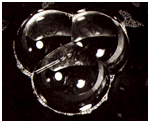
And if there are two bubbles touching, we know they meet and form a dyad of bubbles. And three bubbles meet, and they will always meet at 120 degrees. And more?


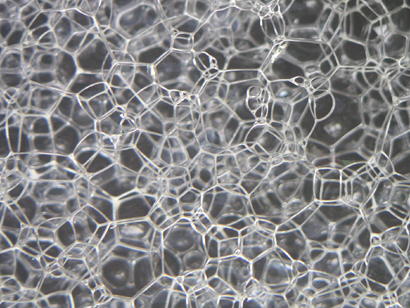
The more the bubbles, the more they are touched on different sides by other bubbles, forming flat faces. We end up seeing that the bubbles form polyhedra!

What if you had a whole bunch of bubbles in a foam bath? What would be the idea formation of them?

In 1887 Lord Kelvin asked the question: what is the shape that partitions space in such a way that the shape has the minimum surface area?

One example of a shape that partitions space would be boxes — stacking boxes, one on top of each other, in all directions. But boxes end up not having minimum surface area. Spheres aren’t a possible answer, because you can’t fill space with spheres — there will always be gaps between the spheres!

Bubbles, by their very nature, partition space by taking the shape that minimizes surface area. Kelvin studied bubbles and conjectured that the answer to his question was “tetrakaidecahedra.” Well, in his words, “a plane-faced isotropic tetrakaidecahedron.” (These are truncated octahedra.)

And in fact, there is a slight curvature, but “no shading could show satisfactorily the delicate curvature of the hexagonal faces.” But no worries, because you can see them yourself, like Kelvin did, by making a physical model:

it is shown beautifully, and illustrated in great perfection, by making a skeleton model of 36 wire arcs for the 36 edges of the complete figure, and dipping it in soap solution to fill the faces with film, which is easily done for all the faces but one. The curvature of the hexagonal film on the two sides of the plane of its six long diagonals is beautifully shown by reflected light.

I find it extraordinarily awesome that even though you can work on mathematics with pen and paper, you can play around and experiment with soap bubbles to see solutions.

It turns out that Kelvin’s conjecture was wrong. It wasn’t until 1993 that it was shown there was a better shape. Denis Weaire and Robert Phelan found shape that had 0.3% less surface area than Kelvin’s shape. To do this, they had to use a computer program!

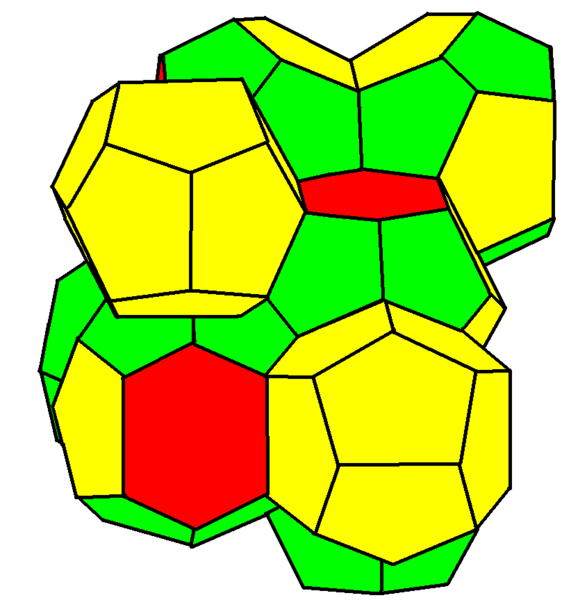
Their shape was more complicated looking. (Kelvin’s shape was formed from a single cell; Weaire and Phelan’s shape was formed from two different types of cells.)

If you want to build your own, you can print out the nets to fold here!

Wikipedia states:

The Weaire-Phelan structure uses two kinds of cells of equal volume; an irregular pentagonal dodecahedron and a tetrakaidecahedron with 2 hexagons and 12 pentagons, again with slightly curved faces…. It has not been proved that the Weaire-Phelan structure is optimal, but it is generally believed to be likely: the Kelvin problem is still open, but the Weaire-Phelan structure is conjectured to be the solution.

And this structure was the inspiration (and formed the basis) for the Water Cube in Beijing; we’ve come full circle. Surprising is the totally random look to the structure (like it had no order behind it). That was an effect achieved by taking a cube composed of the Weaire-Phelan structure, and then slicing it not horizontally, but at a 60 degree angle. See the excellent NYT graphics below.

Best! News! Ever!

I just got my second “the summer is winding down but don’t worry it’s not really over, but actually, wait, here is a package of information for you, so that you can’t pick up your margarita without thinking how few are left to imbibe in the freedom that has been your summer” mailing from my school.

No, silly, that’s not the best! news! ever!

It’s my schedule. I knew what I was teaching this year (natch!), but I didn’t know that… wait for it… drum roll… brrrrrrrrrrrrrrrrrrrrrrrrrrrrrrrrrrrrrrrrrrrrrrrrrrrrrrrrrrrrrrrrrr

I get to have all my classes in the same room.

YESSSSSSSSSSSSSSSSSSSSSSSSSSSSSSSSSSSSSSSSSSSSSSSSSSS! (The crowd roars!)

For context, last year I was in 3 different rooms: one of them was in this room that I wouldn’t have wished upon my teaching nemesis, if I had one, and another one was in the middle school which is hard to get to in the passing period (well, it was a 7th grade class, so that’s a bit legit).

Take a moment, and close your eyes. WAIT! Then you can’t read this. But imagine yourself with your eyes closed imagining the following, if you will:

You walk down half a flight of stairs from my office and enter the science wing. You turn left and in front of you, a science room. Not just any science room. A very spacious science room, with two rolling whiteboards (love it!) in addition to the SmartBoard. The austere black lab desks/tables each seat two students. Now rearrange these desks set up in a “U” shape, where the “U” faces the SmartBoard. Peeking in, you see eager young faces looking with admiration at their teacher — they can’t believe he has moved up in the ranks so quickly to have somehow gotten such a room. The teacher does a quick sweep of his domain, and indicates he’s about to speak. The students rush to pick up their pencils, their heartbeats beating faster in excitement. “What’s about to be said? What sage words will he impart to us?” they think. “Math,” he says, followed by a very pregnant pause. “Is about the coolest thing ever.” A sea of heads start nodding vigorously, while thunderous applause fills the vast room, echoing through every nook and crevice.

Darn, I lost my train of thought. And dude, where’d my margarita go?