Author: samjshah

Good or Bad: This valedictorian speech

“And god, after 18 years of math, aren’t you so sick of formulas?” Pshaw.

What do you think? This wasn’t me, at graduation. I did feel strongly about my (second) high school, and much of it negative, but I wasn’t bitter. I left with a lot of great friends, which made my time less like a prison and more like… well… high school.

But is this video reflecting the sentiment of the majority of our students after senior year? I’ve met a lot of people since high school, and I’d say a good majority of them don’t look back on high school with a sympathetic eye. I do. (I wonder if a lot of high school teachers do. It would make sense, anyway.)

Last year I taught only one senior class. This coming year I’m teaching three.

It’s my birthday tomorrow!

Tomorrow is my birthday!


I will be turning 27, which is truly the most significant birthday I’ve had to date. This is how I figure it. I was born on August 3rd, and I didn’t get to enjoy my golden birthday, because I was too young to appreciate it. (For those of you not in the know, golden birthdays are when you turn the age of your birthdate, in my case 3).

But shouldn’t turning 27 be even more precious than my golden birthday, because it’s (goldenbd^{goldenbd}=3^3)? I have decided it is so, and will designate it my platinum birthday.

In totally unrelated news, MIT’s magazine Technology Review has two really good puzzles in their puzzle corner. I think I solved them, but since they are the kind where you send in your answers, I won’t post the solutions here. Just the problems, for you to mull over.

  • Jerry Grossman has equipped n children with loaded water pistols and has them standing in an open field with no three of them in a straight line, such that the distances between pairs of them are distinct. At a given signal, each child shoots the closest other child with water. Show that if n is any even number, then it is possible (but not necessarily the case) that every child gets wet. Show that if n is odd, then necessarily at least one child stays dry.
  • Each of logicians A, B, and C wears a hat with a positive integer on it. The number on one hat is the sum of the numbers on the other two. The logicians take turns making statements, as follows:
    A: “I don’t know my number.”
    B: “My number is 15.”
    What numbers are on the hats of A and C?

Half our size, those dopplegangers beyond the looking glass

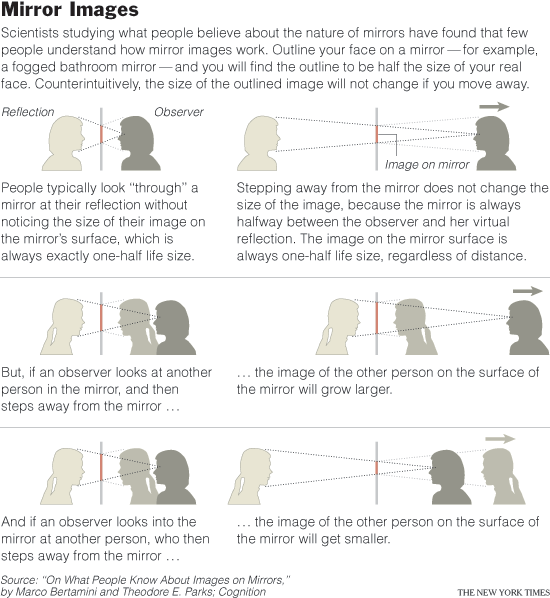
The New York Times has an article about mirrors, which had a few passages which blew me away. I think of mirrors as relatively simple entities, until they get curved and start flipping images upsidedown… depending on where you are looking at the mirror from. But no, mirrors are interesting as simple, flat creatures too:

In a series of studies, Dr. Bertamini and his colleagues have interviewed scores of people about what they think the mirror shows them. They have asked questions like, Imagine you are standing in front of a bathroom mirror; how big do you think the image of your face is on the surface? And what would happen to the size of that image if you were to step steadily backward, away from the glass?

People overwhelmingly give the same answers. To the first question they say, well, the outline of my face on the mirror would be pretty much the size of my face. As for the second question, that’s obvious: if I move away from the mirror, the size of my image will shrink with each step.

Both answers, it turns out, are wrong. Outline your face on a mirror, and you will find it to be exactly half the size of your real face. Step back as much as you please, and the size of that outlined oval will not change: it will remain half the size of your face (or half the size of whatever part of your body you are looking at), even as the background scene reflected in the mirror steadily changes. Importantly, this half-size rule does not apply to the image of someone else moving about the room. If you sit still by the mirror, and a friend approaches or moves away, the size of the person’s image in the mirror will grow or shrink as our innate sense says it should.

What is it about our reflected self that it plays by such counterintuitive rules? The important point is that no matter how close or far we are from the looking glass, the mirror is always halfway between our physical selves and our projected selves in the virtual world inside the mirror, and so the captured image in the mirror is half our true size.

Rebecca Lawson, who collaborates with Dr. Bertamini at the University of Liverpool, suggests imagining that you had an identical twin, that you were both six feet tall and that you were standing in a room with a movable partition between you. How tall would a window in the partition have to be to allow you to see all six feet of your twin?

The window needs to allow light from the top of your twin’s head and from the bottom of your twin’s feet to reach you, Dr. Lawson said. These two light sources start six feet apart and converge at your eye. If the partition is close to your twin, the upper and lower light points have just begun to converge, so the opening has to be nearly six feet tall to allow you a full-body view. If the partition is close to you, the light has nearly finished converging, so the window can be quite small. If the partition were halfway between you and your twin, the aperture would have to be — three feet tall. Optically, a mirror is similar, Dr. Lawson said, “except that instead of lighting coming from your twin directly through a window, you see yourself in the mirror with light from your head and your feet being reflected off the mirror into your eye.”

This is one partition whose position we cannot change. When we gaze into a mirror, we are all of us Narcissus, tethered eternally to our doppelgänger on the other side.

What a great thing to know… NYT graphic below:
Polar form of Laplace’s Equation

As you might know, this summer I’m prepping for the multivariable calculus course I’m teaching next year. When going through the textbook, I’m attempting some of the “challenging” problems near the end of the section.

Today, when refreshing myself with the chain rule, I came across a problem which tested my intuition. And I’m afraid I’ve lost what little intuitive mojo I had years ago. I’m going to reproduce the problem below.

Question:

Suppose that the equation z=f(x,y) is expressed in the polar form z=g(r,\theta) by making the substitution x=r \cos \theta and y=r\sin \theta.

  1. View r and \theta as functions of x and y and use implicit differentiation to show that:
    \frac{\partial r}{\partial x}=\cos\theta
    \frac{\partial \theta}{\partial x}=-\frac{\sin\theta}{r}
  2. View r and \theta as functions of x and y and use implicit differentiation to show that:
    \frac{\partial r}{\partial y}=\sin\theta
    \frac{\partial \theta}{\partial y}=\frac{\cos\theta}{r}
  3. Use the results in parts (1) and (2) to show that:
    \frac{\partial z}{\partial x}=\frac{\partial z}{\partial r}\cos \theta-\frac{1}{r}\frac{\partial z}{\partial \theta}\sin\theta
    \frac{\partial z}{\partial y}=\frac{\partial z}{\partial r}\cos \theta+\frac{1}{r}\frac{\partial z}{\partial \theta}\cos\theta
  4. Use the results in part (3) to show that:
    (\frac{\partial z}{\partial x})^2+(\frac{\partial z}{\partial y})^2=(\frac{\partial z}{\partial r})^2+\frac{1}{r^2}(\frac{\partial z}{\partial \theta})^2
  5.  Use the result in part (4) to show that if z=f(x,y) satisfies Laplace’s equation
    \frac{\partial^2 z}{\partial x^2}+\frac{\partial^2 z}{\partial y^2}=0
    then  z=g(r,\theta) satisfies the equation
    \frac{\partial^2 z}{\partial r^2}+\frac{1}{r^2}\frac{\partial^2 z}{\partial \theta^2}+\frac{1}{r}\frac{\partial z}{\partial r}=0
    and conversley. The latter equation is called the polar form of Laplace’s equation.
Here’s my issue. I can do parts (3)-(5) fine. But I got stumped for a good 15 minutes on the parts (1) and (2) and I’m sad about it.
So my lament is: wow, I suck.
And my question is: is there an easier way to solve this?
My solution is the following:
We know y=r\sin\theta, so differentiating with respect to x we get
(1) 0=\frac{\partial r}{\partial x}\sin\theta+\frac{\partial \theta}{\partial x}r\cos\theta
We know x=r\cos\theta, so differentiation with respect to x we get
(2) 1=\frac{\partial r}{\partial x}\cos \theta-\frac{\partial \theta}{\partial x}r\sin\theta
We now have a system of two equations, which we can solve for \frac{\partial r}{\partial x} and \frac{\partial \theta}{\partial x}. Going through the motion yields the right answer.
So yeah, looking back, its all makes sense. And I feel sheepish for posting this, because this is pretty easy to do. But it doesn’t seem simple. There is a part which calls for intuition: to know that we have to get two equations and then solve them together. I’m guessing there’s an easier way to do this, that doesn’t involve solving a system of equations. Is there?

Earthquakes, Richter Scale, and Logarithms

Today there was an Earthquake in Southern California. A NYT article said:

The quake, estimated at 5.4 magnitude (reduced from an initial estimate of 5.8), was centered 35 east of downtown Los Angeles in Chino Hills, just south of Pomona in San Bernardino county. It was felt as far east as Las Vegas and as far south as San Diego.

My first reaction, a question: how much of a difference was there in terms of the seismic energy released at the epicenter of the estimated earthquake versus the actual earthquake? How off was the esimate? I know that the Richter Scale is logarithmic, so the answer would be:

\frac{Magnitude_{Estimated}}{Magnitude_{Actual}}=\frac{10^{5.8}}{10^{5.4}}=10^{0.4}=2.51

The estimate was over 2.5 times off.

But I realized: I know very little about the Richter Scale and how earthquakes are actually measured. How could an initial estimate be so wrong? I’m going to use this post to explain what little I’ve pieced together from the internet.

Jump on below!

(more…)

Integration as Accumulation

I was downloading something yesterday and noticed that my downloading program tells me the download speed, and it updates it every half second or so. It also tells me how much of the file I’ve downloaded, total (e.g. 29.6 MB out of 64 MB, 46.3% completed).

This is a perfect example of integration as accumulation! The integral gives you the total amount of the file the program has downloaded. The graph above — created by a bittorrent program called \mu-torrent — creates a graph of the download speed over time. [1]

This actually would be a great way to have students come up with the conceptual idea of Riemann sums themselves: given a thousand data points, collected every half-second, of the download speed, what would be a good way to figure out how much has been downloaded. How would you estimate it?

And you could extend it to say: if you wanted a quicker but less accurate way to come up with how much has been downloaded, how would you do that? Students might say, “take every fifth data point” or “average every five data points” or come up with some other interesting method!

Or you could ask if there is a more accurate way to come up with how much has been downloaded. And there’s a good chance, with some requisite prompting and asking the right questions, that they could come up with the Trapezoidal Rule. And then you could segue into Simpson’s Rule.

Note: I know, I know, you could do the same thing with a speed v. time graph (giving you distance), or any other number of graphs. But I like this. It comes naturally out of things we do everyday!

[1] I cribbed this from here.


