A High School Math-Science Journal

In my first year of teaching, fresh from my haze from history grad school, I remember approaching the history and English department chairs about creating a high school level journal for those subjects. I mean, our school has a literary magazine, and also even a publication for works in foreign languages (seriously!). But nothing for amazing critical analyses and interpretations in English and history. I figured having something like this might encourage students to revise already excellent work for publication, and also make the audience of their paper be an audience of more than one. I even contacted the literary magazine student editors to see if they would feel like the journal would encroach on their domain (they said no). For reasons that are still quite beyond my understanding (because I still think it’s an amazing idea), both department heads rebuffed my idea. (Also, if they said yes, they would have gotten an enthusiastic first year teacher who would have taken on all this work!)

And so, I let this idea pass. One of many that I have, think are awesome, and then languish and die, either due to my own laziness or due to external circumstances beyond my control.

Until last year. When I was thinking: I’m a math teacher. Why not start a math and science journal? It’s so obvious that I don’t know why the idea didn’t hit me over the head years ago. So I found a science teacher compatriot who I knew would be interested, and we came up with an initial plan. And at the end of last year, we presented it to some students who we thought might have been interested (as this was something that is something that has to be for them, by them… if they don’t want it, there’s not point in doing it… it’s not about us…). They were, and we were officially off to the races.

We shared with the students the following document we made, with a brief outline of one vision for the journal. But with the understanding that this was their thing so their ideas reign supreme. This was, in some sense, a mock-up that the science teacher and I made to show them one possibility. The one thing that the science teacher and I were really aiming for in our mock-up was that the journal shouldn’t just be for superstar students. We wanted to come up with an journal that has a low barrier of entry for students submitting to the journal, and that if a student has interest or a passion for math or science, that’s really all they need to get started. To do this, original and deep research wasn’t really the primary focus of the journal. So here’s our brief proposal:

The additional benefit of having this journal is hopefully it will cause curricular changes. Teachers will hopefully feel moved to create assignments that go “outside of the box” — and that could result in things being submitted. Students who express an interest in some math-y or science-y idea (like why is 0/0 undefined… something that came up in calculus this week) could have a teacher say “hey, that’s great… why don’t you look it up and do a 3 minute presentation on what you find tomorrow?” … and if they do a good job, encourage them to write it up for the journal. Or a teacher might assign a group project on nuclear disasters, and encourages the students who do extraordinary work to submit their project to the journal. (Which can be showcased by teachers the following year!) Or a student who notices a neat pattern, or comes up with an innovative explanation for something, or who wants to try to create their own sudoku puzzle, or decides to research fractions that satisfy \frac{1}{a}+\frac{1}{b}=\frac{2}{a+b}. Or whatever. Knowing there is a publication you can direct the student to, as a way to say “hey, you’re doing something awesome… seriously… so awesome I think you kind of have to share it with others!” is going to be so cool for teachers. (As a random aside, I was thinking I could enlist the help of the art and photography teachers, because of the overlap between math and art… They might make an assignment based around something mathematical/geometrical, which students can submit…)

I honestly have no idea how this is going to turn out. What’s going to happen. How the word is going to get out. If anything will be submitted. If kids get excited about it. Lots of questions. But I have a deep feeling that the answers will come and good things are going to happen with this.

I’m soliciting in the comments any thoughts you might have about this. If your school does a math journal, a science journal, or a math-science journal, what does it look like? What works and what doesn’t? Do you have a website/sample we could look at? If you don’t have one, and you are inspired and think of awesome things kids could put in there (e.g. kids submitting their own puzzles! kids writing book reviews of popular math/science books, or biographies of mathematicians/scientists! getting kids to create photographs or computer images of science or data visualization or just making geometrical graphing designs! trust me — brainstorming this is super fun!) I’d love to share any and all ideas with the kids involved with this project at my school.

Math Blogging Initiation: A Final Roundup

(A quick starting note: the mentor blogs and their posts featuring these math bloggers, along with all the prompts for blogposts, are archived here.)

I’m ready to declare the Math Blogging Initiation a success.

How do I know? In week 4, when people were submitting their posts, I asked “”Have you gotten anything out of this experience? If so, what is/are the things you took away?” The responses blew me away (some of my favorites in red):

Yes, I’ve learned more about Modeling, SBG, and gotten dozens of lesson ideas–all that in only 3 weeks or so!!

I have been paying more attention to what math teachers are blogging about. In these blogs I have gotten many great ideas that I’ve already used with success in my class. I feel like the teachers at my school are great teachers, but we all pretty much do the same things. It’s rejuvenating to get new fresh ideas that work. I’ve also enjoyed being able to share my thoughts, it helps me to reflect expand what I’m doing.

It helps to know you are not the only one beginning this practice. You have connected us to each other. Thank you!

I received an email comment from a person who found my Week Two post about the Beat the Teach game.  Not only did they used to live near where I currently teach, they had been looking for a long time to find the game I had posted about and were excited to find it on my blog. I found it very rewarding to receive that feedback, especially hearing that I was not the only teacher out there who enjoyed the game I posted about.

There is so much to learn from the online community!

This has been awesome! Thank you for all the time and effort you put into it!! I’ve rediscovered my love of writing and experienced how fulfilling it is to share my thoughts with others. :)

I took away a lot of ideas, the kindness of strangers, and the feeling that I might still be useful in the world. Biggest idea? It doesn’t matter if anyone reads the blog or not. Sometimes it’s just a relief to write and post.

Guilty! I skipped week 3 due to classroom set up and first week trainings. :)  The writing prompts have been great. Thanks!

Most definitely. Some things: Best PD ever. Asynchronous and free. Desmos. Blogging greats take time for others. There are wonderful math teachers out there. A world of connectedness that the uninitiated hardly know about. And I’m basically shy and have to get over that, so I can be a part.

I am definitely a blogger now.  Every time I write a post, I’m thinking about new things and then I get awesome feedback in the comments as well.  Thanks for making me do this.

Motivation for one.  I’ve been thinking about blogging for a few months now and when the this started I knew it was now or never. Also, blogging is a great reflective practice, even if nobody else ever reads my posts.  I’m seeing that more now. Thanks again!

I’ve learned about some pretty sweet other math teacher blogs. It’s great to see what other folks are up to.

Your prompts have made me look deeply at my beliefs about teaching and learning, so, yeah, I’d say I got something out of this experience. Thanks.

I have learned so much from all the math bloggers out there. Everyone has such interesting and valuable approaches as well as perspectives. I look forward to my growth by being part of this sharing community.

Thank you so much for jump-starting this for me! I have found a voice that I did not realize I had, and realize even if no body reads, writing is theraputic. I hope I can contribute to this world I have been lurking in for the past few years!

The prompts that you have given us have been so useful, and this experience has really helped me start my blogging journey!

My brain is on overdrive and this makes me very happy! The community of mathematical enthusiasts (and my attempt to get myself noticed by them) is definitely the best part of this project for me. I have made a few G1 buddies on Twitter, and a few G2 buddies through reading their blogs and/or them reading mine. I’ve found some ideas I’ve been able to use directly in my classroom, such as INB’s and foldables, and a cool poster or two. It’s really validating to have people you’ve never met read your blog, comment on it, refer to one of your posts on their blog (and tell others to check it out), and perhaps most amazing of all, to have someone add your blog to their blogroll. Wow! Boy, do I want to be able to make #TMC13!

I got over (or mostly over?) my hesitance to blog – and I even commented! I’ve been a long time lurker, and it’s so nice to feel more like a contributing member of this amazing society of educators!

Yes…I probably would have abandoned the whole thing once I was sick, but I kept going so that I could get the 4th one in on time!

Writing is therapeutic.

Absolutely. It’s nice to feel like you’re not the ONLY one reading your posts. Lol.

He pushed me to write when otherwise I would have felt too busy to do so. And it’s gotten me in touch with some other teachers in the mathblogotwittersphere. I’ve learned so much over the past six months or so by using twitter and reading blogs. It has been a great experience.

I thought deeper about how to deal with a misconception.

A small school like mine doesn’t provide for a lot of interdepartmental, professional discourse. Being in touch with other math teachers through the blogging world is a huge help in my ongoing efforts to become a better teacher

I teach one section of language arts so I appreciate how writing clarifies one’s thinking. Blogging forces reflection and doing it weekly “”forces”” me to reflect on my practice. Also, the feedback I’ve received has been incredible. Even if no one reads and responds, a blog is like an open journal and I’m leaving a small footprint.

Courage! I felt so encouraged and welcomed to join the online community and I know that my teaching will only continue to improve since I joined and am now sharing in these valuable conversations.

Yes, four weeks in a row of regular posts.  I hope I can keep the motivation to continue posted about once a week or so.

That producing a post feels really good. That writing for an audience, even if largely imaginary (put potentially real and willing to give feedback!) is more satisfying and more constructive than writing purely as a private reflection. The accountability factor is immense. And the looming sense of possible connection with other mathteachers is really appealing.

I am so happy. I love feeling free to geek out and talk about what I do and read that others want to talk about curriculum and teaching.

The post that I shared was not supposed to be my post for Week #4! I wrote (and published) a different, mopey post.

The reflection that the public mope entailed, and the feedback I received, inspired me to get my act together, and try something new. I reflect on the something-new in the post that I submitted. Feeling so much better!

I really enjoyed reading comments on my blog…it is just a little booster for me :)

Just happy to join the community.

I really appreciated have the step by step instructions on the software needed to do this. I feel that I am off to a good start. Thank you so much!!!

Thanks for giving me a reason to blog.  Seriously.  I think about blogging now, something I’ve never done before.  I crave page views.

I want to continue doing this. I think for the most part, it has made me even more connected than I was. I have been reading blogs for a while, but I never participated. I guess I want to become a part of the community in math blogging and twitter (i know there is a name), so I am just trying to find my place within that.

I just have found so many other blogs to follow and connect with. I also have recieved a few more followers of my own. This is exactly what I wanted-to expand my connections to become more a part of this math education community.

Yes! Even though I’ve only blogged 3 times, I feel more reflective about my day to day teaching. I often think about things I would blog about, how I would say them, etc., even if I don’t actually end up blogging about them. I like the prompts, and I hope to keep using them in the future. I also feel more comfortable writing for myself and not just for readership.

Sometimes you write something you are super proud of and like 3 people read it. Sometimes you write something random and for some reason bunches of people read it. It’s hard not to be disappointed about one and excited about the other, but in the long run it is just important to write.

Well the prompts and a deadline kept me blogging when I probably would have quit after the school year started. And subscribing to the rss feed has immersed me in so many interesting ideas and thoughts about teaching math. It is like one great big PLC that I love being a part of.

Finally joining in the conversation, the fantastic conversations that you guys have all the time and I was just watching from the wings.  I look forward to contributing throughout the year and hopefully gaining some readers!

A jumpstart on exposure – some motivation to post once a week (which is my goal)

Well,  I am not teaching this year which feels strange.  I truly enjoy blogging and I have thought about blogging about other things, but then I am consumed with questions.  Should I blog about other things on my math blog?  Should I start another blog?  Is it worth the time?  I am surprised how much I enjoyed blogging but how long it takes me!

I am taking with me, the joy of blogging.

Think “outside the box” every once in awhile when it comes to forming blog post ideas.

This initiation really got me posting a lot, and reading more than ever! I love seeing what everyone else is doing in their classrooms and for their students.

The Blogger Initiation was a great way to get introduced to the mathtwitterblogosphere.  It would have taken a lot of effort to establish this many connections on my own.  Thanks so much for all of your hard work.  Already, I have connected with potential collaborators, and am closer to my goal of producing something that will be useful to all of us.

I have “met” a lot of different people and started creating my online PLN. I have already seen so many awesome ideas and I’m and pushing myself to be a better, more creative teacher.

I feel like I’m part of an awesome community now. Thanks for running this!

I’ve met many more second year teachers who also teach algebra 1 and 2. I’m not the only one, and that has helped me. The feedback from people’s comments has also been really useful.

Additionally, week after week, in my “Anything else” box on the page when participants submit their posts, there were continuously really positive comments. I should probably copy some of them here, because they made me MELT,  but I’ll just let you trust me so I don’t have to dig around for them!

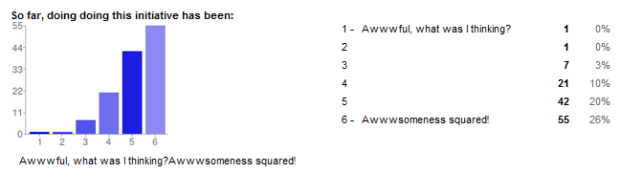
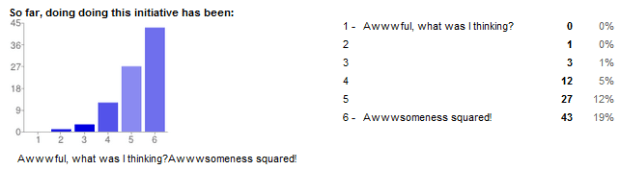
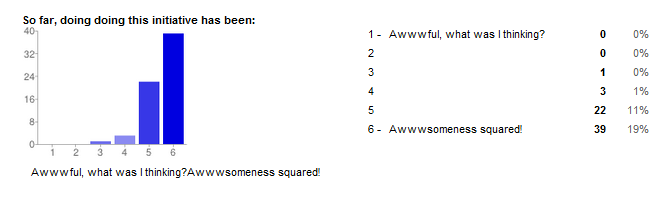
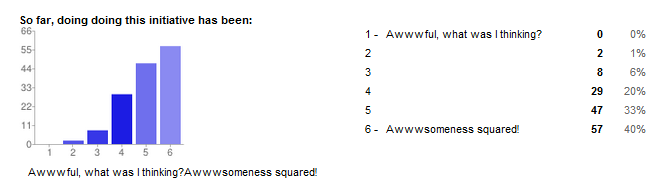
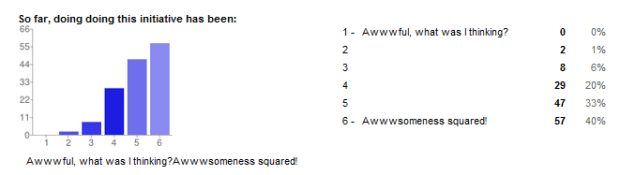
Also, I asked what doing the initiation has been like. The responses of those who made it to week 4:

And if those who submitted to week 4 would continue blogging:
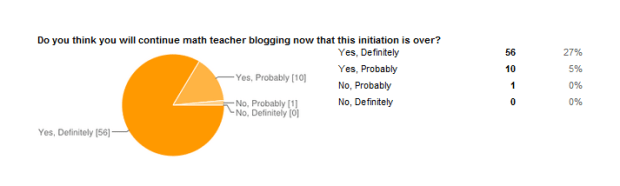
For those who made it to week 4, A+. Double unicorn rainbow points for you!

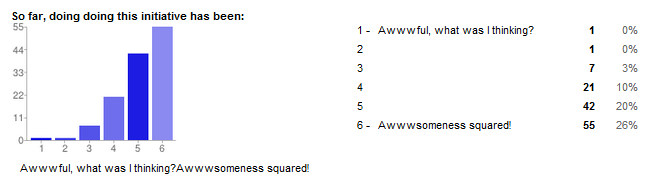
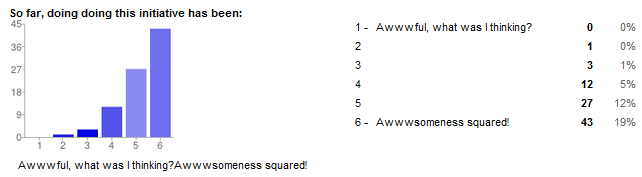
PS. Stats from Week 1, Week 2, and Week 3 below:
]

Counting Without Counting: An Introduction

On the second day of Precalculus class, before embarking on our starting unit on Combinations and Permutations, I put students in groups and had them work on this packet. I’m including it below with my teacher notes in the margin, and also without my teacher notes in the margin:

(Also the .docx file so you can modify, cut, paste, hack apart! To see with teacher notes, go to the “Review” tab and click on “Final: Show Markup” and to see it without teacher notes, click on “Final.”)

This was a two day activity, with the groups working together, and every so often, I would stop and we would go over some of the problems. Some problems were assigned for nightly homework, and because of time issues, I had to cut out the Applebee’s problem completely. I’m quite proud of some of the problems… namely the Applebee’s problems, the bit.ly / QR code problems, and the Mozart’s Minuet problem (largely taken from here, and modified with some extensions).

The goal of the packet was fourfold:

1) I wanted problems which promoted thinking, conversation, etc., before students were introduced to formulas, notation, etc.

2) I wanted students to understand that “counting without counting” means that instead of listing all possibilities and counting, there are often other faster ways to get answers. This is the essential understanding that I would hope for in any unit on combinations and permutations. In order to do this, students will need to organize your information in some special, logical way. Usually this requires students to multiply numbers. But students need to really understand why multiplication (rather than another operation, like addition).

3) I wanted students to work in groups, so the problems were designed to be conducive for groupwork.

4) I wanted students to get some sense of what huge numbers mean.

How did it work? Overall, I think it worked pretty well. I gave groups “hint tokens” and most didn’t rely on them for a hint. Most students were able to see that you have to multiply for most of the problems, but most had trouble explaining why. Finally, most had never seen a tree diagram. In the future, I honestly think having students draw a complete tree diagram and explain what each leaf means would be useful. Adding two questions like the following would help:

1. If you have the letters A, B, C, D, E, and F and you want to write a three letter code and you are allowed repetition, what would the tree diagram look like. Make all the branches. Then pick a single “leaf” of the tree and explain what that leaf means.

2. If you have the letters A, B, C, D, E, and F and you want to write a three letter code and you are not allowed repetition, what would the tree diagram look like. Make all the branches. Then pick a single “leaf” of the tree and explain what that leaf means.

The reason I say this is that I’ve been collecting homework problems, and the tree diagrams some of the kids are constructing are just nonsense.

I probably should write more about this, but I’m exhausted and all I want to do is sleep. (I’ve been sick since Monday.) I suppose I should end adding that I’m teaching a Precalculus Advanced class. I don’t think I would have these problems for a standard Precalculus class… I would use fewer of them, and I would scaffold them more, and build in more “listing” of things, rather than go straight into “how many different ways…?”

Round Up of Week Four of the Math Blogging Initiation

We’re at the end. It’s been four weeks — hectic for all of us at the start of the year — and now the Math Blogging Initiation is over.


Even though I have never played the game Portal and this song
doesn't match up with this, it does come at the end of the game...
and I love it. So there you go.

Some of us did all four weeks, some did just a few. And honestly, if you tried it and found out it was not for you, that’s important and you wouldn’t have known it otherwise. (There are lots of professional development things that aren’t for me.) So thanks for keeping an open mind! And if you tried it and decided it was for you: egg-celent.

For those of you who want to continue, some unsolicited advice:

1. You don’t need to blog every week. This was just a “boot camp” to get started! Sometimes I blog twice in a day and then go a couple of weeks with nothing. Normally it has to do with how much free time I have. Blog when you feel like it, blog for yourself, don’t rely on having commenters/readers. There’s something super valuable about codifying and archiving your thoughts about a worksheet, a lesson, etc.

2. Have fun with it, and let it push you as a teacher. One of the things I started realizing was that having a blog not only let me archive and reflect upon stuff, but it also made me want to take risks. I wanted to try out things I was scared to do (whether it be not grading homework, employing Standards Based Grading, including more regular groupwork in classes, etc.) because they were new. (“Why try something new when what I’m doing works pretty well?”) But knowing I have a blog to write about these things made me feel more excited about trying them (even when they didn’t work out perfectly)… I got excited to share what I was doing. It’s like we’re in a laboratory with experiments always in progress… and we each year experiment and refine and experiment and refine. Your blog can be like your lab notebook.

Finally: THANK YOU. THANK YOU. THANK YOU. It was on a lark that we decided to do this. It was a little haphazard I know. (One example of it: I tried to email all y’all that signed up, and no matter what I tried to do, the internet thought I was a spammer. That was two hours down the drain until @jreulbach stepped in to save me!) But you guys don’t even know how much this has exceeded our wildest expectations. We expected 20, maybe 30, responses, and this became something much bigger. This is all because of you. So THANK YOU. For being awesome. For taking risks. For engaging. It’s been a pleasure.

This final week we had 66 bloggers.

Now without further ado, week four bloggers.

Aaron C | Random Teaching Tangents

Aaron C. @CarpGoesMoo has a blog named Random Teaching Tangents. The fourth post for the Blogging Initiation is titled “New Blogger Initiation 4” and the author sums it up as follows: “Algebra 2 isn’t random … it’s structures (sets, matrices, vectors, etc.) and relationships (properties/identities, graphs, functions, etc.)” A memorable quotation from the post is: **(by the way, obvious is an extremely dangerous word in mathematics – I personally detest it almost as much as variations upon “the proof is left as an exercise for the reader” – thanks scumbag mathematics PhD).”

My Response: Aaron is talking about something I’ve been struggling with since I started teaching. Five years ago I started teaching Algebra II and like him, I quickly abandoned the book. But the thing that I wasn’t able to do well is come up with a common theme that could tie the class together — for me and for the kids. Aaron has an idea that could be the common reference points: structure and relationship. And building a course with those themes in mind appears, to me anyway, like it could be successful. I think the key to this is to explicitly COMPARE and CONTRAST various structures and relationships. That’s a way to tie disparate topics together.

Lisa Nussdorfer | Reflections of a Learner

Lisa Nussdorfer @nussder has a blog named Reflections of a Learner. The fourth post for the Blogging Initiation is titled “Multiplication, Take Two” and the author sums it up as follows: “I am expanding on Hard Enough Problem’s blog about visual multiplication and reflecting on my experience learning other methods of multiplication as an adult.” A memorable quotation from the post is: “I specifically remember that it was the FIRST time I had seen alternative multiplication methods in my mathematical existence.”

My Response: Lisa talks about how we tend to only remember/do one type of multiplication, but if you look a little deeper, there are tons of ways to multiply integer numbers together! And she also notes (as I have experienced) if you learn only one way, it’s hard to use another way. But precisely that’s the key to why learning other multiplication methods is important: it forces us to think about why they work. And that gets down to the underlying structure of mathematics (and what’s going on). I personally think asking a middle or high school kid who loves mathematics why the “lattice method” for multiplication works would lead to a great “a ha” moment! (We did this in math club a year or two ago!)

Kelly Berg | The M Stands for Math

Kelly Berg @kmbergie has a blog named The M Stands for Math. The fourth post for the Blogging Initiation is titled “I can’t even watch TV without thinking about school” and the author sums it up as follows: “This metaphor just hit me about teaching. It has nothing to do with math specifically, just about teaching in general. If you could classify your classroom as a TV show, which kind would it be?” A memorable quotation from the post is: “I need to interest them to come back after the commercials, keep them guessing as to how the story ends, and invite them back for more. Each day.”

My Response: Kelly has an awesome analogy to the classroom, which really resonates to me because I love love love LOVE TV. A class is about as long as an hour long TV show. How do we stay wrapped up in a TV show so long? Can we capitalize on that for our classrooms? 

Cindy W | findingEMU

Cindy W @finding_EMU has a blog named findingEMU. The fourth post for the Blogging Initiation is titled “msSunFun: Musical Math Partners” and the author sums it up as follows: “Well, I think I definitely cheated on this one. “Write about anything” gave me an “out” to use my game post from msSunFun this week. The description of the “game” is followed by a multitude (especially if people share more ideas in the comments section) of possible variations!” A memorable quotation from the post is: “It is quite flexible, gets kids out of their seats, and gives students an opportunity to use mental math skills”

My Response: Cindy has a great idea for a large, well-behaved middle school class! If you train the kids early on on how to play it respectfully (I can see some pushing happening if you don’t!), I think it could be a really fun and active way to engage kids. I don’t play a lot of “games” in my classroom (I see games as good for review, but I don’t have a lot of time built into my planbook for review at the high school level, except on super challenging topics), but if I did games, this is one I would put in my back pocket.

Andrew Knauft | Limsoup

Andrew Knauft @aknauft has a blog named Limsoup. The fourth post for the Blogging Initiation is titled “NBI Week 4 — Finding a Polynomial” and the author sums it up as follows: “I walk through my favorite method for finding a polynomial passing through a collection of points, with a brief interlude into my view on how many answers math problems have, and a fun clincher involving a special type of polynomaial.” A memorable quotation from the post is: “I realized today that for years I’ve been thinking “I like math because there is only one answer to every problem” — but that’s entirely untrue!”

My Response: Andrew presents a simple polynomial problem which has many solutions, and many ways of approaching the problem. He starts out the post by talking about how he used to like math because it only had one answer. But that’s not always true, and he’s enjoying the… and this is my words… creativity and generalizations and extensions of problems with more than one solution. I want kids to see kids the CREATIVITY in mathematics — as I think creativity and structural elegance goes to the heart of mathematics. I suspect, by this post, that Andrew would agree.

Tyler Borek | Real Problems

Tyler Borek @opusproblems has a blog named Real Problems. The fourth post for the Blogging Initiation is titled “Digesting “The Exeter Series”” and the author sums it up as follows: “My post is about Exeter’s math curriculum (discovered via Glenn Waddell). Exeter has an interesting take on math curriculum. They have my attention.” A memorable quotation from the post is: “Caveats aside, I think that Exeter’s curriculum is a masterpiece, and – as with many masterpieces – it sets itself apart by looking at a situation in a different way.”

My Response: Tyler is taken by the Exeter math curriculum. I too am taken by it. The two defining features of it (that Tyler notes) is that the course isn’t divided into discrete topics (no “quadratics, followed by polynomials, followed by matrices”), and that problems precede concepts. You do problems, and they build up beautifully, until you can generalize to a mathematical truism. (One example is in their Math 3 curriculum where they show where the 1/3 comes from in the formula for the volume of a pyramid.) I also have thought of how it could be used in a school that isn’t Exeter, and I have my doubts. So I’m interested to see how it has been wholesale implemented, or adapted in interesting ways, in “normal” schools.

Stephanie Macsata | High Heels in the High School

Stephanie Macsata @MsMac622 has a blog named High Heels in the High School. The fourth post for the Blogging Initiation is titled “My First Foldable” and the author sums it up as follows: “I wanted to try making a foldable and this post goes with me through the process.” A memorable quotation from the post is: “I feel like the more I create the easier it will be aaaaaaand my mind will just start thinking “in foldables” haha.”

My Response: Stephanie presents her first foldable, on slope. YES! I have heard a lot about foldables, and I meant to design some this summer but didn’t. But Stephanie has inspired me with an idea for my first foldable. It will be for precalculus. We’re learning about combinations/permutations right now. I’m going to have a foldable which has kids understand/categorize the difference between _nP_r, _nC_r, n!, and n^r (all arise in different types of problems). Thanks for reminding me I wanted to do a foldable too!
Jeff Brenneman | Trust Me – I’m a Math Teacher

Jeff Brenneman @brennemania has a blog named Trust Me – I’m a Math Teacher. The fourth post for the Blogging Initiation is titled “A Not-At-All Comprehensive Review of Socrative” and the author sums it up as follows: “A few weeks ago, I was introduced to this awesome student clicker software called Socrative. Here, I discuss how it can be used in the classroom to inform a data-driven instructional practice through formative assessment.” A memorable quotation from the post is: “That’s not to say that questions about ninjas and ice cream aren’t important, BECAUSE THEY ARE.”

My Response: Jeff reviews (positively) Socrative. I first heard about this site this summer, and I can see myself training my class to use it for an exit task. That way I don’t have to deal with lots of slips of paper. 

Haydee C. | MathyMissC

Haydee C. @mathymissc has a blog named MathyMissC. The fourth post for the Blogging Initiation is titled “Classroom Engagement?” and the author sums it up as follows: “This was a short post about giving classroom engagement a grade. What are the observable behaviors and how would they be graded? I ask more questions than actually provide answers.” A memorable quotation from the post is: “The obvious question is what do you mean by classroom engagement?”

My Response: Haydee is grappling with a question I have been grappling with: classroom engagement. I first used the term participation, then generalized it to classroom engagement. But she asks the questions: how do we assess it? If you can’t give feedback and have students improve, then it’s a fake grade. Something you arbitrarily decide. So this year in precalculus I have made “classroom engagement” part of my grade, but I am (on the fly) trying to come up with concrete ways to assess it. It’s going to be an interesting process, and I’ll see if I can’t come up with anything useful to share. 

Update: Posts featuring all the others bloggers participating in the fourth week of the Math Blogging Initiation:
Julie, Fawn, Anne, Megan, Bowman, Sam, Lisa, John, Shelli, Tina, Kate, Sue

Round Up of Week Three of the Math Blogging Initiation

We’re getting close to the end. This is week three of the Math Blogging Initiation. And although most of us featuring the new bloggers have 7 or 8 people to showcase, this week I only have 5. I anticipated a few extra late bloggers, but they didn’t show up! Overall, this week we had a little less than 90 bloggers! You guys are like the little engines that could, especially considering that by now, everyone has started school. This is possibly the most stressful time to do something like this, but you guys are killing it! I’m so impressed with all y’all.

Without further ado:

Haydee C  | MathyMissC

Haydee C  @mathymissc has a blog named MathyMissC. The third post for the Blogging Initiation is titled “Math Autobiography” and the author sums it up as follows: “I usually give people one of two answers whenever I am asked why I became a teacher. There’s a short and long version. Pick one!” A memorable quotation from the post is: “I knew a career that involved numbers and working with people would be the perfect job for me.”

My Reaction: I love this post precisely because Haydee’s trajetory to becoming a teacher was so different than mine. Not that we both didn’t have excellent teachers, but she wasn’t a math-lover at first. And so to read the story of someone who had such drive in a different direction at an early age, and who was so affected by one particular teacher who put her on the path to becoming a teacher… well, it was a pleasure to read about. 

Tim Reinheimer | Asymptotically Cool

Tim Reinheimer @timreinheimer has a blog named Asymptotically Cool. The third post for the Blogging Initiation is titled “Misconceptions” and the author sums it up as follows: “Using whole number substitution to dispel the algebraic misconceptions.” A memorable quotation from the post is: “I have found that I like to use whole number substitution to dispel the certain misconceptions.”

My Reaction: Tim notices, as I’m sure we all have, that our kids learn mechanical rules without any understanding of why they work. His solution: just have students plug in numbers to see that it doesn’t work. Personally, I think that’s a great way to start working on these misconceptions. To take this further, this post has gotten me wondering… I wonder if there isn’t a way to dig deeper, to remediate the misconception instead of just showing that their mechanical process doesn’t work. Digging into why they think it works, why it doesn’t work, and finding a way to make that stick with them? It’s well and good to say “look this doesn’t work” but harder to say “this is why” and also “this is what does work, and this is why.” I think some sort of brain laser will do the trick. Tim, you on this brain laser?

Tyler Borek | RealProblems

Tyler Borek @tyler_borek has a blog named RealProblems. The third post for the Blogging Initiation is titled “Responding to a Lament” and the author sums it up as follows: “My post is a response to A Mathematician’s Lament by Paul Lockhart. I explore whether or not Lockhart is too heavily biased towards pure mathematics, and what a more equitable treatment of pure and applied mathematics might look like. Whether or not you read my post, I recommend Lockhart’s “Lament.”” A memorable quotation from the post is: “It may be that the majority of people who are willing to endure the long haul in mathematics will be the ones that Lockhart describes – those with an appreciation for simple problems.”

My Reaction: A cogent, thoughtful, and convincing critique (not tear-down, though) of Lockhart’s Lament. I was inspired by this document when I first read it a number of years ago (and although he teaches literally next door to my school, I have never met him). However, the author reminds me of something that I’ve noticed in my classes. I am someone who tends to eschew the “applied” nature of math and instead focuses more on the organization and elegance and puzzle-y nature of things. Because that’s what appeals to me. But many of my kids, so many of them, really respond to the applied stuff… even if I see it as loosely applied or even fake-ly applied. Like our “can optimization” project in calculus… Many kids really dug that project, even though it felt pretty forced/fake to me. They see it as real. And so I have to remember to not always eschew the applied, because just because it didn’t speak to me when I was a student doesn’t mean it won’t speak to any student. I’ve sen the contrary. 

David Price | Compact Spaces

David Price @compactspaces has a blog named Compact Spaces. The third post for the Blogging Initiation is titled “Algebra II and Precalculus are a hodgepodge of ideas” and the author sums it up as follows: “In this post I try to work through some of my thoughts on unifying themes of Algebra II. One distinction I try to make is that between very deep ideas in Algebra that might be hinted at and thought processes that are strengthened on a regular basis in a good Algebra II class. ” A memorable quotation from the post is: “Another issue is that advanced high school mathematics, even more than Algebra I, is like an underwater mountain range in that on the surface it appears disconnected.”

My Reaction: First off, I love the picture. Makes me long for summer vacation again. But seriously, I think that David has a plan of action for Algebra II. He’s teased out what the “core ideas” are for the course, for him, and these are the ideas he wants students to take away. Instead of being topics, they are actions… ways of dealing with problems. And I love that. The process is fundamental, and the result is incidental. This almost makes me feel sad I’m not teaching Algebra II this year!

Valerie Higgins | Crafty Math

Valerie Higgins has a blog named Crafty Math. The third post for the Blogging Initiation is titled “Miss Higgins, why are you a math teacher?” and the author sums it up as follows: “This post is a collection of the varying answers I’ve given when asked why I decided to be a teacher, or why I like math.” A memorable quotation from the post is: “I knew I wouldn’t be happy doing anything else.”

My Reaction: My honest initial reaction was “surprise!” because Valerie spoke about how she saw teaching kids math as a religious calling… and I’m not religious and nor are most of my teacher friends, so this wasn’t a response I had ever heard. But Valerie, because of seeing teaching as her calling, said something that moved me. She has the desire to see and cultivate her kids’s best selves. That’s a really lovely thought. I do hope that Valerie uses religion to shape her beliefs, but not part of the classroom, unless she teaches at a parochial school.

Posts featuring all the others bloggers participating in the third week of the Math Blogging Initiation:
Julie, Fawn, Anne, Megan, Bowman, Sam, Lisa, John, Shelli, Tina, Kate, Sue

Advice from Calculus Students Past, Informing the Calculus Student Present

I’ve done Standards Based Grading in Calculus for two years now. This is the start of my third year.

One of the things I have my kids do at the end of each school year (not just in calculus, but in all my classes) is to write a letter to themselves. But in the past. Yes, I tell kids to compose a letter that can be sent back into time, to them, at the beginning of the year. Things they wish they had known at the start of the year that they know now that it is the end of the year. And I let them know whatever they write is up to them, and that I don’t look at this until way into the summer. We seal them up.

I usually share these letters with kids the following year. When I do, I ask kids to think about commonalities they noticed in the advice from students, and also, if anything struck them. We have a conversation about that. I definitely emphasize that what works for one person might not work for another.

Without further ado, here is the advice that my 2011-2012 calculus kids wrote to their past selves, which I will be sharing with my 2012-2013 calculus kids.

To me, the major commonalities are… advice to do their homework even though it’s not graded, not to use reassessments as a crutch because it’s to your benefit to learn things the first time around, and to ask for help from colleagues and Mr. Shah.

With that, I’m out like a light.

A little bit crazy! And some goals!

So I’m feeling totally and utterly overwhelmed with the impending onset of school. I have tomorrow to keep working, and then we have three days of activities with our advisory (Wednesday, Thursday, Friday) and then starting next Monday we have the first day of classes.

File:The Scream.jpg

My anxiety level is at about a billion. On a scale of 1 to 10.

With the exception of my first year teaching, this is possibly the worst I have ever remembered it being. I think I wanted to post this to let any other teachers who are feeling this way (especially while seeing all the excitement and incredible first-day-activities abounding on the internets) know: it’s okay.

It’s okay.

At least… I think it is.  (Even Lisa has been in a funk.)

For me personally, my anxiety is coming from a few places:

1. the idea of teaching a bunch of new students, and having to develop a positive rapport with them from scratch again
2. teaching a class which is new to me (advanced precalculus) with very little supporting material
3. co-teaching/collaborating with two teachers, when I have never truly collaborated before
4. having a giant class of 19 (in my school, this is monstrous) and not knowing how I’m going to manage
5. being on supervision & evaluation cycle this year
6. anticipating the late nights every day after school, which will come out of having to write/create calculus reassessments, plan precalculus lesson plans and smartboards from scratch, and having to re-work lots of multivariable calculus homework problems since I haven’t taught the course in a year
7. mentoring a math teacher new to the school
8. starting up (with the help of another teacher) a math-science journal
9. not having any concrete goals set for the year, yet

I think the solution for my anxiety is to work a crazy amount (obviously, that will help). But also to set the bar low. Usually by now, I have two or three very concrete but “large” things I want to do this year. It’s stressing me out that I haven’t decided what they are. Maybe, though, this needs to be a year of stasis. While I’m working on a new course, maybe I need to be okay not doing anything dramatic.

Although not set in stone, perhaps my goals this year should be something as simple as:

(1) Be sure to provide formative feedback to kids in all my classes, at least once a week
(2) Really endeavor to use groupwork (and part and parcel of this, whiteboarding) in precalculus, and be sure to give feedback to groups at least once every two weeks so they have a record of their strengths and places they can improve.

These are weaknesses of mine, so they’ll bring me forward as a teacher. But aren’t so overwhelming in their scope as to feel impossible.

There’s a 50% chance that as I try to work out the beginning of classes this year, I will be posting a lot. And there’s a 50% chance is that I go a little crazy and have to hide for a few weeks while I get settled.

With that, night all!

PS. Since it feels weird to post without any equations, videos, documents, I am going to include this picture of me in front of a stained glass window at my school.