Round Up of Week Two of the Math Blogging Initiation

Hello all! Welcome to the round up of the second week of the math blogging initiation. Today I will be featuring 14 posts by math teacher bloggers — out of over 120 that participated this time ’round. Again, zowee!!!

As soon as the other bloggers have finished putting up their posts featuring the participants of the blogger initiation, I will include the links in this post. Apologies for the terse reactions. I am exhausted, and literally fell asleep while trying to read the posts and write my thoughts. Sorry!

Jasmine | Jazmath

Jasmine has a blog named Jazmath. The second post for the Blogging Initiation is titled “First Day” and the author sums it up as follows: “The first days of school are full of excitement and newness. Sometimes we forget about those terrible days when we just don’t want to go to school tomorrow. I am hoping to record what is going well now so that I can draw on that when things are tough later in the year.” A memorable quotation from the post is: “Yesterday was not one of those days where I question my qualifications to teach, but calculus class reminded me of those times. “

My Response: Without going into a disquisition as to why, there is a lot I have in common with the author of this post. Both teach at small independent schools with great faculties, we both teach calculus, and we both have high expectations for our kiddos. 

Evan Weinberg | gealgerobophysiculus

Evan Weinberg @emwdx has a blog named gealgerobophysiculus. The second post for the Blogging Initiation is titled “Flipping, Week 1: Stop the Blabbing” and the author sums it up as follows: “In addition to doing standards based grading, I’ve been trying to move all my direct instruction to two minute chunks of video that students watch in class. This is after I saw how effective this was in some courses I took from Udacity (http://www.udacity.com). Students aren’t sitting and listening for long, and I can quickly move to help students that understand the concepts quickly to move on to higher level tasks around the material. Those that need more time can get it, as well as ask questions and get help from me or other students.” A memorable quotation from the post is: “Moving to a more student-centered learning model though has made the students in charge of making sure they understand what they are learning.”

My Response: Regardless of your opinion on the flipped classroom, this is absolutely in my opinion required reading for all math teacher bloggers out there. High praise for a fantastic post. I wanted to underline every other line of it. Probably because the realizations in here are things that I’ve been slowly making in the five years I’ve been teaching… most are there!

Craig Ortner | Mr. Ortner

Craig Ortner cortner has a blog named Mr. Ortner. The second post for the Blogging Initiation is titled “… – the math part was less memorable.” and the author sums it up as follows: “A meta-rumination on one of the prompts.” A memorable quotation from the post is: “… – the math part was less memorable.”

My Response: I would be so happy if my kids remembered any math at their ten year reunion. Anything! 

Sarah Miller | Proof in the City

Sarah Miller has a blog named Proof in the City. The second post for the Blogging Initiation is titled “Upcoming Project I am Super Excited About” and the author sums it up as follows: “A brief summary of a project my kids will do soon, where they will perform an experiment to determine if two values have a linear relationship.” A memorable quotation from the post is: “I love that it will (hopefully) clarify and deeply define what “linear” is, in a way other than “it makes a line.””

My Response: Hello math-science collaborations! I love it! It’s so important and I wish we did more of it at my school. As for the question for things that are possibly linear, I seem to remember Kate Nowak had a post where she asked people for help coming up with things that form linear relationships, and got a zillion (or fifty) comments. I’m too exhausted to look it up, but I think with some searching good things will come up!

Mrs Crackers Math | Check Your Work

Mrs Crackers Math has a blog named Check Your Work. The second post for the Blogging Initiation is titled “On posting learning objectives…” and the author sums it up as follows: “In my new district (my first at a public school) my administrators and colleagues are very gung ho about posting learning objectives. I just can’t get excited about it and my blog post explains why.” A memorable quotation from the post is: “…that there objective is just plain icky.”

My Response: Here is an interesting question… is posting daily objectives too restrictive and “give away” the conclusions that the class is suppose to discover together? This is a great question that I’ve never thought of, but yes, maybe posting objectives is kinda icky. I don’t usually post them (I teach in many different rooms), but I always felt guilty. Now I feel like I’ve accidentally made a good decision all along.

Pippi | Pippi’s Adventures in Teaching

Pippi has a blog named Pippi’s Adventures in Teaching. The second post for the Blogging Initiation is titled “Learning” and the author sums it up as follows: “I have no illusions that my students need to know the details of physics in their everyday lives. Sure, physics can be applied to sports and driving and cell phones, but they’re right when they say that they can get through life perfectly well without knowing how. But I hope there are skills and, strangely enough, feelings from my class that they carry along with them for a long time.” A memorable quotation from the post is: “I hope she remembers what it feels like to look at a page that looks like gibberish one week, and the feeling of each word and symbol slowly coming into focus and making sense.”

My Response: Here are some nice bigger goals for a physics classroom, instead of content-only goals. 

haversine | Bowditch’s Apprentice

haversine has a blog named Bowditch’s Apprentice. The second post for the Blogging Initiation is titled “Playing Games in calculus” and the author sums it up as follows: “I found a paper-based game about identifying the rules needed to take derivatives of various expressions, and turned it into an interactive smartboard game. My students loved it!” A memorable quotation from the post is: “I quickly found that my students loved anything I could turn into a game.”

My Response: I pretty much use all of Maria Andersen’s calculus games. This is one I had somehow missed. But it’s great, for calculus!

Tofer Carlson | teachertofer

Tofer Carlson has a blog named teachertofer. The second post for the Blogging Initiation is titled “Hope for My Children*” and the author sums it up as follows: “This post is a response to an xkcd comic about our society’s habit of using one woman to stand in for her gender when completing tasks have been more commonly completed by men in the past.” A memorable quotation from the post is: “When I have children (*sometime in the not-so-near future), I hope identity comes easy, and gender-roles are anything but traditional–little girls catching snakes, before going to tap class and playing ice-hockey; or boys who learn to sew while building lego forts for their pirates to take back from Raggedy Ann.”

My Reaction: Gender and math classes is something I only started thinking about after my first year of teaching. But it was clear to me that, in my school at least, girls were more often playing “learned helplessness” while guys wouldn’t ask for extra help. I think one must be conscious of these things though it can be tough.

Tangent Vector | Tangent Vectors

Tangent Vector @TangentVectors has a blog named Tangent Vectors. The second post for the Blogging Initiation is titled “In 10 years…” and the author sums it up as follows: “In this post I pretend that I’m not egotistical and don’t care whether or not I’m remembered in 10 years. Fine, maybe I do care just a little–but in all honesty, the rational side of me believes every word I wrote.” A memorable quotation from the post is: “Frankly, if in 10 years my former students are well-functioning members of society–good citizens who exercise critical thought and aren’t hoodwinked by the many propaganda machines that seemingly grow in number, ferocity, and audacity each year–that would give me plenty of satisfaction.”

My Reaction: Okra as unpleasant? Come on now!

Kelly Berg | The M Stands for Math

Kelly Berg @kmbergie has a blog named The M Stands for Math. The second post for the Blogging Initiation is titled “Pick up the milk carton please” and the author sums it up as follows: “Quit complaining. Just do it.” A memorable quotation from the post is: “Complaining about the issues and doing nothing is like eating slimy okra.”

My Reaction: Kelly is going through a lot of changes right now. But one thing she knows is to not surround herself with negativity.

Ann Gorsuch | angorsuch

Ann Gorsuch @AnnGorsuch has a blog named anngorsuch. The second post for the Blogging Initiation is titled “Random Tidbits” and the author sums it up as follows: “Does anyone have recommendations for good blogs, RSS feeds, or websites that I can add to my Zite magazine and google reader? Also, anyone with me on feeling under-prepared to differentiate and accommodate students with special needs? What should I do? Lastly, if you like racing, check out my Triathlon problem that has students solving systems of equations.” A memorable quotation from the post is: “Nothing re-inspires me more than reading a few good articles on my Zite or google reader.”

My Response: I don’t know about this Zite magazine thing (haven’t used it before), but I should definitely check it out someday soon.

loveteachingmaths | love teaching maths

loveteachingmaths has a blog named love teaching maths. The second post for the Blogging Initiation is titled “Grade C Card Sort” and the author sums it up as follows: “It is a review of a resource I have used with a borderline C/D class.” A memorable quotation from the post is: “I teach a few GCSE resit groups and I found this resource on the TES website and thought it was fantastic.”

My Response: A simple idea for groupwork. Often times, the simplest ideas are the best ideas.

Nancy | Infinitely many solutions

Nancy has a blog named Infinitely many solutions. The second post for the Blogging Initiation is titled “Venn diagrams” and the author sums it up as follows: “This post is about using Venn diagrams to compare and contrast math concepts and procedures.” A memorable quotation from the post is: “So one way I like to help them make connections is to use Venn Diagrams in class to compare concepts or procedures to see what they have in common as well as how they differ.”

My Response: Nancy’s post on Venn Diagrams reminds me of foldables, and how useful they are for cataloguing, but also comparing and constrasting. This idea of using Venn diagrams for organizing information is pretty fantastic. Simple, but as I stated above, simple ideas are often the best ideas.

mathaholic | Confessions of a Mathaholic

mathaholic has a blog named Confessions of a Mathaholic. The second post for the Blogging Initiation is titled “BFT” and the author sums it up as follows: “It’s a chart form of the special trig values, to emphasize patterns and relationships between the columns and rows.” A memorable quotation from the post is: “So all we need are 5 little values to get the entire table.”

My Response: This seems like an interesting idea for how to organize basic trig values/relationships. I especially like that students are on the lookout for observations and patterns when analyzing a table of trig graphs.

Update: Posts featuring all the others bloggers participating in the second week of the Math Blogging Initiation:

Julie, Fawn, Anne, Megan, Bowman, Sam, Lisa, John, Shelli, Tina, Kate, Sue

Round Up of Week One of the Math Blogging Initiation

Hello all! Welcome to the round up of the first week of the math blogging initiation.

It’s rather unbelievable, but we have a little less that 140 of y’all participate in the first week. With the crunch time of school ramping up, I’m beyond impressed. A giant round of applause for all of you.

If you’d like to subscribe to all (or almost all… late submissions are probably not in this list) the new teacher blogs in Google Reader, simply copy and paste this long URL thingamajigger into the box that appears when you click “SUBSCRIBE”:

This bundle was made by John Burk (@occam98) and a thousand thank yous have to go out to him. I can’t imagine how much copying and pasting he had to go through to create this bundle. This giant list of blogs will probably be overwhelming to you, but what’s nice is that you can unsubscribe to individual blogs within this bundle. So pick and choose the ones you like, or do what I am planning on doing, and keep all of them for a while and do a lot of skimming!

As you know, each week of the Math Blogging Initiation, a number of different blogs will feature a select few of our new or revitalized bloggers. (I’ll update this post linking to all the other featuring posts, once they are completed.) This week I have the great pleasure of introducing 14 of your compatriots. Please take some time to read (or skim) through them. It’d be awfully kind if, after you read some of them, you take the time to write a short comment/note/word of encouragement. Even though I always say “write for yourself,” there is a special feeling when you know that someone else has read what you have to say and has taken something away from it. And maybe someone will do the same for you… and a blogger lovefest is born!

Without further ado:

Peg Cagle | Math Education News & Views You Can Use

Peg Cagle @pegcagle has a blog named Math Education News & Views You Can Use. The first post for the Blogging Initiation is titled “Curricula-proof teachers vs teacher-proof curricula” and the author sums it up as follows: “I have been thinking about the relative importance of classroom teachers vs. intended curricula. Policymakers are able to mandate curricula, therefore they want to believe that will adequately address current issues with mathematics achievement. If only it were that simple.” A memorable quotation from the post is: “It is at best naïve and at worst delusional to advocate or believe in the existence of such a thing as a “teacher-proof curriculum”; what is needed instead is “curricula-proof teachers”.” 

My personal response: I’ve met Peg. She’s passionate, thoughtful, and one of the most forward-thinking and concrete-and-honest-about-our-profession teachers out there. This short post encapsulates the direction which the arrow of the education-policy-weathervane ought to point. Unfortunately I suspect this simple and common-sense point of view gets drowned out often enough by other clamoring interests.

Jeremy Loukas | Making Math Work

Jeremy Loukas @jloukas has a blog named Making Math Work. The first post for the Blogging Initiation is titled “Writing My Own Job description” and the author sums it up as follows: “This year brings new opportunities and challenges. More than ever, I feel that I have the tools I need to succeed, but I also feel more pressure to get my peers involved in online communities.” A memorable quotation from the post is: “I have been given amazing ideas, and while I always give credit, I have never been able to move my peers to joining these amazing online communities.”

My personal response: Jeremy is at a place which feels similar to my own in teaching. He’s taught a total of five years (four consecutive), and I get the feeling he finds himself to be a good teacher trying to break through and become great. He struggles with similar things to me, and he has made them real by articulating them, and coming up with a real plan of action. I have yet to decide what my few big goals are this year (each year I come up with two or three, instead of a million, and try to follow through… I usually accomplish one), and this post is reminding me to get myself back into school-mode and decide on my own goals. It’s tough to transition into school-mode because I have a lot more Friday Night Lights to watch before I finish off the series. True story.

Jillian Paulen | Laplace Transforms for Life

Jillian Paulen @jlpaulen has a blog named Laplace Transforms for Life. The first post for the Blogging Initiation is titled “Hi Math Friends!” and the author sums it up as follows: “I wrote about how I decided to start blogging after reading so many awesome posts by other bloggers. I also wrote about the name of my blog, “Laplace Transforms for Life.” It may be corny, but I like it. ” A memorable quotation from the post is: “I have always appreciated ominous looking math problems that, after a long algebraic fight, turn into a nice pretty answer.”

My personal response: I love the blog title. Partly because I have a really funny memory of the particular lecture in college when we first learned about laplace transforms and inverse laplace tranforms — a memory that might not be totally appropriate for sharing here. (An inappropriate math class story! Indeed! Ah, college.) But mainly because the idea of a function which smooths out badness, and which converts something intractable into something tractable. They were really the height of beauty, when I learned about them. Jillian also shares that she wonders if she has anything worth sharing — and I just repeat my refrain… archive your thoughts, questions, lessons, post stuff you’re proud of, things that didn’t work, whatever. You will grow from it, and I promise that it will speak to others. As this first post did for me, reminding me of the beauty of simple higher level mathematics, and that sense of awe.

Mark Davis | Graph Paper Shirt

Mark Davis @graphpapershirt has a blog named Graph Paper Shirt. The first post for the Blogging Initiation is titled “Why Graph Paper Shirt?” and the author sums it up as follows: “My post is about why I began blogging and why my site is called Graph Paper Shirt. I have been blogging, very sporadically, for about a year, but I hope this project will kick start a more involved and focused learning process.” A memorable quotation from the post is: “So…here’s to contributing.”

My personal response: I want to see a photograph of this infamous graph paper shirt! I have lots of gingham shirts that I bought this summer, but no graph paper shirts. Now if we could get logarithmic scale graph paper shirts, I’d be in heaven! But back to the post — Mark is taking a leap moving from commenting and twittering to actually wanting to contribute. I remember going through a similar transition (except mathteachertwitter didn’t exist when I started)… where I spent all this time commenting, and then I realized: hey I have something I want to say myself! Not in response to someone else, but my own! So I started blogging. Thanks for wanting to contribute — science teacher, notwithstanding. (JK, I love science teachers!)

Justina Andrews | mathstina

Justina Andrews has a blog named mathstina. The first post for the Blogging Initiation is titled “Week 1 of the Blogging Initiative” and the author sums it up as follows: “I literally just started my 5-week teaching practicum three days ago, here are a couple of goals for this prac. Last prac I just tried to survive, this prac I want to excel.” A memorable quotation from the post is: “I felt like kicking myself when I realized how below his standard I had hit.”

My personal response: Justina is going through a teaching practicum. That’s hard stuff, but her goal is to be better than she was in her first practicum. The question is how is this going to happen? And Justina provides some answers — and for me, the most important lies around organization (having things like lesson plans done well in advance). It reminds me of the good advice given by @approx_normal to all her student teachers.

Anna | Borscht With Anna

Anna @Borschtwithanna has a blog named Borscht With Anna. The first post for the Blogging Initiation is titled “First Week Goals” and the author sums it up as follows: “My first week goal is to change my struggling students’ perceptions of math class and create a positive class atmosphere. I want students thinking and working together, but most importantly, feeling hopeful about the year to come.” A memorable quotation from the post is: “Yup, that’s a raccoon group hug.”

My personal response: Anna’s post is essentially about the class culture she wants to create, and she’s right in that the classroom culture gets well-established in the first week or so of classes. And she has a strong sense of what her classroom culture is going to be — though the specifics of how she will achieve this will probably be revealed as the first week of classes unfold. I can’t wait to read all about it. I mean, who doesn’t want a giant huddle of raccoons cuddling in the middle of a classroom?

Damon Hedman | Wild Math

Damon Hedman @wildmath has a blog named Wild Math. The first post for the Blogging Initiation is titled “Procrastination” and the author sums it up as follows: “Two things I plan on implementing this year are 3 Act Math and Standards Based Grading. I think the buy in will be easy but the execution will be difficult.” A memorable quotation from the post is: “3 Act Math helps them see that some of the questions they encounter can be answered with mathematical reasoning.”

My personal response: I am ashamed to say that I haven’t tried any of Dan’s 3 Act Maths in my classroom, for no reason other than being overwhelmed with work and scared to change my mode of teaching. Damon is throwing himself in there — doing 3 Act Math and SBG! Wow! Also, here’s a random thought: the procrastination poster is awesome. We all procrastinate. I wonder if, a week or two into SBG, we have an assignment where we show the poster to our kids and say “respond, now that you’ve been introduced to SBG.” I think a really good discussion could come from that, as procrastination (and how that ties into personal responsibility) is one of the things students initially struggle with when it comes to SBG. 

Jocelyn | Making Science

Jocelyn @enigmaniac has a blog named Making Science. The first post for the Blogging Initiation is titled “Starting Teaching” and the author sums it up as follows: “This semester I’ll be a new teacher of a well-developed intro course in the Physics department.. I want to build on the existing use of educational research-based methods and make them my own.” A memorable quotation from the post is: “I want to actually walk the walk about learning goals that are required by the university policies.”

My personal response: Jocelyn says something that I decided I would do two years ago, but have had trouble being consistent with: explain to students why you are asking them to do something, in the way that you are asking them to do it. If kids know that you put thought into each part of the lesson, if you have a reason for asking for individual work vs. partner work vs. group work or for giving pop quizzes or for assigning a project, they will at least understand that you aren’t doing it only to torture them (but that’s a bonus, right? psyche!). More implicitly, it is showing them that you care about their learning because you’re thinking about these things, and your ultimate goal is to make sure they undergo some deep learning. Whether they enjoy it or not, at least they know you are doing things in a particular way because you care. (Of course, you don’t want to be all edu-jargony — blech — but just normal when explaining your choices… I would also probably have to be sure I don’t sound defensive…)

John McGowan | Math Tech Tips

John McGowan @jmacattak has a blog named Math Tech Tips. The first post for the Blogging Initiation is titled “Return to blogging” and the author sums it up as follows: “I blogged about returning to blogging and why I am excited to change schools and classes I teach. I am blogging to stay more organized for myself and future years!” A memorable quotation from the post is: “I just did my first day activities based on some great ideas I stole from a bunch of great teachers, I will blog about it soon, so tune in to see if you were stolen from (I will give credit and links ;)!!”

My personal response: What a transition — to middle school students! John, you are forgiven for posting late. There is infinite absolution in our community. 

Tangent Vector | Tangent Vectors

Tangent Vector @TangentVectors has a blog named Tangent Vectors. The first post for the Blogging Initiation is titled “Commence Blogification” and the author sums it up as follows: “This is a very short introductory post describing how I plan to set the tone for a year of group-centric learning to fall in line with the new Common Core standards. I briefly discuss the plans I’ve pilfered from Fnoschese to start things off on what I hope to be the right foot.” A memorable quotation from the post is: “To prepare for the first day of what will be a Commmon Core-centric, deep-thinking, no-longer-yesterday’s style set of math classes, I’ve lifted a few plans from Fnoschese–the subversive lab grouping and the marshmallow tower.”

My personal response: Yay! A first year teacher, who is already using Noschese-esque stuff! Already this new teacher is eons beyond where I was when starting (ummm… so… let’s look at the book and make a lesson plan mimicking the presentation in the book…). This teacher’s goal to create a sense of camaraderie in the first week (what a tough word to spell) is awesome, and I can’t wait to read specifics on how that goal is going to be achieved. 

Tyler Borek | RealProblems

Tyler Borek @tyler_borek has a blog named RealProblems. The first post for the Blogging Initiation is titled “Real Problems, Real Time” and the author sums it up as follows: “This post is about an idea for a free math problem bank, created and curated by K-12 teachers. It’s about the power of a great problem to evoke great work, and to communicate the relevance and power of mathematics. Finally, it’s about the ability of a community to create a resource that no individual could create alone.” A memorable quotation from the post is: “When we give a student a cookie-cutter problem, we are asking her for “work.” When we give a student a great problem, we are providing her with an opportunity to create an “opus.””

My personal response: This is a beautifully written post about a hard part of teaching: coming up with great problems. Not good problems, but great problems. I feel this is something I struggle with in my own teaching. I love the idea of a good math problem bank, cultivated by motivated teachers, for motivated teachers. I don’t know if and how it will succeed, but I’m rooting for it. Because it is precisely what we as teachers are trying to do: go beyond the textbook and the standard problems to teach deep concepts and deep thinking. I personally often fail at this… I fail more often than I succeed… but I’m okay with that, because there is no magic bullet for success. 

Jenny Kinter | kintermath

Jenny Kinter @jennykinter has a blog named kintermath. The first post for the Blogging Initiation is titled “Week 1 Blogger Initiation” and the author sums it up as follows: “It is responding to the suggestions. Mostly about my pre-algebra class which is bigger than any class I have ever taught as well as the youngest. I am feeling most challenged there.” A memorable quotation from the post is: “My favorite topic to teach is…how can I pick…my favorite topic is the one where I see the lightbulb turn on in a students mind, especially a struggling student.”

My personal response: Jenny has a number of really specific things she wrote about. My favorite is a large geometric prism hanging in her classroom with the simple question on it: “What is my volume?” I’m teaching in three or four different classrooms. I wonder if I had little solvable but curiosity-inducing puzzles hanging up and changing in my classrooms at random times, if that might be something my kids would be into. I think it would speak to a certain population of kids — and not necessarily those at the “top.” 

Roy Dallmann | Dallmann’s Deliberations

Roy Dallmann @RoyDallmann has a blog named Dallmann’s Deliberations. The first post for the Blogging Initiation is titled “Returning to Form” and the author sums it up as follows: “The hiring process happens quickly and takes us in directions that we don’t always expect. Within a month, I changed from slightly discouraged graduate teacher job hunter to Canadian expat preparing to teach within 17km of the great pyramids.” A memorable quotation from the post is: “Given that I tend to be on the slightly analytical side of the personality spectrum (if you define slightly as frequently paralyzing due to the time required to consider all angles), deliberations made the most sense.”

My personal response: A first year teacher! Teaching near the pyramids in Cairo, Egypt! We might have another http://bowmandickson.com/ on our hands… 

Steve Grossberg | It’s all math

Steve Grossberg @5teve6rossberg has a blog named It’s all math. The first post for the Blogging Initiation is titled “Why it’s all math.” and the author sums it up as follows: “Every math teacher has had a student ask them at one time or another why they have to learn whatever it is you’re trying to teach. Here’s how I answer this question.” A memorable quotation from the post is: “When you are learning how to [do] Algebra you are also learning tools for how to make better decisions in your own life.”

My personal response: I think how one responds to “The Question” is great. I hope I remember to put it as an option on one of the future week’s list of prompts. Because we are all faced with the “Why do we have to learn this?” question (where this is any math topic, or even math itself) … and I’m terrible at responding to it. I know, I know, everyone says being asked that question means you’re doing something wrong in the way that you’re teaching… so I know I’m doing stuff wrong… but that doesn’t quite help me respond to that question. So I am excited to crowdsource responses!

Update: Posts featuring all the others bloggers participating in the first week of the Math Blogging Initiation:

Julie, Fawn, Anne, Megan, Bowman, Sam, Lisa, John, Shelli, Tina, Kate, Sue

My 2012-2013 School Planner

I know it is Thursday, but I have never really been good with working on a schedule. (I am not the teacher that has a unit outline and homework to give my kids at the start of each week, because how the heck am I going to know where we are in five days let alone one?) So forgive me this fault of posting my Made4Math Monday on Thursday.

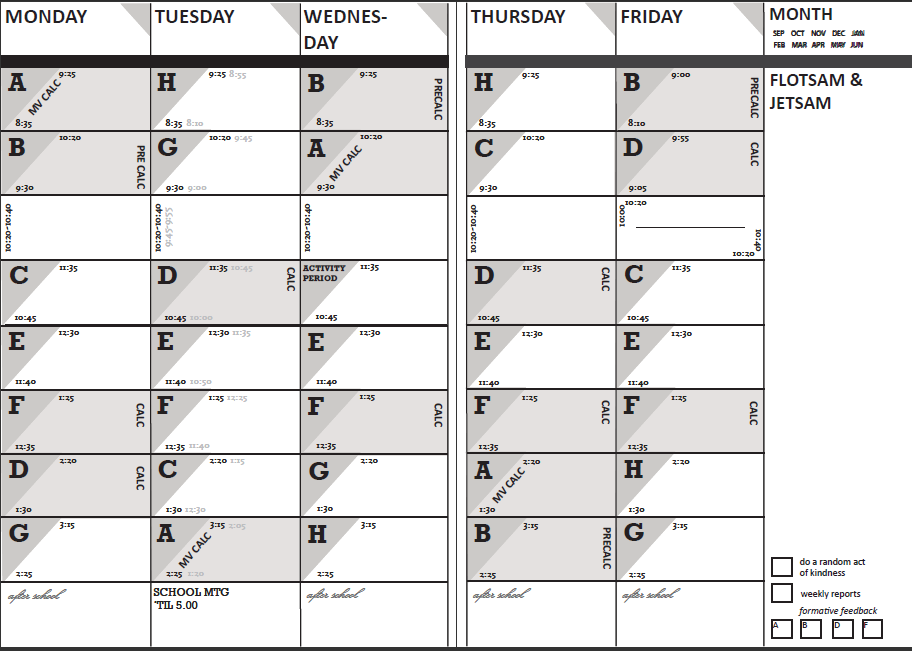
Anyway, I’ve posted about this each year. I figure I’ll do it again. My school has a rotating schedule, where we meet kids four times a week (50 minutes each). We’ve had this schedule for the five years I’ve been teaching at my school, and I still don’t know it by heart. I have gotten the class period start-end times down, but which class I’m meeting when is always a mystery. Also, with my brain, scheduling meetings with kids is something that has to happen in my planner so I don’t double book.

To help me out, I designed and published my own 88-page weekly planner. A copy of my weekly schedule for 2012-2013 is below (missing, of course, the 10th grade team meeting, the two “duties” I will be assigned, math club, and the weekly meetings I have to schedule with the other Calculus and the other Pre-Calculus teacher… so don’t be so jealous of all the free time… it’s really not there.)

The cover for the planner is:

Simplicity.

What’s nice is after my first year, there were a few other people who wanted to order planners too, so I have put up a blank planner (meaning: without my classes inputted in them) for them to buy. I don’t make any money off it or anything.

How I Made & Ordered Them

In order to make them, I had to use Adobe InDesign, which I had never used (the school laptops which we are issued come with it already installed). So I spent hours, years ago, making the original grid, picking the fonts, and working on the design. [1] But those hours were worth it, because even though bits and pieces change each year, I have been super happy with the look of it. (I created the file to be A4 paper size, because I wanted it to be slightly bigger than regular paper so I could slip a sheet of regular paper in there without it sticking out.) Then you convert your file to PDF. Just remember: if you’re going to design your own, make sure you have a blank sheet before you start your calendar pages. This way the entire week will be on facing pages. 

So after I made the planner, I used lulu.com to order it. You just upload your PDF and specify what you want. I get saddle stitch (fancy way of saying heavy-duty staples). Designing your cover on lulu is really annoying — their “cover wizard” is difficult as all heck to use. But even if you order a black and white planner (as I do), a color cover comes with it. And if you are a photo person, you can have a photo background! Each year, the price of printing between $7-$9. With shipping it comes to around $15 plus or minus a few bucks.

And viola! Your own fancy planner!

How I Use It

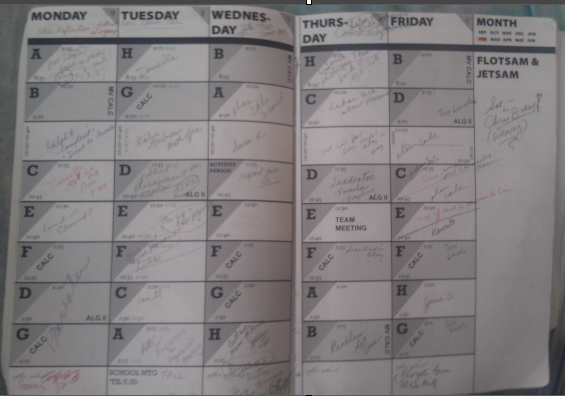
I basically just use it to schedule my time. A page from my planner from two years ago:

Also, because of my horrible brain, I require kids to email me to set up a meeting. I’ll have none of the coming up to me after class asking to set up a meeting (usually I have to run to another class, so that doesn’t work for me), or accosting me in the halls. I simply don’t know when I’m free. So they email me with all their free periods for three days and I find the first common free that works for both of us. (Usually it is the next day… rarely I have to go a couple days in the future, if our schedules are so opposite.)

And that’s it! My planner, from creation to use.

[1] You simply need to upload a PDF file to lulu.com to get it published, so if you are good with Word, you could even create something nice in there!

If Students Learn, Then We’ve Accomplished Something: Part I

When I was at PCMI in the summer of 2010, I was part of a Japanese Lesson Study group. I realized I never posted some of the good work we created, probably because I never got to use this in my own classroom (it was never a curricular topic in a course I was teaching). However I do know this is a great lesson because we taught it twice (revising in between) to both adults and to actual students.

Before beginning, I should say that this was a totally collaborative effort of eight different people. So please don’t think of it as “Sam’s lesson.”

If anyone out there in the electronic ether does use this (or part of it), please throw down your feedback/experience in the comments. Because we created this lesson in a highly formalized way, I am going to present it in a highly formalized way. Well, at least the first half of the lesson. (I don’t have time to writeup the second half of the lesson.)

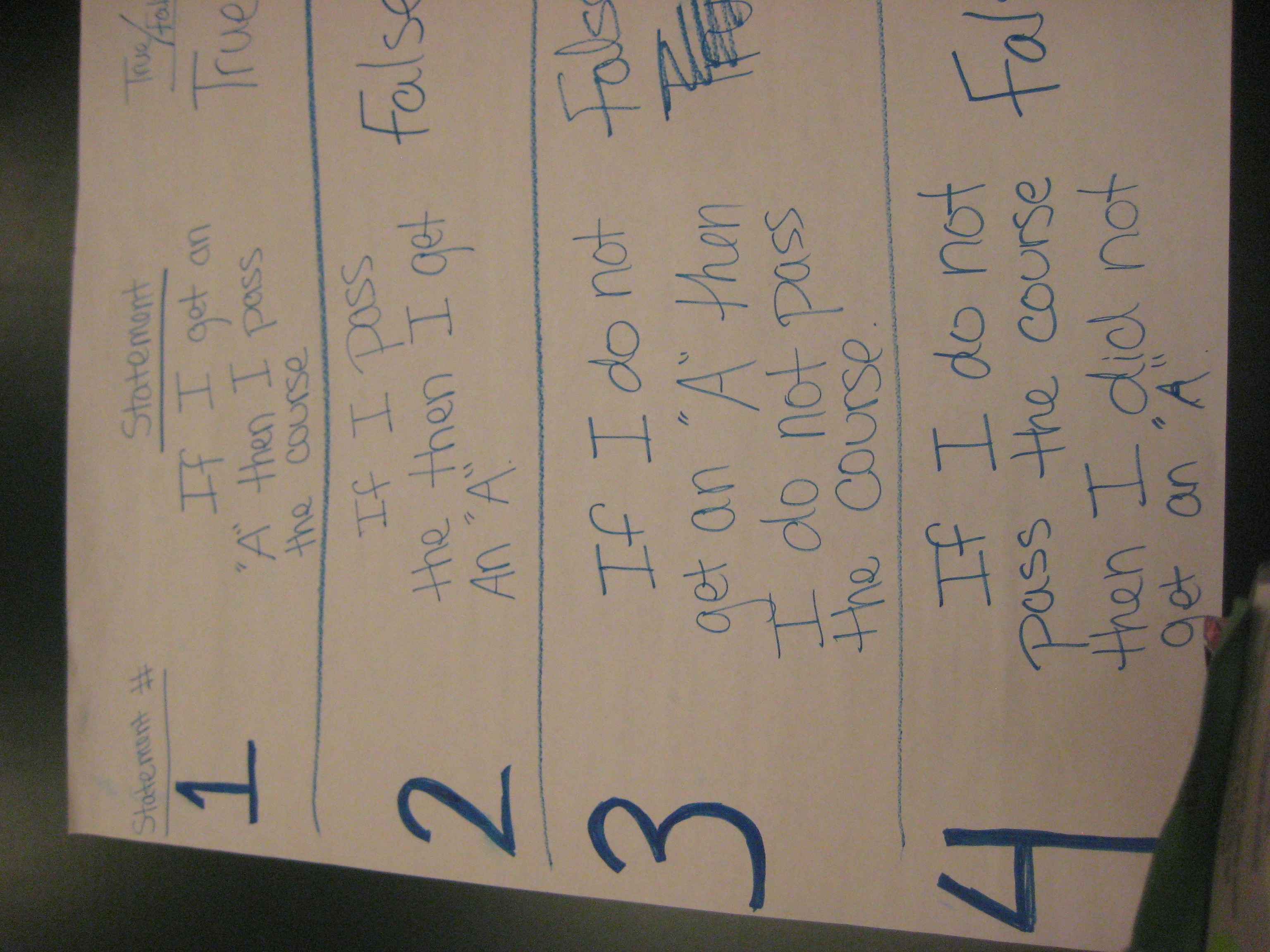
The quick rundown of first half rundown which is presented below: Initially, students participate in a launch task that gets them thinking about the meaning of words like “if,” “then,” “not,” and the importance of precision. Then, in pairs, students work with index cards to take a statement like “All squares have four sides” and create four statements out of that (the conditional, the inverse, the converse, and the contrapositive) and determine the truth value of each statement. The students still have not learned the vocabulary words for each of these statements. However, they will be playing around with the main ideas. Each pair is working on a different statement, and makes a poster with each of the four statements, and the class goes on a “gallery walk” to see what the other groups have done. Then finally the whole class comes together and does one example together, finally providing the vocabulary words for each type of statement and solidifying what these four statements are and how they are constructed.

What happens next, which is not presented below: Part two of the lesson involves the introduction of Euler diagrams, and a more focused look at the truth or falseness of each of the kinds of statements. First students will generalize from their posters. Then students will use Euler diagrams as a way to justify their reasoning. Finally, they will have an individual exit task to test their understanding.

Title of the Lesson:

If Students Learn, Then We’ve Accomplished Something.

Goals of the Lesson:

a. Students will develop a conceptual understanding of the converse, inverse, and contrapositive statements, and will be able to use multiple models (specifically Venn diagrams and sentences) to reason about these statements.

b. Given an assumed true conditional statement, students can distinguish and clearly explain the truth values of the inverse, converse and contrapositive statements – using counterexamples to show the falsity of statements.

c. Students will develop an appreciation for the precision of language, and usefulness of if-then statements.

Relationship of the Lesson to the Standards

According to the Common Core State Standards for Mathematics, Standards for Mathematical Practice, educators at all levels should seek to develop the following faculties in their students:

3. Construct viable arguments and critique the reasoning of others.

This lesson aims to enhance students’ abilities to construct viable arguments (item 3 above).

The CCSS for Mathematics further elaborates on this standard on their website.

The Lesson Plan

Part I: Launch Task:

Introduction

The students will be given a piece of paper with either a rectangle or a triangle and a horizon. The instructions for the students to complete the task will be read aloud simultaneously while shown on the powerpoint. The teacher will pause distinctly after the hypothesis and before the conclusion for each statement. No questions will be allowed.

The original rectangle/triangle papers will look like (click to embiggen):


Teacher instructions to student: Explain the directions to the task, and also to assure students that any questions or interesting points they come up with will be addressed afterwards. Students are not allowed to talk at all.

Task Instructions:

1. If you have a rectangle on your paper, then sketch a square around it.

2. If you have a triangle on your paper, then draw a congruent triangle approximately three inches to the right.

3. If you do not have a triangle on your paper, the sketch an equilateral triangle above the largest quadrilateral.

4. If you have exactly two triangles on your paper, then sketch a square using the top vertices of the two triangles as the base of the square.

5. If you have a square on your paper, then sketch a circle in the upper right hand corner of your paper.

6. If you don’t have two triangles on your paper and do not have a circle on your paper, then sketch a flower in the lower right hand corner of your paper.

7. If you have only one triangle on your paper, then sketch a thin rectangle sticking out of the left hand side of the triangle.

8. If you have a flower on your paper, then sketch two more flowers next to it.

9. If you have two triangles and one square on your paper, then sketch a smaller square on top of the square.

10. If you have a single circle and no flowers on your paper, then sketch a smiley face in the circle.

11. If you do not have a flower and you have an even number of squares and an even number of triangles, sketch a sad face in the smaller square.

12. If you don’t have any flowers on your paper, then sketch five flowers on the right side of your paper, slightly above the line that was on your paper when you received it.

13. If you don’t have a smiley face on your paper, then don’t sign your names on the bottom left corner of your paper.

14. If you have more than one flower on your paper, then don’t sketch three more flowers.

15. If you have a circle in a corner of your paper and an even number of squares and an even number of triangles, then sketch two thin rectangles coming out of the left and right sides of the largest square.

16. If you don’t have an even number of flowers, then sketch two stick figures on the left side of your paper, slightly above the line that was on your paper when you received it.

17. If you don’t have an odd number of flowers, then sketch three stick figures on the left side of your paper.

18. If you have more than one stick figure, sign your names on the bottom right corner of your paper.

The powerpoint is here:

[.ppt]

Task Debrief:

At the end of the task, each student will have a drawing on their page.

The teacher will instruct the students to stand up and find other student’s work and find similarities and differences.

Task Discussion:

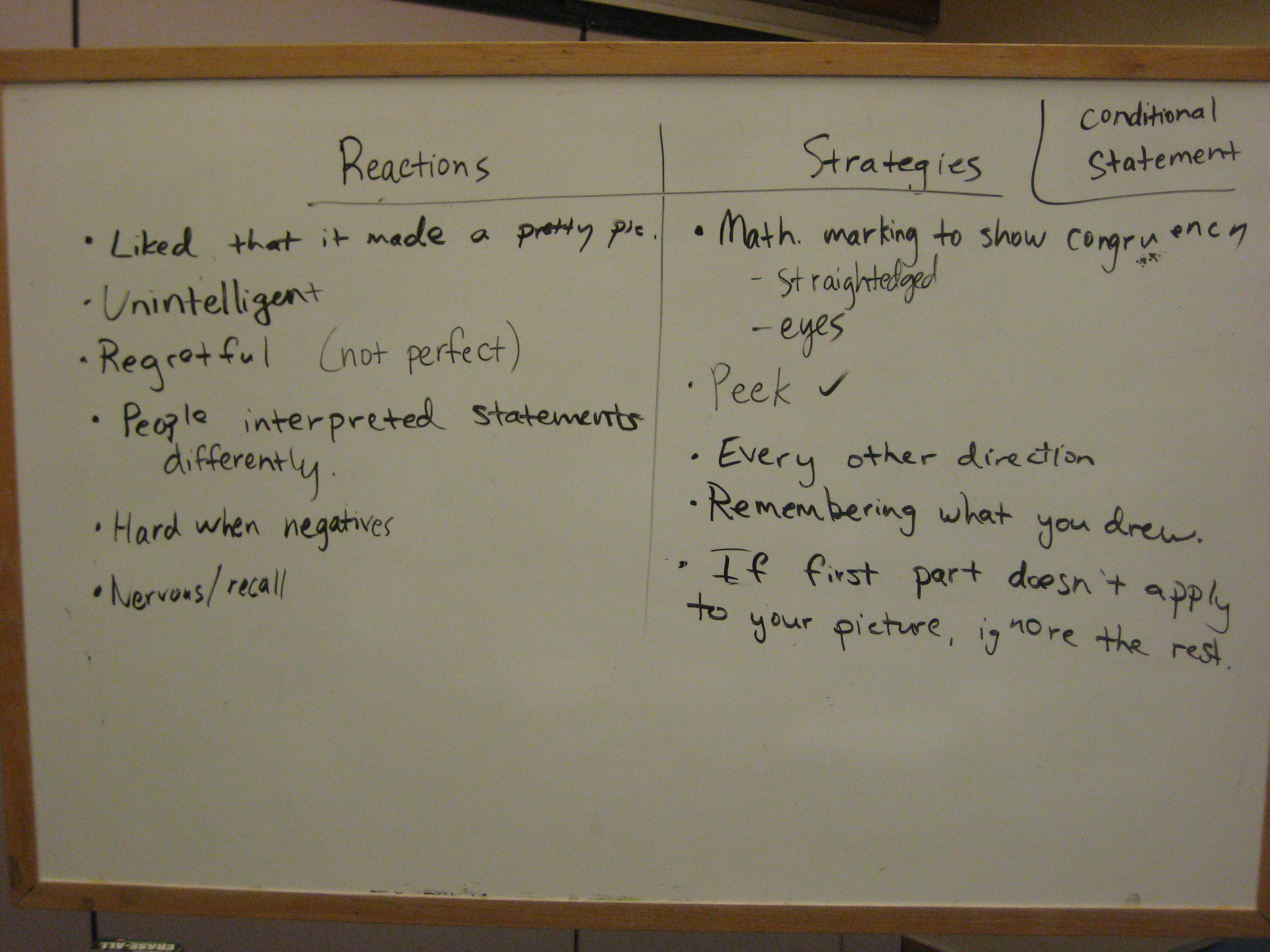
Teacher will go through these questions below. Teacher will spend more time on the discussion of strategies than the other topics. Teacher will record “reactions” and “strategies” on the chalkboard while leading the discussion. During the discussion, the teacher needs to highlight near the end of the strategy discussion that these if-then statements are conditionals, because that is one of the major goals of the launch.

 How did you feel when you completed the task?

What did you notice as you shared your work with other students?

What did you find easy about completing the task?

What did you find difficult about completing the task?

What strategies did you use to decide whether to draw something or not?

What our lesson study debrief looked like when we taught it to kids:

As a side note: we did not show the correct pictures with the class. Instead, we wanted to focus on the thinking process, not the result.

Part II: Crux of the Lesson

Students will be given the following materials –

  • A set of 3 index cards (each group’s set of index cards should be about a different statement) that will look something like this
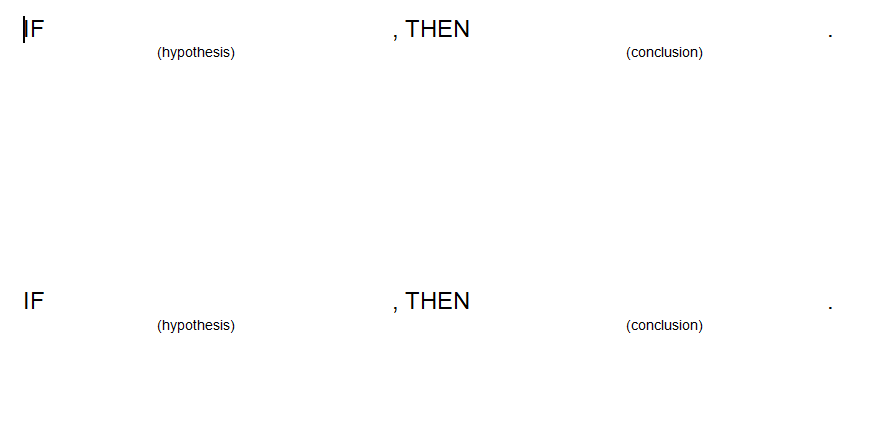
  • An “if – then” template (printed on large 11×17 paper) that looks like this — upon which students will place the index cards in various configurations
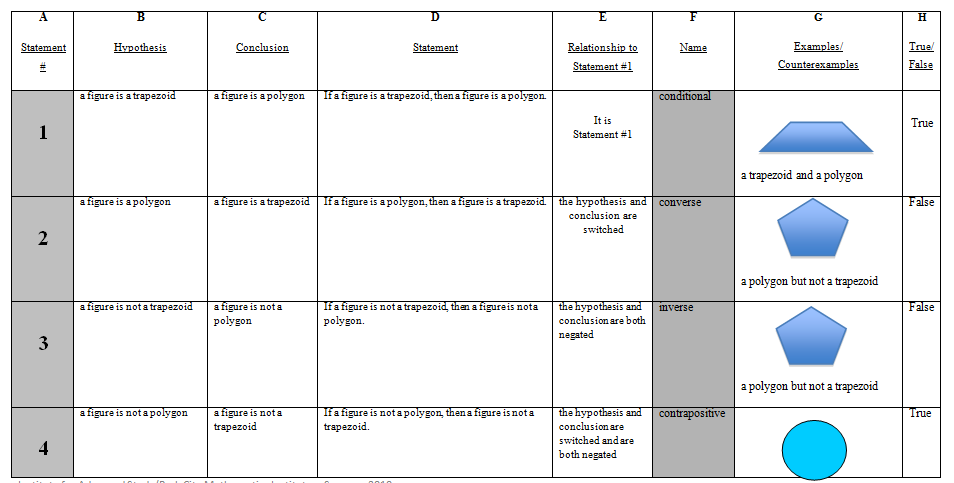
  • A table (printed on large 11×17 paper, for students to fill out) and list of directions (these seem complicated, but students working together actually can follow them!)
  • A piece of poster paper
  • Tape
  • Pens

Students will be allotted approximately 15-25 minutes to work in pairs and complete the table AND poster.

This directions to the activity asks students to mix up the green and purple index cards in such a way that they will generate the original conditional statement, and also the inverse, converse, and contrapositive. The names for these statements are purposefully not given at this point. We want students to focus on the actual statements themselves, and use this as motivation for the need to have names for these statements. For each statement (the original, the inverse, the converse, the contrapositive) the students is asked to determine the truth or falseness of the statement.

One student will be the recorder (“little paper person”) and fill out the table while the other student will write the completed statements and whether they are true or false on the larger poster paper (“big paper person”).

At the conclusion of the activity, the student pairs will post their posters on the walls. The teacher will ask each group to stand up and walk around to observe what is written on the posters.

An example of a completed table (filled in by the “little paper person”) (just a note: column F with the name of each statement would not be filled in now… it gets filled in way at the end of the lesson… the directions that students are following say to leave that column blank):

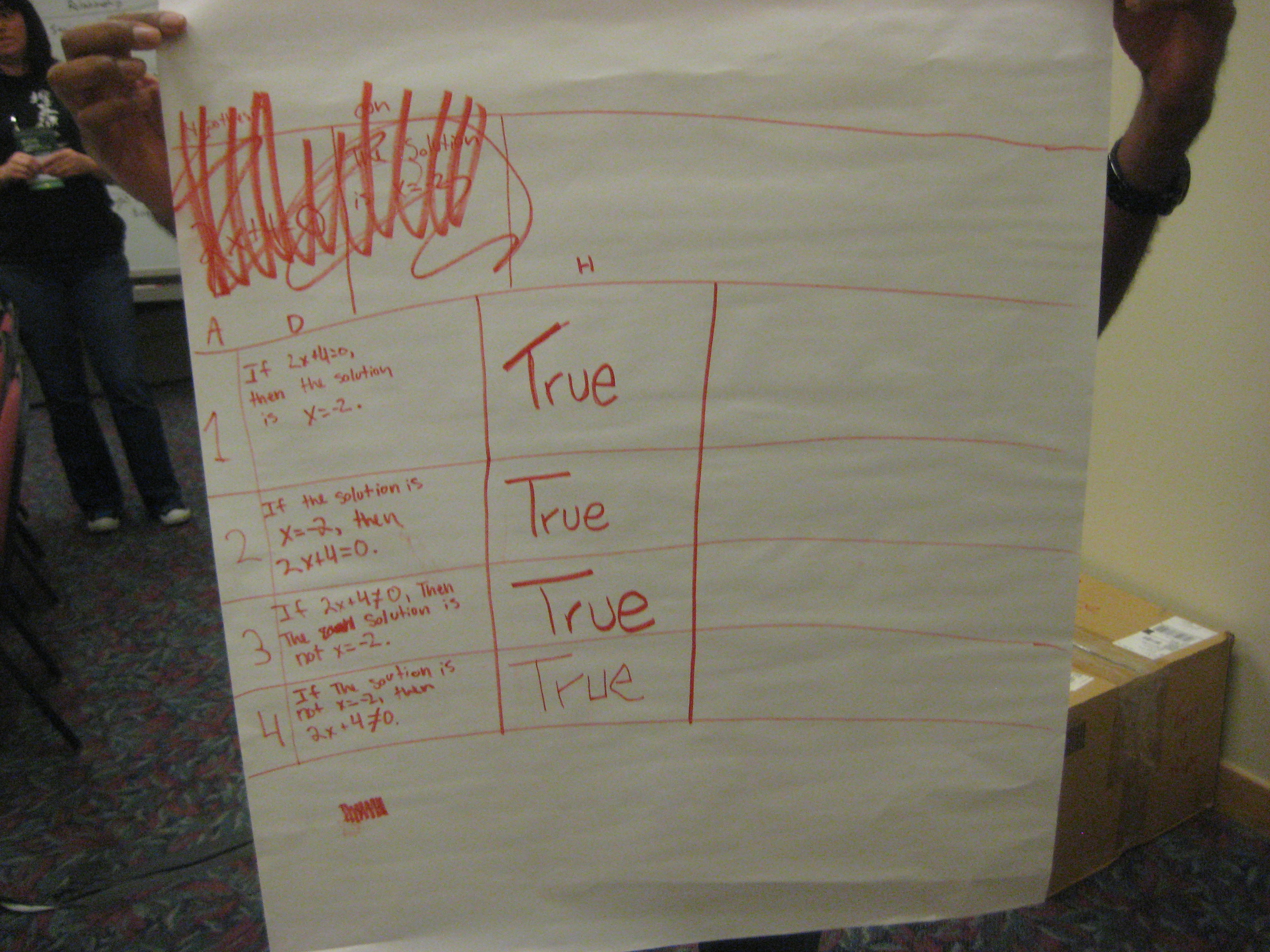
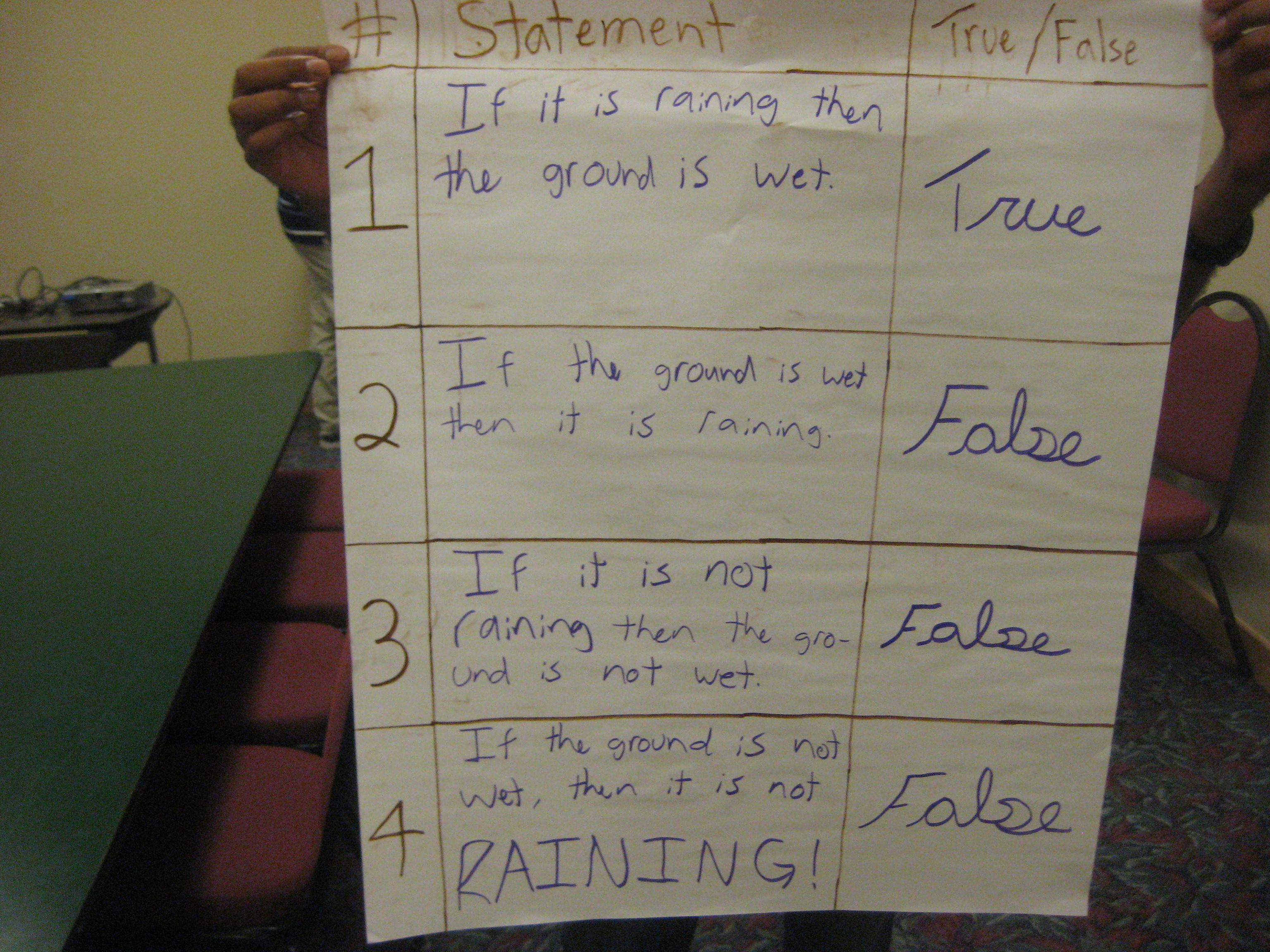
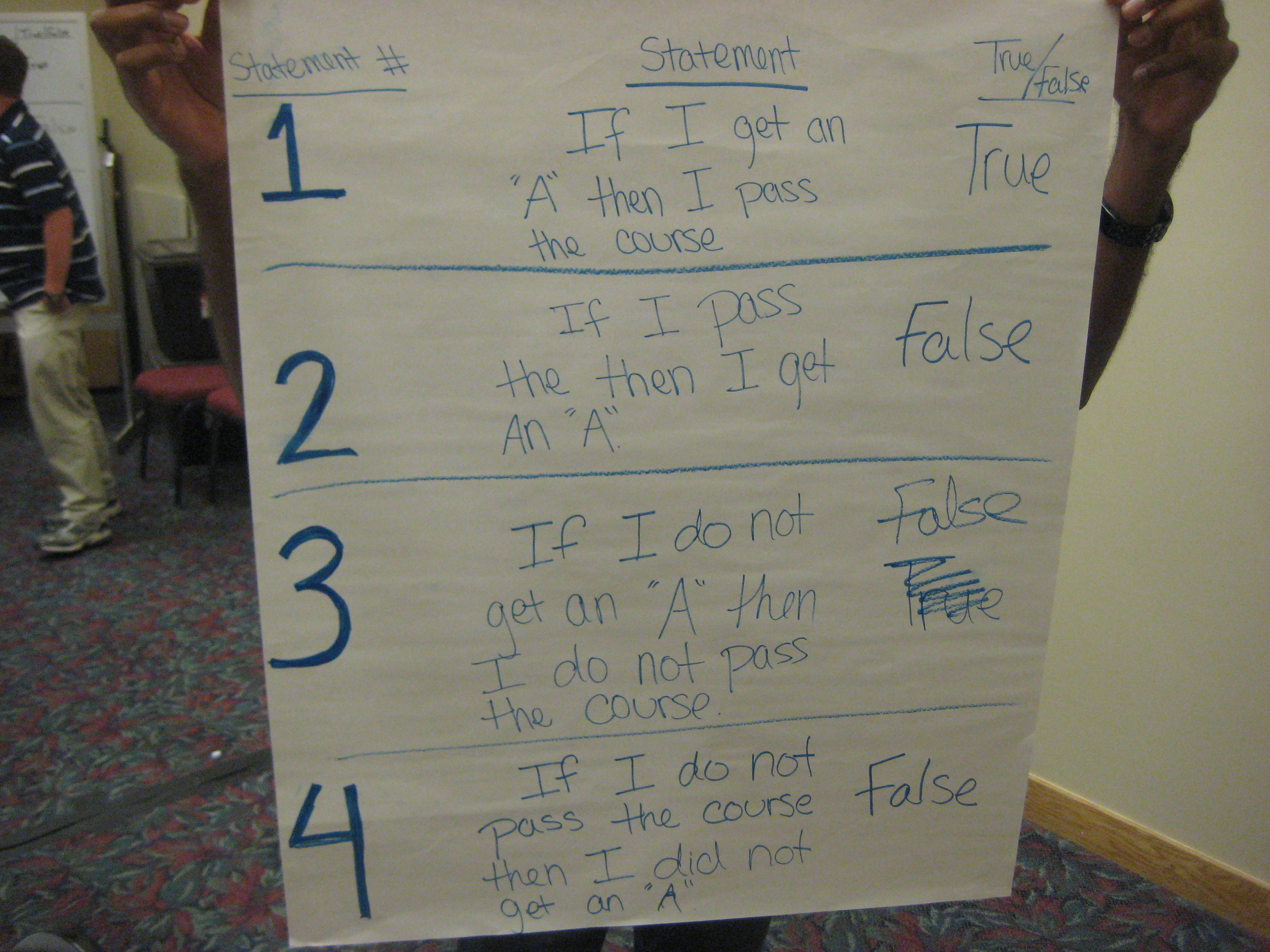
Examples of posters (filled in by the “big paper person”) (click to embiggen):


As students walk around and look at other posters they will jot down notes on the following questions:

1. Which statement really strikes or puzzles you?
2. What patterns do you notice?

(Although they take notes now, ]he gallery walk will be debriefed after the whole-class activity which is outlined below.) While students are on the “gallery walk.” the teacher will prepare a table on the board with four rows and three columns.  This will be used for the whole class to do a problem together, and to solidify the understanding of the four statements. In the first cell, the teacher will write:

1) If you have a driver’s license, then you are at least 16 years old.

This is almost the same activity that the pairs did individually, except now that the gallery walk is over, the class will be doing this exercise together. Importantly, the names will be given for each of the statements (conditional, inverse, converse, contrapositive) and a discussion of the truth value of each of those statements will ensue.

Teacher leads discussion of relationship between sentences and gives each type a name.  In particular, teacher will ask how Statement 1 in each case was restructured to create Statement 2.  Teacher will record student answer (something like: “change the first part and the second part”) on the board.  Teacher will identify this as the converse and ask a student to state the converse of the statement “If you have a driver’s license, then you are at least 16 years old.” Teacher will not yet address the truth value of any of the statements.

Teacher repeats this discussion for inverse and contrapositive.  Students record the names “conditional, converse, inverse, and contrapositive” in Column G of their organizer as the names are announced during the discussion.

An example of what the board would look like (except it would not have the true/false written down yet):

After this discussion where students have been given the vocabulary to talk about the statements, the teacher will lead a discussion about the gallery walk – using a shared language.

Discussion questions:

  1. Were there particular statements that struck or puzzled you, and why? (First question from the gallery walk questionnaire.)
  2. How did your group decide if a statement was false?
  3. What patterns did you notice from the gallery walk?

With that, the first half of the lesson is over. At this point, students understand the meaning of the conditional, inverse, converse, and contrapositive and have had some experience trying to decide the truth and falseness of each of these statements. However, the second half of this lesson would really focus on the truth-value of each statement. Importantly, by the end of the second half of this lesson, students would not only be able to identify a statement as true or false, but would be able to justify their reasoning both using words, examples and counterexamples, and Euler diagrams.

Sorry I’m too lazy to put up the second half of this lesson. But there’s some good stuff in the first half!

Sequences and Series: An Exploratory Unit

I had great ambitions to do a lot of schoolwork this summer. Instead I started, abandoned, and restarted a unit for a course that I’m teaching next year. That’s about it. It’s a new course for me: Advanced Precalculus. The other teacher and I have decided to totally mess around with the ordering of topics, and we put sequences and series as the second unit. Our department is also trying to integrate more problem solving in the curriculum, and so I tried to make this unit involve as much problem solving as possible [1]. I like that we’ll be doing it early in the year, because I want them to see immediately that we are not going to be focusing on plug-and-chug but real thinking.

Those of you who know me know that I am a pretty traditional teacher, and I have gotten in the habit of creating guided worksheets as a structural backbone for a lot of my classes. This is the first time I’m creating an entire guided unit. It isn’t flashy or have a good hook. It’s simply a scaffolded way to help kids think in an increasingly abstract way. It also gets at almost all the standard things in a sequences and series unit (except for recursive equations, which I threw out). To put it out there: I would never say that what I do is inherently engaging for my kids. But it does get kids talking. I guess what I mean to say is: these packets/worksheets that I tend to create don’t make kids like/love math, but it does get them to think about math. I’m not great at the former, but I’m definitely getting better at the latter.

The last thing I have to say is that although it may look pretty traditional (the questions), try to think about the packet if you were a student and you were in a class going through it. It builds up elegantly, in my opinion. The motivation for sequences comes out of a series of IQ-test-ish puzzles, and the motivation for series comes out of a lottery problem. No formula is given to students. There are connections drawn to graphs, and to a few geometric visualizations of sequences and series. Students are asked to conjecture and defend their conjecture at various times.

I’m including two copies below. The packet with my teacher notes, and the packet without my teacher notes.

With Teacher Notes

Without Teacher Notes (Blank)

[Word version of this to download: .docx… to see my teacher notes, go to “Review” and go to “Final Showing Markup”]

Huge thanks in the creation of this goes to @JackieB, who went through a lot of it page by page and gave excellent suggestions! Precalculus guru! Also I included a few blogposts at the end of the document which I stole wholesale from or adapted in my own way.

Lastly, yes, I know this is a long packet. Usually I think classes do this whole unit in single week, and there’s no way we’ll be done with it in that time. It’s an experiment. From what I’ve heard from teachers everywhere, sequences and series always get short shrift in precalculus classes because they come at the end of the year. But I think there is so much depth and abstract thinking that can be brought out of a unit properly done. I’m super nervous, but we’ll see if this is an experiment that fails or not.

[1] I’m liberally defining problem solving as having students deal with situations they have never dealt with before, and generalizing from those situations. But I understand I am giving them A LOT of scaffolding with which to do it.

New Blogger Initiation! Pledge by Tuesday, August 14th.

An Idea!

For a few weeks now, I have had this idea bouncing around in my head. A new blogger initiation! All it involves is writing four blogposts. There will be no hazing of any kind, except for the kind where we all say how much we think you’re awesome. That’s a form of hazing, right? Like happy hazing?

It has recently come to my attention that there are about a zillion new math teacher blogs that I don’t know about. They are new and probably awesome and exciting and fresh. I also have come to find out that there are a bunch of lurkers who are reading and absorbing and loving the math teacher blogs out there, but are on the fence about blogging themselves.

For those who have taken the leap and started blogging recently: awesome!!! Welcome! Define recently however you want… 3 months, a week, half a year, whatever… if you feel like you’re a new blogger, you should read on! This is for you!!!

If you’re a lurker but don’t yet feel like you want to blog, maybe you just need a little encouragement and motivation to get you to start. There’s a site with an awkwardly long url that a bunch of people created with the sole purpose of convincing you how awesome it is. If you’re nervous about writing, read this footnote [0].

Take the plunge!

What The New Blogger Initiation Is:

New and new-ish bloggers pledge to participate. This is to help kickstart you into actually doing it. You sign up. There isn’t any time limit on what constitutes a new blogger. If you’ve never blogged before, you’re definitely good to go. If you feel new, or just want to participate because you’ve been lagging in your blogging and you need to rejuvinate yourself, sign up!

Each week for a month you will be emailed a mystery prompt (but it will be rich and evocative and you’ll want to write about it) — and given a week to write a blogpost on that prompt [1]. Short, long, picture-based, whatever. No pressure. Just get something down! This will happen just four times… In your email, you’ll also get instructions on how to submit your blogpost once it is written and published on your blog.

Each week, I (or hopefully me and a few other bloggers) will compile your posts and share them with the rest of the blogosphere by linking to them from our pages. This way we’ll get to say hi and get to know y’all, and you’ll get to say hi to each other, and everyone will be happy.

Of course you can write as many other posts as you want. This is just hopefully a way to kickstart you into starting or keep you with us if you’ve just started!

And remember, if you need help starting a blog, we have a site to help you!

All You Need To Do:

All you need to do if you’re a new-ish blogger and want to pledge to participate is to sign up below by Tuesday, August 14th. You’ll get your first mystery but awesome prompt via email soon thereafter!

UPDATE: SIGN UP IS OVER! FORM TO SIGN UP HAS BEEN REMOVED.

[0] Do you think you’re bad at writing, so you don’t want to blog? HELLO HOLA we’re math teachers so we don’t care. We don’t snicker when someone writes there instead of their, or misuses a word.  Do you not have time to do it? Just try it out for a month and see if it really takes more time that you have! Do you think you aren’t creative or interesting enough or have anything to say that would interest anyone. SHUT THE FRONT DOORSeriously, we all feel this way. We just put it out there. And writing even about the smallest things like a bell-ringer/do now that you like, or musing on an article about education that you found interesting or disheartening, or a single math problem you found interesting, or recollections of one of your favorite math teachers, or whatever. Heck, I just learned the most amazing trick about how to teach matrix multiplication from a teacher who thought that everyone taught it that way. I love the little things.

[1] It’s a secret what these are.

Talk to New Math Teachers

So I’m a little terrified because I never give talks. Some people have thought it weird when I say I hate public speaking, but there are so many teachers I know that feel similarly. And it’s scarier to think that I will be talking to teachers-to-be! Anyway, @PiSpeak (CLopen Mathdebater, mwahahaha) is running a two day session for new math teachers. They are about to have their first year in their classroom. And he wanted them to know that there are communities of teachers outside of their schools that can be a great source of inspiration.

Enter me.

I agreed to a 30/45 minute session with them. My goal is to convince them that reading blogs can be useful. That’s it. I will talk a bit about twitter. And I will probably make a plug for blogging themselves.[1] But that’s it. Showing what’s out there and how it can be useful. The way I hope to do convince them: have them play around online a bunch. See the good stuff out there, and see if they think it can help them.

Here’s what I’ve come up with. Most of the images and links are clickable from the presentation, so go ahead.

[my entrance/exit slip: .docx]

(Here’s an old 7 minute talk on this online community.)

I’m anxious about this, so hopefully it won’t suck. If it does, well, I’ll be glad I did it because I’m putting myself out there. But I will be sad that I took away half an episode of Buffy or 20 pages of 50 Shades of Grey from each person whose time I wasted. I hate having my time wasted, which is why I stress.

[1] I know it isn’t something that everyone recommends for a new teacher… heck, there is enough on their plates… but I blogged from the beginning of my teaching to the present and I can’t tell you how nice it is to be able to be able to go back and see how I’ve evolved from that first year.

UPDATE: The results of the Entrance/Exit Slips.

As you saw, I used an entrance/exit slip asking people to say their interest in reading math teacher blogs before the presentation, and afterwards. (Similarly, for using twitter.) Even though not given numerically, I numericized the responses (1=no interest to 4=a lot of interest).

I plotted the before versus after for both reading blogs and twittering, and the line y=x. Anything on the line means I did no harm. Anything above the line means some sort of success (and the further away from the line the better!). Anything below the line means I did some harm.