Video Analysis: Feedback

So as I wrote before, I had a dickens of a time getting the courage (courage, as they say in French… not that different) to share my teaching video with others. But I did it, and here are my general thoughts based on my feedback — thoughts reinforced by what y’all commented:

(1) To do video analysis, there needs to be some sort of safe space for teachers to share. This was terrifying for me, because I felt like I was going to be exposed as a fraud — someone who can’t teach. And more importantly, I was afraid that people who lose any respect they had for me. I think teachers who are participating in video analysis need to have someone help them deal with the emotional aspects of this. The thing that helped me, personally, was realizing that I would be a pretty sucky teacher if I never learned to grow. So I had to change my outlook about sharing the video: from a vulnerable place where we feel we’re exposing ourselves to a cruel world, to an exciting but challenging opportunity to really improve my practice through the help of friends. It’s like with our kids… we don’t want them to see our class as an unsafe space to make mistakes and grow from them… we want them to see our class as a place to learn and grow and be excited about what they do.

(2) I sent out the 50 minute video and asked my friends to look at it without any directions. Basically because I hadn’t learned how people actually analyze videos. I got a diverse set of responses — each focusing on different things.

EXCERPT ONE

–Wow, great way to respond to a kid asking a question that was just asked. I’ve never thought of having kid 1 respond for me and will be stealing that for next year.

–Thank you for using the word ‘exemplar’

–I wonder what other students would have done if you had written what [STU] had originally said at 9:15; 10x vs 10^x.

–You use the phrasing “will you..” when intro-ing the problems on the board. Sounds like kids have the option not to.

–I like your use of ‘crazy’. A lot of your side-comments to the students are super-similar to mine and it’s just nice to hear that I am not the only teacher that talks like that.

–I like how at 14:20 you have her point to things on the page instead of doing it for her.

EXCERPT TWO
EXCERPT THREE

EXCERPT FOUR

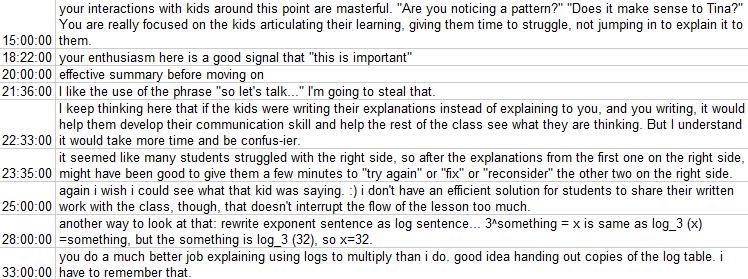
There were a lot of things that I didn’t notice, or acknowledge, about my own teaching that came through in these. Especially the things the reviewer liked. I also really appreciated when I was given a suggestion for an alternative thing I could have done (e.g. “I keep thinking here that if the kids were writing their explanations instead of explaining to you, and you writing, it would help them develop their communication skill and help the rest of the class see what they are thinking”).

(3) Of the various ways I got feedback, I think the third one (+, delta, ?/notes) made the most sense for me. I would love for it to also have had approx times on the video (like in the second one) so I could go to the video and look at that particular point of the video without having to do a lot of skipping around.

(4) I don’t know if sharing 50 minutes (a whole class) was worth everyone’s time. I wonder if picking a 10-15 minute clip and having the reviewers focus on three things (e.g. my questioning, my body movements, the students engagement) would have worked better. It’s hard to know exactly what to do with all the feedback I got, because it’s not targeted. It would make sense to have some particular things I want to work on, and get feedback just on those. Also, making explicit what I need to work on makes the notion of getting negative feedback less nervousmaking, because I already have admitted to everyone “I suck at these.”

(5) I wonder about doing this in person vs. doing this virtually. One thing about doing this virtually is that people can do it on their own time, and it might feel safer for everyone. At the same time, there isn’t any discussion about the clip. If there were three reviewers and the presenter together, it could generate some fantastic discussions.

Thanks for those who helped me with the video analysis! I appreciate the time you took and the comments you gave me!

UPDATE: One reviewer writes about her process.
Random Ideas Gathered from the Klingon Math Curriculum Group

I also wanted to archive the random ideas I gathered from the Klingons, before they got lost in the ether:

  • Keep a physical toolbox somewhere in the room. And when kids are stuck, make a dramatic point of walking to the toolbox, taking it out, and loudly plopping it on the desk. “What tools are in our toolbox?”
  • Bring a construction helmet to class. When you need to get things settled and move on, put it on. “This is a work zone, people, a work zone.”
  • Play “Math Taboo” where you have kids evidence their understanding of concepts. Have notecards with things like “Coordinate plane” and have them try to explain to their team what it is, but without using other words on the card, like “x-axis” “y-axis” “graph” etc.
  • Ask a lot of what if questions. So, if you are in geometry and have covered that triangles have 180 degrees, ask: “What if we didn’t have a triangle, but a quadrilateral or pentagon? Would this still work? How many degrees do those have?” (This is very much under Polya’s art of problem solving philosophy.)
  • On the top of every homework page, students need to write a list of problems they had difficulty with and circle it. If they didn’t have any difficulties, they can write the null set and circle that. On that vein, don’t put up the solutions to the homework problems that weren’t from the book (or the even ones from the book) until 2 minutes into class. Students need to be talking with their partner and comparing answers and asking questions first. Then halfway through “homework check time” project answers. (This is only for classes where you check homework.)
  • Have practice tests (call them “scrimmage quizzes”) before tests, asking students to solve problems to assess their own understanding. But do NOT make them exactly like the summative assessment. They need to learn how to do problems without having the numbers be slightly changed. But make sure they cover the same ideas / understandings.
  • When you’re in a zany mood, use phonetic punctuation (http://www.youtube.com/watch?v=lF4qii8S3gw). You know, just for fun.
  • Have the class, at the start of the year, come up with a collective list of classroom norms. Make sure to refer back to that list throughout the year, and enforce it. These norms should be enacted each and every day. And students have ownership on them. (Add to the norms too, when need be.) Frame the norms positively. Also, collectively make a list of attitudes shared by good math students (e.g. tenacity, willingness to ask questions, etc.) and refer to those.
  • Change language. Don’t call problems “problems” but “challenges.” Don’t call tests “tests” but “celebrations of learning.” Don’t write the number of points off, write the number of points earned.
  • When students are asked to show their work to the class, don’t tell them to “show their work” or “show their solution.” Tell them to “teach the problem.”
  • If a student shows up late, say to them “I’m so glad you’re here. Thanks for joining. We value your thoughts.”
  • Keep a stack of postcards/little notes in your desk drawer. If a teacher does something really nice, or well, write a short note to the teacher telling “I appreciate…” and leave it in their mailbox.
Throw in other things below, if you want!

The Taught Curriculum vs. the Learned Curriculum

I’ve taken away a lot of valuable ideas from the Klingon summer program. I wanted to distill them into a really strong set of reflections, but I’ve found I haven’t been able do that because I am still trying to play and tease them and turn them into some sort of coherent philosophy which I can envision being enacted in my classrooms. So as opposed to most of the blog posts I tend to write, I’m going to go a bit theoretical, and ask for your help to come up with concrete ways to show these things happen.

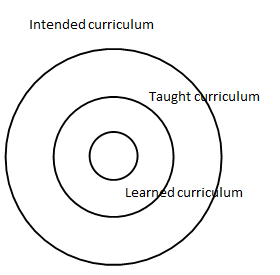
The first thing I’ve been struggling with, and I now see as one of my biggest weaknesses as a teacher, is the lack of attention I’ve given to bridging the gap between “the taught curriculum” and “the learned curriculum.” What’s strange is that I thought I had been giving that a lot of attention — and was one of my strengths. Here’s the idea:

We all have a plan of what we want to cover in a year, in a class, or in a small bit of a class. That’s our “intended curriculum.” Then we go about and teach stuff. That’s our “taught curriculum.” Then there’s actually what our kids learn. That’s our “learned curriculum.” It has been kinda obvious to me since my first year teaching that there is always going to be a gap between the taught curriculum and the learned curriculum. These commonplace catchphrases are things I’ve heard over and over in the blogosphere…

Just because you teach it, it doesn’t mean they learn it.

Teaching is not the same as student learning.

So the goal of teaching is to minimize the gap between the taught curriculum and the learned curriculum. And I thought I was doing that. I see myself as being cognizant of the mistakes that students tend to have in thinking, I work on developing their understanding rather than having them rely on algorithmic/procedural learning, I teach my classes at the pace of my students — and alter how far we get with the material based on how much time I see them needing.

However, I have come to realize that I have been missing a gigantorific thing, because I’ve had some sort of blinders on. Especially egregious because this has been the central idea and nexus of the math teacher blogosphere for over a year now. I’m embarrassed to say: I don’t have any idea if I’m being successful at reducing the gap between the taught curriculum and the learned curriculum.

In other words, if asked how I assess student understanding in the classroom before tests, I wouldn’t have a good answer. Yes, I do that whole I look at their faces thing (which tells a lot) (but some of them are good at playing the game with their faces too) and I do the whole check yo’self before you wreck yo’self thing (questions which have students solve a problem after we have gone over a concept and done one together as a class) and I do the whole let me ask you a question thing and I very occasionally do the whole “put your head down and raise the number of fingers” where 1 finger is ‘totes got it’ and 5 fingers are ‘what just happened?’ …

But when it comes down to it, if my department head came to my class three-fourths of the way through, and froze the kids (okay… okay… no… she can’t do that… only I wield that power with my magic unicorn wand!) and asked me “what is the level of understanding of each kid in the class for the material you covered yesterday?” and “what is the level of understanding of each kid in the class for the material you covered today?” I wouldn’t be able to answer her with much confidence.

I don’t have strong systems to formatively assess my kids understanding.

Yes, there you have it. I said it.

Now I need to find ways to do this. I am currently thinking of giving short quizzes at the start of every class and exit slips at the end of every class. I would like to pilot out clickers at my school. And I would like to come up with more intentional questioning which can get to the heart of whether a student understands a topic or not (meaning: I have these questions prepared before class and I can whip out when I’m ready to check their understanding).

But more than anything, I’d love to hear ways you come up with ways to formatively assess kids understanding during a class or even outside of classtime. Big, small, thoughts on how to form questions that get deep to the heart of the subject matter, ways to figure out what every kid or what most kids know?

Video Analysis: Beginnings

For the past week and some, I’ve been at the Klingenstein Summer Institute for Early Career Teachers. We’ve been kept so busy that I haven’t had a lot of time to post, so I am losing insights left and right. Sigh! But I am making it a priority to talk about the reorientation I’m having with regard to math curriculum before I head off to PCMI.

One thing we’re doing today is having others watch videos of us teaching. And it’s terrifying. It was terrifying when I was being videotaped. I don’t know what will happen, how we will structure the conversations (they give us free reign to do what we want with regard to the conversations),

Something that I’ve heard happens with video analysis is that the teacher, before doing it, has one conception of who they are and what they are like in the classroom. They have this impression based on what’s going on in their head. When they watch the video, they suddenly see a very different person, someone they might be unacquainted with. It breaks you down.

That’s what happened when I watched my video last night.

But I’ve held, for about two years now, that I felt that video analysis of teachers is actually going to be the most powerful and next form of serious professional development… So I’m trying to overcome my fear, and so I asked a couple of our mathemablogotwittersphere cabal to watch my video and send me feedback. It’s terrifying. I feel like my blog gives one big false impression of who I am as a teacher (read this), and so it’s scary to think that people who I respect a lot will suddenly think: WTF this guy sucks.

But then I decided: heck if I’m not okay with that, because isn’t that the whole point of me blogging and twittering. I reoriented my thinking to say I own this class (I felt when I finished it was one of my better classes) and I’m using this to suck a little less. Going with that mindset (Dweck’s growth mindset” anyone?) has made me feel like I can do this.

Anyone who has any experience with videotaping their classroom and self-analyzing their tape, or analyzing other’s tapes, or online resources which give a “method” to analysis, or any notes about their experiences, I’d love to hear them in the comments.

UPDATE: I just want to clarify, I am taking things slowly so I don’t think I’m ready to share it with more people, yet. i just want to slowly edge myself into this.

To Reassess (or, how to make more work for me)

Part of standards based grading is getting students to remediate before being allowed another shot at demonstrating their mastery. Reassessing shouldn’t be a “free pass.” I think I wrote previously about how I deal with this. They have to send me a form email.

When I hit upon this idea, I was worried that students wouldn’t take it seriously — and they would lie about what they did to remediate just to take the reassessment. I am sure that a few did, but my gut feeling, based on the responses I got, was that students were being forthright about what they had done. (Many were very specific in their emails.) What I found interesting was less how they remediated (many met with a study buddy, met with me, or redid problems) and more how they were able (or in some cases, not able) to articulate what went wrong. Many students interpreted “The reasons I didn’t do well on the skill are…” to mean “what mathematically didn’t you understand, that you now understand?”

Two examples of student responses:

I also tried to be really clear with students when their email was not up to snuff, saying things like:

… Also, you cannot say you are going to do something to remediate the skill. You can only say things you have already done. You also need to be more specific. In the future, I won’t accept “I went over the assessment” when you have more that you need to have done. Please talk with me if you have any questions about what is expected to reassess.

Most importantly, though, I want to remind you that I’m always here to meet to help you, so hit me up for help.

and

1) Why specifically don’t you think you had a firm understanding of the material? What didn’t you do that prevented you from having a firm grasp of the material? The point is to be honest here, so that you can learn from your actions. If you didn’t study, say that. If you just looked over problems, but didn’t practice them, say that. Whatever.

2) What specifically about skills 49, 51, and 52 did you get wrong? What were you doing incorrectly for EACH one of them?

Overall I felt like the email-to-apply-for-a-reassessment was good. It’s worth considering if you don’t know how to deal with the bureaucracy of ensuring remediation and setting up reassessments.

I do think I need to be more particular early on in what is acceptable and what isn’t, in terms of an email. I went over it in class, but just once, and that clearly wasn’t enough. As I write this, I think I should also call sending that email “applying for a reassessment” because I think by the end, students were taking it for granted that they’d be approved. Many were.

Idea for my summer lark

Just 5 minutes ago, I was taking a refreshing cold shower — because it’s too dang hot! And as best ideas are wont to come when paper and pencil are not around, I stumbled upon, in the rambling brambles of my nonlinear thought process, exactly what my summer project is going to be.

A little background first. The museum of math has had a series of math lectures (Math Encounters) this year, and so far I’ve been to all of them. They are delivered by people with grand speaking skills and on topics which are fascinating and excite the imagination. You can watch the first one (that they’ve put online) here:

I have decided I am going to try to come up with 3 lectures that I’m going to give in the first semester to students at my school. I’m thinking these are going to be after school things for anyone interested, and honestly, I will probably only get a couple teachers and a couple students to come. But it will be a fun lark for me this summer.

To be clear, I’m not talking about a workshop or problem solving sessions or anything super interactive. I’m actually thinking straight up lecture (with maybe some audience participation).

I’m excited enough about the idea that I think I will probably follow through on it. And so I thought I’d share the idea here, in case I can get others interested in doing the same. Anyone out there interested in doing it? I don’t think it would make sense for us to work together on the actual lectures, but I do think bandying about ideas for possible fun and high school accessible lecture topics could be superfun.

Just off the top of my head right now I have a few ideas: continued fractions, Farey sequences, the violent and sordid history of mathematics [I’d have to do some fun research on this one], topology, etc. Oooh! Coming up with good lecture titles will be EXTRA FUN!

My secret hope is that this is something that widens the scope of what kids think “math” is. I had that happen to me when I went to math camp in high school, where I was treated to so many amazing lectures on so many weird and fun topics that I saw the huge scope of math and saw the beauty even more piercingly than I had when exploring it on my own.

Email breakdown 2010-2011

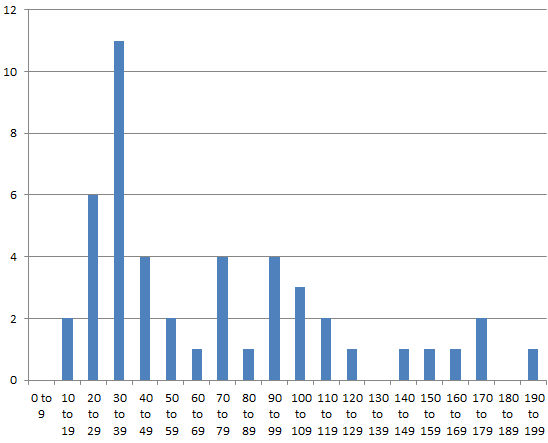
Last year I had archived 2,270 emails to and from (and about) students. (I make a separate folder for each student and file everything related to that student.) The breakdown from the data last year was here.

This year, the total comes to 3,364 emails. The reason for the increase is probably due to the reassessments in calculus… students had to send me an email justifying their request for a reassessment.

The student with whom I had the least communication to/from/about had 16 emails. The student with the most had 192 emails. Each student on average has 71 emails.