SugarSync

How many of you out there use Dropbox?

(Hopefully many of you raised your hands.)

I do. It has been really awesome. For those who don’t know, it’s a site which “shares” all the files in a single folder among multiple computers. So I put all my teaching stuffs (worksheets, tests, smartboards, etc.) in that folder and I can access them anywhere. And it automatically updates — so any new documents I make at school will be on my home computer too. Any changes to tests I make will be made on my home computer too. Best of all, it’s free.

But the problem is: I’ve reached my (free) 2GB limit. I want to have all my teaching stuff on Dropbox, but probably like most of you, I have more than that.

One of my students who is taking computer science mentioned SugarSync to me… It’s like Dropbox… it’s also free, but better. (HOLLA!) You get a huge 5GB of free storage, plus it has somethings which I like better than Dropbox. But mainly, it has more space. Right now it seems like that site has already started to be a serious competitor for Dropbox. And I think they’re trying to get the word out. Right now, if you refer someone to SugarSync, you and the person you refer both get an additional 500MB of free storage space.  Clever, right?

Obviously, I want to be all over that. So if you are thinking of trying it out, use my referral link! You and I each get an additional free 500MB of space!

Image representing SugarSync as depicted in Cr...

Image via CrunchBase

You should DEFINITELY try it out.

PS. If you want to sign up for a Dropbox account, use this link and I get 250MB of free space. I don’t think you get any free space though. :(
 

3D Maxima and Minima

In multivariable calculus, we were finding relative maxima and minima. It’s much like finding maxima and minima in 2D.

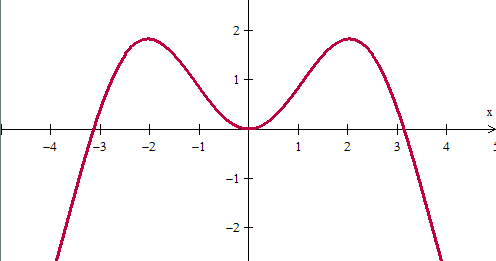
The general idea in 2D is that if you go a little bit to the left or a little bit to the right (changing x by a wee bit) at a maxima or minima, you aren’t really changing your height much (you aren’t changing y by much). Another way to look at it… if you zoom in enough to a maxima or minima, you’ll almost see a straight line! And you can make it as “straight” as you want it by zooming in more and more and more.

Does that make sense?

Now we do a similar argument for maxima and minima in 3D:

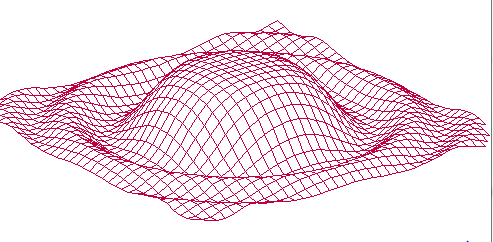
At the top of peaks or troughs, you’ll notice if you walk a wee little bit in the x direction, the height (z) isn’t changing by much. Similarly if you move a wee little bit in the y direction, the height isn’t changing as much. (Or, analogously, if you zoom in a lot lot lot lot, you’ll be looking at something almost perfectly flat, a horizontal plane…)

In other words, instead of saying maxima and minima only occur when f'(x)=0, we now can say that maxima and minima only occur when f_x(x,y)=0 and f_y(x,y)=0. That’s the mathematical way to talk about moving a bit in a x-direction or y-direction.

So my kids know to find possible relative maxima or minima, you have to find the points (x,y) which make f_x(x,y)=0 and f_y(x,y)=0.

In class I then posed a few good questions:

(a) If you know a maximum occurs at the point (2,3), how can you show that the directional derivative in the direction <\frac{1}{\sqrt{2}},-\frac{1}{\sqrt{2}}> is also 0?

(b) If you know that at the point (5,7), the directional derivative for <\frac{3}{5},\frac{4}{5}> is 0, and the directional derivative for <\frac{1}{\sqrt{2}},-\frac{1}{\sqrt{2}}> is also 0. Prove that the point (5,7) is a maximum or minimum or saddle point.

These were things that I thought up on the fly… it’s interesting. We get so used to procedures, that we sometimes forget what they mean. The point I was trying to make is that if any two (different) directional derivatives were 0 at a point, then that point could be a maxima or minima. If you pose that as a claim, and students are used to thinking algebraically, they have to go through the motions to see this is true. (It basically involves creating and solving a system of two linear equations…). [1]

But there’s a much easier way to get students to buy that claim. If you think graphically, this makes sense… if you are at a maxima or minima, and you zoom in enough, the surface will look like a flat plane. So of course if you walk a short distance in any direction, you shouldn’t be moving (much) in the z direction.

I don’t know… this isn’t deep or anything. But it was something that I didn’t plan in class that I thought was interesting…

[1] This is how it would go… Assume you know D_{<a,b>}f=0 and D_{<c,d>}f=0 (and the two vectors aren’t scalar multiples of each other). Then you can rewrite D_{<a,b>}f=af_x+bf_y=0 and D_{<c,d>}f=cf_x+df_y=0. Well then you simply have a system of equations that you can solve for f_x and f_y — and it is easy enough to show that the solution is f_x=0 and f_y=0.

Piecewise Functions Worksheet

This year, I’ve been resting on all the worksheets and smartboards I’ve made in years past. Because of the time commitment spent heading the disciplinary committee and implementing SBG in calculus, there just hasn’t been time to reinvent the (unit circle) wheel. It actually kinda sucks, because I love creating new lessons, worksheets, smartboards, whathaveyou. It makes me look at whatever I’m teaching from a fresh perspective, because I’m forced to ask “how do I want to approach this topic so that my kids will get it.” I don’t know why I love it, but I do. When I’m using my existing material, I am not forced to ask that question a second time. And when I am using someone else’s material, I don’t get any say in the matter.

Anyway, for reasons beyond me, I can’t seem to find anything I made in years past on piecewise functions for my Algebra II kids. I decided to whip up a guided worksheet which would be at their level and walk them through it. My book and Ms. Cookie both approach piecewise functions in the same way. It’s actually a way I really like. But introducing it in this way, and having them make these charts, takes time I don’t have. I am not sure it will make sense to my kids if presented as an opening salvo. I think it’d make a lot more sense if they first get a basic introduction to piecewise functions, and then see it work with these numerical tables.

So for the first time in a long time, I whipped (my hair back and forth…) up a guided worksheet that I hope will go over well:

That’s all.

Squeezing an elephant in a tube of toothpaste

Okay, so the title gotcha! What I’m talking about is: preparing for midterms and finals. My school asks us to spend 3 days of class time to review with our kids. (Of course, because we had a snowday today, that number goes down to 2 days!)

(found here)

I constantly am torn between various models of studying. The three standard ones are:

A. Prepare a giant packet and have kids do it in class (requiring — or recommending — certain pages be done on certain nights). The packet covers the entire course.

B. Prepare review games.

C. Let kids study on their own, focusing on what they need to work on. They have all their assessments (and reassessments), their skill lists, handouts, and home enjoyments (our corny word for homework). Let them sift through their material, organize it in a way that makes sense to them, and let the teacher know what they’d like to cover. The teacher prepares some (optional) mini-lectures, but pretty much lets students use the class time on their own.

I’ve tried A and B, but I’ve found them lacking. The big issue is that each kid has different areas they need to target with their studying. Games —  though fun! — end up being less about learning and more about letting students know they don’t know something. They don’t really give students the time to remediate. Also, a game can only cover so much material.

The packet thing feels a bit coddling to me. I want students to learn to study without everything being so spoon fed. But a small voice always seems to be squeaking: am I railing against that because I don’t want to take the time to write a giant packet? And am I afraid that the students, even though I tell them otherwise, will feel like doing the packet is enough?

So I’ve tended to do C. I let my kids spend the class time any way they want. I give them a list of topics (or because I’m doing SBG in calculus, I give them a list of skills) and ask them to classify them as “know” “kinda know” and “don’t know”

I then have them make a concrete plan of action, to show them that reviewing everything is manageable. Finally, I have them pick 3-5 they most want me to give a “mini lesson” on. I compile the data, figure out the most requested topics, and prepare short lessons on each topic. During class, my kids can listen to the mini lectures they are interested in, or work alone or with a partner on whatever math skill they want to work on.

The point is: I want kids to spend their time on what they feel they need to work on.

Other things I do/have done:

1. Have students each write their own study guide for a topic, complete with problems and solutions. These get put online electronically for others to use.
2. Have students make a general outline of the course, so they can see what we’ve done in a big picture flow-chart-type-thing.

I guess what I’m wondering from you is: What do you do to review for midterms and finals, and why? And does it work? I’m just not totally happy with anything I’ve done. I want the most kids to get the most out of a short amount of time. I feel I’m not there yet.

Quarter II on SBG

We’re at the twilight of the second quarter in my calculus class. Standards Based Grading has become normal. The most exciting thing about SBG is seeing students who are traditionally unsuccessful turn that around. They can get it, but they realize they have to conquer their weaknesses. The Giant Specter that Haunts All Calculus Teachers is the deficiencies we see with our kids’ algebra abilities.)

Students will use the quotient rule to get something like \frac{(x+1)(2\cos(x))-(2\sin(x))(1)}{(x+1)^2}. And then, then, *shudder*: \frac{2\cos(x)-2\sin(x)}{x+1} because, you know Mr. Shah, you can just cancel the x+1.

Students simply can’t get by without fixing their algebra deficiencies. But they have lots of opportunities to fix them. It’s really hard to unlearn bad algebra, but many are doing it.

The flip side is possibly the MOST FRUSTRATING THING ABOUT SBG. Yes, all caps means I’m yelling. It’s the students who just sit there, don’t reassess, and *hope* everything will turn around. I encourage (of course I encourage!), but I am only going to go so far. They’re not freshman. They’re seniors. They know what they’re doing. They’re making choices. It saddens me that students who have been given the opportunity to learn would rather languish.

It simply highlights my biggest pet peeve. I really really dislike it when I am confronted with a student with SO MUCH POTENTIAL and SO MUCH ABILITY but they flounder because they don’t want to work. They don’t want to put in the effort it takes. It angers me because they don’t realize that THEY ARE SO LUCKY TO HAVE THE OPPORTUNITY TO LEARN. They’re squandering opportunities and closing doors and that saddens me.

However, those students are few and far between.

In terms of the number of kids reassessing this quarter:

Week 1: 6
Week 2:  8
Week 3:  11
Week 4:  15
Week 5:  15
Week 6:  17

TOTAL:  72 reassessments

Making the change this quarter that students can only reassess on Fridays (and they have to send me their form email demonstrating they’ve remediated by Tuesday at 5pm) has been amazing, in terms of my own self-preservation. I generally spend (closer to the end of the quarter) an extra 4 hours/week writing, grading, and recording the reassessments. It feels worth it, so I do it.

I was hoping that the number of reassessments would decrease in the 2nd quarter, once students began to recognize what was required of them to do well on the assessments. That isn’t the case (Quarter 1 had 70 assessments). I have two conjectures about this:

1. The material is harder, and way more algebra heavy, so students are struggling more.
2. Students have started to view the reassessments as their safety net (or their crutch, depending on the student), so they aren’t adequately preparing for assessments

I also wonder how senioritis will affect things in the 3rd and 4th quarters.

School Store & Matrices

I spent a day on matrices and then we had winter vacation. Two weeks off. We came back and it took us two days to polish them off. In Algebra II, all we do is teach students some basics. I go over how to add, subtract, and multiply matrices. I remind students about multiplicative inverses. Then I introduce the identity matrix — so that we can talk about how [A][A]^{-1}=I. And finally we write systems of equations in matrix form, and use our calculators to solve the systems.


Early on when introducing matrices, I threw the following two slides on the board:

And then I asked, without students doing calculations, which grade took in the most money? We took a poll. Then I asked how we might figure it out. A student answered “well we take the number of sweatshirts and multiply it by the cost of each sweatshirt and add it to the…” and I said “hmmm, this sound like you’re doing a lot of multiplying and adding… we just did a lot of multiplying and adding in this funny way.” MATRICES!

So we were able to figure this out using matrices (and I showed them how to use their calculators to do this). Turns out that no student guessed the 10th grade (which was the right answer). They were so enamored by the sweatshirts that they ignored the socks! (Next year I might have them do a ranking — who made the most to who made the least.)

The next day, before we embarked on using matrices to solve systems of equations, I threw the following on the board as a do now:

FIND THE PRICES OF THE ITEMS! They just sort of sat there blankly. Well, a few said “I remember how much things cost from yesterday” but I said the school store was under a new regime of leadership and the prices have changed. I told my kids to guess and check or try anything they wanted. Most just sat there dumbfounded. We left it.

We went through class as normal, going over home enjoyment and solving systems (which is not easy to teach, btw, because you have to talk about how matrix multiplication is not commutative, how there isn’t matrix multiplication, how you need to have an inverse matrix, and how there is something called the identity matrix and how it acts like the number “1”). At the end of class I threw up the same slide.

Most kids knew what to do. They saw the system of equations, and how matrices could help them solve it.

I don’t know if I’ll keep the ordering of these problems the same — in terms of when I introduce them in class. I don’t think I gave them due deference. But for some reason, I  really enjoyed them. Although it doesn’t really answer why we do matrix multiplication the way we do it, the first day slides really show them that there is some logic to wanting to multiply and add, multiply and add…. The second day’s slide really highlights how intractable some problems might be at first glance, and how powerful matrices are to get us out of a seemingly impossible quandary.

Books from 2010

My dear friend Robin posted some of the books she read in 2010. (The short time she needs to get through a book is incredible. I’ve known her to finish dense academic tomes in the time it takes me to read the first hundred pages.) Well, her list reminded me of something. One thing I made a concerted effort to do this year was to read more. You see, after my time in grad school, where we were reading 3-4 books a week for classes, I lost any interest in reading. And for someone who, growing up, saw the library as a second home, this sucked.

Well, time heals all wounds — even the ones perpetrated by graduate school. And this year, my love of reading returned in full form. I’m not a fast reader, but I was proud of the number of books I went through this year. Like her, I’m going to post them. I’m pretty sure I read these books this year, but one or two might have been from 2009. (The site I used to track my reading is nicht so gut.) They aren’t in any order.

The Girl Who Played With Fire (Stieg Larsson), Lit (Mary Karr), Duel at Dawn (Amir Alexander), The Magicians (Lev Grossman), Admission (Jean Koreliz), Getting In (Karen Stabiner), Codex (Lev Grossman), Wired (Robin Wasserman), The Girl Who Kicked the Hornets’ Nest (Stieg Larsson), Born Round (Frank Bruni), Methland (Nick Reding), Of Bees and Mist (Erick Setiawan), Euler’s Gem (David Richeson), Lightness of Being (Frank Wilczek), The Girl With the Dragon Tattoo (Stieg Larsson), When You Are Engulfed in Flames (David Sedaris), The Majesty of the Law (Sandra Day O’Connor), The Supreme Court (Jeffrey Rosen), The Falls (Joyce Carol Oates), How To Solve It (George Polya), Becoming Justice Blackmun (Linda Greenhouse), Tales of the City (Armistead Maupin), Zero (Charles Seife), The Lost Language of Cranes (David Leavitt), The Perks of Being a Wallflower (Stephen Chbosky), The Brethren (Bob Woodward), e (Eli Maor), Dead Until Dark (Charlaine Harris)

I also purchased a bunch of books which I haven’t read yet. So here’s to hoping I can continue the trend in 2011.