NCTM, day 2

The second day was a disappointment. Of the four talks I went to, three of them were bad. If they were a smell, I would be passed out. So bad. I actually felt angered by two of them, because the description was so fascinating that I felt betrayed. Talks in sheeps clothing.

I feel bad listing the three terrible talks, so instead I thought I’d at least point to the one good talk:

#201: Linear Functions: Much More than y=mx+b

The major thesis of this talk was that we might want to invert our traditional way of teaching linear functions. We tend to teach:

1. y=3x+4
2. make  table of x-y values
3. plot
4. connect the points. oh my gosh! a line!

But students find the equation y=3x+4 to be the abstract part. The numbers and working with them is the easy part. So the speaker provided some ways to say let’s END with the equation and have it make sense to the kids, rather than START with the equation.

What was nice is that he started with some easy problems — that I couldn’t use in my classes — but then went to more advanced and more interesting problems — including one that would be great for an independent research project for a kid, and one that just blew my mind relating Pick’s Theorem to… systems of equations. Seriously.

But what was great is that he focused on student learning, and eschewed ed jargon and talked about why he made his choices for each lesson, and what his students got out of it. It was sweetness.

UPDATE: Commenter “m” below has prompted me to flesh things out a bit more. The easy part is with Pick’s Theorem… the speakers said he stole his connection to systems of equations from somewhere else… I suspect here! (He also showed a second way to derive Pick’s Theorem, which I am too lazy to do here. I remember first learning about this theorem in high school and spending days trying to prove it. I did eventually prove it and proudly showed my writeup to my math teacher.)

As for motivating simple linear functions, he basically had students engage in pattern recognition and play around with numbers.

blocktiles

White blocks in the first picture? The second picture? The third picture? What about the 5th picture? The 27th picture? He also talked about relating the blocks to tables to graphs really explicitly, as well as making explicit the connection between the “slope” (I put that in quotations because the speaker hates the term slope – he thinks it obfuscates) and the pattern, and the “y-intercept” and the pattern. His thesis was actualized: being explicit and very visual, and having students start with numbers and then come up with the equation out of these numbers provided a more natural and more deep way of motivating linear functions.
NCTM, day 1

So right now I am sitting in Hynes Convention Center – room 109. In case you aren’t in the know (for shame!), I am at the National Council for Teachers of Mathematics (NCTM) conference in Boston. I just finished Day 1. I spoke to a total of three strangers, one of them who I recognized (and who recognized me) from the Phillip Exeter conference from this past summer. I don’t do well with meeting new people, which is such a shame in such a math-teacher-rich environment. But hey, three isn’t bad.

The sessions I went to today were:

#14: Identifying and Remediating Misconceptions [about CAS/TI-Nspire and developing numerical intuition]
#46: Show me the Sign! [about using sign analysis effectively in 9th, 11th, and 12th grades]
#79: Helping Students Read Math [about how to teach students to read their textbooks]
#142: Discovering Trigonometry [on how Exeter uses problem solving to teach their courses, using trigonometry as the vehicle to talk about that]

This was my first NCTM conference. Let me put this one piece of information about me: I don’t like my time wasted, so I tend to be critical of speakers [1]. I expected to really appreciate one or two of the sessions, and politely sit through the others. I thought I’d be inspired maybe once or twice.

You can see where this is going. I really, really enjoyed all four sessions. The speakers were prepared, and focused – for the most part – on concrete things in the classroom. It wasn’t about giving us the most difficult but interesting mathematical problems to work on. In other words, it wasn’t about mathematics. It was about teaching mathematics. We talked about topics and skills we work with everyday, and the speakers spoke about their approaches. None of them were zealots, saying “you should do it my way because it is the best.” It was “this is what I do, this is why I do it, and maybe you can use bits and pieces of what you hear here in your own classrooms.” I appreciated that.

I don’t know if I will have time to post about each individual session, but I will hopefully post some interesting bits later. (I said that about things I learned at the Exeter conference this past summer, and never did, though. So I can’t promise.) But maybe if (when) I actually apply some of what I’m getting to the classroom, I’ll feel more inspired to write.

(FYI, if you feel like you just absolutely need to know more about one of the sessions I went to, throw that down in the comments. You know I can’t deny you.)

[1] Yes, yes, I know our kids feel the same way, and we should always keep this in mind when we enter a classroom.

Mr. Sandman

I don’t know what it is but thing have been so busy in the last two weeks that I don’t remember a time I left school before 7pm (most days 8)… and I continue doing work at home until 10 or 11. I honestly don’t know why. I’m not getting any more work done that I have previously. I’m just grading and lesson planning. Maybe it’s that all my free time at school is now being taken up by meetings with students. (Note to self: do you really want to encourage students to seek out help? [1])

It’s a little bit crazy. Actually totally wackadoodle crazy. I mean, anytime that I don’t read my “back twitter feed” (the tweets that happen when I’m in school or working), it’s just wackadoodle crazy. And I’ve had a couple of those days where I thought “Can it be winter vacay already, please, Mr. Calendar, because I seriously need to lie down and sleep for hours.”

Unfortunately, I won’t have time to do that for a while. Because today right after school I am getting on a bus to go to Boston for the NCTM conference. I don’t return until Sunday evening. And what do I have waiting for me on Monday morning? Yes, the substitute is administering exams in 3 of my 4 classes. So I totally win the prize by having tons of stuff on my plate when I return.

AWESOME.

Followed quickly by the end of the quarter, and comment writing time.

Please, sir, I’d just like some sleep.

[1] In case it wasn’t obvious, sarcasm. Obviously.

Flowers for Algernon?

A couple o’ days ago, I posted a question about how to come up with a set of parametric equations equivalent to an implicit equation. It seemed to me like the general solution to this broad question would be like differential equations. There would be certain tools you could pull from the toolbox, once you saw what “kind” of equation you were dealing with. There isn’t a one-size-fits-all algorithm for solving differential equations (at least, not that I learned).

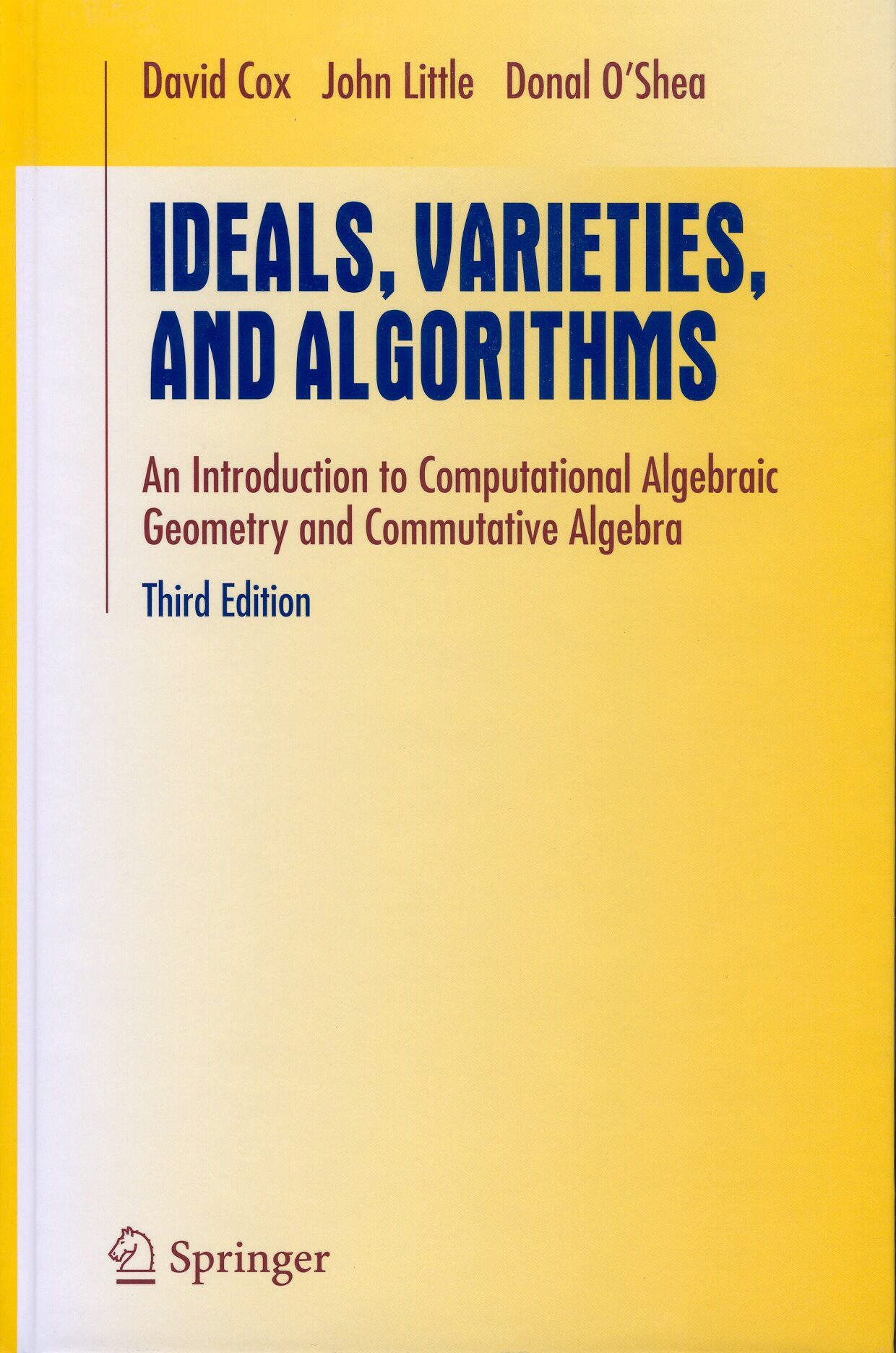
I got to thinking… didn’t I learn how to convert between parametric and implicit equations some time years ago? And, in fact, the answer was: yes. I took a class on algebraic geometry. The book we used (one of my favorite math textbooks when I was an undergrad) was:

IdealsVarietes.jpeg

The way this course was designed (it was officially a “seminar”) was that each day, two students would “teach” a section from the book to the rest of the class. We somehow made it through the whole book. It was a great experience, having to learn a section well enough to teach it the my classmates. The class was — however — a bit of a failure. The desks were in a row, people rarely asked questions, and no one engaged with each other. (Much like most of my college math classes, actually.) For something so student-based, it was strange that I didn’t make a single friend in that class. Plus, there was no “teaching” us how to teach well. Some some of us were great teachers, but most of us sucked. I can’t say what I was, really. I don’t remember. Regardless, I remember thinking: this textbook was incredible because I pretty much had to teach myself the subject. (I have to give major kudos to the instructor because he forced me to learn an entire course by reading a textbook.)

So upon reminiscing about this class and this book, I pulled it down from my bookshelf.

I am so dumb.

I will revise: I am so dumb now.

I look at the pages, and read theorems like Theorem 9 on page 241

“Two affine varieties V \subset k^m and W \subset k^n are isomorphic if and only if there is an isomorphism k[V] \cong k[W] of coordinate rings which is the identity on constant functions.”

and see words like “Nullstellensatz,” and wonder how I ever got to the point where this stuff made sense, and how I got to the point where I see a bunch of gibberish now. Seriously, it’s disturbing. I mean, I don’t expect to be able to pick up a book I learned from years ago and know everything in it, but I do expect that it is in a language I can read.

I’ve figured it out. I am Charlie in Flowers for Algernon.

I don’t know how to feel about the loss of my mathematical mind, besides sad.

Maybe I’ll try teaching myself some math again, to either prove to myself I still have it somewhere in me, or to know that my brain has truly atrophied to a giant anti-intellectual morass.

Folium of Descartes

Today, actually just an hour or so ago, another math teacher asked me if I knew a way to parametrize the following:

x^3+y^3=3xy

It is also known as the Folium of Descartes and looks like:

folium

Her purposes was just trying to find a quick and easy way to graph it on the calculator. It was just a small, unimportant question. She didn’t need to know the answer, if it wasn’t easily doable. But to me, I needed to know! How do we find the parametric equations which define this? I just don’t know. The answer I found online is:

x(t)=\frac{3t}{1+t^3} and y(t)=\frac{3t^2}{1+t^3}

And it’s pretty easily verifiable when you work backwards with the parametrization.

Is there something I’m missing? Is there a method to working from implicitly defined 2D functions to parametrizations for them?

Parents Night

Last Thursday was Parent Night. Also fondly known as The Longest Day You Experience In The Entire Year. Yes, indeed, on this day I woke up at 6:30am and taught until 3:10pm, followed by an hour of tutoring and a little bit of working, followed by running out to grab an early dinner in the ‘hood with some colleagues, followed by Parent Night! Which concluded, for me anyway, at 10pm-ish. Note that there is no time to lesson plan for the next day. Which is why I worked backwards and planned my classes so each would be having tests on Friday. Genius?

Check.

For those without Parent Night, it involves, in short, parents arriving at 6:30pm and attemping to follow their child’s school schedule — spending 10 minutes in each class (and 5 minutes getting lost between classes). I think it’s a very good thing we do. As one of my colleagues who retired a couple years ago said: “You know, it helps the parents know there isn’t a crazy person watching their kid for 50 minutes each day.”

Check.

My first year, I was told the two tricks for the night:

1.) Do not like parents corner you to talk about their individual child. If it does happen, either say “I’d love to talk but I don’t have my gradebook in front of me. Can we set up a time to talk by phone or in person later?” or “I generally don’t talk about individual students tonight, but I’d be more than happy to sit down and talk with you sometime soon.”

2.) When you’re “teaching” your class, talk for the entire 10 minutes. If you go under, and parents start asking questions, the night can turn very quickly if you have one upset parent.

My third trick to surviving the night without going crazy:

3.) Accept that parents are going to be on their PDAs while you’re talking. It’s annoying, but not worth getting riled up about.

Of course, although I tried my hardest, I got drawn into 4 conversations about individual students. You know how parents are, so sneaky. They lull you into a sense of calmness, and then THWACK: “Mr. Shah, we really liked your presentation. I really liked calculus when I took it in college. Stu is really excited about your class. How is Stu doing? THWACK!”

If you wonder what I spend the 10 minutes doing in each class, I give a SmartBoard presentation. Of course, my presentation is 15 minutes if I’m talking fast, so I basically edit to 10 minutes based on the cues my parents give me (if they’re stoic, I skip over the jokes; if they look interested in the structure and content of the class, I speak more in depth about that).

My calculus presentation is below.

Of course, this year, I came home sick. I barely made it through Friday. And I slept all of Saturday and Sunday. Yes, even though I know germs get you sick and not Parents Nights, I blame you, Parents Night, I blame you.

sin(1/x)

In my most recent calculus classes, I wanted to show my kids their first “not nice” functions. After being introduced to how to find limits graphically (fancy way of saying: looking at the graph of a function) and numerically (fancy way of saying: using the graphing calculator’s TABLE function to guesstimate limits), I wanted to have them think about what they learned.

I had time to show one class that these methods aren’t foolproof — that the calculator can lie to you, and make you think a limit is 3 when it is in fact 3.004, or that it can’t graph things when numbers get too large or too small. So they have to be careful. And that we will be learning algebraic methods to do limits. But for now, they need to use their brains and wits.

So I divided them into groups of 2 and 3 and had them use whatever methods they wanted to find:

\lim_{x \to 0} \sin(\frac{1}{x})

I made them each draw a sketch of the function, write down an appropriate table of values, make observations about the function, and then decide on an answer. (In one class, I had each group turn in their findings, and then I photocopied them and distributed them and had the class talk collectively about the results the next day. In the other class, we didn’t have time for this, and we just met up together as a group to talk.)

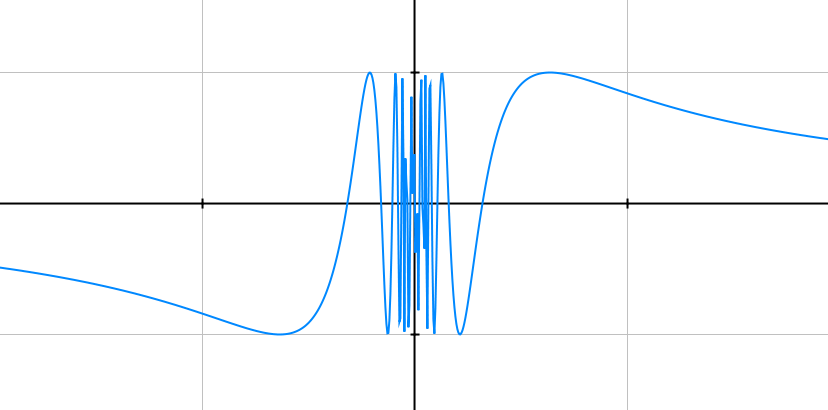
FYI, the graph is here.

Picture 1

It was great. Students were debating whether the craziness was a function of the calculator lying or if that actually was what the function looked like. They wondered if the limit was 0 or if it was “does not exist.” They noticed that the function starts to oscillate more and more rapidly as x approaches 0. They noticed that it bounced between -1 and 1. It’s not an easy question to solve with this information.


When we came back as a group, we talked about their observations and conclusions, and documented them on the board — so everyone had the same notes. Then I said: “so… one of you said that the function is crossing the x axis more and more as x is getting closer and closer to 0. Can we be more exact? Where does the function cross the x axis?”

Of course my students didn’t know exactly what to do. We got to the point where we knew we had to solve:

\sin(\frac{1}{x})=0

But then they were stuck. So I guided them through it.

I asked: “When is \sin(\square)=0

We generated: \square=...,-4\pi,-3\pi,-2\pi,-1\pi,0,1\pi,2\pi,3\pi,4\pi,...

We then said: \frac{1}{x}=...,-4\pi,-3\pi,-2\pi,-1\pi,0,1\pi,2\pi,3\pi,4\pi,...

We went through solving one of the equations for x and saw that we needed the reciprocals…

We concluded: x=...,\frac{-1}{4\pi},\frac{-1}{3\pi},\frac{-1}{2\pi},\frac{-1}{1\pi},\frac{1}{\pi},\frac{1}{2\pi},\frac{1}{3\pi},\frac{1}{4\pi},...

I then asked: So what? Why did we do this? Don’t lose the forest for the trees…

Finally, we converted those numbers to decimal approximations

x \approx \pm 0.318,\pm 0.159,\pm 0.106, \pm 0.080, \pm 0.064, \pm 0.053, \pm 0.045, \pm 0.040, ...

and saw that the zeros were getting more and more frequent as we approached 0. No matter how close we came to zero, we were still going to be bobbing up and down on the function. And crucially, we’ll be bobbing up and down between -1 to 1.

Picture 2

We then talked about what a limit means again… what the y value of a function is approaching as the x value gets closer and closer to a number. Using that informal definition, I asked them if the y value of the function was approaching some number as x was approaching 0.

At this point, most of my kids had that “a hah” moment.

I am definitely doing this again next year, but perhaps more formalized. I might generate a list of good conceptual questions to walk them through this more systematically. One such question: “How many zeros are there in the interval (.5,1)? How about (.1,1)? How about (.01,1)? How about (.001,.1)? How about (0.0001,1)? And finally, how about (0,1)?” Another such question: “How do we know the function will bounce between -1 and 1?”

Also, maybe next year, I’ll couple it with an analysis of the function:

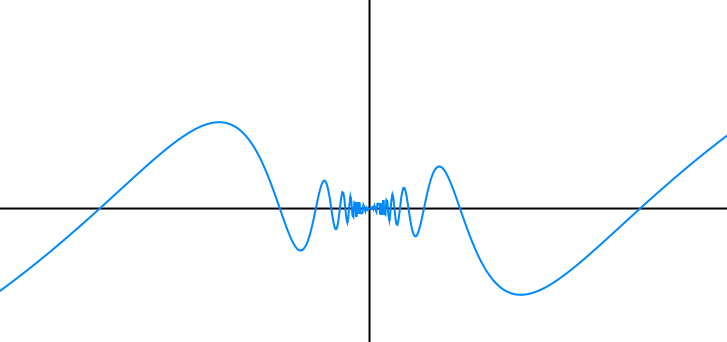
\lim_{x \to 0} \sin(x)\cos(\frac{1}{x})

The function behaves similarly (crosses the x axis more and more rapidly as x approaches 0), but the limit in this case is 0. You can see it in the graph easiest.

Picture 3

So if anyone out there is looking for something to spice limits up, you might want to really go in depth into these functions. They are often used as exemplars, but rarely investigated.