Multivariable Calculus Projects

Monday is the start of the 4th — and final — quarter at my school. I desperately want my Multivariable Calculus students to really love the end of the course. In the same spirit as the rest of the course (focusing on basic concepts and applying them to very difficult problems), I have decided to assign half as much homework and have students spend their time really investigating a hard problem, researching an interesting topic, or creating something based on what we’ve learned. Their choice.

I whipped up a draft of my expectations for their end of year project, which I’m embedding below (Go Scribd! I’ve been waiting for this feature to be WordPress.com compatible for eons!). I know this is not an ideal set of expectations. I need to clean up the redundant language, provide examples of good and bad prospectuses, as well as have on hand sample rubrics for students to use as guides when creating their own. (As an aside, if you know of any prospectuses/rubrics for me to show them, I’d very much appreciate you throwing the link down in the comments!) But my thought now is that I’ll see what happens this year, and then tweak it for future years:


I also spent a number of hours coming up with possible Multivariable Calculus projects, posted at my Multivariable Calculus resource site. I hope to add to it as ideas strike me. I’ll copy the projects that I have as of April 11, 2009, below the fold. But click the link above for a list that will hopefully be updated.

(more…)

Take what you don’t know…

In Calculus, I sound like a broken record. Each time we learn something new, I say “take what you don’t know and turn it into what you do know.” I say that at least three times a week. I said it last week when doing integrals like:

\int \frac{1}{4x^2+1} dx

We don’t know how to deal with that, but we do know how to deal with

\int \frac{1}{x^2+1}dx

So let’s try to turn what we don’t know how to do into something we do know how to do. For those who haven’t taken calculus for a while, the integral above is \tan^{-1}(x)+C. So to do the original problem, we want to somehow get the original integral to look like \int \frac{1}{(something)^2+1}d(something) — the integral of 1 over something squared plus 1. So we rewrite the integral as \int \frac{1}{(2x)^2+1}dx. That’s much closer to what we want to get — it looks more like something we know how to deal with. Next we use u-substitution to finish this beast off (u=2x) to get \frac{1}{2} \int \frac{1}{u^2+1}du. Now we have something we know how to deal with, from something we didn’t.

Again today, I showed my students how to solve \int_0^1 \sqrt{1-x^2}dx, and told them to solve: \int_0^1 5-3\sqrt{1-x^2}dx. At first sight, they recoiled, but again, we used the mantra of “take what you don’t know and turn it into what you do know” to solve it. If it looks scary, fine, have a moment of panic, but then ask yourself “what does this look like” and “can I turn it into that with some simple manipulation”?

I was thinking today how this actually could be my refrain in Algebra II also. Example: I could frame quadratics in that way. Students know — or quickly learn — how to solve equations like (x+1)^2=5 (hopefully). But what about something like x^2+6x+1=0? It’s not nearly as easy. But then we can talk about if there is a way to that what we don’t know (that equation) and turn it into something we do know how to solve ((x+3)^2=8). It’s not that I don’t do this already, but I am not always explicit about it. It is not my mantra.

But it should be. It’s how we solve math problems. We have something we don’t initially know how to do. And we have to figure out if we can simplify/rewrite/re-envision it to bring it to a place where we know how to do it.It seems stupid and simple and obvious, so much so, that I don’t say all the time. But if I started saying that as my refrain, if students really saw that math is simply this simple process, it might stop seeming like a huge bag of tricks that never fall together. They might see it as the art that it is — where there is creativity in deciding how to get from point A (hard problem) to point B (simple problem they know how to do). And all the specifics that we do in class are giving them the tools which they can use to chisel out a path from A to B. It might finally be us always trying to work out the puzzle: what does this look like that we know how to do, and can we get it to that place? 

In other words, we’re now talking processes instead of methods. We’re talking problem solving instead of rote memorization. And whenever a student is stumped on a problem, you can stimulate his/her thought process by saying “we’ve always taken what we don’t know how to do and turned it into something we do know how to do… what similar things does this beast remind you of?”

So yeah, it’s not a huge revelation or anything. But I’m thinking that it might be a really amazing experiment to frame my Algebra II and Calculus classes with this mantra next year. Heck, maybe even in the next few weeks when I’m teaching exponential and logarithmic functions! I mean, yeah \log(2x+1)+\log(x-1)=2 may look ugly. But is there a way to turn it into something we do know how to do? Namely something of the form \log(something)=2? Obvi.

Query for Teachers: Exponential & Logarithmic Equations

I have a question for you. In a day or two I’m going to be teaching exponential functions, followed by logarithmic functions. These are historically very difficult for our students (and I’m assuming your students too). One idea I had to making things easier is to separate “e” from the lessons totally. I’m thinking that teaching a difficult topic, and then integrating another foreign concept at the same time, has been part of the problem.

(Just like last year I taught quadratics, and when we saw the square root of negative numbers, I taught complex numbers. It arose naturally, but it was too much for my students. This year I taught complex numbers as a short mini unit before embarking on quadratics, and things went amazingly!)

I was going to teach exponential equations and logarithmic equations without “e.” Then when students had done everything, I was going to spend a few days introducing e and applying what we had learned to it.

What do you think? Do you do something similar?

Also, if you have any good ideas on teaching these topics, or good activities, or good resources, or even good questions/problems, please leave them in the comments. I want my students to really get and appreciate the concepts this year.

Moving Day!

I found a new apartment that I’m in love with, and I’m moving at the beginning of May. I called two moving companies which had been recommended to me to get price estimates.

Both will send 3 people.

Company A charges $100/hr for their services. However, they have a 2.5 hour minimum charge. They also charge $100 for 1 hour of travel time (30 minutes to the apartment and 30 minutes from the apartment). There is an additional fee of $50 for packing charges for my futon, mattress, and TV. Lastly, they charge by the quarter hour. So if they worked 151 minutes, they’d charge me for 2.75 hours.

Company B charges $130/hr for their services. They have a 2 hour minimum charge. They also charge a travel fee, but it is only $65 in total. Lastly, they too charge by the quarter hour. So if they worked 121 minutes, they’d charge me for 2.25 hours.

The question I was left with is: which is the better company for me to hire?

The only variable is the amount of time the movers spend moving.

moving-companies1

The x-axis is the hours spent moving, the y-axis is the amount of money my bank account will be missing. Company A is in blue, Company B is in red.

What’s awesome is that we just taught functions and function transformations in my Algebra II class. And one of the functions we worked with a lot was the floor (step) function. We’ve also talked about piecewise functions. If I were teaching an accelerated class, I would literally give them the information and ask them to (a) first produce the graph,  and then (b) from the graph, come up with a function that gives them the graph.

They’re going to have to recognize they’ll need a piecewise equation, and then also have to figure out how to make the function transformations on the step function to get the second half of the piecewise equation.

I kind of love this problem.

April Fools!

Wednesday was April Fools day. I had all these ideas of jokes to play but they all got foiled. My students, on the other hand, got me twice.

My attempts:

1. One of my students in my 7 person calculus class was not in the room at the start of class.  I told all the students that they should each have one of their English or History papers ready to hand in, because in the middle of the class I was going to exclaim “Oh my! I forgot to collect your reports on the mathematicians important to the development of calculus.” And then everyone would go in their bags, rustling their papers, and one of them was going to say how they didn’t have a stapler… The student who was late was going to totally freak out, about this huge assignment that he clearly knew nothing about and didn’t do.

It didn’t work. Why? The student wasn’t late. He was absent.

2. I finished class 5 minutes early, so I sent two students to the math office to get the department head, or any teacher who wasn’t teaching. They were supposed to say something about how I got angry and threw a calculator at a student, and it hit the student in the head and now the student was bleeding and I was freaking out, and they didn’t know what to do so they thought they’d get the department head. Then I would yell APRIL FOOLS when she came into the room.

It didn’t work. Why? Because the department head wasn’t in the office, and the teacher who did come knows me too well. Plus the students were being overly histrionic and said that I was sobbing in the corner. She knew I wouldn’t sob.

However, students in the same class pulled two jokes on me.

1. We’ve been working on integrals involving inverse trigonometric functions, including \int \frac{1}{\sqrt{1-x^2}}dx=\sin^{-1}(x)+C. Literally 30 seconds after reviewing this, I put up a new smartboard page and I put on the board the question:

\int \frac{2}{\sqrt{1-x^2}}dx

One student raises his hand and says he wants to try to solve it. He then proceeds to do a really convoluted u substitution, which basically led us down the worst paths possible. Each step he takes, I start cringing some more, but I don’t want to give it away that this is just lunacy, and that we can solve this problem SO easily. I want him to come to the conclusion that whatever he’s doing won’t work. Finally, after we take up 5-7 minutes going down this path, and he suddenly shouts out “APRIL FOOLS! IT IS OBVIOUSLY 2 \sin^{-1}(x)+C!”

2. Later in the class, I’m working out some harder problems at the board, and I notice that one of the students is seems like he’s closer to me. I continue on, and every few seconds, I’m thinking “something is off in this room.” About sixty seconds later, I look at this student, who is sitting at his desk, which is now literally 2 feet away from me. He had slowly been inching his desk towards me. APRIL FOOLS MR. SHAH.

However, I did get a small prank in today, April 2nd.

In my OTHER calculus class (17 students – and 10 of them were absent for a field trip), I gave a 3 question pop quiz and 8 minutes to complete it. Well, two minutes before time was up, I told everyone “don’t forget to do the problems on the back.” Frantic students flipped over to see what they still had to do. (Of course, the other side was blank.) Then I shouted “APRIL SECONDS!” They said “Good one Mr. Shah.”

And it was. And it was.

Function Transformations

On the Friday before Spring Break, I gave my Algebra II class a quiz on function transformations. It only had reflections about the x- and y-axes, and vertical and horizontal shifting.

I know, I know, you can’t believe how cruel I am, doing something in class the last day before Spring Break. 

Now that we’ve gotten that out of our system, back to the point at hand. Today, I finally got around to grading them. And I have to say that I was really pleased with the results. With the exception of one or two exams, all students did really well.

I told students they needed to memorize the eight standard functions and key points on them (the standard functions include y=x^3, y=|x|, and y=floor(x)). Key points are points I require to be correct on all graphs — after the transformations, they need to be in the right place. So, for example, I require students to know that (-2,-8), (-1,-1), (0,0), (1,1), and (2,8) on y=x^3, and then when  they were asked to graph y=-(-x+1)^3+1, they need to make sure each of those five points are in the correct place. 

A few students — as expected — mixed up translating right/left. And a few performed the reflections last (when they have to perform them before they do any translations up/down/left/right. But yeah, few and far between.

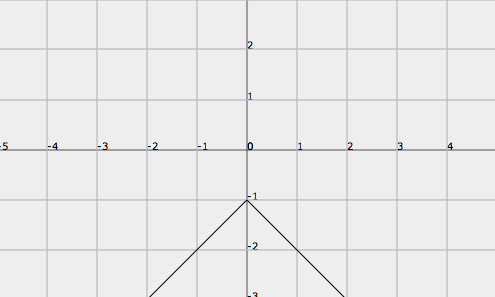
My favorite part of the exam was giving students a graph like:

picture-11

I asked my students to give me the equation describing the graph. Most students rocked that part, even though I only gave them one problem of the same sort as a warm up. I don’t know why I didn’t give them problems like this last year — they require students to really think hard about function transformations to work backwards.

The one question that students almost universally bombed, which made me want to turn myself into a sheet of paper and crumple myself up and throw myself in the wastebasket, was the “explain” problem. The question read something like “Explain in words why y=-\sqrt{x} is a reflection of y=\sqrt{x} over the x-axis. You may want to use a diagram/graph and a table of values to explain your answer.” 

What’s clear to me is that, frankly, my students still have no idea how to explain their ideas in words. I have given questions like this on each assessment, but previously we had a discussion about the concept and how one would go about answering the question. This time, I threw the question on to see if they could do it themselves. Clearly not.

Next year I am going to have to come up with a good way to integrate these “explain” questions in the course. Perhaps I’ll come up with a list of possible questions for each test and hand them out — so students can try to properly prepare their answers. And after each exam, I’ll hand out a list of possible answers and having a discussion about which are good, which are bad, and which are mediocre — and why. (In addition to verbally having the discussion in class.) I think this year I’m just not being clear enough with my expectations. 

Or maybe I’ll just have students write up good answers at home and hand them in, instead of having them on an exam. And if they aren’t satisfactory, I’ll give students the opportunity to rewrite their answers with my comments incorporated.