Ennui

I don’t really have the energy to give a true update, and I don’t want to complain. I just feel like in the past few days, I’ve been struck with a sense of lingering ennui, and I’m hoping that Spring Break rejuvinates me. It appears that students are really stressed out this week, and it’s being reflected in the way they’re acting. And honestly, it’s a bit of a cycle, because the way the students are feeling is affecting the way I’m feeling, which is affecting the way that students react to me, and so on and so forth.

For short updates on my three preps, read on.

1. In Multivariable Calculus, we’ve been working very slowly on our current chapter. I thought we’d be able to finish it before the quarter ends, but now I’m skeptical. We’re going to have to work pretty darn hard. The current problem set that I’ve given them is pretty tough, but we’re doing this one even more collaboratively than the others, so I’m glad about that. Recently, in class, we had to solve \int \cos^4(x) dx and I forgot how to even go about it. We found a nice, but convoluted solution, because we were working with nice limits of integration. But I have to tell you… I forgot how to do a lot of these less straightforward integrals. The good news is that we came up with ideas and found the solution using symmetry arguments and trig identities. Awesome. At first I feared this was a waste a time, but then I realized: this is what this course is about. Problem solving. You have something you don’t know, and you don’t have a formula for it. Work it out.

2. In Algebra II, I’m a bit behind the other teacher. We’re teaching function transformations, after a pretty arduous — but I’d say successful — unit on inequalities and quadratics. I don’t have a great way to introduce function translations, other than students doing some graphing by hand and noticing some patterns. (“Oh! The graph is the same as the other graph, but moved up one unit!” or “Oh, why is the graph the same as the other one, but moved to the left?”) I’m repressing the name now, but some math blogger posted a Logarithm Bingo game. I think that once I finish the functions transformations unit, I’m going to design and play Function Transformation Bingo!

3. In Calculus, we’ve been working more on the anti-derivative. It’s funny how different my students are. Some have the intuition like *that* while others are struggling to figure out what’s going on. But honestly the only way to do these problems is to really struggle through them. My favorite problem from last night’s homework was to find the antiderivative of x^{1/3}(2-x)^2. Almost all students got it wrong, because they didn’t see that if you expand everything out, the problem reduces to something much easier: finding the antiderivative of 4x^{1/3}-4x^{4/3}+x^{7/3}. Well, them not seeing that it is easily expanded causes me less chagrin than a student saying, “so you must first multiply the x^{1/3} by each term in the 2-x expression, and then square it?” YEARGH!

That’s all folks.

How do you introduce integrals?

I’m putting a call out to calculus teachers and calculus aficionados out there. I want to know how you transition to teaching integration, and why you cho0se to do it that way. And if you have any activities, investigations, etc., that you can send me, I’d love to have them (and post them here for other calculus teachers).

I’m not super pleased with, but I don’t hate, what I’m going to be doing tomorrow.

Here’s the deal. I just gave my last test on differentiation today, and tomorrow I’m transitioning to teach integration. I teach a regular (non AP) calculus class, so we can take our time. At the moment, I’m grappling with two things: (1) whether to teach anti-differentiation first and the notion of “area under the curve” second, or vice versa, and (2) how to make integration intuitive.

Last year, I transitioned by giving students a graph of y=\sin(x) and told them to find the shaded area. Those were my only instructions.

sine

Some students made triangles, some students guestimated, some students made rectangles. I don’t remember all the different approaches. But then we had a discussion about how they estimated their areas, which then led to me transitioning to Riemann sums and a general introduction to the whole new unit. The thing I emphasized: “In all your previous math classes, you only learned how to find areas and volumes of silly little figures, like squares and cubes and maybe you remember a nonagon or cone. But what about crazy, strange, weird areas? Volumes of crazy, strange, weird figures? Did you ever wonder where the formula for the volume of a sphere come from? Calculus not only can answer questions about position, velocity, and acceleration, and how to maximize and minimize quantities, but it can do all this other stuff too.

This year I’m not going to talk about areas under curves (yet). I’m going to start with two days of practicing antidifferentiation. I’m not going to say much to transition to this new material except to say that derivatives were the first part of the course and antiderivatives will be the second. And that we’ll soon be able to do a lot with them, like we found out we could with differentiation… Then I’m going to introduce the idea of the “opposite of differentiation” and spend the entire period having students build their intuition.

First, they’re going to do a matching game in pairs (PDF). We’ll then quickly debrief, but not really go into depth about any question.

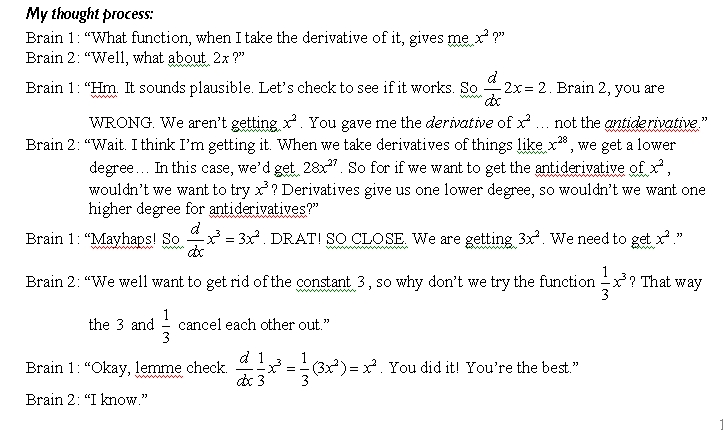
Second, they’re going to work in a different set of pairs on just playing around with finding the antiderivative, by intuition and guess and check. I want them to learn to think through a problem. So I typed up what goes through my head when I try to do an antiderivative.

thoughtprocess

And then I’m letting them loose on a set of problems which should hopefully introduce them to some basic integration rules (PDF). I think it’ll take the whole period. And we’ll spend the next day debriefing. I want them to struggle through integration now. I want them to see why \int x^2 dx=\frac{x^3}{3}+C instead of memorize the power rule. I anticipate it to be kind of hellish for them; they — like most students — want formulaic ways to do calculus.

But just as I struggled to hone my students intuition (see my previous blog post) for differention, I wanted to make something similar for integration.

We’ll see what happens tomorrow.

Pendulum Lab, Reprise

This post refers to the pendulum lab I recently posted about. I had my students collect data, and this is what they got:

Length (inches) Period (sec): Group I Period (sec):
Group II
Period (sec):
Group III
Period (sec):
Group IV
60 2.57 2.57 2.49 2.50
54 2.36 2.38 2.34 2.50
48 2.31 2.29 2.17 2.23
42 2.16 2.06 2.03 2.09
36 2.07 1.96 1.86 2.00
30 1.82 1.89 1.77 1.79
24 1.64 1.67 1.64 1.63
18 1.44 1.43 1.42 1.39
12 1.12 1.14 1.12 1.16
6 0.86 0.83 0.87 0.78

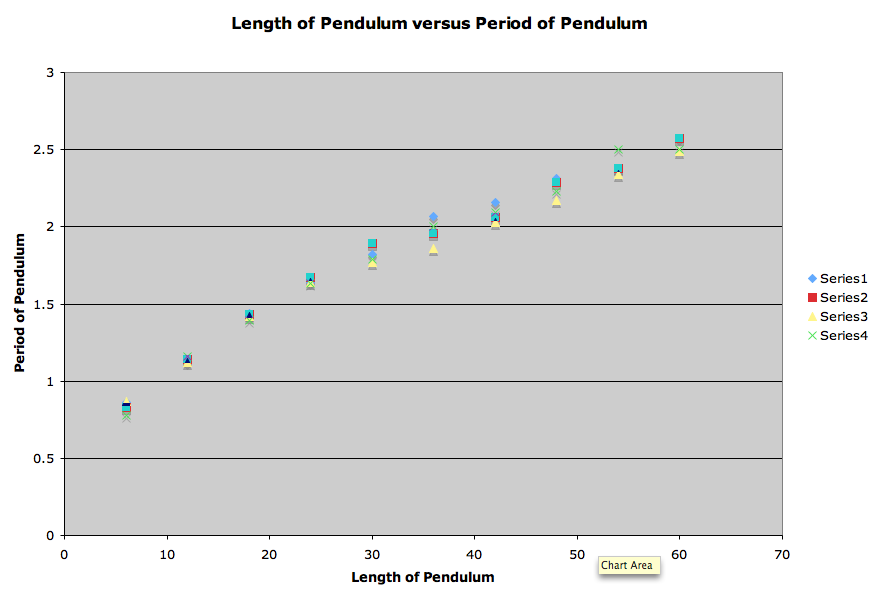
The data was pretty consistent among the various groups. Remember we did this lab in the context of parabolas. However, when the groups plotted their results, they were getting:
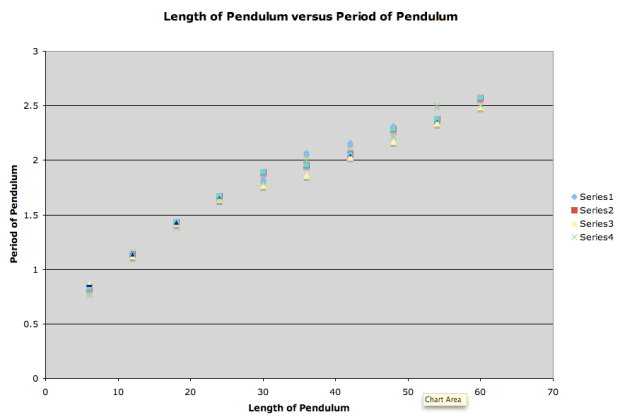
picture-4

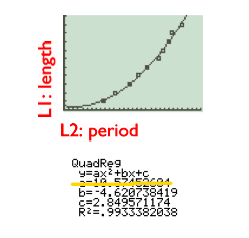
What?! The data doesn’t look quadratic. If anything, it looked to us like a square root or a quadratic with a negative x^2 coefficient. We used our calculators to do a quadratic regression, and got (for one set of data):
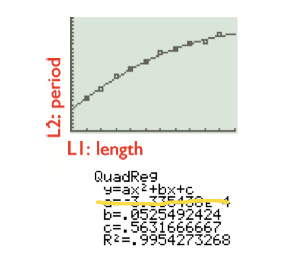
picture-5I tricked my class into believing this was a good model. I mean, look at it! The parabola fits the data so well!

But then we looked at the x^2 coefficient and saw it was negative and nearly zero. And then when we expanded our domain, we got:

picture-6

It was at that point that students saw how our model sucked. Because they said that if we increase the length of the pendulum, the period should increase too.

So we went back to the drawing board. I suggested  that we plot period versus length, instead of length versus period. (Next year I’m going to have us discuss this idea more — the swapping of x and y coordinates, and how something that looks like a square root might look like a parabola if we do that. Because of timing issues in this class, I just told them that was what we were going to try. Sigh.)

And we did, and found the quadratic that modeled it, and saw:

picture-7

And then we extended it to see that if we increased our period, if the length would increase too…
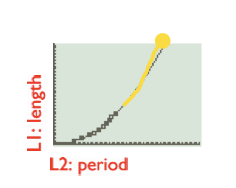
picture-8

It does! It makes conceptual sense too! (We also talked about whether it should hit the origin and why our model does or does not hit the origin.)

With our newfound analysis, I had students answer the following question based on their “good” quadratic model (in our case above: y=10.57x^2-4.62x+2.85):

(a) If your pendulum has a period of 1.5 seconds, estimate the length of the pendulum.
(b) If your pendulum  has a period of 20 seconds, estimate the length of the pendulum.
(c) If your pendulum has a length of 10 inches, estimate the period.
(d) If your pendulum has a length of 1,200 inches, estimate the period.

What is nice is that (a) and (b) just involve students plugging in x=1.5 and x=20 into their model. And all the groups got very similar answers for the first length, and really different answers for the second length. So we got to have a short (I wish it could have been longer) discussion of why that is so. (We talked about interpolation versus extrapolation.)

And then (c) and (d) involved students solving a messy, real world quadratic because they’re setting y=10 and y=1200. The same thing that happened in part (a) and part (b) happened in part (c) and part (d); all the groups got very similar answers for the first period, and really different answers for the second period.

What we didn’t get to talk about, unfortunately, is the theoretical answers, based on physics. The formula for the period of a pendulum is T=2\pi\sqrt{\frac{L}{g}} where T, L, and g are in standard metric units. So I was hoping we’d get a chance to do some unit conversions to see how our experimental data relates to to theoretical data.

I did get to show my students how their values compared with the theoretical data:

Length of String Group 1 Group 2 Group 3 Group 4 Theoretical
60 2.57 2.57 2.49 2.50 2.48
54 2.36 2.38 2.34 2.5o 2.35
48 2.31 2.29 2.17 2.23 2.21
42 2.16 2.06 2.03 2.09 2.07
36 2.07 1.96 1.86 2.00 1.92
30 1.82 1.89 1.77 1.79 1.75
24 1.64 1.67 1.64 1.63 1.57
18 1.44 1.43 1.42 1.39 1.36
12 1.12 1.14 1.12 1.16 1.11
6 0.86 0.83 0.87 0.78 0.78

I think they were impressed, though I didn’t get the ooohs and aaahs I was hoping for. I’ve plotted the theoretical (purple) with the actual data (yellow) so you can see how good the experiment was. I am not plotting it on a period versus length graph, though if I were to show my students, I would do that because that’s the way we analyzed the data (we got a parabola).

picture-9

And with that, we finished our lab.

Moore’s Law

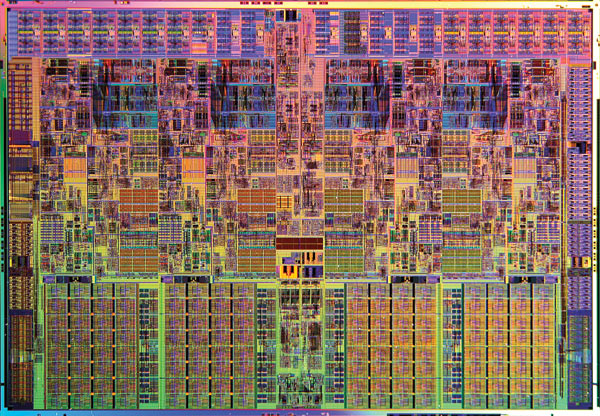
The Technology Review magazine has an arresting photo essay on Moore’s Law — as told through a bunch of stunning pictures of computer chips. Click on the link above to see all the other circuits. For those who don’t know, Moore’s Law says that about every two years (some say 18 months), the number of transistors that can fit on a circuit doubles (for Wikipedia article, click here).

0109-chip-m_x600

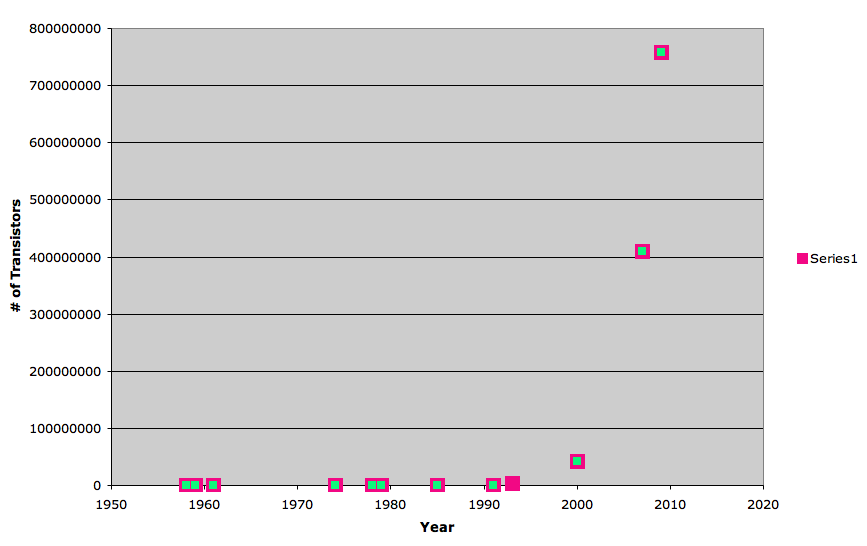
The only thing I wish about the photo essay is that there was some sense of scale for each picture. Regardless, the captions tell the year each circuit was created, and the number of transistors on each circuit. The data are:

1958 1
1959 1
1961 4
1974 5000
1979 68000
1978 29000
1985 275000
1991 200000
1993 3100000
1993 2800000
2000 42000000
2007 410000000
2009 758000000

So of course, even though this data isn’t perfect nor complete, I thought I’d see how it’d look graphed.

picture-1

Ohhh, it looks like it could be exponential… Let’s plot it on a log-scale. If it’s exponential, we should get a straight line:

picture-21

Ohhh, this looks pretty linear! I wasn’t sure that it was going to work out.

The exponential line of best fit is: Transistors=e^{0.397*\text{Year}-777.29}. When I plot the data (pink) and the exponential line of best fit (blue) on the log-scale graph, you’ll see that Moore’s Law looks like it has some serious bite to it.
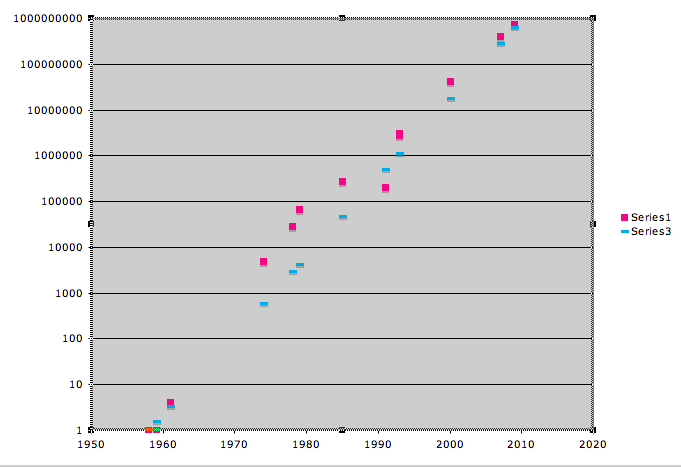
picture-31

Doing a little algebra with the exponential model we came up with, it appears that the number of transitors doubles about every 1.75 years.

And if you cared, Wikipedia gives their own following graphical illustration of Moore’s Law:

I’m going to be teaching exponential functions in a bit. I hope we’ll have time to do regressions. If so, I’ll probably make a 2-day investigation out of Moore’s Law.

Other posts I’ve made about logarithmic and exponential functions:

Logarithmic Graph in the News
Earthquakes, Richter Scale, and Logarithms
The Supreme Court, Linear  and Exponential Growth, and Racial Segregation
The Origin of Life on Earth and Logarithms
Paper Folding and Exponential Functions

Pendulum Lab

This week I’ve had one and a half Algebra II classes to “kill” because I’m ahead of the other teacher and we need to sync up again. Since we’re working on parabolas, I thought we could do something fun.

A while ago, I watched this video:

And I decided, perfect! I’m going do the pendulum thing in class. I got some string and washers, and put masking tape on the string every 6 inches. And I had student calculate the period of the pendulum when the length of the string was 6 inches, 12 inches, 18 inches, … , 60 inches.

To minimize the error generated by a student not exactly stopping the stopwatch when pendulum swung back and forth, I had students have the pendulum swing three times. That way any reaction time error of the person operating the stopwatch gets reduced by a third! And I had students do 3 trials for each length of string, to further minimize error.

It took all 50 minutes for students to collect all their data, plot it on a graph, and enter the data in their calculators.

Tomorrow we get to have fun. To warm up, we’re going to talk about sources of error. Then each group will get to share their graphs and talk about their findings. Then we’re going to perform a quadratic regression on our calculators, talk about if we have a good or bad model and ways to decide, and then use our model to make some predictions. (If we know the period, can we find the length of the pendulum, and vice versa.) Then, I’m going to conclude by showing students the theoretical formula for the period of a pendulum (T=2\pi\sqrt{\frac{L}{g}}) and we’re going to see if their collected data matches up with the theoretical predictions.

The best part about this is that all the groups data seems in line with each other, and in fact, they are all really close to the theoretical predictions. I can’t wait to see if there are oohs and aahs about how accurate these data points they got are to the theoretical predictions.

I’m excited for tomorrow!

UPDATE: my data collection sheet (PDF), my lab debrief sheet (PDF).

Digital Artifacts

Dan Meyer has recently been asking teachers to consider (a) the problems with textbook application problems and (b) finding or creating compelling content for the classroom.

I’ve been thinking about this since he’s started posting, and I’m trying to think of where I can find — but not create — the interesting digital media that would satisfy his criteria.

In the meanwhile, I decided to look on youtube for some videos that would naturally lead to a particular discussion/topic for some high school math class. Some are better than others. Without further ado…

Inequalities and Quadratics

In Algebra II,, we’ve recently been delving into quadratics. I recently blogged about how I taught completing the square and the quadratic formula, and put up a bunch of resources. Since then, we’ve moved on to graphing quadratics, followed by inequalities.

The complete topic list for inequalities is:

picture-3

I’ve been trying something new, which is creating packets for students to work on. In essence, I’m creating my own textbook for these sorts of questions. I thought I’d share them with you in case they prove useful [1]. I’m pretty proud of them — and they way they fit together and build up understanding, not just providing a method to solving problems.

1. PACKET 1: Linear and Quadratic Inequalities on the Number Line (PDF version)
2. Additional Homework on Quadratic Inequalities (PDF version)
3. PACKET II: Linear and Quadratic Inequalities on the Coordinate Plane (PDF version)

4. PACKET III: Systems of Inequalities (Linear and Linear-Quadratic) (PDF version)
5. Additional Homework on Systems of Inequalities (PDF version)
6. Pop Quiz on Inequalities and Quadratics (PDF version)

Hopefully they’ll be useful to someone else out there!

[1] The formatting might be a bit off for you… It looks slightly off (meaning the pages don’t end where I intended them to end) on my mac but fine on my PC. I think you need to make sure that on a Mac you select all and convert the font to “Gill Sans” (on a PC, I think it’s called “Gill Sans MT”, which is creating the problem).

UPDATE: PDFs posted, without typographic weirdnesses.