The images below are thumbnails. Click on the image to see it properly.
ALL 4 SLIDES TOGETHER:
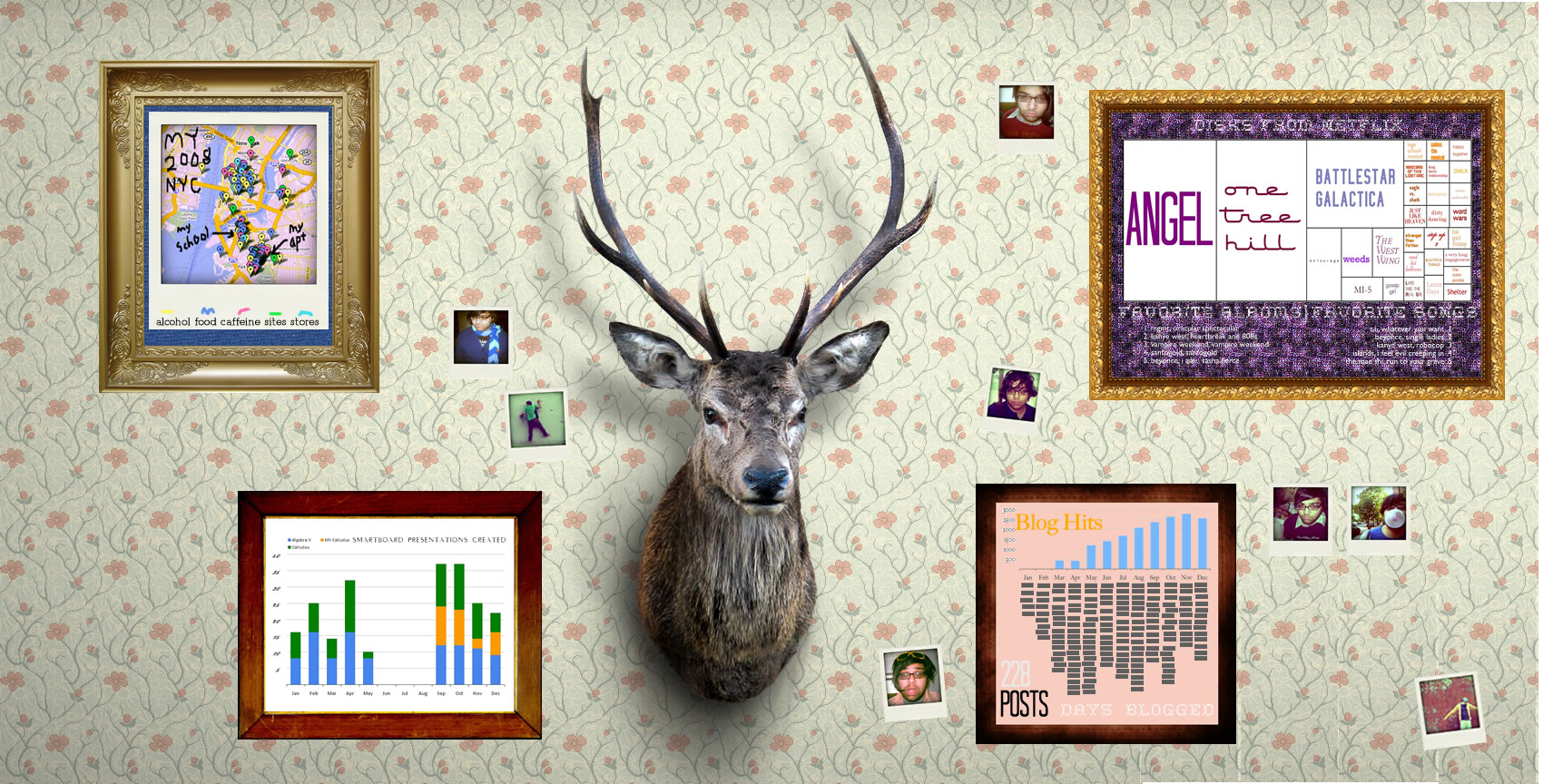
To see the slides individually (click on them to see bigger versions) and read my reflection, jump below the fold.
The images below are thumbnails. Click on the image to see it properly.
ALL 4 SLIDES TOGETHER:
To see the slides individually (click on them to see bigger versions) and read my reflection, jump below the fold.
Just a quick link passing you along to Dan Meyer’s Annual Report contest.
Design information in four ways to represent 2008 as you experienced it. This can mean:
- four separate PowerPoint slides with one design apiece,
- one JPEG with four designs gridded onto it,
- an Excel spreadsheet inset with four charts,
- etc.
I had a blast working on it last year. To get a sense of what we’re talking about, check out examples from last year.
The memorial service for the student who passed away last weekend was held today. I went with a group of teachers so we could support each other and students. The church was packed and hushed, and the service was emotional. Students — his friends — spoke about their memories of the deceased, and about his best qualities, and about the love that exists between friends. The pain in the tremors in their words was hard to hear. That was the hardest part of being there for me. But hearing all the wonderful memories, how much this person touched those around him with his large heart and humor-filled personality, was also the best part about being there too. I almost cried when someone read “Goodnight Moon,” which was one of his favorite books when he was a child.
A few of us went out for a late lunch afterwards and just being around each other was helpful. Not that I’ll ever forget this incident, and surely there is still going to be an aftermath for weeks to come, but with this, I think I’m done talking about it on this blog. There’s probably just going to be one more post about how this relates to teaching at some point in the future.
Goodnight stars
Goodnight air
Goodnight noises everywhere
Today in Multivariable Calculus I was supposed to teach my students how to find the plane tangent to a surface at a point.

The book, however, was not clear how to do this. They had an equation involving the gradient of a function, but the equation was derived via local linear approximations. Fine and dandy, but I didn’t like it. I didn’t “see” it or grasp what was going on.
What’s clear is that to find the equation for the plane — for any plane — we need a point and a vector pointed in the direction normal to the plane. We are given the point, but we need to find the direction normal to the plane. That’s the same as the direction normal to the surface!
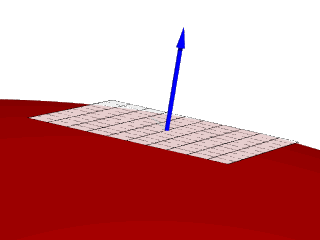
So I set my class up with the task of doing this on their own. They’re still working on it.
But honestly, I’m not quite there yet. I don’t want to just give them the equation and method on how to apply it, but I don’t think I can explain it in any good way. I’m almost there, at a conceptual tipping point, but I need one last shove over the edge. Anyone out there ready to help?
First of all, I decided that working with surfaces is silly and I’d reduce the problem to curves. So let’s start simple.
Let’s say we have the graph of 


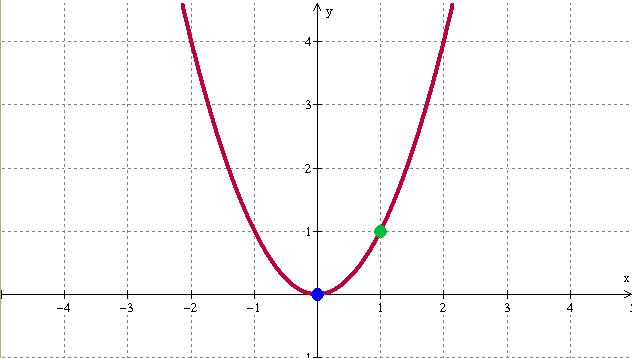
Well, traditionally, we’d be crazy and parametrize the parabola by creating the vector-valued function 


But trust me, this is an awful amount of work, and 
And it can. And this is where I need your help.
Instead of considering the plain old boring function 

The function 

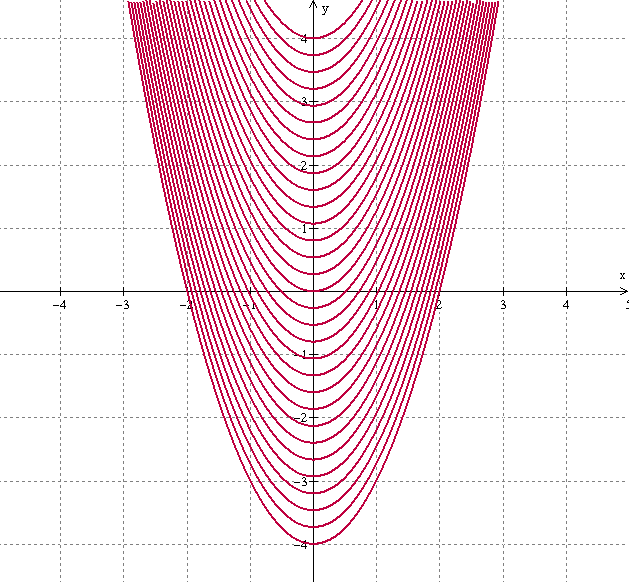
Remember that one important (perhaps the most important) property of the gradient is that the gradient of a function points in the direction of maximum of steepness on a graph of level curves.
Let’s look at the points we’re interested in!
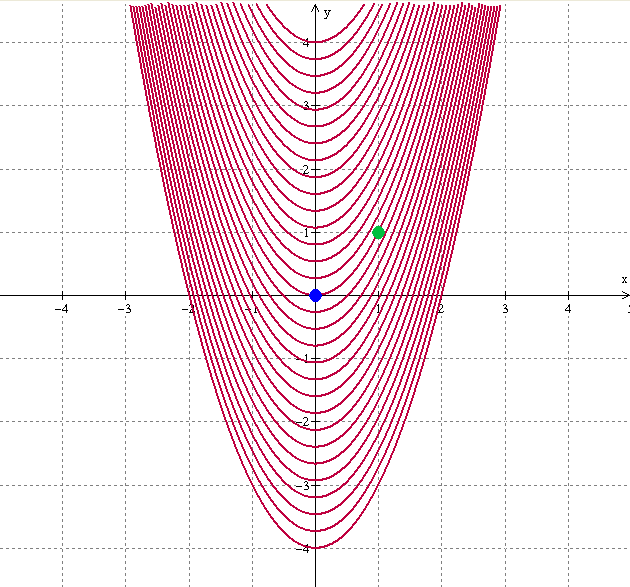
Just looking at the graph shows we’re onto something. Look at the blue dot. Which direction is the steepest, if you were standing at the blue dot and wanted to walk in the steepest direction? Well, clearly it would be directly north. (You want to walk the shortest distance to get to the next level curve. Since the change in heights between level curves is constant, you want to minimize the distance you’ve walked to get to the next height to have the steepest slope.) What about the green dot? Clearly, northwest.
And actually calculating the gradient of 
At the blue dot, we get 
At the green dot, we get 
I’m plotting them below.

And without all the pesky level curves to distract us.

Clearly this method works. We take the original function
The questions I have after doing this:
(1) Why did we have to change our nice curve
(2) How can we understand that the vector normal to the curve somehow is “magically” the gradient of the surface we created — one of whose level curves is the curve we’re interested in.
(3) Extending this analysis to problems where we want to find the normal vector to a surface like an ellipsoid (like 

(For a picture of some level surfaces, check it out here.)
Anyway, this is just my musings, my way of thinking through this. I’m not quite there. Any help you can give, great. If not, that’s cool too.
[1] I guess to make things simpler, we could simply calculate the direction of the normal vector and not worry about making it a unit normal vector, so we could simply calculate $\vec{T}'(t)$ only. We’re not concerned about the magnitude of the normal vector, only the fact that it’s normal.
Dan Meyer of dy/dan fame has a series of posts titled “What can you do with this?” — where he shows a picture or video with some sort of math connection, and asks teachers how they might use it in class. (Others are jumping on the bandwagon.) I figured why not. I love the idea. What I’ve noticed is that many of the pictures deal with ratios and proportions. I wonder if we can get pictures that deal with other things — like radical equations and limits.
Michael Lugo at God Plays Dice directed me to the following picture:

Fantastic, isn’t it! What you could do in a math class isn’t obvious at first glance. But let’s see what you come up with! For a spoiler (do NOT check it out until you’ve come up with an idea yourself), see below the jump.
Today, besides waking up tired, I went through a whole range of other emotions. Frustration being the most prominent. Now that day 1 and day 2 are over, the school is slowly starting to go into full swing again. Classes are starting to put more content in them, students are becoming more engaged, jokes are being made, and I can finally smile again. Which is all really wonderful.
Still, the logistical aftermath of the tragedy is starting to unfold. We had midterms scheduled for next week, and the powers that be decided instead of changing the nature of the midterms (have teachers make them take home, or one hour instead of two, or have group midterms, or any number of other things), we are canceling them entirely. Which I can support, and will support. Sometimes top-down decisions have to be made. However, the result of this is that teachers are expected to continue teaching next week.
But no teacher, at least none of the teachers I’ve talked to, is in any way ready to start teaching our new material next week. We have a bunch of work we planned on doing during the lull of midterm week. At least, I have a ton of work — in addition to prepping for next semester.
So things are stressful. And the fact that this is all coming out today, Wednesday, makes it hard to manage.
Clearly, you can see from this that I like order, stability, and clear expectations. When things are messed up, I get messed up.
As a last side note, I found out that I’m not even going to be in the classroom next week. I was told this after trying to figure out what I’m doing in each class, and when I’m doing it. The school is hiring me a substitute for every one of my classes, because I’m a 10th grade adviser and we have to put on gradewise community service project that was planned for midterm week. So apparently I have to leave all 4 of my classes in the hands of substitutes for a week. Which is such a waste of time for the kids.
I hate to say this, but I think showing math movies is on the table in some of these classes.
Yesterday, the key word was exhaustion. The fact that it was Monday, and when the day was over and it was still Monday, was unthinkable. Wednesday, Thursday, surely it was much later in the week. 7:45-3:10 felt much longer than 7 hours and 25 minutes. Waves of tiredness hit all of us, at various points of the day, and the thought of going home and preparing for the next day unfathomable.
I ended up having 3 cups of coffee and a can of Coke to get through the day.
As with many bad things, one of the most striking things that I noticed about yesterday was that I still had moments when I was laughing. Not the awkward, nervous laughter that comes out of not knowing what to say or do. It was true laughter at funny things. I recognized that I was going through a range of emotions, and something the school psychologist told us stuck with me. “You may, for a second or minute or a few minutes, forget what happened. You may be happy. That’s okay.” When he said it, I understood it but I did not comprehend it. I went home exhausted at 8, passed out at 10.
This morning I woke up feeling… refreshed. Like my battery had been replaced and I had a fresh supply of energy. I had rested away the sheer exhaustion that yesterday brought on. I wasn’t sad or happy or anything — except functioning. And this, my friends, was nice.
As I approached the school, the heaviness started to set in again. But at least today I had the restedness to deal with everything. Today people were figuring out not how to cope, comfort, and deal with the shock and tiredness, but how to move forward. This wasn’t all people — but I saw smiles and laughter, overheard some normal conversations instead of yesterday’s hushed whispering and muffled whimpering. I saw hustle and bustle instead of trudging and robotic-front-stare-walking. Not that it was all roses, or roses at all. A sadness and heaviness blanketed the school, but underneath this weighty shrowd, stirrings. Stirrings. That’s when the school psychologist’s statement really was highlighted:
“You may, for a second or minute or a few minutes, forget what happened. You may be happy. That’s okay.”
And I did forget, too. Not all the time, not even a majority of the time, but there were moments when I realized I hadn’t thought about the death of our student for the past three minutes. It was initially scary — because I wondered if that made me unfeeling. I don’t think that’s the case. I think that I’m in the initial stages of moving on. Not forgetting — this students’ death will be with me for years. But moving forward. Being able to function.
Not all my students are at that point, nor should they be. Some seem to be able to function. One of my classes carried on fine. Another one was quieter but students weren’t incapacitated. The last was the hardest, because it is populated with students the grade of the student who passed away.
I knew they were not sleeping — a student told me that no one in that grade has been able to sleep well. We spent only 15 or 20 minutes learning new material, and it was very basic stuff. Almost no one raised their hands to answer my questions. When I gave them the remaining 25 minutes to work on a worksheet covering some of the same material, I told them: you can work on this if you feel you can focus, you can work alone or with friends, you can not work on this if you don’t feel you can focus, whatever. I expected students to get with their friends and maybe work on the worksheet or maybe talk. Or if they were sick of talking about the death of the student, they would at least talk about math.
But the level at which they were affected was so enormous that literally, for those 25 minutes, no one said anything to anyone. I encouraged students to work with each other, but no one moved. Teenagers, not wanting to talk. Let me say that again: Teenagers, not wanting to talk?! The only voice in the room was mine. All students worked alone on the sheet, and they worked pretty assiduously. And quietly.
In the last four minutes of class, I had to ask them if they thought us doing a small bit of lesson and some worksheet work (and no homework) was helpful. Again, silence. Quiet. One mumbled something about it being fine, and then another two said it was good.
I could have asked them if the moon was made of cheese and gotten a similar response.
It’s hard to see this class so deeply affected — because all teachers want to protect their students. But we can’t. And we’re all grieving in different ways and at different paces. I wish I could neatly tie today up in some summative way. But every hour was different, every class was different, every interaction was different.
So with that I’ll stop. I’m exhausted again. Maybe more tomorrow.
 Continuous Everywhere but Differentiable Nowhere