Somewhere, over the rainbow

I was watching the TV show MONK this weekend, and the latest episode featured a double rainbow.

I got excited, because last year one of my calculus students did a mini-project on rainbows and I learned what caused double rainbows. One thing I learned while helping this student is that when you have a double rainbow, the colors of the “top” rainbow are reversed.

When I noticed that the colors on this rainbow weren’t reversed, I was like… “hmmm… this is a crucial clue to the mystery.” Turns out, however, that it was just a rainbow badly superimposed by someone who doesn’t know about rainbows.

A double rainbow actually looks like this (notice the reversed colors):

If you care to learn about the mathematics behind rainbows, I suggest reading this very accessible paper.

One thing I didn’t know about rainbows is that they are actually circular; from the ground, we are just privy to part of them. But from air, we could see the whole thing!

Pretty cool, huh.

Cross Products

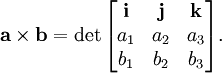
So I was teaching the cross product in my multivariable calc class on Friday. For those who are a bit rusty, \vec{a} \times \vec{b} is the notation for the cross product between 3-dimensional vectors \vec{a} and \vec{b}. It is defined as:

Prompted by a question from a student, I was struck with two related questions. One is: why does \vec{a} \times \vec{b} yield a vector orthogonal to both \vec{a} and \vec{b}? That question doesn’t mean I want a proof: I can do that. But I want some intuitive sense of why it works.

The second question is: can we find cross products in other coordinate systems, in the same way? How generalizable is this whole “take the determinant of a 3×3 matrix”? Would finding a cross product using a determinant work in, say, spherical or cylindrical coordinate — where instead of putting \vec{i}\vec{j}\vec{k} as the top row of the matrix, you put the fundamental unit “direction” vectors in these other coordinate systems? I haven’t played around with these coordinate systems in a long time, but I suspect the answer is no. (And to see that, I’d just have to do a simple test case, which wouldn’t work out… and that ought to be good enough.) I have to run to a picnic now, so maybe I’ll try this out later.

Hm, this looks like it could be turned into a good question for the next problem set, or even a good project for the multivariable students.

This train of thought also got me musing on the “what are the origins of vector analysis?” question. I haven’t had time to do any serious research, but it appears that one important book on this question is A History of Vector Analysis by Michael Crowe.

There’s something wrong here…

It’s funny that both Dan and Mr. K posted about giving that quizzical look to students — the “are you absolutely sure you’re right?… absolutely absolutely sure you’re right?” face. Or, to put it in the game show analogy, “is that your FINAL answer?”

Like Dan and Mr. K, I do this a lot. Both when kids are wrong and when they are right. And just today, after I had students give me answers to a worksheet, I stood at the board. Rubbed my fingers on my chin, stroking my imaginary beard. Gave that quizzical look. And then snapped back and said: “there’s something wrong here.”

They searched and searched, and someone said they thought they found something wrong — but it wasn’t actually wrong. And in the end, after a good 45 to 90 seconds (who knows? time gets so nonlinear in the classroom), I turned them them and said: “Okay, so you got me. You got everything right.”

I did it on purpose.

This all reminds me of my calculus teacher in high school He was a great teacher, and he prefaced the course by saying he would make mistakes on purpose to see if we’re paying attention. And each time he made a “mistake,” hands shot in the air. He would pass it off like something he did on purpose. Looking back, I think a good number of times, he just had made some silly error and was covering. (Sneaky genuis!) But I can say that every so often, once in a blue moon, he would make mistakes that no math teacher would make. (Like saying (a+b)^2=a^2+b^2.) These mistakes became warnings of what not to do.

Ah, I miss that class.

A Candy Bar Competition?

Ah, Mondays. I hate them. Alas, it is no surprise that when you spend a long time preparing something for your students, it will go awry. Indeed, it seems inevitable.

Over the weekend, I prepared SmartBoards for all three of my classes. Of course, I go into my classroom and see the dreaded red and orange lights of the projector blinking. No, not just blinking, more like maliciously mocking me. Blink. Blink. Blink blink blinkblinkblinkblink blink blink. The projector wouldn’t turn on.

At least I learned my lesson from last year, when the exact same thing happened a few times, and I knew how to cope. The secret: wing it. Seriously. Trying to “recreate” the presentation will be a flop.

And so I did. And things went okay. Not amazing — but okay.

With four school days down (and about 160 left), I can say that so far I think I’m in a really good groove with two of my classes. The other two are trickier, and I can’t quite get a pulse reading from them. It isn’t that they are dead, exactly. It’s just that I don’t see the students’ personalities yet — they aren’t coming out naturally.

That’s my fault. I haven’t quite given us any time to bond as a class; I dove right into material for a variety of reasons. And now we aren’t having the relaxed and anxiety-free atmosphere I always thought I was so good at fostering. It isn’t that we are all tense or anything. It’s just that everything feels… well… slightly boring. And if math is anything, it is the opposite of boring.

So now I’m wondering if I can think of something to do during class on Friday to help us get to know each other, to help the two classes each become a cohesive set of adventurers working together — in an exciting atmosphere — to solve something mathy…

I’ve been thinking about having a candy bar competition: the class (or maybe break the class into two groups?) works as a unit to try to solve N problems in 40 minutes. If they can do it, they each get a candy bar at the end of class. (Hey, it worked for us in MathTeam, all those years ago when I was in high school. A blatant bribe, yes, but such a community builder!)

And since this is still the beginning of the year, I can find problems which should be “review” for them, but which they need to know well to succeed in the course (e.g. for Algebra II, they need to know their exponent rules from Algebra I; for Calculus, they need to know basic trigonometry).

Argh, this is more work for me, and it might just blow up in my face, but maybe it’ll be worth it? If I do it, I’ll post the results of this sociological experiment.


Mid-Day Calculus Question

I asked a question to the two AP calculus teachers today, and I think we’ve concluded that we each aren’t 100% sure of the answer. It’s one of those questions that seems so basic that how could we not be sure?

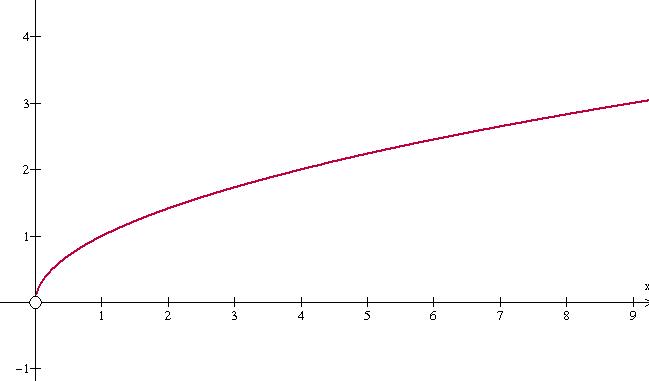
I’m going to put up two graphs (of the square root of x). Can you tell me what intervals the following function are increasing on? [Notice the difference: Function A is defined at x=0, Function B is not defined at x=0.]

FUNCTION A

FUNCTION B

According to Anton’s Calculus text, it says:

Let f be a function that is continuous on a closed interval \text{[}a,b\text{]} and differentiable on the open interval (a,b).

If f'(x)>0 for every value of x in (a,b), then f is increasing on \text{[}a,b\text{]}.
If f'(x)<0 for every value of x in (a,b), then f is decreasing on \text{[}a,b\text{]}.

According to Rogawski’s Calculus text, it says:

Let f be a differentiable function on the open interval (a,b).

If f'(x)>0 for x \in (a,b), then f is increasing on (a,b)
If f'(x)<0 for x \in (a,b), then f is decreasing on (a,b)

So my questions are: Are these two different definitions? I’m not teaching AP Calculus, but would this even be an issue for the AP exam? And why am I so not getting this?

Day Two: Completed

A little surprise for you above — so take a click.

Today was good; not productive in terms of lesson planning, but great in terms of getting all settled in. I got to finally meet my other two classes (Algebra II and Multivariable Calculus) and I thoroughly enjoyed both. Overall, I think all my classes are going to be really solid this year. I’ve been trying to do this really mixed attitude: friendly but firm. (An example of firm: “Can I get a drink of water?” “No.” [I continue teaching].)

Also, I now have a calculus motto, used by a student in an aside conversation: “ANYTHING FOR CALCULUS.” Maybe I’ll make buttons.

My one concern is the split between the two calculus classes: in one I have 15, in the other I have 4. I’ll be honest: I’m already noticing a huge difference in the amount of material we can cover each day. I anticipate getting to cover 5-7 minutes worth of more material in the small class than in the large class. Even today, I got much further, and felt more confident about where we left things. And this is day two. I don’t know how the class sizes got so wackadoodle, but I have to figure out — and early on too — how to keep them at least approximately in sync, without doing either class a disservice.

But I am really looking forward for tomorrow — because after Friday comes THE WEEKEND. (And I’ve been working for the weekend.)

UPDATE: A seal made for my calculus class.