Algebra II

Our New Algebra II Curriculum

This year, my math department has changed radically from last year. Among the many changes is a revamping of the Algebra II curriculum. Not only are we adding new topics, but we’ve removed a whole bunch of what we traditionally taught — pushing it to precalculus, I suppose. The course is totally reordered. For our first quarter, we are covering:

Unit 1: Number Lines, Intervals, and Sets

1.Set notation and interval notation (along with union, intersection, and subset)

2.Linear inequalities –graph on a number line

3.Compound inequalities

4.Absolute value inequalities

Unit II: Algebraic Manipulation: Rational Expressions and Exponents

1.Factoring two, three, and four term polynomials

2.Review of basic exponent rules and simplification

3.Polynomial addition, subtraction, multiplication, and division

4.Rational expression addition, subtraction, multiplication, and division

Unit III: Radical Equations

1.Review properties of radicals (integer exponents)

2.Simplifying radicals with exponents under them

3.Solving radical equations

This seems very hodge-podgy to me, now that we’re going through it for the first time. One day we’re talking about sets and subsets, the next how to solve 2|2x-1|-3<5. We are doing a lot without the textbook (which I’m fine with), but every so often we’re turning to the middle of the textbook to cover a topic (e.g. compound inequalities and absolute value inequalities come at the end of chapter 3). It just feels fractured. Why am I concerned?

I don’t know. I can’t articulate it. It’s just a whole bunch of thoughts running through my head…

We haven’t started graphing, and that makes me nervous. I’m now feeling like we’ve cut out too much of the curriculum in quarters three and four to cover this stuff. I don’t see the natural flow in this beginning material, as I saw the natural flow in our old curriculum (functions and lines; quadratics; polynomials; rational functions; exponentials and logarithms; trigonometry).

However I’m hoping that the past month and a half — which seems like a lot of vamping before we get to the good stuff — is worth it, because it does force students to practice their basic algebra skills. 

If there are any other Algebra II teachers out there: how do you start the course? And do you like it (equivalently put: does it work)?

In non-AP calculus — since I get to cover what I like at the pace I like — I focused the past month and a half specifically on the skills that my students last year had difficulty with: visualizing basic functions including logs and exponents, solving logarithmic and exponential equations, solving trigonometric equations, and knowing trig values at special angles. This too is totally different than what I did last year, where as a new teacher I just forged through our book. But let me tell you — unlike with Algebra II — I am certain that all this review is going to do some good, because I remembered some of the wounds my students suffered last year, and I am applying extra padding in those same areas to my students this year. 


M45 and M46

Two new Mersenne Primes have been in the news recently. (Mersenne Primes are prime numbers of the form 2^n-1.) Finally, finally, after their primality (primeness?) was independently verified, they were revealed to the rest of the world:

M_{45}=2^{37,156,667}-1 and M_{46}=2^{43,112,609}-1.

There was a lot of speculation about the number of digits that these numbers would have. Not least for the fact that the first person to find a Mersenne prime with more than 10,000,000 digits would win $100,000. And indeed, the newly discovered primes have 11,185,272 and 12,978,189 digits respectively.

To put that in perspective, The Math Less Traveled shows that if you write out the number of atoms in the universe, that number would have a paltry 80 digits.

Of course, I think: how can I use this in my own classes? We don’t really talk about primes in Algebra II, Calculus, or MV Calculus. However, we do talk about logarithms in Algebra II.

Check it out.

How do you think we know how many digits are in M_{45} and M_{46}? It’s a simple application of logarithms.

We know that that a number is written in the form 10^N, it has N+1 digits (if N is an integer). Think about it: 10^1 has 2 digits; 10^3 has 4 digits; 10^5 has 6 digits.

If N isn’t an integer, it’s just a hop skip and jump away to saying that the number of digits is the next higher integer. So if we have 10^{3.1}, we have 4 digits.

Where do logarithms come into play?

Well, 2^{37,156,667}-1 has a certain number of digits. Since that 1 probably won’t affect anything since it’s such a huge number, we will ignore it. How many digits does 2^{37,156,667} have? Let’s use what we just discovered:

2^{37,156,667}=10^N

Then solving for N, we get N=37,156,667\log(2) \approx 11,185,271.306. Hence, we know there are 11,185,272 digits.

And a good question for the really ambitious student is to ask: can we be sure we can ignore that 1? (Answer: yes.)

(You can find the number of digits for M_{46} in the same process.)

Neat TI-Calculator Trick #1

Inspired by Math Teacher Mambo’s “that super awesome functionality been on my calculator for YEARS and I never knew about it” post, I decided to post something that I learned this year which had a similar effect on me.

(You probably already know this if you teach statistics. Maybe everyone knows this.)

ENTERING REGRESSION EQUATIONS AUTOMATICALLY IN THE EQUATION LINE OF A TI-83/4

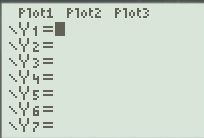
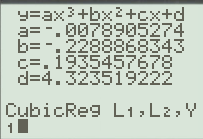
The short version: when doing any form of regression, you end up getting the coefficients displayed like this (below left). However if you wanted to graph that cubic, I had my students manually write down every coefficient on a piece of scrap paper, and then type it into the equation screen (bottom right). To make matters worse, you had to write down a good number of digits so you wouldn’t lose too much accuracy. I couldn’t find a way around it. What a pain, and students would make mistakes with all the copying, followed by typing the equation in Y1.

Of course you all knew that the “duh” moment came. The other Algebra II teacher taught me this simpler, foolproof way. It automatically enters the regression equation into Y1:

When you do the CubicReg command, you need to add the Y1 argument (above left). (You can get Y1 by following key sequence: VARS, Y-VARS, FUNCTION, Y1). Then it’s automatically entered in Y1 (above right).

I can’t believe no one ever told me that. I can’t believe I made my students write down the coefficients by hand.

I made a jing video of how to do this. Sorry about my voice. I hate hearing myself recorded. One of the many things that terrify me.

Vodpod videos no longer available.

more about “2008-08-21_1928“, posted with vodpod

The Supreme Court, Linear and Exponential Growth, and Racial Segregation

I just started reading Closed Chambers: The Rise, Fall, and Future of the Modern Supreme Court — and I came to an interesting case which could turn into a good problem dealing with exponential math.

A paraphrasing of the case

The case, originating in 1980, was filed by the U.S. Department of Justice and joined by the NAACP against the city of Yonkers, New York. The charge: violating the 1968 Fair Housing Act by purposely placing public housing in such a way as to perpetutation residential segregation. Finally, in 1985, the federal district court judge ruled in favor of the Department of Justice. However, with the ruling needed to come some sort of remedy — how could this wrong be righted?

The judge, Leonard Sand, ordered the city of Yonkers to build 200 public housing units spread throughout Yonkers, and to plan for subsidized housing in previously segregated neighborhoods. The city initially balked, but in January 1988, the city council formally agreed to the order. However, two weeks later, four of seven members of the city council decided to go back on their agreement, in defiance of the court.

Here’s where it gets interesting.

“Judge Sand first cajoled, then demanded, and finally threatened the city and its recalcitrant officials with contempt of course. As a last resort, Sand ruled that if the council did not adopt the necessary legislation by August 1, he would fine the city $100 a day, doubling every day until the legislation passed… In addition, he would fine each council member voting against the legislation $500 a day, with the possibility of incarceration after Day 10″ (page 40-41).

It wasn’t clear to me whether the fines would be cumulative or not (so if the fine after day 2 would be $200 or $200+$100), but from this New York Times article and others, I can say with a high degree of certainty that it was cumulative!

The fines were to start on August 2nd. However, they were suspended from August 9th to September 2th, while the case was waiting to be being heard by the appeals court and the supreme court.

The appeals court ruled that the exponentially increasing fine was excessive and unconstitutional. The ruling reads:

The City contends that the amount of the coercive fines imposed as a remedial sanction for civil contempt is excessive and a violation of the Due Process Clause of the Fifth Amendment and the Excessive Fines Clause of the Eighth Amendment. The fines start at $100 a day and double each day of continued noncompliance. As a result of doubling, the fine exceeds $100,000 for day 15, exceeds $1 million for day 21, and exceeds $1 billion for day 25.

Um… me thinks that even though it is a true statement that on day 15, the fine is more than $100,000, the justices probably meant day 11. Well, anyway, let’s continue:

The Court acted well within its discretion in starting the fine schedule at $100 a day. The Court also was entitled within reasonable limits to double the amount of the fine for each day of continued defiance. At that rate the cumulative fine after seven days, when we issued our stay, was $12,700. At some point, however, the doubling reaches unreasonable proportions. Under the current schedule the fine for day 25 is more than $1 billion; the fine for day 30 is more than $50 billion.

We believe that the doubling exceeds the bounds of the District Court’s discretion when the level of each day’s fine exceeds $1 million. The present schedule calls for a fine of more than $800,000 on day 14. We will therefore modify the contempt sanction against the City to provide that the fine shall be $1 million per day on day 15 and $1 million per day for every subsequent day of noncompliance.

So instead of having the fines double each day, after the doubling reached $1 million, each subsequent day, the fine would be another million bucks. The U.S. Supreme Court got the case in 1988 and decided not to grant a stay (meaning they didn’t want to put the Court of Appeals ruling on hold). In other words, the fines imposed by the Court of Appeals were constitutional and enforceable!

Even with the “reduced” fine, the city of Yonkers started to feel the pinch…

Mr. DeLuca [the city manager] has estimated that the city could pay fines through day 79, when the total would exceed the $66 million the city has in available resources… [NYT article].

On September 8, the New York Times ran an article about the drastic measures that Yonkers was about to be forced to take, since the contempt fines were nearing $1 million. By November 5th, the city would have to layoff 1,605 employees, leaving only 348 critical employees needed for minimal public safety and health! The article, rightly titled “‘Doomsday’ Layoffs Plan Adopted for Yonkers” continues:

According to the city schedule, ”all city services would be phased out after 12 weeks, on Thanksgiving Day, Nov. 24, 1988.” Under the state plan, the city would be operating under an emergency austerity program by Nov. 5, with the money saved available to ”retain a small work force” that would provide ”minimal public health and safety.”

Mr. DeLuca circulated a notice this evening to all employees, saying that they would be ”informed in writing as to your scheduled layoff date with as much notice as possible.” Employees would also be informed of their rights regarding unemployment insurance and options to continue benefit plans at their own cost.

”A final ‘Doomsday Plan’ will be in effect by Thursday morning,” Mr. DeLuca wrote. ”I regret to inform you this is not a rumor.”

Two days later, two of the four city council members who were defying the court order relented. The vote had switched, from 3-4 to 5-2. The first round of layoffs, scheduled in a matter of days, was averted.

Approval of the housing plan means an end to the fines that threatened to bankrupt the city, with the last assessment recorded on Thursday. The money already paid, $1.6 million in checks made out to the U.S. Treasury, will not be returned.

The case was not officially closed until May 2007 — twenty seven years after it began — when Judge Sand finally ruled that the court order had been followed through.

SOME MATH ANALYSIS

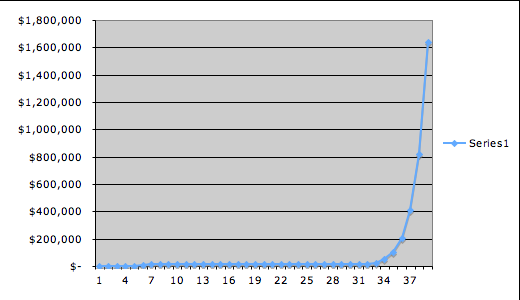
I made a graph of how much Yonkers owed the government each day starting on August 2nd until they agreed to the court order on September 9th:
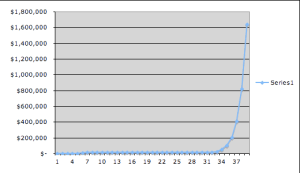
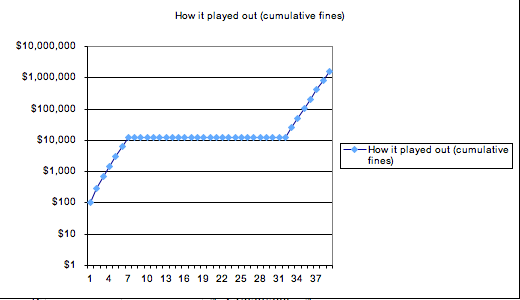
However, you can’t quite tell what’s going on for the first 30 days, because the scale is so large… And in general, when you’re plotting three or more orders of magnitude, you should plot on a log scale. So…
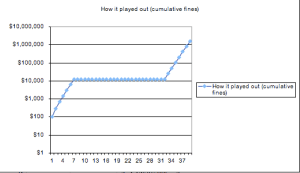
Notice the new scale (see the numbers on the left increase by an order of magnitude). It allows you to see more information. Like what’s that really long straight segment in the middle? Well, remember the fines were put on hold from August 9th to September 2nd, so the amount of money owed by Yonkers was kept constant for those days. That sort of “detail” got lost in the first graph, because the scale was so large!

And the first third of the graph looks linear, while it looked totally flat on the original non-log-scale graph. Why linear? Well, because remember the fines were doubling for all of those days, and when you plot exponential growth on a log scale, you get a line! But be careful! It isn’t exactly a line… We aren’t plotting $100, $200, $400, $800, etc., which would be perfectly exponential data. We are plotting the cumulative totals, which are $100, $300, $700, $1500, etc. These numbers don’t form a perfect exponential growth, though they are super duper close to being perfectly exponential! So for all intents and purposes, we can call it exponential, and hence, the first third of the graph is pretty darn linear.  Since the last third of the graph still has the fines doubling and being added to the cumulative total, that section too is linear.

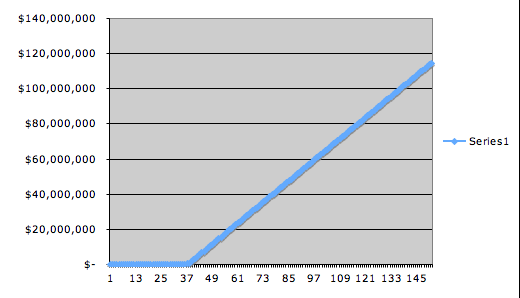
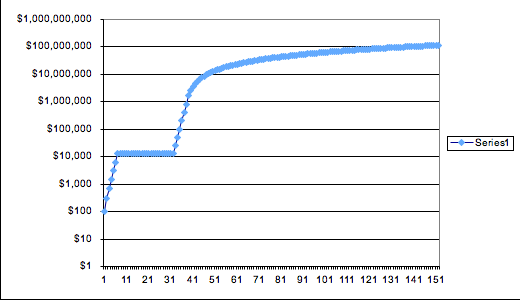
I also was really curious what would have happened if Yonkers didn’t pay up when they did… What if they let the fines accumulate until December 31st? Well, I also plotted that without and with a log scale…
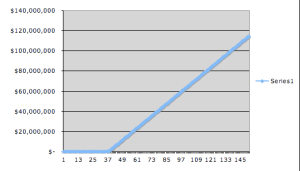
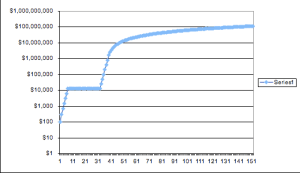
Looking at the first graph, we see that starting around day 37, we get a linear increase. Recall that’s because the Court of Appeals ruled that after the fines reached $1 million/day, they would stay $1 million/day. So each subsequent day, the fine just grows by the constant amount of $1 million.

(On the second graph, the log scale graph, we see the data go from linear to constant to linear — just like in our graph of what the town actually owed — but then the graph starts “slowing down” right at the same time the first graph becomes linear. That curve is actually logarithmic. Can you see why?)

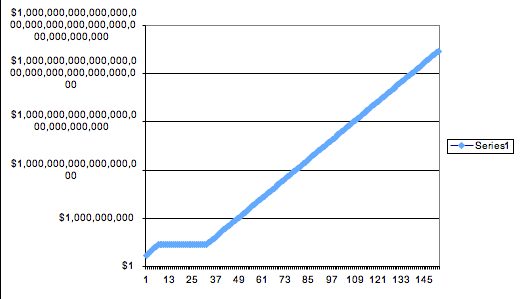
My last hypothetical is: what if the Court of Appeals and the Supreme Court didn’t find the doubling fine unconstitutional. What would that graph look like if extended to December 31st? Plotted on a log scale, we get:
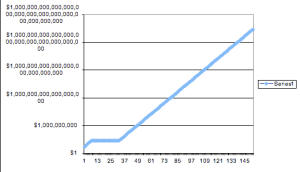
On December 31st, Yonkers would have owed the federal government: $17,014,118,346,046,900,000,000,000,000,000,000,000,000.

And as of the writing of this post, the national debt is only about $9,500,000,000,000.

YIKES! Good for the paying off the national deficit, bad for Yonkers.

A timeline for the case’s initial unfolding was published in the NYT here:

  • Dec. 1, 1980: Justice Department sues Board of Education, City of Yonkers and Yonkers Community Development Agency, charging that the city racially discriminated in education and public housing.
  • Dec. 1, 1980: Justice Department sues Board of Education, City of Yonkers and Yonkers Community Development Agency, charging that the city racially discriminated in education and public housing.
  • Nov. 20, 1985: Judge Leonard B. Sand of Federal District Court in Manhattan rules that Yonkers’s housing and schools were intentionally segregated by race. A housing remedy order directs the city to build 200 units of public housing and to plan additional subsidized housing.
  • Jan. 28, 1988: City Council approves consent decree that sets timetable for building 200 units of public housing and commits city to an additional 800 subsidized units.
  • July 26: Court sets Aug. 1 deadline for Council to adopt zoning amendment needed to build the 800 units.
  • Aug. 1: Council rejects amendment in a 4-to-3 vote.
  • Aug. 2: Judge Sand finds city and the four Councilmen who voted against the amendment in contempt of court and imposes fines. The city’s fines start at $100 and double every day. The Councilmen are fined $500 a day.
  • Aug. 9: The fines are suspended by a Federal appeals panel while the contempt ruling is appealed.
  • Aug. 26: An appeals panel upholds contempt ruling and fines, but fines against the city are capped at $1 million a day. The fines remain suspended so the city can appeal to the United States Supreme Court. Sept. 1: The Supreme Court refuses to grant the city a further suspension of fines but does continue the stay of fines against the Councilmen so they can seek the High Court’s review of their contempt rulings.
  • Sept. 2: Judge Sand reinstates the fines against the city.
  • Sept. 5: Mayor Nicholas C. Wasicsko meets for 7 1/2 hours with the City Council in an effort to end the impasse, but no compromise is reached.
  • Sept. 6: The Westchester District Attorney decides not to prosecute the four Councilmen who voted against the plan.
  • Sept. 7: As contempt fines continue to build up, a state panel adopts a ”doomsday” plan to cut city services.
  • Sept. 8: Fines pass the $1 million mark. As Yonkers residents confront layoffs and cuts in city services, pressure grows on the Mayor and the City Council to resolve the crisis. A City Council meeting over a transfer of funds to finance the fines erupts into a shouting match.
  • Sept. 9: The City Council votes to accept the plan.

My Algebra II Video Project

So did I mention the “big” Algebra II project I did this year? I suspect that I said something in passing, and then flew on, waiting until the day that I could do a final analysis of whether it was a success or not (it was a low to moderate success) and how I’m envisioning it for next year now that I’ve had one crack at it.

For those who want to jump right to the finished product: http://mistershah.wordpress.com

Details, documents, and analysis are after the fold.

(more…)

Matrices, Social Networking, and Algebra II

At the tail end of the fourth quarter, my students and I grew tired, weak, and weary from trigonometry overload, so we did a short one week lesson on matrices and systems of equations. I taught them how to add, subtract, and multiply matrices — by hand, and on their calculators. Then, I decided I wanted to bring some “real world” stuff to them.

So I decided to do a lesson on matrices and food webs [click here to view the assignment]. I pretty much stole it wholesale from some website or another (my motto: beg, borrow, and steal!), made a few changes, and let them go at it. And even though I don’t know how interested all of them were with the assignment, I was actually extraordinarily pleased at how well they did on it and how engaged they were in the classroom [1]. They talked, debated, and came to some pretty solid conclusions. My role in the classroom was relegated to going around and asking them questions like “so you answered the fourth question… can you tell me what the 2 in that matrix represents?”

You know, just to make sure they were getting it.

And they were.

One of my favorite moments was when a group asked me “do you add or multiply the matrices?” and I asked them “what do you think?” and then they got to arguing about it for 3 minutes before they came to the right conclusion.

Literally five minutes after finishing this activity in my first class, I realized that all the social networking sites (MySpace, Facebook, and the like) can be analyzed in the same way as food webs. Hello six degrees of separation!

So at the beginning of my next class where we were going to do food webs, I first drew a bi-directional network on the whiteboard with three teachers and one student. The student I chose is one who I felt I could poke fun at because he pokes fun at me. Of course I made up funny relationships between all my characters. So, for example, I said that the student liked teacher A, but teacher A didn’t like the student one bit — she told me that she thinks he is too rambunctious. And so forth. It was a tiny, fun little network, with all these fun little stories behind each relationship, and we made a tiny, fun little matrix from it. Then we moved on to the food web activity.

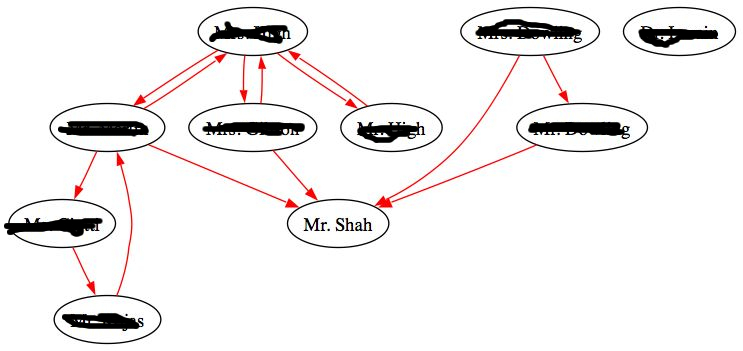
After class, I thought: why not do this whole social network thing next year? So last night I made up a fake set of relationships among teachers at my school and then created a network:

It’s pretty funny actually. I have one husband who likes his wife, but the wife doesn’t like her husband, and other strange relationships. And to accompany it, I made a draft of a worksheet to use next year [click here for draft]. And you know what: I think it’s pretty good. [2]

Besides food networks, and friend networks, I had two more ideas:

  1. Actually make a small celebrity network using IMDB, connecting them only if they’ve been in the same movie. A la Kevin Bacon. Then using that matrix to calculate the degrees of separation.
  2. Have students pick an airline and a bunch of cities it serves. Look at all the flights of an airline on a particular day — and make a matrix representing the number of flights that are made between all cities that one day. Some cities won’t have direct flights between each other — but that’s when you use the square of the matrix, to find which cities are accessible to one-another via one stop over. And you can take the cube of the matrix to find out which cities are accessible via two stop overs. And so forth.
Actually, I really like the second idea for some sort of take-home student project, where we also learn and use some basic Excel. Hmmmm….
And you were wondering what my last post was all about! Ah, gentle reader, I would not leave you hanging for too long.
[1] What was interesting to me about this assignment was although I saw them all working and thinking and grappling, showing true engagement unlike other times when I’ve failed, they didn’t show a true *interest* in the topic. Which makes me question the whole equality that teachers and administrators often believe in implicitly: student interest = student engagement.
[2] Although I might make two changes: (a) not make the network bi-directional (if person A is friends with person B, then person B is friends with person A), and (b) focus more on how to figure out how many degrees of separation someone is from someone else.

Teaching Detritus

It’s midnight and I’m still wired, so I’m going to type this quick post and get to bed. Super-productivity characterized today. I pretty much finished dotting the last i and crossing the last t (jot and tittle!) for my Algebra II video project. More information has been posted to my online porfolio:

http://www.virb.com/samjshah

Just scroll down to the section called “Teaching Detritus” and look at the “Algebra II Video Project” subsection. While you’re there, you might as well check out the myriad of smartboard presentations I posted under “Teaching Detritus.”

I guess today was a tech happy day. That’s not always the case. Last week, if you recall, was a week of SmartBoard terror, where it didn’t work in 3 different classes! Those were tech sad days.

The more I’m thinking about it, the more I realize that I could be a technology facilitator/integrator for a school. I’m talking a possible long-term goal… but a very doable one…