General Ideas for the Classroom

Topic Lists, Reprise: Obvious and yet, I never would have thought of it

This idea totally came from someone else, and I’m awful for not remembering who from the math-teacher-edu-blogosphere came up with it. But it’s just such an awesome idea, and I wanted to spread the love. If this is your idea, just throw the original post down in the comments, and I’ll be sure to add a huge giant link to it so you can have credit.

It could be really useful if you’re trying to help kids get organized for an end-of-year exam.

I wrote a while ago (causing some chafing for a few) about how I give my kids topic lists before major assessments.

They used to look like this:

Now, I’ve added a single image, in order to help students more effectively learn how to study:

So you can see what it looks like in it’s final glory…

It’s a little late in the year to make this effective, but I’m hoping it’s helped a few kids identify where they should focus their (precious and limited) time studying. If a student bombs an assessment, when I meet with them, I can ask them to pull out their topic list with these little boxes filled out, and we can start a conversation correlating their assessment with their filled out topic list.

(Of course, this is after the all important question: “Tell me how you prepared for the assessment. In detail. Don’t leave anything out.”)

Surprise ’em with what they don’t know

Sometimes it isn’t that we are bad teachers. And it isn’t that we aren’t giving students the lessons they need. It is that students aren’t willing to shore up their knowledge each night to make sure they know what they know, and figure out how to learn what they don’t know.

So I try to aperiodically remind them of that fact.

Yesterday, for example, I hinted to my students that they might have a pop quiz. We’ve been working on quadratics, and have seen questions like:

Solve 2x^2+5x+7=0

and

Graph x^2+10x-8=y

and the latest feather in our caps

Solve x^2+10 \leq 0

It’s a lot. And quadratic inequalities killed my kids last year. So I told my students to spend the night just reviewing the material and making sure that they can organize the information in their heads. They come to class today and I give them a two question pop quiz, both questions on quadratic inequalities. 6 minutes. Most are frantic. Clearly many didn’t shore up their knowledge.

I then tell them to stop and put their pencils down. I tell them it wasn’t for a grade. I tell them I’m not collecting it. They breathe a sign of relief. We then had a conversation.

What was hard about the pop quiz?
Did you think you knew the material?
Did taking this quiz demonstrate that? Or did it tell you something else?

It was a nice and short conversation and I think it really drove home the point: you think you know, but you have no idea.

So here’s something for you to consider doing, if you’re cruel like me: a very occasional fake pop quizzes can be a nice conversation starter about studying and nightly responsibility.

UPDATE: So in this case, the faux pop-quiz was only moderately successful. Last year so many kids didn’t know what to do on the 1D quadratic inequalities question on the final unit assessment.  This year they were less were confused. But still there were enough students who didn’t know how to solve it to give me pause. I realize now that we learned so many different types of linear/quadratic things that students kept confusing “what’s the question asking?” and “how do I solve that kind of problem?” So I need to come up with a way to emphasize at each point of the unit these two fundamental questions. And maybe designing a short activity where students are forced to answer those questions.

SmartBoard Notes

David Cox recently wrote an interesting post on an internal debate he’s been having: to post his SmartBoard notes or not. He frames the issue as follows:

I have always taken a “students gotta take responsibility for their notes and review them regularly” kind of approach which has prevented my from exporting and posting the chicken-scratch covered slides from class. But if posting them is going to help them learn, should I care about the personal responsibility they take on (or don’t take on) in regards to their own note taking?

I totally identify, and I believe note taking is a valuable skill that has to be taught — not just something we expect students to learn. We model it every day with what we write on the board, and how we write on the board.

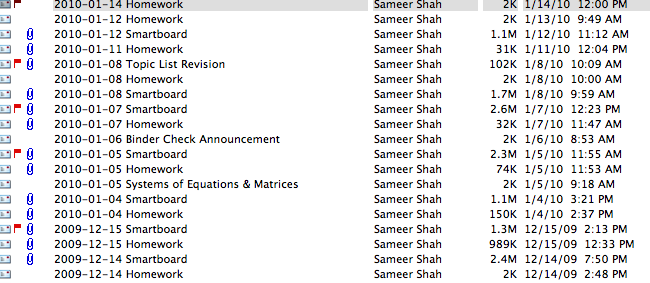
But enough of that. I have firmly come down on the side of “post the darn notes every day, if you have SmartBoard!” (Although I had the same reservations before I started posting my notes daily.) Why? Because it helps students learn math and makes my life way easier. Absent students know what they missed and try to work things out on their own. (Just today I met with a student who was absent, and had already looked at the missing day’s material and asked me specific questions!) It provides yet another resource for students to go to if they are stuck, or didn’t have time to copy all the notes from the board. And I’ve noticed that some students really do well watching and processing — instead of furiously scribbling all the time and not really following what’s going on.

How do I know my kids are using our digital notes?

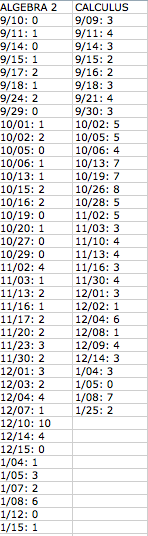
I have the ability to see who has downloaded my notes, and when. You can see some quick data I compiled. Below are two of my classes. The Algebra II class has 17 students in it. The Calculus class has 11 students in it. The dates are the dates I posted the class notes. The number after the semi colon is the number of different students who downloaded the notes.

I found the data surprising.

My Algebra II class uses the electronic notes sparingly. (Probably because a lot of the work we do is on worksheets — so they have those to refer to.) It seems like it is mainly used by students if they are absent. My Calculus class (which is overall incredibly strong) regularly use the notes. To be totally frank, I didn’t think any of my calculus students used them! So I’m really glad I looked at the data. Some downloaded the notes the day we went over them, some waited until before an assessment, and some used them to study for the midterm. But clearly they are being used — a lot! Remember there are only 11 kids in this class.

But the point is: I put it up there, and it is being used. Differently by different people in different classes. But it’s doing some good. So I’m happy.

Binder Checks

In Algebra II, I am trying something that I find is working pretty darn successfully that I’m going to replicate it in all my classes next year. One of the things that aggrieves me more than anything is asking a student to take out a recent worksheet or assessment, and they reach in their backpacks and dig around — their hand burrowing and further crumpling piles of papers from all subjects. It’s always miraculous when they do find what they were looking for, but you all know what it looks like.

Crumpled. Torn. Smudged.

In other words, terrible.

What’s clear is that students haven’t yet learned the skills to keep themselves organized. So this year I thought I would integrate that explicitly into the course. In the process of doing this, I’ve also found a way for kids to do homework and test corrections as part of their routine. No longer is homework something that students do at home, come to class and ask questions, and then forget about. Let me explain.

BINDER CHECKS

Materials: Each student is required to have a binder and a folder. The folder is to be brought to and from each class, while the binder can stay in their lockers unless instructed to bring them to class. The binder has one divider in it, to separate “homework” and “assessments.”

Implementation: Each day, students keep their homework in their folder, organized chronologically. They date everything — textbook homework, worksheet homework — with the date these things were assigned. We make sure to be very consistent with our labeling — especially because we only meet 4 days a week because of our rotating schedule. I also post the homework (and daily notes) on something called a course conference (for those of you familiar with first class) — also organized by the date assigned.

Each night that homework is assigned, students are expected to work assiduously on it. And if it is from the textbook, they are required to check the odd answers in the back — and mark the right answers on their papers if they get something wrong. At the start of class, I always display the even answers to textbook problems (or the answers to any worksheet we did), and I go over questions. At this time, students are expected to correct their work on their homework. They are expected to write down the correct answer. They are expected to ask me (or their colleagues) questions. And if they don’t have enough time to finish all their corrections (I expect them to show work to get the right answer, not just the right answer), they have to finish it at home.

In other words, there is no reason that my kids should have anything less than perfectly completed and corrected homework assignments. (And similarly, when they get tests back, they are required to correct them too.)

For this to happen, I had to talk about this a lot at the beginning of the year. I reminded them constantly about correcting their homework. About dating their work religiously. About writing down the correct answers if they’re getting something wrong — and figuring out why they got something wrong.

And at the end of each unit, students file away all the homework and all the assessments in their binders. They start fresh with an empty folder.

Why would they do all this for me?

Because half of their homework grade is based on this. On binder checks. I sell it to them by letting them know there is one certainty in this course: it is totally ridiculous if they don’t get 100% on the binder checks — it’s me giving them free points, in essence. Just for being organized and checking their work. That’s all!

When

We scheduled 2 binder checks in the first quarter, and then we only have 1 at the end of each of the three remaining quarters. We wanted to do 2 in the first quarter, so students could learn from the first one. We assumed (pretty rightly) that some kids would just bomb the first one because they wouldn’t take it as seriously as they needed to.

What they look like

On announced binder check days, students come into the classroom with their binders, and see a note on the board saying to have only their binders on their desk… Nothing else, no writing utensils, no papers, nothing [1]. When all their compatriots arrive and are set, I hand everyone a red pen. I also hand them the binder check which might look like this [2]:
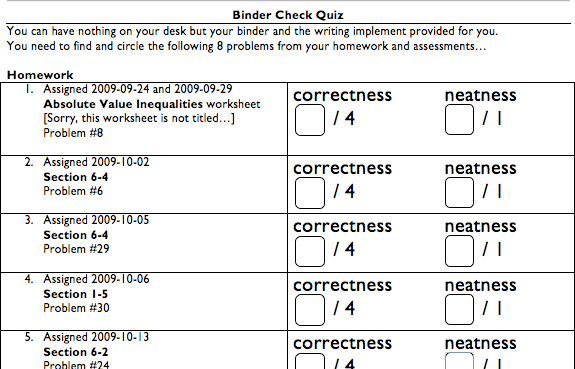
They are given 5-10 minutes to flip through their binders, and circle their work and answer for the problems asked for. That’s all. It doesn’t take very long at all, especially since their binders are organized chronologically.

I collect them, and we go on with our lesson.

How I Grade Them

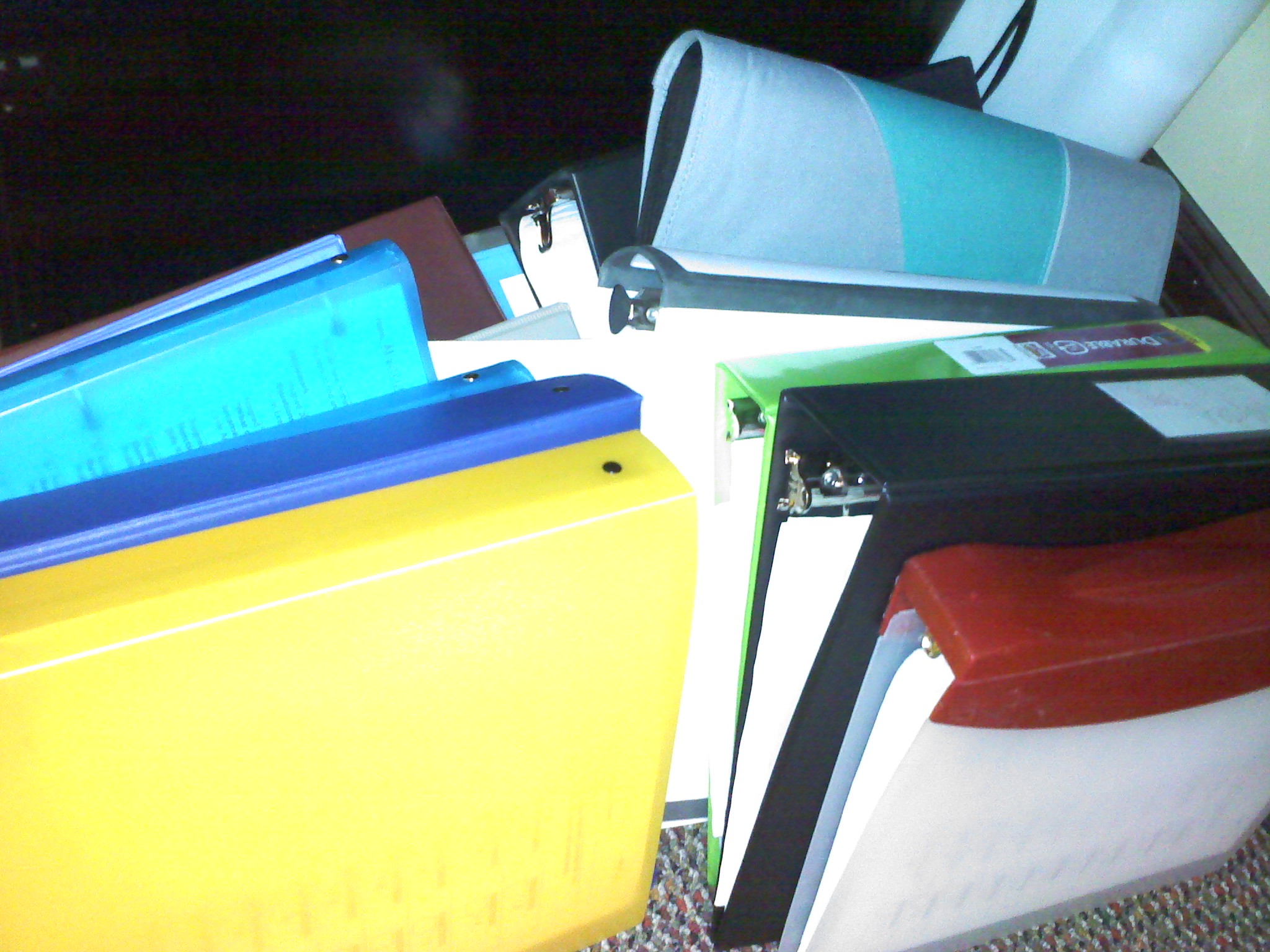
Each time I collect them, I get a nice stack of binders that I store under my desk, like I had today:
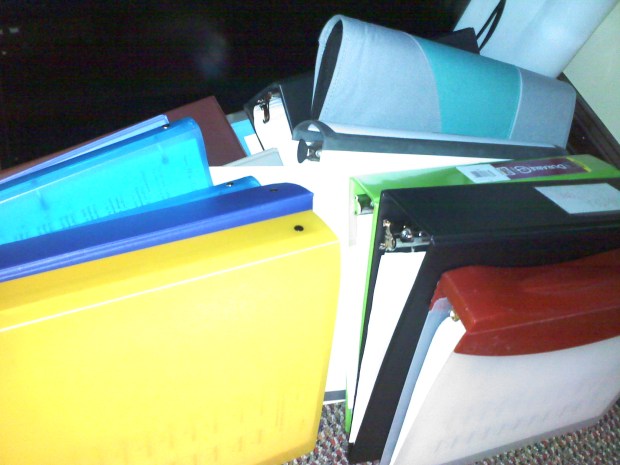
I pick up a binder, and look for all the circled questions. If the student was neat, and had the correct answer originally, they get full credit for that problem (5 points). If the student messed up but had the corrections (and new correct work), they get full credit for that problem (5 points). However, if the student messes up and has a wrong answer, the student only earns 1 point (or none, if they aren’t neat). I go through the whole binder this way.

Clearly I care about students getting things right. And I love this binder check because it can do so much work for me. I don’t have the time to collect and grade homework everyday. I don’t want homework to be graded for correctness the day after a student learns new material. (They could go home and be totally lost!) However, I do want students to eventually have things right. To work on correcting what they don’t get. Be proactive about what they don’t know. Ask questions. Figure things out.

The stack of binders above looks daunting, right? But let me tell you, I can get through a stack of binders for my class in 2 hours. It surprises me how quickly grading those goes. Seriously!

How I Pick the Questions

It’s no secret here. I pick questions for the binder quiz that span a number of homework assignments, and require some deeper thought and written work. I usually try to pick questions that students get wrong, or asked about in class.

What I’ve Noticed?

My kids now check their odd answers in the back of the book, they are really attentive at the beginning of class checking their even answers (or their worksheet answers), they ask questions so they can make the corrections, and they are much, much, much, much more organized.

You can see the learning curve my kids had with this. On the first binder check, the average grade was in the 70s. On the second binder check, the average grade was in the mid 80s. (And the standard deviation went from 18 to 11.) Almost every student improved, some drastically. Which is all the more impressive because I graded more harshly on the second one because students knew exactly what to expect.

Other Benefits

There are three major other benefits I see from these binders.First, I can collect the binders before parent teacher conferences, so I can show parents the totality of their child’s work.Second, when I write narrative comments on my students, I can use these as a reference to be more specific. Third, when it comes time for cumulative assessments (e.g. midterms, finals), my students will have all their tests organized in one place, to study from.

Overall, I see this initiative as a TOTAL SUCCESS.

P.S. Things to note:

There needs to be a place for students to write the “Date Assigned” on each homework assignment. If it is something from their textbook, they need to write a clear and consistent header. If it is a worksheet I create, I always make sure to put a “Date” section.

Everything handed out needs to be hold punched. You can’t expect students to use the binder if you don’t make it super easy for them to use.

[1] The reason for this is that I don’t want students using pencil to fix up answers to questions they didn’t correct. What they come to class with in their binder is what they get.

[2] For the 2 binder checks in the first quarter, there were about 8-10 things students needed to circle, including not only problems from homework, but also problems from assessments.

Teachers Say (and do) the Darndest Things

We all have catch phrases. Things we say, purposefully or accidentally, enough times that the kids have taken note. You know, these are things kids probably mimic when doing impressions of us. Which I know they do. I mean, don’t they?

I bet someone doing an impression of me teaching any of my classes would say “ooooh, CRUST!” as an expletive a lot. That’s my curseword in class, whenever I lose track of time or make a mistake. I also often deny mistakes, jokingly. A brave student will note “you forgot the negative sign there.” I’ll carefully add it in and say “Um, hell-O, no, I DIDN’T. I have no idea what you’re talking about.”

We also have catch phrases related to math. In calculus, you all know my motto, which gets said at least once a week if not two or three or four times a week:

turn what you don’t know into what you do know

And in Algebra 2, I have one class rule for safety. Which I pull out of my pocket a lot:

don’t divide by zero! if you do, the world BURSTS INTO FLAMES!

[And then I take the red smartboard marker and draw flames around the thing that would have a zero in the denominator.]

Kate Nowak’s recent post talked about the changing of traditional teaching phrases in her class[1]:

Today in Algebra 2 we reviewed negative exponents and the children acted like they had never seen it before. I told them about the phrase “move it, lose it” for dealing with a negative exponent, as in, move the term to the other side of the fraction, and lose the negative sign. A student who moved here from another state (where, you know, they get to spend enough time on things to actually learn them) told us about the phrase she learned “cross the line, change the sign.” Which the kids liked better. “You know, because it actually rhymes, Miss Nowak. Unlike yours.” Um, last I checked “it” rhymes with “it.” I’m not an English teacher! You can tell because I’m not wearing cool shoes and I don’t give hugs.

Okay, a big giant *grin* for the best two lines I’ve ever read on a blog (the last tines, obvi). But it got me thinking more about these techniques we use to teach kids to remember things. Yes, I think kids should know the reason why particular algebraic manipulations / formulas work. But once they show me that they “get” it I have no problem with them using phrases and shortcuts to help them remember things.

I mean, how many of you always rederive the quotient rule when taking a derivative of a rational function in calculus? Or do you sing a little sea shanty like:

low de-high less high de-low
and down below
denominator squared goes

Or for the quadratic formula? In your mind you’re definitely saying the formula in a very specific way each time. Think about it.

THINK, I said.

Yup, I thought so. So inspired by Kate, I thought it would be a neat exercise to chronicle three of the ways I get kids to remember things or do hard things.

(1)

The “pop it out” rule for logarithms. When we are learning how to expand \log(x^3) to get 3\log(x), I always say “POP IT OUT!” and do a raise the roof hand gesture. I don’t know why I do that. I don’t know how it started. Maybe the raising of the roof is popping out of the exponent. Then when students are working and get stuck, I sometimes help ’em out by quickly doing a mini raise the roof. Then they always exclaim “Oh! Pop!”
(2)

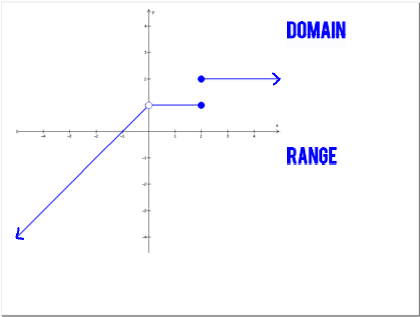
[Note: I am pretty sure I stole this from someone from a couple of years ago.] When teaching how to visually find the domain and range of a function, I tell students: “Guess what? You don’t know this but besides your calculators you have another a highly sensitive and powerful mathematical instrument. It’s kind of awesome. It’s called a domain meter.” I throw a relation on the board:

I tell them to hold out their index finger way to the left of the graph. Then slowly move it rightward across the graph. As they do it, I do it with them, and as soon as my finger hits x=-2 I start annoyingly sounding “BEEEEEEEEEEEP” while continuing to move my finger. Finally when my finger reaches x=2, I stop beeping and I silently continue to move my finger. I tell them: “my domain meter only beeps when it hits the graph. What’s the domain?” (They get it.)

Then I say “Believe it or not, you have another amazing mathematical instrument. You guessed it, a range meter.” I then hold up my vertical index finger (“domain meter!” I exclaim) and turn it horizontal (“range meter!” I exclaim). Then I take my horizontal finger and start at the bottom of the graph and move it upwards. I only start beeping at y=0 and continue until y=2. They all can state the range at this point.

I’ll end up finally throwing something more complicated on the board:

and they’ll get it, first try.

(3)

In calculus, I want my kids to be able to see derivatives quickly. My first year teaching it, I focused a lot on u-substitution to take the derivative of \cos^4(x). Why? Because my kids just couldn’t get the hang of “seeing” the answer. So I came up with the “box method” of teaching the chain rule, which works great. (And yes, of course, I always teach u-substitution first and we talk about why this “box method” works.)

I have my kids first rewrite the function so that they can see “inner” and “outer” functions. So for example, they have to rewrite \cos^4(x) as (\cos(x))^4. That way they can see the “inner function” easily. Similarly, they need to rewrite \sqrt{\cos(x)} for the same reason. I then ask them to put a box around the inner and outer functions respectively. If there are more than two (functions within functions), they should make all the boxes.
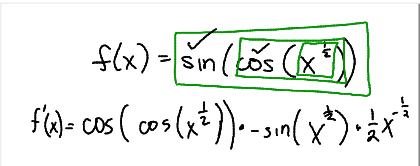
So let me show you with a simple example from class today:

I have students write the functions in terms of “outer,” “inner,” “more inner,” etc. until they get to the gooey center of a composition of functions. Then I tell them to look at the outermost function, ignoring everything from the boxes inside (in our example above, they’d say “sine of blah”). I asked them “what’s the derivative of sine of blah?” and they all say “COSINE!” So I write

\cos(stuff)

and ask “what do I put in here?” They say “don’t touch the innards!” So I fill it in:

\cos(\cos(x^{1/2})).

Then I put a check next to the outermost function and say “we’ve dealt with you, so we’re done with you.” I then go to the middle function and say: “What’s the derivative of cosine of blah?” and they all say “NEGATIVE SINE!” So I go to the board and add

\cos(\cos(x^{1/2}))*-\sin(stuff)

and ask “what do I put in here?” They say “don’t touch the innards!” So I fill it in:

\cos(\cos(x^{1/2}))*-\sin(x^{1/2})

Then I put a check next to the cosine function and say “we’ve dealt with you, so we’re done with you.” I then go to the middle function and say: “What’s the derivative of x^{1/2}?” and they all say “\frac{1}{2}x^{-1/2}. So I stick that on at the end.

\cos(\cos(x^{1/2}))*-\sin(x^{1/2})*\frac{1}{2}x^{-1/2}.

And fin, we’re done. It goes pretty fast once they get the hang of it. And they actually secretly love having equations that are scrawled across a whole page.

[1] Kate, forgive me for cribbing so much wholesale. But I needed to have the last sentence in there!

People have been telling us what we need to do

Student quotation from an online survey I gave about class today:

I think it went really good. Although many of us struggled, that feeling of struggling felt good. Teachers always give us equations to use or tell us what we need to know, but during class today that wasn’t the case. We had to pull together what we knew in order to solve problems. You didn’t give us specific equations to use or anything.  I feel like this connects to life, and especially now for us seniors. Throughout most of our life people have been telling us what we need to do, but soon we will be the adults who need to know how to resolve problems when we are approached by them. People won’t be giving us what we need to solve our problems any more, we need to learn to struggle and figure out our own ways to succeed.

I am aglow with how thoughtful, reflective, and mature my kids can be. I also was reminded how capable my kids are. And yes, probably more to come on what prompted this.

One teacher’s advice for dealing with cheaters

A first year teacher on twitter asked me how to deal with cheaters. My immediately response was: find out your school policies and procedures. Dealing with cheating is emotionally fraught, for the students, for parents, for the teacher, and for administrators. My school has something called the Student-Faculty Judiciary Committee, which I serve on, which provides a way for students to reflect on their actions, as well as distances the teacher from the situation. More than anything, you need to know what others in your school do, because it can all backfire on you if dealt with improperly.

So I tweeted that school culture and policies — and knowing you have support in what decisions you make — are important. And then I typed up my advice, if a teacher has carte blanche and no SFJC or disciplinary board.

Knowing nothing about your school policies and culture, and assuming you have the support of your administrators to deal with it in your own way, and assuming you’re pretty darn sure your two students cheated, here’s what I would do.

First approach the students individually, and to each, say you noticed something odd about their latest exam, and if they have anything they want to tell you, to let you know by the end of the day.

If one (or both) do come to you and admit to cheating, skip to the paragraph beginning “If they admit to cheating…”

Most likely neither will come see you, so the next day sit them down individually, state the facts, and let them talk. I wouldn’t even mention the other student’s name in that meeting – and if you pull out the other exam, be sure to cover the name up. This meeting is about the kid in front of you. Not the other kid. And be sure to make sure the student knows that.

Start off by admitting you don’t know the whole situation, but it looks too suspicious to let it go, and that you wanted to have a conversation about it. Lay out the facts. Keep pressing the student on the improbability/impossibility of the similarities being a coincidence, and how you really need them to help you see their side. Don’t get attacking, don’t get put on the defensive, don’t accuse, just keep to the facts. You aren’t putting them on trial. You are their teacher, and you want to keep that relationship first and foremost. So stay cool and firm. And if it gets too emotional, take a 5 minute break and come back.

If they admit to cheating in that meeting, GREAT! Then have a conversation about what was going on, have them reflect on why they cheated (pressures, panic, etc.) and ask them about things they can do to prevent it from happening in the future. Then ask them what YOU can do to help them to prevent it from happening in the future. THEN talk about your consequence (0 for exam? 50% for exam? whatever). I’d give the consequence last, and it is NOT up for negotiation. Finally thank them for their honesty, and remind them that above all else, you’re there for them. That you care, and that you’re their teacher.

If they don’t admit anything in that meeting, and after hearing what both students had to say you are still convinced that it was cheating, then tell the students you are still skeptical and their explanations, but you are going to sleep on it and get back to them.

The next day I would talk to them again (individually, as before) and say that you are sorry about the situation, but as a teacher, you can’t just sit on it.  Then tell the student that they are going to get a 0 (or 50%, or whatever your consequence is) for the exam. Remember, sometimes as a first year teacher, students feel can convince you that everything is up to negotiation. That’s not true, and don’t let them negotiate with you. However, you need to emphasize that even though the situation isn’t ideal, YOU ARE THEIR TEACHER and YOU ARE ALWAYS THERE FOR THEM. Say you know things will probably feel very awkward for them, and they might really be angry at you or the situation for a while, but they need to get past that quickly because you are there, always, to help them succeed.  And you don’t want anything preventing them from coming to you for extra help or support, or to feel like they can’t speak up in class.

Cheating is hard for me. I have gone through a cheating situation (sometimes more than one) each year. And I get really emotional, angry, frustrated, and sad. Maybe it’s just me, I don’t know. But what gets me through it is even though I feel like the student violated my trust (which he or she did), they did not cheat to violate my trust. It is not personal, though it feels personal. It usually arises out of panic and pressure. And that’s the opening where I find a place to start a conversation with a student.

[1] To me, anyway, it is really important that the student-teacher relationship doesn’t get totally broken as a result of a cheating incident. Teachers have to be the adult in these situations and recognize that our students are just kids. It may seem like a huge breach of trust to us, but we still have a responsibility to them.