General Ideas for the Classroom

Desk Banging in Calculus

I have two calculus classes, and one of them is deafeningly quiet. I know or have taught many of these kids before, and they are just a shy and reticent bunch. Enthusiasm and a lighthearted atmosphere has always worked in the past, as has groupwork, but not with these kids.

I normally can break through this, but so far it’s still a little weird. Today, though, I had a glimmer of hope. Just a glimmer, but that was enough encouragement!

Today, we were talking about average and instantaneous rate of change, and how these ideas relate to the slope of the secant and tangent lines. And of course I wanted to relate this to position/time graphs.

I wanted my kids to see that having a position of an object was so… powerful. I always assumed that my kids in years past understood the awesomeness that came out of understanding that knowing the position at all times tells you the velocity at all times. That knowing information about the position of an object was giving us information about the motion of the object.

Maybe to us this is obvious. It is an idea only truly half formed for them. They have an intuition about it, sure, but that’s about it. I really wanted to drive home the idea that we could see so much from a position versus time graph.

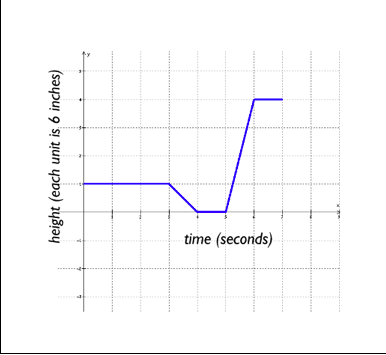
So I showed them this graph [1]
Picture 1

and I ask them where the object is at various times.

Then I say, let’s actually act this out.

I start banging my hand on the desk nearest to me, BANG BANG BANG BANG… I hold up my other hand in a fist 6 inches above the desk, and say “it starts out at 6 inches.”

As I did this, all my students joined in by banging on their desks. (I didn’t ask them to.) They all put their hands up. They all joined in. It was a true glimmer of life! of community!

For three BANGS we held our fist still, and then after three bangs, we moved it down to the desk and held it there for another bang, when all hands shot in the air and then stayed there for an extra bang.

We acted it out. And then I said: let me tell you what makes calculus so powerful. It allows us to look at this graph which gives us just the position an object — that’s all it gives us — and it lets us understand the MOTION of the object. What we have here is information about where the object is, but we now can find out how the object is moving. We could actually act out the MOTION of the object from that.  It seems so obvious, but the connection is so deep.

Then we constructed the velocity-time graph. And I pointed to the [4,5] interval and said “oh, negative. what does that mean?” (Our fist was going down.) And I pointed to the [5,6] interval and said “oh, positive. what does that mean?” (Our fist was going up.) And I pointed to the [6,7] interval and said “oh, zero, what does that mean?” (Our fist wasn’t moving. It was high in the air, but standing still.)

I’m building the concepts here. We do the math later.

[1] Pre-emptive footnote: Yes, we had a discussion about how this graph could not actually be representing something in the world, because of the sharp edges.


NCTM, day 2

The second day was a disappointment. Of the four talks I went to, three of them were bad. If they were a smell, I would be passed out. So bad. I actually felt angered by two of them, because the description was so fascinating that I felt betrayed. Talks in sheeps clothing.

I feel bad listing the three terrible talks, so instead I thought I’d at least point to the one good talk:

#201: Linear Functions: Much More than y=mx+b

The major thesis of this talk was that we might want to invert our traditional way of teaching linear functions. We tend to teach:

1. y=3x+4
2. make  table of x-y values
3. plot
4. connect the points. oh my gosh! a line!

But students find the equation y=3x+4 to be the abstract part. The numbers and working with them is the easy part. So the speaker provided some ways to say let’s END with the equation and have it make sense to the kids, rather than START with the equation.

What was nice is that he started with some easy problems — that I couldn’t use in my classes — but then went to more advanced and more interesting problems — including one that would be great for an independent research project for a kid, and one that just blew my mind relating Pick’s Theorem to… systems of equations. Seriously.

But what was great is that he focused on student learning, and eschewed ed jargon and talked about why he made his choices for each lesson, and what his students got out of it. It was sweetness.

UPDATE: Commenter “m” below has prompted me to flesh things out a bit more. The easy part is with Pick’s Theorem… the speakers said he stole his connection to systems of equations from somewhere else… I suspect here! (He also showed a second way to derive Pick’s Theorem, which I am too lazy to do here. I remember first learning about this theorem in high school and spending days trying to prove it. I did eventually prove it and proudly showed my writeup to my math teacher.)

As for motivating simple linear functions, he basically had students engage in pattern recognition and play around with numbers.

blocktiles

White blocks in the first picture? The second picture? The third picture? What about the 5th picture? The 27th picture? He also talked about relating the blocks to tables to graphs really explicitly, as well as making explicit the connection between the “slope” (I put that in quotations because the speaker hates the term slope – he thinks it obfuscates) and the pattern, and the “y-intercept” and the pattern. His thesis was actualized: being explicit and very visual, and having students start with numbers and then come up with the equation out of these numbers provided a more natural and more deep way of motivating linear functions.

Parents Night

Last Thursday was Parent Night. Also fondly known as The Longest Day You Experience In The Entire Year. Yes, indeed, on this day I woke up at 6:30am and taught until 3:10pm, followed by an hour of tutoring and a little bit of working, followed by running out to grab an early dinner in the ‘hood with some colleagues, followed by Parent Night! Which concluded, for me anyway, at 10pm-ish. Note that there is no time to lesson plan for the next day. Which is why I worked backwards and planned my classes so each would be having tests on Friday. Genius?

Check.

For those without Parent Night, it involves, in short, parents arriving at 6:30pm and attemping to follow their child’s school schedule — spending 10 minutes in each class (and 5 minutes getting lost between classes). I think it’s a very good thing we do. As one of my colleagues who retired a couple years ago said: “You know, it helps the parents know there isn’t a crazy person watching their kid for 50 minutes each day.”

Check.

My first year, I was told the two tricks for the night:

1.) Do not like parents corner you to talk about their individual child. If it does happen, either say “I’d love to talk but I don’t have my gradebook in front of me. Can we set up a time to talk by phone or in person later?” or “I generally don’t talk about individual students tonight, but I’d be more than happy to sit down and talk with you sometime soon.”

2.) When you’re “teaching” your class, talk for the entire 10 minutes. If you go under, and parents start asking questions, the night can turn very quickly if you have one upset parent.

My third trick to surviving the night without going crazy:

3.) Accept that parents are going to be on their PDAs while you’re talking. It’s annoying, but not worth getting riled up about.

Of course, although I tried my hardest, I got drawn into 4 conversations about individual students. You know how parents are, so sneaky. They lull you into a sense of calmness, and then THWACK: “Mr. Shah, we really liked your presentation. I really liked calculus when I took it in college. Stu is really excited about your class. How is Stu doing? THWACK!”

If you wonder what I spend the 10 minutes doing in each class, I give a SmartBoard presentation. Of course, my presentation is 15 minutes if I’m talking fast, so I basically edit to 10 minutes based on the cues my parents give me (if they’re stoic, I skip over the jokes; if they look interested in the structure and content of the class, I speak more in depth about that).

My calculus presentation is below.

Of course, this year, I came home sick. I barely made it through Friday. And I slept all of Saturday and Sunday. Yes, even though I know germs get you sick and not Parents Nights, I blame you, Parents Night, I blame you.

Google Forms

Tonight I got a call from my dear sister. She’s an amazing teacher, and I always forget that she’s starting her 7th year of teaching. That’s right, 7. But — dear blog — that isn’t what I wanted to write about today. I was talking with my sister about the best thing I’ve done so far, in my three days of teaching.

It was using google forms to get information from my classes. I needed some basic info from each student, and I didn’t want to hand out individual sheets for them to fill out. I hate keeping track of papers. So I created a google form and made filling it out homework.

Please, if you don’t know about google forms, click here and see a sample of the form I used. Fill it out! Put nonsense down! Play around with it! It’s a fake form. So do whatever!

If you want to see the responses to the fake sample survey, click here.

It took me less than 10 minutes to create this survey and email out to my students. What I got was a quick way to get information about each of my students — information that has already helped me see where my students are coming from and what they’re going to need from me.

Example? One student wrote about being nervous about math because s/he hadn’t done well in math for a while. I saw that and wrote an individual email to this student off on a positive place.

Hi [Student],

I am reading through the online survey, and wanted to respond to a few students. In one of your responses, you said

[student quotation]

I want you to know that it’s okay to be nervous. But I want you to know that I am here to help you, so you shouldn’t ever hesitate to meet with me. I would also recommend finding a few students to work with in this course — so that you can study with them or ask them questions, and so they can ask you questions too!

I’m here to help you! And I hope you have a great year this year in math. We will work hard, yes, but the reward is that I promise that you will leave knowing a heck of a lot!

Always my best,
Mr. Shah

I responded to a bunch of these.

A second benefit is that this form actually asks students questions about my course expectations and policies. I used to just assign “carefully read the course expectations” for homework. But I never really knew if my students did. Having them answer questions about my expectations shows me they know exactly what I want from them.

I can see me possibly using this in my classes throughout the year…

… when we’re collecting data and doing some basic statistics/regressions. I can say “For homework, find how many DVDs and how many books you have in your room. Enter what you find in this online survey.” Or when we’re in class, measuring the period of pendulums of various lengths, I could have them enter all their data in a  survey and then we’d have a class’ worth of data on a single spreadsheet.

…I can also see this as a way for me to survey students to see how they’re feeling about a particular topic, or to write what they learned in a particular class. “What did you take away from class today? What did you learn? What questions do you still have?”

…I can see using this to administer an online “take home quiz” for students (on the honor system).

…I can see using this to find out what to focus on before I hold review days. I just create a survey with the various topics, and ask them to answer on a numerical scale how they’re feeling about each topic.

Just throwing a few of the ideas I have out there. I knew about google forms, but I didn’t fully see their potential.

PS. I was first convinced of the power of google forms when I created the homework survey for math teachers.

New Year’s Resolutions

At the end of the calendar year we make (and quickly break) new year’s resolutions. But as teachers, I thought it might be fun to make — at the end of the summer and the end of the academic calendar — some resolutions. Okay, geez guys, maybe “fun” isn’t the right word. But inspirational maybe? Okay, okay, maybe just a lark.

In order for them to be effective, I’m throwing down three simple rules.

  • You should come up with at least 1 but at most 3 resolutions. This is so you don’t get overwhelmed.
  • They have to be easily doable and sustainable throughout the year. This is so you don’t get overwhelmed.
  • You need to publicly announce them – whether it be on your blog, on twitter, on the comments here. This is so you have some external accountability.

I will make mine here:

1. I read on someone’s blog (forgive me for not searching to find and link to it) an idea to keep students engaged. If students point out mistakes that I make, I will visibly tally them somewhere in the room. The student who caught the mistake will hopefully feel good about themselves and students will hopefully always be second guessing me. And after 30 mistakes are pointed out, the students get to have a “candy day” or something where I bring a little treat for them. I will do this in my Algebra 2 and Calculus classes.

2. I will do this random acts of kindness thank you card activity again in my Algebra 2 and Calculus classes.

3. I will decorate the classroom that I will be teaching 3 of my 4 classes in so it will be colorful and kitchy, but not elementary school-esque. I will have this done by… no, not the first day of school… by the end of the first quarter.

Signed,

B30089BABC910237E9DFD6CD067B5412

UPDATE: I am going to have to nix goal 3. Even though one day I would like to do this, apparently this year my rooms have been switched beyond recognition, so instead of teaching in 2 rooms, I’m teaching all 4 classes in 4 different rooms. I will be running around the school like a chicken with my head cut off. And although I’d like to decorate all 4 rooms, I honestly don’t have the energy to create and maintain something in 4 different rooms, and I won’t have “priority” in these rooms because other teachers will probably be teaching in them more and want to do something.

Idea I’ll Never Follow Up On, Though It Is Good

So I have a awesome idea (toot toot)[1], but if I know me when the school year starts, I won’t actually follow through on it. But maybe someone out there in the great Internet cosmos will follow through on it.

Kids like Pizazz sheets. I have a bunch of them for calculus. There is a great payoff because when the kids solve the worksheets,  solutions to the world’s corniest riddles are revealed. It is a self-checking homework sheet, because if students mess up, the answer to the joke is garbled.

My idea is to make my own Pizazz worksheet, but the solution will be… well, lemme just whip a sample one up.

Of course this can be done with vimeo or even any url shortner. I had at one point a grand ambition to make a giant internet web puzzle for my students, that we’d spend the year trying to solve. Each unit brings us another clue, which brings us to another page… But you know, grand ambitions get foiled at every turn, by my own laziness and the exigencies of life as a teacher.

And no, I won’t give you the answer to the puzzle. Figure it out!

[1] That’s me tooting my own horn.