General Ideas for the Classroom

Bric a Brac, Flotsam and Jetsam, This and That

It’s only Monday, but I’m wiped. For some reason, my kids were exhausted today also — zombies! This week is going to be rough, methinks. I have to come to school early every day, and I have to stay late (until 8:30pm tomorrow!) a few other days. But we endeavor, right?

In any case, I wanted to share a few things I did in my classes recently – a schmorgashborg of this and that, bric and brac.

1. A while back, I had Edmund Harriss (@gelada on twitter) come speak to a few of my classes about what real mathematicians do. He had them play with infinite tilings of the plane, by actually having them do tilings! But with weird tiles (including the Penrose Tiles), which made it all the cooler.
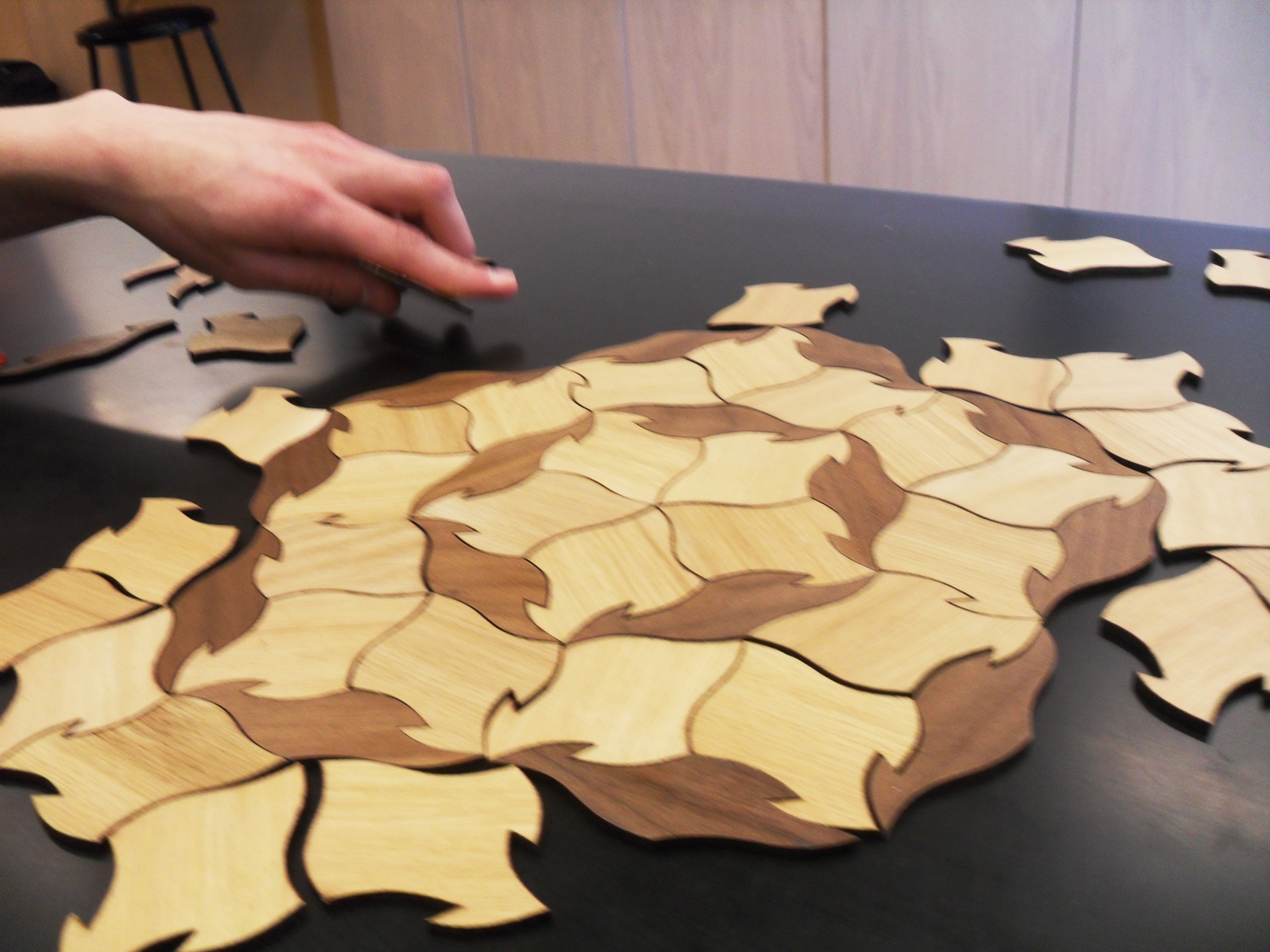
Fun times. I liked having something out of the ordinary for my Calculus and Algebra II kids. I think they’ll remember him coming to visit more than how to find the solution to 1D quadratic inequalities or how to find the concavity of a function.

2. With another teacher and two students, I went to the Museum of Mathematics first Math Encounters lecture titled The Geometry of Origami, from Science to Sculpture, given by MIT professor Eric Demaine on origami and math. I have seen a few talks on origami and math (in person or on video), and this was the best. I’ve already signed up for the next two lectures.

3. I needed to prepare a review for my Algebra II kids for advanced quadratics topics. If we have a review at all, I usually just whip up 8 problems and give my kids the entire class period to work on them — from the “most difficult” to the “least difficult.” I have a set of solutions that I keep at the front of the room, so students can check their work. However, I decided to try to mix things up. I wanted to use Sue Van Hattum’s Risk game… it forces students to ask themselves: what do I know and how confident am I in what I know? (It’s meta-cognitive like that).

To set it up, I talked to my kids explicitly about how the purpose of the exercise was to review, but also to be hyper-conscious about what you actually know (versus what you think you know). I put kids in pre-chosen pairs. And each pair got a booklet of the Quadratics and Inequalities Review Game (each page was cut in half and stapled). Below are the first two questions from the game.
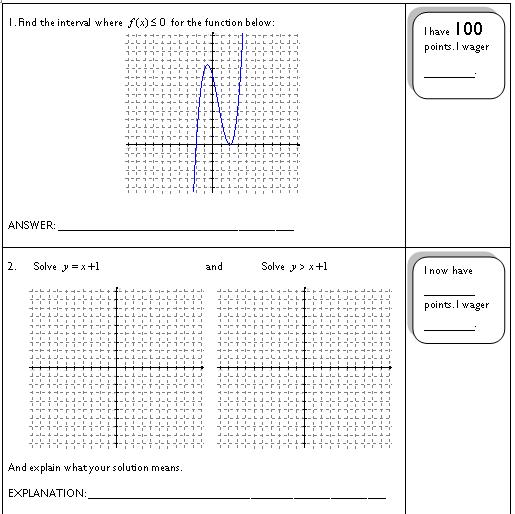
Each group started with 100 points to wager — and they lost the points if they got the question wrong, and the gained the points if they got the question right.

Some possible game trajectories:

100 –> 150 –> 250 –> 490 etc.

100 –> 10 –> 15 –> 30 etc.

Anyway, what was great was that the game really got students engaged and talking. Each student tended to work on the problem individually, and then when they were done, they would compare with their partner.

(If you try this, you have to make sure that students know NOT to skip ahead… everyone is working on one problem at a time. Then you go over the problem, and THEN everyone starts the next problem.)

Since I don’t like review games with a time-pressure element, I also gave out a page of problems on older first quarter topics. Getting those questions correct were each worth 20 points.

I am definitely going to use this review activity again.

4. I used Maria Andersen’s Anti-Derivative Block game today (it’s like tic tac toe, where you need to get 4 in a row, and uses calculus). I didn’t teach my kids antiderivative tricks. I just told them what an antiderivative was and had them play the game. I’m currently trying to teach intuition regarding antiderivatives (many students have trouble reversing their thinking) and so I spend a day or two just working on this intuition.

5. When completing the square, another teacher in the department shared with me a great mnemonic that helps student remember what to do. She does a funny little thing recalling BOP IT. If you know BOP IT, then you know if you say it in that BOP IT voice: Halve it! Square it! Add it!

Of course this comes AFTER they can explain to you why you’re halving it, squaring it, and adding it. They have to know WHY these are part of the completing the square process, but once they do…

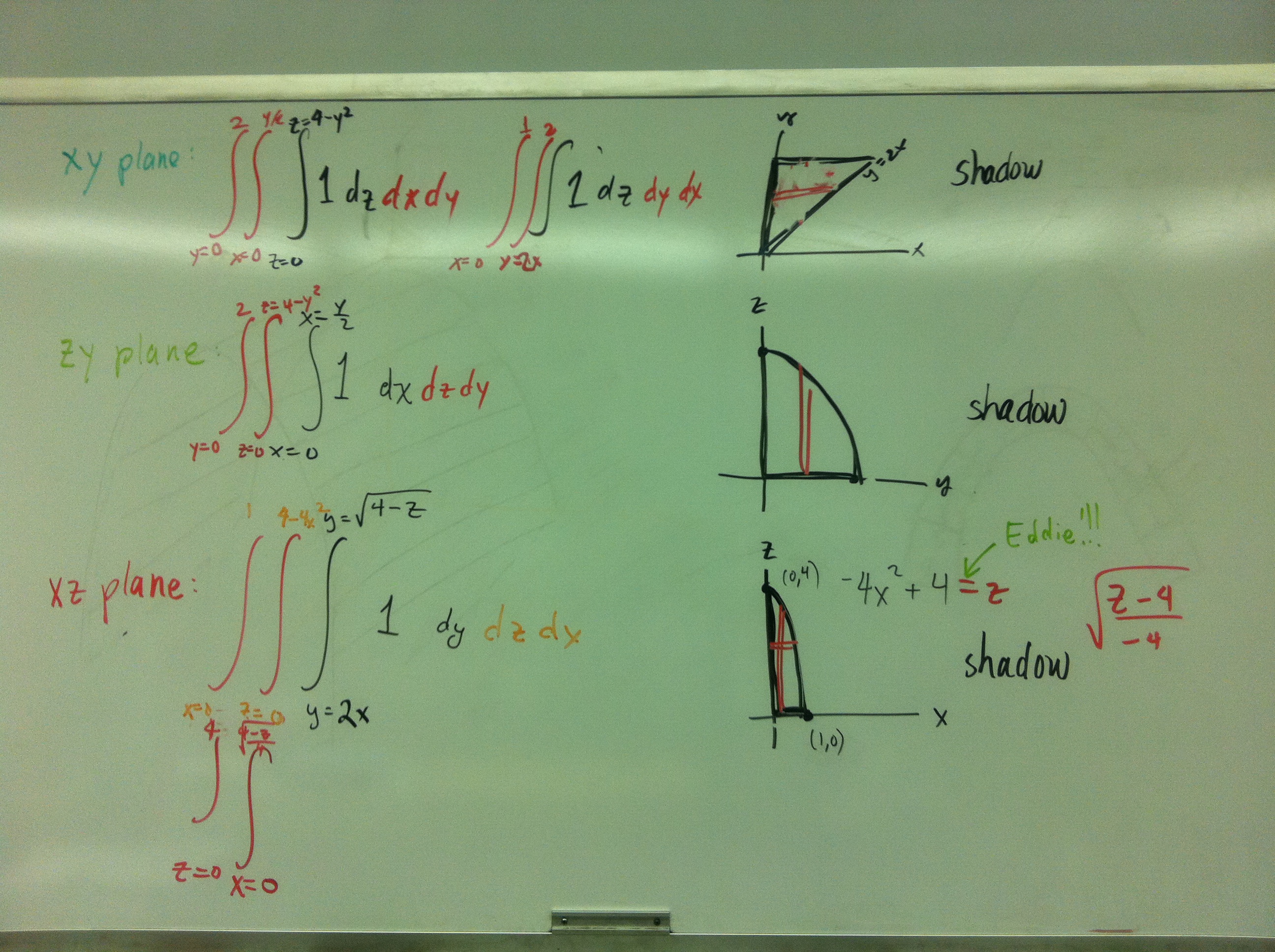
6. Three of my multivariable calculus students — one with an iPhone, a blackberry, and a droid — wanted to decide which one took the best picture. So each captured our triple integral lesson on their phone, and me and another teacher picked the best. The winner:
SugarSync

How many of you out there use Dropbox?

(Hopefully many of you raised your hands.)

I do. It has been really awesome. For those who don’t know, it’s a site which “shares” all the files in a single folder among multiple computers. So I put all my teaching stuffs (worksheets, tests, smartboards, etc.) in that folder and I can access them anywhere. And it automatically updates — so any new documents I make at school will be on my home computer too. Any changes to tests I make will be made on my home computer too. Best of all, it’s free.

But the problem is: I’ve reached my (free) 2GB limit. I want to have all my teaching stuff on Dropbox, but probably like most of you, I have more than that.

One of my students who is taking computer science mentioned SugarSync to me… It’s like Dropbox… it’s also free, but better. (HOLLA!) You get a huge 5GB of free storage, plus it has somethings which I like better than Dropbox. But mainly, it has more space. Right now it seems like that site has already started to be a serious competitor for Dropbox. And I think they’re trying to get the word out. Right now, if you refer someone to SugarSync, you and the person you refer both get an additional 500MB of free storage space.  Clever, right?

Obviously, I want to be all over that. So if you are thinking of trying it out, use my referral link! You and I each get an additional free 500MB of space!

Image representing SugarSync as depicted in Cr...

Image via CrunchBase

You should DEFINITELY try it out.

PS. If you want to sign up for a Dropbox account, use this link and I get 250MB of free space. I don’t think you get any free space though. :(


Randomness, because it’s Still Early

I don’t know. I thought I was doing okay — dealt with a SmartBoard crisis, made good progress into the content of each of my classes. Yes, I’m only three school days in, and I’m rushing forward, like the train that I always think I’m on. And I was thinking “wow, I’m getting back in the groove of things.” However, I read Mythagon’s most recent post, and I’m more certain than ever that: I’m not.

I’m not unhappy. And I’m not all pie-in-the-sky. But I did have one big goal for this year, and that involved having a lot more group work and math-talk in the classroom. So far, we haven’t had that, not in any significant way. And it’s so important early on — so you can build the norms and show “hey, this is something we do.”. I hope I can get something group-work-y happening soon.

Here are some other random things from the start of the year:

1. When kids want to go to the bathroom, they just have to go like:

Then I’ll see it, and just gesture for them to go, without interrupting the rest of the class/lesson. (One of the middle school teachers mentioned this to me, and I think she said she got it from the Lemov book.)

Funny true story. When I introduced this to one of my classes, a student said: “Do I need to put one finger up for a number one and two fingers up for a number two?” I love kids.

2. I designed this poster for my Multivariable Calculus room. (It’s poster size.)

Each time we encounter a new Greek letter, I’m going to have a kid highlight the letter we’ve learned. We’ll see how many letters we’ve picked off by the end of the year.

3. The teacher I’m teaching Algebra II with this year is new to my school. In her old school, she renamed homework “home enjoyment.” It’s silly and corny, but at least it gets you thinking about homework as something other than work. (Too many negative connotations.) Last year, I tried going with the uber-dry phrase “daily practice.” Just to remind my kids what they were working on. I couldn’t stick with it. This year, I’m going to stick with home enjoyment. In all my classes.

You can see I’m already on top of it. I’m doing it on my “course conference” (where I post the home enjoyment and smartboards each day.)

4. I decided that I need to try to make sure I have at least one humorous thing in my smartboards for my Calculus and Algebra II class every day. I had this whole schtick setup on my smartboard…

… but then I decided I would print out a color picture of beebs, and write out the conversation for two histrionic students to act out in a script (while holding the picture of beebs over one of their faces).

5. I’m working SUPER hard to learn my kids’ names. But — if any of you know me in real life — you know this is perhaps my biggest challenge. I can barely get their names when they are in assigned seats and have name tents propped up. But I think I’m getting the hang of them. The worst is when I see one out of their natural habitat. Meaning: out of their seat. They might come into the math office. They might see me in the hallway. And they’ll start talking to me. And my brain just goes into overload. It’s embarrassing.

Luckily, I preempt all awkwardness around this by telling my kids this on their first day and joking about it. They know I’m bad, and they see me trying (and often failing) in class to come up with their names.

6. My non-teaching plate is full this year. I’m taking over the Upper School’s (read: high school) Student-Faculty Judiciary Committee. I’ve been a faculty representative on it for two year, and now I’m beginning my two year tenure as the “faculty advisor” (read: grand poombah). It requires a dauntingly scary amount of work. But in my opinion, it’s the best thing about my school. Which is why I’m willing to be dedicated to it.

I’m also helping create a Peer Observation Group at my school. I’m hoping it turns into a semi-formal-yet-still-informal, positive way for teachers to start migrating into other classrooms — like little bees — and collecting and cross-germinating all sorts of wonderful idea-pollen. My current feelings: I’m super excited to go look at other classrooms, while I am super anxious about anyone coming to see mine.

As well as helping advise the math club. And running the New York Math League and AMC.

More things will probably be added to my plate as the year goes on.

UPDATE: I forgot one more thing that worked well at the start of this year that I want to be sure to do next year. My co-adviser and I emailed our homeroom two days before the start of school, promising them a pancake breakfast if they all brought the locks for their lockers on the first day of school. Usually getting 11 kids to bring in their locker locks takes a week or longer. And involves a lot of chasing kids down individually. But this year, it was awesome. THEY ALL BROUGHT THEIR LOCKS.

Why I’m not Blogging

Part of me thought I would get to the Park City Math Institute and be blogging up a storm. I would sit down each night, twitching with excitement, ready to blog about all the ideas and problems and conversations I would be having.

And I am aflutter with excitement about this program.

But the problem is that I’m spending all day talking about math and teaching, and thinking and thinking and thinking, and I don’t have the motivation at the end of the day to organize my thoughts.

This is problematic. Because my memory:elephant’s memory::pebble:mountain.

So tonight I’m just going to jot down a few ideas/observations/thoughts that don’t fit into the larger posts I feel compelled to write on (a) lesson study, (b) math talk, and (c) PCMI-as-a-learning-community [1].

0. There’s a really personable, funny person at PCMI who writes a blog that I’ve been to a few times — but for some reason wasn’t in my reader. It’s awesome. From his about page: “I’m a recently tenured college professor teaching mathematics at a high school during my sabbatical leave. I’m blogging about my experiences mainly to record my successes, frustrations, thoughts and feelings.” The best part: it’s concrete and on the ground and honest. And being new to high school, he makes observations of things we don’t always notice — or that we’ve forgotten (example here). So go back through the archives and drink up! Adventures in Teaching

1. When kids are working in groups, and you want to start having them wind down without the time pressure, you ask them to hold up a 1, 2, or 3 fingers to represent how many more minutes they need. And to make sure everyone is participating, if they don’t need any more time, they hold up a fist.

2. If you’re having a problem with student attending class on time, on certain days you can give raffle tickets to students if they are in their seat before class starts. When class starts, you select a raffle ticket to win a prize. Sometimes the prizes can be lame, sometimes they should be good. (They do this with US — adults — to get to the morning session on time. It works for me.)

3. Watching videos of teachers is powerful. I would love to have DVDs of good teachers teaching. Nothing else – no text, no explanations, just the videos for me to watch and mull over.

4. A group of teachers from Seattle came for a week and presented the work they’re doing with “Complex Instruction.” Part of their work was building a supportive and hard-working community. No easy task. One of the things they do is video tape their lessons and have discussions about the tapes. When talking with one of ’em, he said that the teacher on the tapes of him was not anything like the teacher he thought he was. Powerful, and scary. I asked more about how they set up a safe space for teachers to look at the tapes, and feel supported, and not defensive, it was clear they had to do a lot of work beforehand to make sure that happened. There were stages. But what struck me the most was the norms they had when viewing the tapes. The teachers teaching weren’t individual teachers. They were any and all teachers. They said more than a few times that “it could be any of them.” To emphasize this, they only referred to the teacher as “Teacher” — not by the name of the specific teacher teaching. Everyone saw themselves as working almost as one collective, one Teacher, working towards improvement of practice through these videos and discussions. Just like we say how blogs and twitter have changed our lives when it comes to teaching, they say videos have done that. Scary, but I want to do something like this with a few teachers I feel safe with.

5. Teacher moves. This is a term I’ve picked up here. I generally hate jargon. I am a philistine. But I have come to really embrace it. Because it gives a name to something that we do all the time. We are confronted with a situation (whether it be academic, behavioral, social, blah blah blah) and we have about 2 seconds to decide how we’re going to deal with it. What I’m learning is that although we all have our own set of teacher moves — most that come naturally to us — we can work on expanding our repertoire and honing these teacher moves. How? First, by talking to (or reading blogs of!) other teachers — to see other teacher moves. Second, by thinking through hypothetical situations that might arise in the classroom and anticipating how you’re going to respond to them. For me, just giving these things a name — “teacher moves” — let’s us start having conversations about improvement.

It is letting me see the whole class as a set of discrete teacher moves. Moves I make consciously and unconsciously. But by starting to conceptualize my time in the classroom as a string of discrete teacher moves, I can start thinking about things in a somewhat more concrete way. It let’s me focus more on my actions.

6. In my classroom, as I suspect in most classrooms across the country, the teacher is the sole authority of knowledge. What’s right and what’s wrong. It makes sense, of course. But I’ve been learning that this setup might not be the only approach. One of the most important things to instill in our kids is confidence in their abilities, and the ability to take intellectual risks. The way most math classes are structured, well that’s not so conducive for risk taking. And the teacher is the arbiter of knowledge — that’s right, that’s wrong. Students look to what the teacher writes on the board and starts to believe that only the teacher can be a math authority. I have no problem with the teacher being a math authority. But I’m starting to realize that in my classes, I am the math authority. I want kids to be math authorities too, and to view each other as valuable sources of information. It might be something to think about. Because I suspect that getting at this is also getting at independent learners. And getting at math confidence.

7. Me at the 4th of July parade with a bunch of math nerds! “We love math, how about you?” was the final two lines of our chant.

There are more things, but I’m tired. Sorry it isn’t so coherent.

[1] If I don’t write about these in a reasonable amount of time, feel free to harass me.

Binder Checks, Redux

Introduction

As you may remember (or not, because come on, it’s not like you commit to memory everything I write here), I have been using a binder system in Algebra II this year. I made it a conscious goal this year to teach organization, and to try to make homework more meaningful. The basic idea behind these binders is to (a) help students learn how to be organized and (b) allow students to view homework as not just a chore to “get it done and forget about it.”

Conclusion

So I thought I’d end with the punchline. The binders were a darn good success, for the first year I used them. I saw the results in class when we talked about homework. And for the most part, students themselves bought into the system and saw the benefits themselves. I’ll probably change things here and there a little, but not much.

Signs of Success: Evidence for the Conclusion

I already knew they were doing something seriously good when I threw up answers to the homework on the SmartBoard, and almost all my kids marked the questions they got right with a CHECK and the questions they got wrong with an X. They were also much more proactive in asking homework questions. For that alone, I knew I was probably going to continue these binder checks.

On our last and final binder check, I asked the following:

For 5 more points, I ask your honesty when answering questions on two things. I would never penalize you for being honest when I ask you to be honest. I really am looking for some thoughts on this binder thing.

(1)  Has keeping a binder kept you more organized throughout the year than without the binder?

(2) What is your process for correcting homework/assessments? When and how do you do it? Does it help you?

I also verbally talked to them about how this feedback wasn’t about them, but was about this thing we did this year, and I need them to be completely honest in their responses — even if it meant bashing the binders.

I contemplated typing the most positive responses, letting y’all think that those were representative, and moving on. Because overall I think that the binders were a success, and these responses would have illustrated that dramatically. But heck, things are nuanced, and skipping over the details leaves out the juicy and important bits. So…

Here are a some of the responses to the first question.

(1)  Has keeping a binder kept you more organized throughout the year than without the binder?

It has kept me more organized for the long term versus the present. I think that more frequent binder checks would help us keep us up to date, so like after each unit/assessment.

Yes! Honestly it does because in past years when it comes time to study I can never find the notes/hw/tests I need.

Keeping a binder has made me less likely to lose my work and more organized. It is likely that this will help me in studying for the final. Although it is a pain, I am glad that we do it.

Yes!!! I honestly am so happy that you made us do this, even though it is a bit of a hassle. Now that exams are coming up I am so grateful I have all my material. I wish I had done this for all my classes.

I really did not enjoy doing it. I thought it was really annoying but now when studying for finals it is very helpful. And it has definitely made me more organized.

I guess it has forced me to keep a lot of my old things together but it is not necessary.

I didn’t type all the responses because most read like the one in italics. Overall, when looking at the responses, I distilled the following. The binder checks are slightly annoying, but definitely helpful. For the few students who are already organized, nothing much changed with organization. For the rest who aren’t consistently organized, many seemed to find it frustrating but helpful, and a few just found it frustrating. Many also said they are happy they’ve done it because now they have everything set in order to study for the final exam.

I typed out most of the responses for the second question.

(2) What is your process for correcting homework/assessments? When and how do you do it? Does it help you?

Either I correct them when we go over them in class or I check the course conference later and correct them. It doesn’t always help because sometimes I forget to correct them and then I lose points, but for the most part it helps.

I do it the night before the binder check and it helps me because it’s review and usually I forget how to do the problems at first.

I usually do it before the binder quiz and I go over it with someone for the corrections. Honestly it does help even though it is tedious and hard to do corrections. When I study for tests it is very helpful. It is also good because I know what I have and don’t have.

I try to do it when we go over answers in class or when I get an assessment back. If I realize I’ve not done that, then I will try to correct it when studying for an assessment or before a binder check. It’s helpful to have the right answer to study, but sometimes we go fast going over them and it usually messes me up if I missed out on correcting them.

I usually correct homework when we go over it in class. It is pretty helpful because if I don’t understand something we will go over it when I usually wouldn’t ask too many questions. I correct my assessments out of school on my own. Usually I’ll try and figure out what went wrong but afterwards if I can’t figure it out I’ll ask a teacher for help.

I correct homework when we go over it in class. And I usually correct my tests the day I get them back but sometimes later. It is helpful because then you know what mistakes you have made and how to fix them, and also what you need to work on.

I correct them when we go over it in class. Sometimes before binderchecks I’ll go thru them to find wrong questions. It doesn’t help me personally.

I correct homework assignments in class when we go over the homework and I correct assessments as soon as I receive notice of a binder quiz. Correcting homework helps me better understand problems that I did not know before. It also compels me to be more proactive in my learning.

I correct homeworks in class when we are going over how to do the problems, because that is when I understand what I did wrong and I correct test[s] before the binder checks. It would help me if it were just for the sake of correcting, but binder checks hurt my grade more than help.

Yes, it helps.

With HW I do it in class as we correct it, but for tests, I usually do it a little before the binder check by pulling out notes and old HWs on the topic which helps me overall.

My process is checking in the back of the book, writing down right answers in class, and revising my work in class so I have it correct. It helps me keep track that I’m doing it correctly.

I do it all at once when the binder check comes. Probably not the best idea, but it works.

I do it when we go over it in class or before the binder check. It doesn’t really help me. I never really use that material to help me study anyways.

I was most interested in reading the answers to this second question. Because it was on this front that I predicted that my kids would all tell me that they do all their homework and assessment corrections the night before the binder check, and that they didn’t find doing them useful, and that there would be an outpouring of complaints about their grades (many got Cs and Ds in the first quarter for the binder checks). I suspected that most would say it was just an annoyance and not helpful at all.

But clearly most students explicitly or implicitly talked about how being forced to correct their work helped them, and be more proactive in their learning. I was happy that many found it useful in consciously separating their knowledge into what they do know and what they don’t know.

Putting it all together

On Friday I left home after the first two periods, sick. That’s not the bad news — I mean, we all get sick sometimes. The bad news is that I had already planned on leaving after the first two periods, to go to a wedding. I had to miss my friend’s wedding, to be sick at home. But I guess if there was a perfect time to be sick, it’s the day that I had already prepped sub plans.

I’m going to share ’em with you, because they worked really well.

The year is coming to a close, and I wanted my calculus classes to pause for a moment and take stock of what we’ve accomplished. I also wanted them to try to fit it all together in one large conceptual framework.

So I decided to ask ’em to — on giant yellow poster paper, with markers — create a concept map in groups of 3.

I didn’t know what to expect. I hadn’t done this before. I did offer a prize to the best map (bag o’ candy).

I came to school on Monday, and was really impressed. The maps were colorful, comprehensive, and fun. I can only imagine the conversations that students had when drawing them (“remember when we did …”; “what was that thing we did with…”; “look at this!”).

A funny thing happened by accident. When I broke the kids into groups, I gave ’em group names (“The Polynomials,” “The Concavities,” “The Tangents,” and “The Anti-Derivatives”). There were just cutsie names, no thought behind ’em.  I meant for each group to make a concept map for all of calculus. In fact, each group ended up making a concept map for their group name.

I’ll admit my initial reaction was disappointment, because they missed the “this is the entirety of calculus all together” aspect of what I was goin’ for. But then I looked at all four maps together — and they formed a pretty awesomely comprehensive map for the entire course.

Brainstorming Some Extensions/Changes

1. Use this as a 35 minute final exam review activity for a class — where each group takes a cluster of topics and connects them. Hang these up during review days for students to look at and refer to. (I might do this for Algebra II.)

2. If a course is broken into, say, 12 large conceptual units, ask groups to design one concept map for 4 random units they draw out of a hat — making connections among ’em. Then (somehow — this I haven’t figured out totally), have the class use these smaller concept maps to generate a giant map for the entire year.

3. Have students do this at the end of each unit, so they can visually see what they’ve learned and how everything relates to each other. (Possible studying technique for students who are detail oriented and can’t see the larger picture or how things relate.)

Their Homework

After this exercise, I gave my kids homework. I gave ’em a writing assignment, promising them I wouldn’t read ’em until after their final grades were entered. I do this for all my classes as they wind down.

For homework I’m going to ask each of you to write a letter from yourselves now to yourselves at the beginning of the year, telling yourself what you wish you had known about how to succeed in this particular Calculus class.

Something like:

Dear Sam from the Past,

Wow, what a long year. I can’t believe it is finally winding down. You might think it’s weird that I’m writing to you from the future, but I am. (The future is amazing.) Here are some important things to know so you can be successful in Calculus, and in life. Don’t wear Green. Mr. Shah hates Green. […]

You can talk about my quirks as a teacher (like “Mr. Shah does/doesn’t give a lot of partial credit” or “Mr. Shah doesn’t like when you use pen in class”), math things you wish you knew beforehand (like “you should make sure to really know your exponent rules” or “you should really be comfortable with fractions”), and any other general advice (like “trust me, doing your homework every day is key” or “Mr. Shah knows what he’s talking about so do everything he says without question” and “I found that cramming the night before did/didn’t work”).

You can and should also say whatever you want about the class — if you found it rewarding, if it’s really tough to visualize things, if meeting with me helps, if it’s impossible to do well, whatever. I won’t read them until after your final grades are calculated. Feel free to be funny — like if you look at yourself at the beginning of the year, and you hate that sweater you wore every day, warn yourself not to wear that sweater because it’s stupid. Or if you stole a teacher’s cupcakes, and you want to warn your previous self not to be so selfish, you can do that too. Don’t stress yourself out if you’re not funny.

I use these to create “Advice from Students Past” packets to give to my students next year (here too) — advice which might resonate with ’em on how to succeed. It also gives me some insight into my own teaching and my own class from my students’ perspectives.

So that was all from last Friday, a day I missed.

Brainstorming Ideas for 2010/2011

So about a week or two ago, I started writing down all the ideas I have for next year. And they kept on coming, I got 20, 25, 30… And each time I came up with one, I threw it in my google doc. This is the current instantiation of my list.

I wasn’t going to post it, because it’s just brainstorming (who knows if I’ll decide to follow through with ’em; some are great ideas and some are terrible), and because the list is so specific to me and my classes. But @hemantmehta said it might help him, and who am I to deny @hemantmehta?

I thought writing the list was cathartic. It also helps with my horrible memory. (I tend to forget all the small things I want to change over the summer — when my brain atrophies from inactivity.)

I suggest if you haven’t made one yet, do it now — when you’re in the throes of the last few weeks of school, when things are getting on your nerves and you’re ready to be done. This is the time you should make this list. Because you’ll use your angst and frustration to imagine the educational paradise that you’re going to create the next year.

So okay, here are some of my raw, jotted down thoughts. I’m not really looking for feedback on them.

Ideas for next year (2010/2011)

  1. Binder checks in calculus
  2. Binder checks happening in small chunks 1st and 2nd quarters
  3. Idea: Homework quizzes: Assess students aperiodically on questions from the homework — and they’re allowed to use their homework to do it? (Has kids show more work, if they can just copy, and write down the problem… also encourages kids to label topics from each sections?)
  4. Create a better sheet to walk around with to check homework daily – so I take attendance and homework more consistently
  5. Have sign in sheets for kids to sign in when they arrive late without a note from a teacher – or get caught chewing gum
  6. Have a sheet for kids to write their name down when they forget a calculator/pencil/paper and have to borrow one from me
  7. Rewrite more tests instead of recycling them from previous year
  8. Talk about how to “write” answers to conceptual questions more – at least once per unit – and give classwide feedback and what’s good and what’s not
  9. Give lesson on how to read the book – IN CLASS each quarter spend a period actually learning a topic/section by reading the book in groups
  10. Make a website with links to useful videos for each Alg II topic we learn – so students can learn independently (videos from the Holt website, but also from other places)
  11. When introducing function notation in Alg II, and functions in general, teach how to graph the 8 base/parent functions. Use those as examples for compositions, etc.
  12. Decide to get rid of some topics in calculus (e.g. inverse trig integrals/derivatives, rational function graphing, extensive work on limits?) to spend more time on fun stuff (volume, surface area)
  13. Incorporate probability unit in calculus
  14. Final 4th quarter group project in calculus (introduce EARLY in 4th quarter) – based on problem solving to capitalize on the work we will do all year?
  15. Group work standard in Algebra II and calculus – meaning having standards groups each quarter.
  16. Group pop quizzes for team work and group building
  17. Giant whiteboards to have students work on problems and present their solutions
  18. Calculus problem solving (at the beginning … or end … of each unit) — how to assess problem solving?
  19. Have students in MV calculus be better at deriving equations and solving basic problems (more regular tests? use concept questions regularly?)
  20. In Alg II, don’t have single assessment grade; break assessments into standards and record those
  21. Idea: use Friday 3:20-4pm as a way for students to reassess. REASSESSMENT IS A CAN OF WORMS – think CAREFULLY ABOUT THIS
  22. Write in planner the topics/standards covered each day, so I have a record of how long it takes me to teach things
  23. Allow students 1/2 credit for homework done in pen or not on graph paper
  24. Go over course expectations at the start of every quarter
  25. Talk about what collaboration can look like for homework, and what it can’t. Do this each time you go over course expectations
  26. Come up with a clear idea of what collaboration can look like for MV Calc problem sets… and come up with ways for them to be be enforced
  27. Put review questions on each assessment
  28. Create posters for classroom(s) — with quotations and rules? In general decorate classroom! COLOR!
  29. Create some sort of “prize” that students can work towards (e.g. everyone is focused, and working in groups well, gets a paper clip added to chain… when it reaches 20, donuts?) — very visible!!! Or something like if all students do their homework for a week, we get to play a song at the end of class on Friday – of their choice (as long as it’s appropriate).
  30. Prize for students who get perfect scores on assessments — publicly awarded (BUTTONS I DESIGN?!)
  31. Set aside the last 3 minutes of class, no matter what, to have students summarize what they learned and what they’re confused on
  32. Steal Kate Nowak’s “index card” idea… taped to each desk will be a index card holder (imagine library card holders), and 4 white index cards (so no kid gets embarassed by holding up a different color). On each card are numbers 1 to 4, and the words “1. TOTES GET IT!” “2. I’M ALMOST THERE!” “3. KINDA CONFUSED, SIR!” and “4. NO IDEA WHATSOEVER!” – make sure to only make 4 – don’t want to have a “middle option” for kids to always sit on the fence. Maybe use these at the end of class to see how they feel about the 2 or 3 skills/ideas we’ve learned. Stop asking “do you get it? anyone confused” which clearly indicates I want them to say yes.
  33. Is there a way to make electronic exit slips? Maybe at the end of each week have students fill one out as part of their homework? GOOGLE DOCS! Or ignore, if using 32.
  34. Be consistent about writing one random positive email to parents — one for every “hard”/”bad” email I have to write, and if I don’t write one in a week, then one every Friday. Keep track of this.
  35. Make a sign in sheet for when kids come for extra help — I fill it in, with name, date, and what they’re meeting me for.
  36. Create a template for the email students need to email me when they want to meet… Have on it “I would like to meet because I am having trouble with this specific thing:” Require students use the template.
  37. Go visit at least 4 different classes each semester – plan 2 at the beginning of each quarter to ensure that I start doing this.
  38. When doing review classes, create and use more f(t)/Kate Nowak games
  39. Have more “hooks” — like making homework like https://samjshah.com/2009/08/21/idea-ill-never-follow-up-on-though-it-is-good/
  40. Consider allowing students in calculus to use their calculator more often — with requirements on how they have to express they used their calculator (if they did) on assessments. Talk with them and maybe come up with class norms — they generate — on what they think is fair to be asked to include on an assessment when they use their calculator.
  41. Teach students how to program in their calculators in calculus (how to come up with an approx deriv program, an eqn of the tangent line program, a Riemann Sum program, any others???)
  42. For ONE unit in Alg II, try out sticking strictly to a schedule – to try it out….
  43. Pencils down at the end of assessments. Enforce with a 1pt penalty.
  44. Provide “find the mistake(s) in these solutions” for Alg II and Calculus. For Calculus, make some of the mistakes NOTATIONAL errors. Highlight the importance of notation.
  45. Use many different variables in calculus, besides x and t — to really drive home that d/dx means “taking the derivative with respect to x” instead of “take the derivative”
  46. Continue practice of having students answer questions about the course expectations using google docs – especially about homework makeups from absences and extended time. Do it at the start of each quarter. Make sure to get their graphing calculators’ serial numbers.
  47. Have students write (etch?) their names on their calculators (case, calculator itself, battery lid) one day in class
  48. Make an ongoing list of homework assignments, corresponding with each skill taught. So the following year, I know what to assign depending on how far we got in class.
  49. If students get a solid C or C- or below on an assessment, they must write down 2-3 paragraphs: (1) how they prepared for the assessment, (2) why they think they got a low score, (3) their plan for the future. MAYBE: they also need to get it signed by their parent if they get a C- or below (?) — or is this moving away from student independence?
  50. Honor statement that students must write out on each assessment.
  51. Spell out homework collaboration on course expectations.