Good Math Problems

Analyzing Parametric Equations

I saw a tweet that sumidiot posted on the parametric equations x(t)=t+c*\sin(2t) and y(t)=\cos(t) and spent a good 30 minutes thinking about the value of c which makes the graph intersect itself exactly once. I was going to post about my solution, but I was beaten to the punch. And thank goodness, because there are graphs and everything on sumidiot’s solution, which you should read here.

I still haven’t fully evaluated twitter, which I will post about later once I come to some solid conclusions. But I’m leaning towards liking it. I’ve got lots of good links, anyway. If you want to be my twitter friend, I’m here!

Students Making Their Own Position/Velocity Scenarios!

I closed up a unit in calculus on position/velocity graphs. Most of my students had horrific memories of physics their freshman year. That teacher, needless to say, is gone. Last year, a number of my calculus students just shut down when we encountered this topic.

This year, I focused a lot on the concepts. One day I showed dy/dan’s graphing stories and that night, I had them each come up with their own problems. For these problems, they needed to draw the velocity versus time graph and the position versus time graph.

Initially I was going to use my favorite on the assessment, however, there were so many hilarious, exemplary problems, I had to type them up and spend the next day using them.

Some of my favorites:

1. Dare-devil Mr. Shah one day decides to go Bungee Jumping. At the top of a mountain, scared, he hesitates 2 seconds, then jumps. He [falls] quickly, eventually reaching terminal velocity at 100 m/s . At the bottom the rope reaches its limit pulling him back up, [coming] to a stop. Mr. Shah smiles.

2. Mr. Shah is riding the elevator to the 4th floor. He waits for the elevator for a bit and then gets on. The elevator goes to the basement to make sure no one is waiting down there [and, of course, no one is there, as always]. It quickly goes back up to the first floor, where 15 seniors try to crowd on. When everyone is in the elevator it heads up to the 4th floor stopping at the 3rd floor to let people off. Finally Mr. Shah reaches the 4th floor and comes over to our calculus class.

3. The Jonas Brothers are walking down the streets of New York City at a strolling rate of 2 mph for 10 minutes as they composed a new song. Suddenly, [student 1] and [student 2] began running at them screaming, at 7 mph. Struggling to find a hiding spot, the brothers run down the block at 8 mph for 5 whole minutes, when they lost the crazy groupies-in-training. Stopping for a break, the boys catch their breath for 5 minutes on a stoop. Walking away when the coast was clear at the same strolling rate as they began with, Nick remarked, “Sorry guys. I’ll try to be less attractive.”

4. A helicopter is taking off. It rises constantly at 200 ft/minute. After rising for five minutes. It stops for one minute to survey the surrounding area. After rising again for 2 minutes, the helicopter is abruptly blown up by a terrorist missile.

5. A man runs from a tiger going at a constant velocity of 3 mph for 1 hour. The tiger gets tired so the man catches his breath for 20 minutes. A rhino appears and begins to chase again and the man picks up speed to 5 mph.

6. You are in an elevator on the top floor (6th floor). Each floor, it picks up more people and it goes slightly faster each time. When it stops on the 2nd floor, so many get in that it breaks and crashes to the basement. People die.

This was a fun class. And almost all my class got pefect scores on the conceptual part of the latest assessment, on this material. They got it1 They really got it!

Topological Maps, Google, and Multivariable Calculus

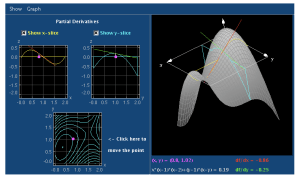
Right now, I’m about to start teaching Partial Derivatives in my multivariable calculus class. I’m going to teach them in a traditional way, to build a sense of what they are. However, I really want to create a project that has students take actual data and find something useful with it.

To take you down my train of thought, look at this applet:

picture-1

So of course we will soon relate partial derivatives to the gradient which will get us to exploring topological maps. Pretty standard stuff.

However, wouldn’t it be neat if each student could pick a place on the globe and create a topological map for it? (And then, using some simple computer tools or a protractor and ruler, come up with estimations about the steepness or flatness of the terrain at various points?) Well, I can easily make this happen! Because now GoogleMaps has a Terrain feature, and if you zoom in enough, you get to see the level curves with the height of the land marked. And you can use sites like this to calculate the distance between two points!

Here’s some random place in Alaska.

picture-2

I’m thinking that having my students actually work to calculate some of these values by hand might really hammer home what these strange calculus concepts are. It’s easy to take the derivative with respect of x of f(x,y)=3x^3y^2. It’s less easy to understand what that means, or what the gradient means, or how they are calculated.

I don’t know if I’ll have time to whip this up, but I think it could be a really great activity.

Water Pistols and Children!

A while ago, I posted about some interesting problems posed in the Technology Review magazine.

  • Jerry Grossman has equipped n children with loaded water pistols and has them standing in an open field with no three of them in a straight line, such that the distances between pairs of them are distinct. At a given signal, each child shoots the closest other child with water. Show that if n is any even number, then it is possible (but not necessarily the case) that every child gets wet. Show that if n is odd, then necessarily at least one child stays dry.
  • Each of logicians A, B, and C wears a hat with a positive integer on it. The number on one hat is the sum of the numbers on the other two. The logicians take turns making statements, as follows:
    A: “I don’t know my number.”
    B: “My number is 15.”
    What numbers are on the hats of A and C?

I submitted my solutions (click here to read my submitted solutions) and lo and behold, one of the solutions got published in the latest Technology Review (click here)!

Arc Length of Lissajous Curves, or Pretty, Pretty Pictures!

In MV Calc today, we were learning about arc length. In 3D, if you have parametric equations defining a curve, you can find the arc length by calculating:

L=\int_a^b \sqrt{(\frac{dx}{dt})^2+(\frac{dy}{dt})^2+(\frac{dz}{dt})^2}dt

I asked them to calculate the length of this curve, which will repeat itself, over and over and over:

x(t)=\cos(3t), y(t)=\sin(5t), z(t)=\cos(2t)

If you graph it, it looks like this (it’s a 3D Lissajous curve):

Vodpod videos no longer available.
more about “2008-10-27_1849“, posted with vodpod

Which is awesome! They had to figure out the limits of integration (the function will go back to it’s original starting point when t=2\pi, so the limits of integration are from 0 to 2\pi. And we had to use our fnInt function on our graphing calculators to actually calculate the length. But it was cool.

During the class, I starting thinking of all the extensions and projects that could come out of this. For example, we could have students study x(t)=\cos(at), y(t)=\sin(bt), z(t)=\cos(ct). If a, b, and c are all rational numbers, we can prove that the curve will repeat itself. However, as soon as we make one of them irrational, we can prove the curve will not repeat itself. Look at this video to see how cool it looks!

Vodpod videos no longer available.
more about “2008-10-27_1852“, posted with vodpod

What if all three (a, b, and c) are irrational? What constraints do we need if we want the function to repeat? (The answer won’t be tough, I imagine, but worth exploring.)

Also, on the subway ride home, I wondered if we could come up with an explicit formula (rather than parametric) for a surface containing every point on the curve. (A harder question, for sure.)

And another: what is the smallest volume you can design to enclose a curve which does repeat, like x(t)=\cos(3t), y(t)=\sin(5t), z(t)=\cos(2t). Since sine and cosine bounce between 1 and -1, I will say that your volume had better be better than 2^3.

Mathclub Hat Problem

One of the students in Math Club recently put his own twist on the age old hat question: Assume you have n people, each of whom has a red or green hat put on them. They each don’t know what color hat they have on. However they can look around and see everyone else’s hat.

After getting to spend some time in a room looking at everyone else and their hats (they may not communicate in any way), they are each placed in separate cells and asked to say whether they have a red hat on, a green hat on, or “pass.” Everyone wins the game if at least one person says their right hat color, and no person messes up their hat color. Everyone loses the game if everyone passes, or if anyone says the wrong hat color.

The question is: what is the strategy that those wearing the hats should come up with beforehand? And can you come up with a formula giving the probability that n people win with that strategy?

To make the problem clear, let’s examine the three person case. The possible combinations of hats are:

RRR | RRG | RGR | GRR | GGR | GRG | RGG | GGG

The best strategy we could come up with is to say: if you see two opposite colors (a red and a green), say “pass”. If you see two hat of the same color, say you’re wearing the opposite color.

So you’ll lose with RRR and GGG (everyone sees two of the same color, so everyone will say the opposite color).

But you’ll end up winning with RRG, RGR, GRR, GGR, GRG, and RGG. Let’s look at RRG to explainThe person wearing the first red hat sees a red and green hat. So that person says “pass.” The person wearing the second red hat sees a red and a green hat. So that person says “pass.” The third person wearing the green hat sees a red and a red hat, so that person says “green” and is right! So RRG is a winning combination. Similar arguments follow for the other five.

Since there are 8 possible combinations of hats, and 6 of them have a winning strategy, there are 6/8 chances that everyone will come out a winner! (That’s a whopping 75%!)

So we’ve been investigating what the strategy will be for n people wearing red and green hats. So far, we’ve done pretty well. In fact, we’ve even gotten Pascal’s Triangle involved, which is always great.

And there seems to be a consensus among the students (though no proof yet) that if you have any even number of people playing the game, say 8, you can actually get better odds of winning if you ask another person to join in (so you’d have, say, 9 people playing). That seems totally counter-intuitive, that adding an extra person to play the game with you would lead to a better chance of winning. So if they’re right, I’ll chalk this problem up to a win.

PS. We did talk about the Bloxorz problem for two weeks, but students grew bored and tired of it. I still think it’s a great problem. Maybe one year a student will want to do an independent study on it, and ask me to be the adviser to the project.