You should head over to the Carnival of Mathematics online. It’s the 
I starts out with a super interesting fact about the number 33 that I had never heard before, so for that one tidbit alone, you should go! now!
You should head over to the Carnival of Mathematics online. It’s the
I starts out with a super interesting fact about the number 33 that I had never heard before, so for that one tidbit alone, you should go! now!
An intuition question.
Look at the function below. It may surprise you that it is a constant! For any value of 

Can you find some geometric way to see that?
It took me somewhere between a half hour and an hour of playing around to get it. I can post my solution in a couple days, but right now I don’t have the energy to find a program to draw my solution [1]. But let me just tell you: it’s beautiful. You’ll be stunned when you first do it. Yeah, the calculus way tells you it is a constant, but seeing the “why” is still a mystery. The geometric way takes a bit, but whoa nellie, you won’t regret spending the time!
[1] Or maybe I should claim there is no room in the margin! (JK)
Update: I did finally write up my solution. I quickly did something I never have done before: do my work in powerpoint. It worked fine.
Update: Mr. K solved the problem in 3 minutes and found a way to show the geometric solution. Head over to his very excellent blog to see it in all it’s glory.
Update: Besides mine and Mr. Ks, a third and perhaps more elegant solution is up at 11011110.
Of the three, I think I like Mr. K’s visualization best, even though it might not be a proof in the formal sense.
The 6th Monday Math Madness is online now. This week is actually not so hard, even though there are two different problems… I was able to get both of the answers in about 30 minutes (assuming I didn’t make any huge errors). I especially like the first question, because it can be easily transposed into a slightly more difficult and fun problem…
The first question reads:
Here’s the slightly modified problem:
That slight change makes it more difficult! But fun fun fun!
In math club this past week, we didn’t have anything to work on explicitly. So we just made up a problem, based on a problem we encountered in the previous week.
Without further ado, here it is. You have a circular field, enclosed by a fence. Two cows Antonio and Barry graze in the field. They are each tethered to some place on the circle, tied with ropes of lengths 

The problem is: come up with a formula for the area of the region that both cows can graze together.
I love that we came up with the problem, and that we’re exploring it ourselves. It’s great that it’s so simply stated, and that it has a pretty tough solution. I love that it’s a generalization of something we did earlier. And I love that even this problem can be generalized further (e.g. we have 
What we did in 15 minutes:
We know we’re going to have a piecewise function of three variables. To start the problem, we make the circle a unit circle, we place Antonio at the point
and we place Barry at
.
By the end of our math club meeting, we had one part of the piecewise function
. We found where there would be no overlapping grazing area, where the function would be zero.
I have some sketches of the problem and the bit of solution we got together. I’ll put them below in a bit.
Oh hells bells, I missed the deadline for submitting a solution to Monday Math Madness #5. I solved it and forgot about it until it was too late. The problem reads:
Aside from 1 and 9, are there any perfect squares whose digits are all odd? Justify your answer.
Since I missed the deadline, I guess it’s safe to post my solution… under the cut.
Even though I don’t mince words when I proclaim my dislike of geometry, there are times when its simplicity and elegance strike me. Today the geometry teacher at my school was talking about Cavalieri’s Principle. Coincidentally, in my 7th grade math class, we are learning about volumes of prisms, cones, pyramids, and maybe spheres.
It got me thinking: without calculus, where do we get the formula for spheres? I mean, with calculus, it’s cake, but let’s assume we don’t have calculus.
These two things in mind led me to this great blog post on Cavalieri. It’s pretty much a proof without words, so I’m going to crib the picture from the post,
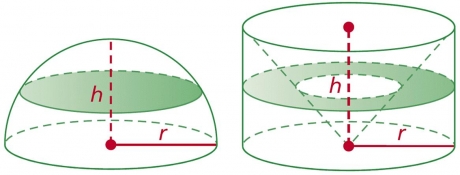
but the post has words explaining the picture. So click on the link and check it out if you are still scratching your head.
We left off in our quest for an explicit formula for the nth Fibonacci number having created this amazing generating function: 
To do what we’re about to do, I need to remind you of two precalculus things:
First, that
. If you don’t know why, I suggest doing long division!
Second, partial fractions.
I’m going to go through this explanation assuming you know these two things.
So let’s look at the denominator of our 



We’ve made good headway, but what we don’t know are 

.
Rewriting this as a simple polynomial, we get:
Now we’re almost done! We use the initial conditions to find out
Since we know 


So the nth Fibonacci number is:
which simplifies to: 
Which is what we set out to show! Huzzah! What’s also nice about this (besides the fact that it’s an integer, which is surprising) is that it shows that the Fibonacci sequence grows exponentially!




 Continuous Everywhere but Differentiable Nowhere