Good Math Problems

Multiple Integrals! Jigga Wha?!

In Multivariable Calculus today, I let my kids loose. We are starting our chapter on multiple integrals, and I generally start out just dryly explaining what integration in higher dimensions might look like. But today, I decided to scrap that and have my kids try to see if they could generalize things themselves and come up with an idea of what integration in multivariable calculus would look like.

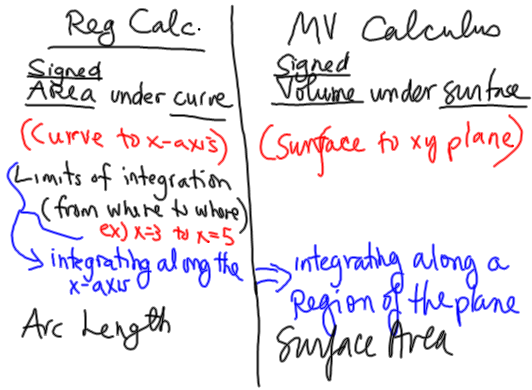
It was awesome. They immediately picked up on the fact that it would give you (signed) volume. That was great. They realized the xy-plane was equivalent to the x-axis. With some prompting, they understood we weren’t integrating over a 1D line (like between x=2 and x=5 on the x-axis), but now on a 2D region. (Of course, a little later, I explained that they could integrate over a line, but they’d get an area.)

Here’s the final list we generated.

It was nice, because students were coming up with some pretty complicated ideas on their own. They were motivating things we were going to be learning. Nice.

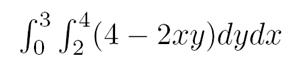
After we went through this thought exercise, still not looking at a single equation, I then threw the following up on the board:

I wanted to see if they could use our discussion to suss out some information about the notation, and the meaning behind it. They actually got that the limits 2/4 correspond with y and the 0/3 correspond with the x. And that the region we’re integrating over is a rectangle. And the surface we’re using is 4-2xy. I mean, they got it.

I then showed them how to evaluate this double integral, briefly. I tried to get the why this works across to them, but we ran out of time and I slightly confused myself and got my explanation garbled. I promised that by the next class, I would fix things so they would totally get it.

Although not perfect (but good enough for me, for now), I whipped up this worksheet which I think attempts to make clear what is going on mathematically.

I strongly believe, however, that this will drive home the concept way better than I ever have done before. If you teach double integrals, this might come in handy.

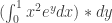
PS. I, a la Silvanus P. Thompson in Calculus Made Easy, talk about dx and dy as “a little bit of x” and “a little bit of y.” So if you’re wondering what I’m looking for question 2 on p.2, I want students to say dy. Then the answer to A is (\int_{0}^{1} x^2 e^y dx)*dy. That’s the volume of one infinitely thin slice. Now for B, we have to add an infinity of these slices up, all the way from y=0 to y=2. Well, we know an integral sign is simply a fancy sign for summation, we so just have \int_{0}^{2} (\int_{0}^{1} x^2 e^y dx)dy

Related Rates: See ’em in action!

A short while ago, I attended the Teaching Contemporary Mathematics conference at the North Carolina School of Science and Mathematics (NCSSM). Before leaving for the conference, I had just started related rates with my kids in calculus. I have had a problem with related rates — because the problems are so bad. It’s just one of those places where you feel: this is where calculus should come alive.

But it doesn’t.

Well, at the conference, one of the last lectures I attended was given by Maria Hernandez. The lecture was ostensibly on using video in the precalculus and calculus curriculum. But in actuality, it was a solution to my related rates problem. Maria had created a wonderful, short activity which brings to life — visually — the idea of related rates.

I stole it, slightly modified it, and used it in my classroom the day after I got back. The activity’s best quality is that students could see math in action, not only from the use of the video, but also from the graphs they produced from analyzing the video. We’d been spending months on this “take the derivative” “take the derivative” “take the derivative” that I felt like we were losing all the understanding we had built up for abstraction. It was perfect to bring us back to basics. I enjoyed doing this in the classroom, and so I asked her if I could share it here. She generously replied:

Of course you can write about the video projects on your blog and feel free to share the worksheets.  You can add my e-mail address so folks can send me a note if they have questions.

Maria’s email is: hernandez at ncssm dot edu

Things to note:


1. All my kids have school issued laptops with Logger Pro installed. (I’ve also heard very good things about the free program Tracker which does the same things as Logger Pro.)
2. All my kids used Logger Pro in other classes, and although most weren’t experts at it, it wasn’t completely new to them either
3. This is all Maria Hernandez’s work… I am just sharing it and my experience with it in my classroom. But if you love it, send her an email shout out!

Prelude

You teach the basics of related rates, in the same, boring way you always do. Blow up a balloon, and ask what sorts of things are changing as the balloon blows up. (Volume, surface area, circumference if you assume it’s a sphere, tension in the rubber, etc.). Then you start talking about how these things are all connected — if you have a bigger volume, you have a bigger surface area — and as one changes, the other changes too. And related rates are how these things are changing in relation to each other.

Go through some basic problems together. I use this packet of problems — where we do some together as a class, some they work with a partner, and some they do on their own. In general, I don’t do the harder related rates problems, because for my (non AP) class, I care more about them getting the fundamental ideas.

The Video

Now it’s time to show the kids The Video.

[Maria has put the video up for you to download here.]

Play them the video once, then ask them to jot down things that are changing in time while you play it again. They will come up with things like radius of the cone, the volume of the cone, the height of the cone, the surface area of the cone, the amount of water that is being poured out of the beaker, the angle of the beaker, etc.

The Question

Here’s the question you should pose: “The person who tried to pour the water into the glass tried really really really really hard to pour it at a constant rate. Watch the video again. Do you think he did a good job?”

So play the video again, and then when they’re done, pose another question:

“How does the rate of change of the volume of water being poured from the beaker relate to the rate of change of the volume of the cone?”

[Note: I’m glad I anticipated this. Interestingly, it wasn’t totally obvious for my kids why the two rates of change would be the same.]

The Task

So then you let them know their task. They’re going to be using related rates to check to see if the person pouring the water did a good job pouring it at a constant rate.  To do this, they’re going to use (a) a guided worksheet and (b) Logger Pro.

Set them off on the guided worksheet. Maria’s original guided worksheet (with Logger Pro instructions!) is here. My (very slightly modified) worksheet is here:

Let them at it however you want. In one class, I had them work on Section A and then we had a discussion about their results. In another, I let them move onto Section B without discussing their results until the end. You can figure out what will be best for you.

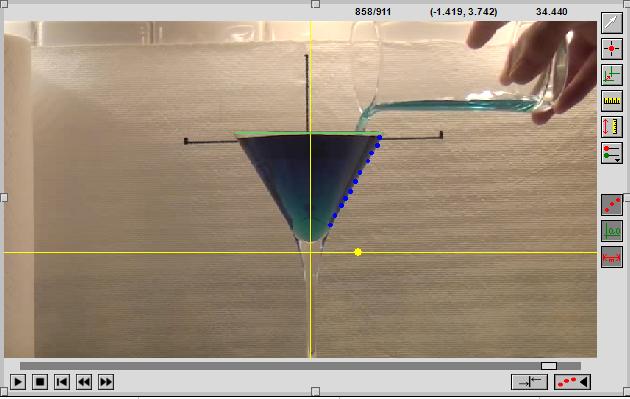
The general idea behind the worksheet is that students make predictions, and then use Logger Pro to evaluate their predictions. First, students capture data using Logger Pro…
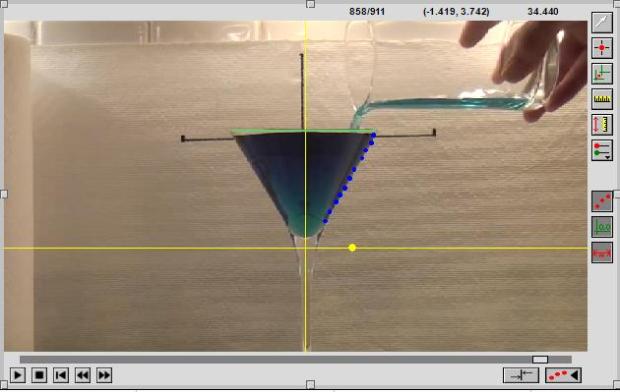
The yellow lines are our coordinate axes (the origin being at the “bottom” of the cone). The dots give us something special. As we play the movie, frame by frame, we add these dots at various times showing where the water is at these times. Notice the wonderful thing about recording the dots on the edge of the class… the x-coordinate of these dots represents the radius of the cone, and the y-coordinate represents the height of the cone.

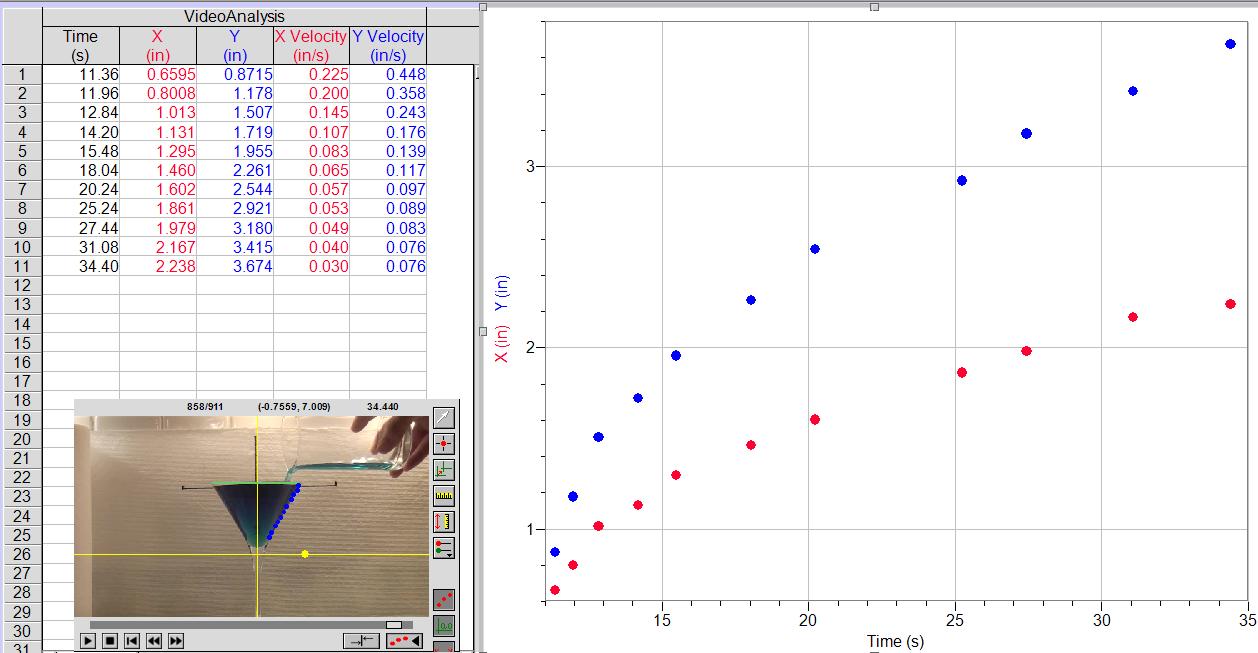
Once the movie has been marked up with blue dots, students can see what wonderful things Logger Pro gives them!
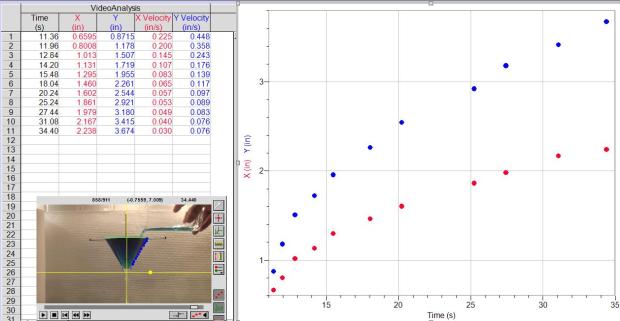
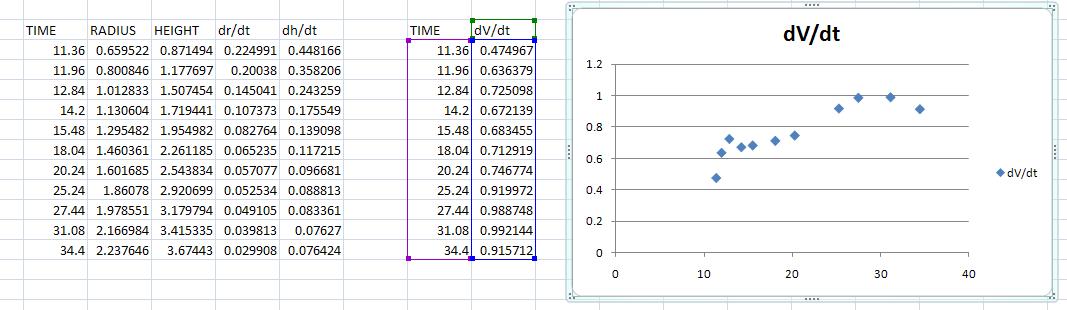
Not only does Logger Pro make a graph of radius v. time and height v. time (lovely!), but it also gives us a spreadsheet set of data… at each time that we made a dot, we are given the radius, the height, and for free thanks to Logger Pro, \frac{dr}{dt} and \frac{dh}{dt}.

Awesome! Well using the fact that V=\frac{\pi}{3} r^2 h, we can conclude that:
\frac{dV}{dt}=\frac{\pi}{3}(2r\frac{dr}{dt}h+\frac{dh}{dt}r^2).

Oh, how nice. Logger Pro gives us all our unknowns in that spreadsheet so we can calculate \frac{dV}{dt}. And isn’t that what we cared to find out? If \frac{dV}{dt} was changing at a constant rate?

Some things of note:

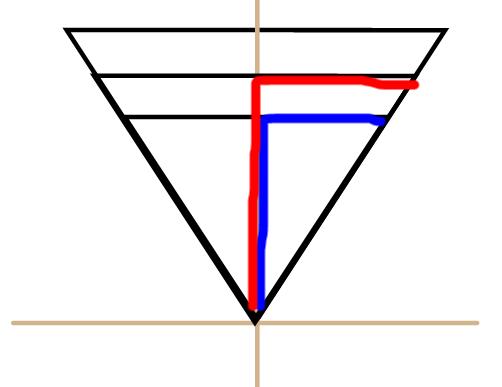
1. When discussing Section A, you can have a very nice discussion about your students’ predictions. It was cool  to discuss why the general shape of r vs. t and h vs. t should be very close to each other. In fact, if you draw the cone filled in at different heights, you can use similar triangles to argue that however fast r is changing, h must be changing at a proportional rate. Why? Similar triangles!
2. In one class, I gave my kids class time to work on the Logger Pro part of the activity. In my other class, I had them work on Logger Pro at home. It was clear to me that the class who worked on Logger Pro in class enjoyed the activity more. There was more discussion, and they had people to talk to when they had technical difficulties. The class that had to do Logger Pro at home was not super pleased by it!

The Conclusion

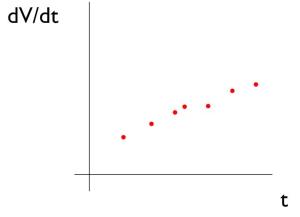
My kids used the guided worksheet to calculate \frac{dV}{dt} at a bunch of different times, and to graph \frac{dV}{dt} v. time. It turns out (we used Excel) we get something that looks like:
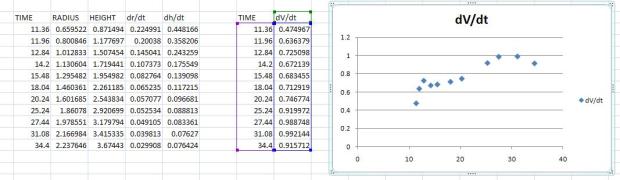
My kids all conclude that the person pouring the water doesn’t do a good job.

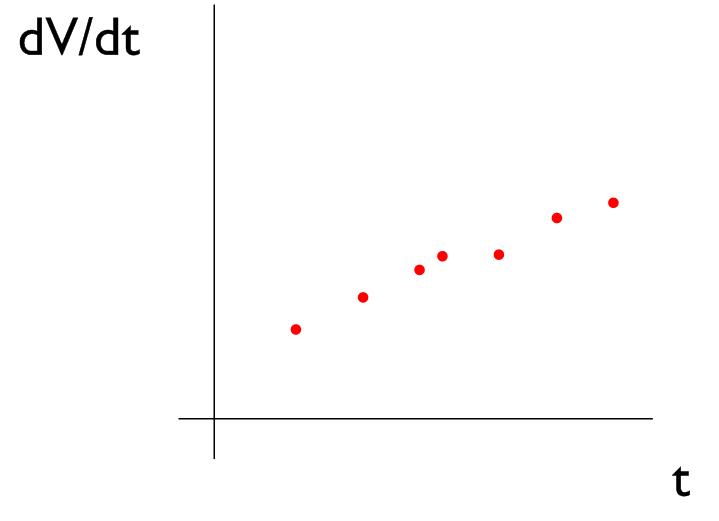
I’m not quite done yet, though. I ask them one last question… If the graph for \frac{dV}{dt} v. time looked like:

“this would mean that the guy was pouring at a constant rate… because the data almost fits a line.”

I tricked almost all my kids in both of my classes, when I said it like that… But one kid in each class caught on that I was faking them out. And they said that this doesn’t mean the water was being poured at a constant rate… but that more and more water was being poured out over time. The only way we would be assured that the water was being poured out at a constant rate is if our data fit a horizontal line…

Nice.

Extensions

I’ve been thinking… perhaps in the fourth quarter I am going to have my students make their own videos filling up cylinders and cones. In a group of 3, I was thinking of asking them to make 2 videos:

  • trying to pour the water in at a constant rate
  • trying to pour the water in in such a way that the graph of \frac{dV}{dt} v. time has a special shape I give them (a decreasing line? a bell curve-y shape?)

Basically it’s going to be a challenge for them, and I’ll have some sort of prize for the group that can get the water in at the most constant rate, and a prize for the group that can get the water to pour in the special shape I give them. Of course the bonus for me is that I might get some more videos to use in future years…
3D Maxima and Minima

In multivariable calculus, we were finding relative maxima and minima. It’s much like finding maxima and minima in 2D.

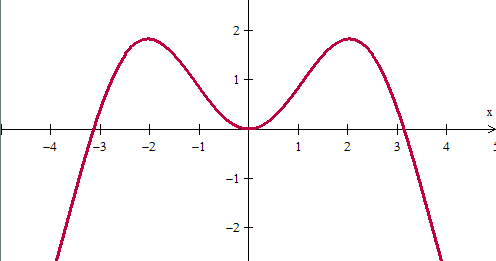
The general idea in 2D is that if you go a little bit to the left or a little bit to the right (changing x by a wee bit) at a maxima or minima, you aren’t really changing your height much (you aren’t changing y by much). Another way to look at it… if you zoom in enough to a maxima or minima, you’ll almost see a straight line! And you can make it as “straight” as you want it by zooming in more and more and more.

Does that make sense?

Now we do a similar argument for maxima and minima in 3D:

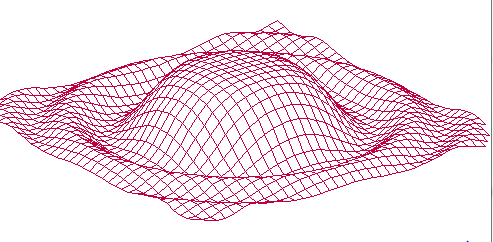
At the top of peaks or troughs, you’ll notice if you walk a wee little bit in the x direction, the height (z) isn’t changing by much. Similarly if you move a wee little bit in the y direction, the height isn’t changing as much. (Or, analogously, if you zoom in a lot lot lot lot, you’ll be looking at something almost perfectly flat, a horizontal plane…)

In other words, instead of saying maxima and minima only occur when f'(x)=0, we now can say that maxima and minima only occur when f_x(x,y)=0 and f_y(x,y)=0. That’s the mathematical way to talk about moving a bit in a x-direction or y-direction.

So my kids know to find possible relative maxima or minima, you have to find the points (x,y) which make f_x(x,y)=0 and f_y(x,y)=0.

In class I then posed a few good questions:

(a) If you know a maximum occurs at the point (2,3), how can you show that the directional derivative in the direction <\frac{1}{\sqrt{2}},-\frac{1}{\sqrt{2}}> is also 0?

(b) If you know that at the point (5,7), the directional derivative for <\frac{3}{5},\frac{4}{5}> is 0, and the directional derivative for <\frac{1}{\sqrt{2}},-\frac{1}{\sqrt{2}}> is also 0. Prove that the point (5,7) is a maximum or minimum or saddle point.

These were things that I thought up on the fly… it’s interesting. We get so used to procedures, that we sometimes forget what they mean. The point I was trying to make is that if any two (different) directional derivatives were 0 at a point, then that point could be a maxima or minima. If you pose that as a claim, and students are used to thinking algebraically, they have to go through the motions to see this is true. (It basically involves creating and solving a system of two linear equations…). [1]

But there’s a much easier way to get students to buy that claim. If you think graphically, this makes sense… if you are at a maxima or minima, and you zoom in enough, the surface will look like a flat plane. So of course if you walk a short distance in any direction, you shouldn’t be moving (much) in the z direction.

I don’t know… this isn’t deep or anything. But it was something that I didn’t plan in class that I thought was interesting…

[1] This is how it would go… Assume you know D_{<a,b>}f=0 and D_{<c,d>}f=0 (and the two vectors aren’t scalar multiples of each other). Then you can rewrite D_{<a,b>}f=af_x+bf_y=0 and D_{<c,d>}f=cf_x+df_y=0. Well then you simply have a system of equations that you can solve for f_x and f_y — and it is easy enough to show that the solution is f_x=0 and f_y=0.

Piecewise Functions Worksheet

This year, I’ve been resting on all the worksheets and smartboards I’ve made in years past. Because of the time commitment spent heading the disciplinary committee and implementing SBG in calculus, there just hasn’t been time to reinvent the (unit circle) wheel. It actually kinda sucks, because I love creating new lessons, worksheets, smartboards, whathaveyou. It makes me look at whatever I’m teaching from a fresh perspective, because I’m forced to ask “how do I want to approach this topic so that my kids will get it.” I don’t know why I love it, but I do. When I’m using my existing material, I am not forced to ask that question a second time. And when I am using someone else’s material, I don’t get any say in the matter.

Anyway, for reasons beyond me, I can’t seem to find anything I made in years past on piecewise functions for my Algebra II kids. I decided to whip up a guided worksheet which would be at their level and walk them through it. My book and Ms. Cookie both approach piecewise functions in the same way. It’s actually a way I really like. But introducing it in this way, and having them make these charts, takes time I don’t have. I am not sure it will make sense to my kids if presented as an opening salvo. I think it’d make a lot more sense if they first get a basic introduction to piecewise functions, and then see it work with these numerical tables.

So for the first time in a long time, I whipped (my hair back and forth…) up a guided worksheet that I hope will go over well:

That’s all.

School Store & Matrices

I spent a day on matrices and then we had winter vacation. Two weeks off. We came back and it took us two days to polish them off. In Algebra II, all we do is teach students some basics. I go over how to add, subtract, and multiply matrices. I remind students about multiplicative inverses. Then I introduce the identity matrix — so that we can talk about how [A][A]^{-1}=I. And finally we write systems of equations in matrix form, and use our calculators to solve the systems.

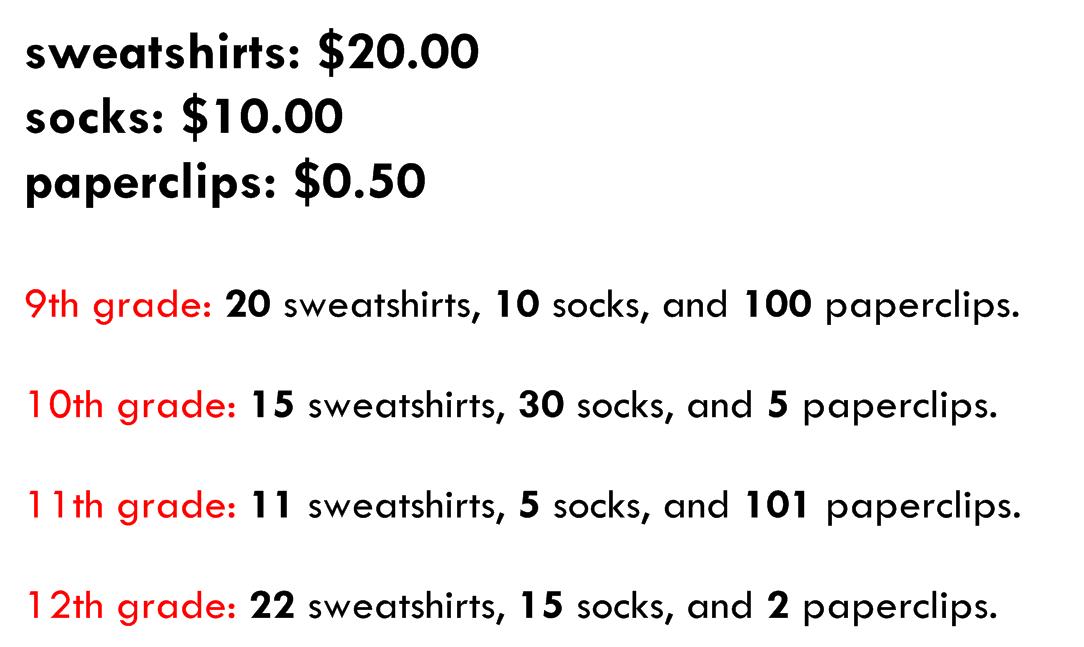
Early on when introducing matrices, I threw the following two slides on the board:

And then I asked, without students doing calculations, which grade took in the most money? We took a poll. Then I asked how we might figure it out. A student answered “well we take the number of sweatshirts and multiply it by the cost of each sweatshirt and add it to the…” and I said “hmmm, this sound like you’re doing a lot of multiplying and adding… we just did a lot of multiplying and adding in this funny way.” MATRICES!

So we were able to figure this out using matrices (and I showed them how to use their calculators to do this). Turns out that no student guessed the 10th grade (which was the right answer). They were so enamored by the sweatshirts that they ignored the socks! (Next year I might have them do a ranking — who made the most to who made the least.)

The next day, before we embarked on using matrices to solve systems of equations, I threw the following on the board as a do now:

FIND THE PRICES OF THE ITEMS! They just sort of sat there blankly. Well, a few said “I remember how much things cost from yesterday” but I said the school store was under a new regime of leadership and the prices have changed. I told my kids to guess and check or try anything they wanted. Most just sat there dumbfounded. We left it.

We went through class as normal, going over home enjoyment and solving systems (which is not easy to teach, btw, because you have to talk about how matrix multiplication is not commutative, how there isn’t matrix multiplication, how you need to have an inverse matrix, and how there is something called the identity matrix and how it acts like the number “1”). At the end of class I threw up the same slide.

Most kids knew what to do. They saw the system of equations, and how matrices could help them solve it.

I don’t know if I’ll keep the ordering of these problems the same — in terms of when I introduce them in class. I don’t think I gave them due deference. But for some reason, I  really enjoyed them. Although it doesn’t really answer why we do matrix multiplication the way we do it, the first day slides really show them that there is some logic to wanting to multiply and add, multiply and add…. The second day’s slide really highlights how intractable some problems might be at first glance, and how powerful matrices are to get us out of a seemingly impossible quandary.

Cribbing

Recently I’ve been using some great resources that I’ve cribbed from you guys. I want to throw out there some kudos:

1. Kate Nowak for her Line Activity (modified for my class)

2. Maria Andersen’s Multiple Derivatives and Power Rule Format card activities (here)

3. Robert Talbert’s use of Wolfram Alpha to investigate the power rule in calculus.

And to give back. None of these are really special in any way, but I figure I’d share ’em in case you find them useful:

1.

A short but effective worksheet on getting students to realize the power of the power rule (pun!) — by applying our class motto take what you don’t know, and turn it into what you do know

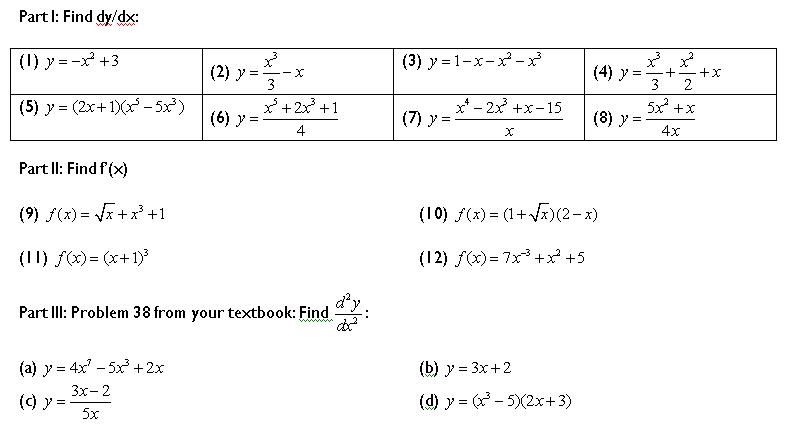
You can probably see what this worksheet is trying to get students to do. We haven’t yet learned the product, quotient or chain rules. But heck if I have students who don’t recognize that \frac{x}{3} is the same as \frac{1}{3}x. Or that you can simplify \frac{3x-2}{5x} into \frac{3}{5}+\frac{2}{5}x^{-1}. This worksheet is meant to get my kids to see how they can simplify and use the power(ful) rule! As you can see, our class motto is coming through loud and clear: take what you don’t know, and turn it into what you do know.

2.

For those teaching lines in Algebra II, and think — “they’ve seen lines before! I want to just jump right in!” — here’s a review sheet I created which has worked well last year and this year. Nothing fancy, but practical.

3.

When having students first understand derivatives, I made this worksheet which they can do in class and finish out of class. It exploits this awesome calculus grapher:

It’s rather simple looking, but my kids loved the site. Also, the last page (of observations about the relationship between the function and it’s derivative) actually usually generates a really lively and interesting class discussion. I’ve tended to generate a class list of all observations on the board — no matter how obvious they might be. The point is: derivatives are rich fodder when students first encounter them.

Aimless Wanderings

I suppose this will have to be a meandering post. I don’t have anything specific to say, so I’ll just do a little free form.

I feel bad that this year I haven’t created any seriously new resources to share. I realized that when @cheesemonkeysf  wrote about how she’s using my “completing the square” worksheets in her class. I remember making them, and how happy I was when I saw my kids finally latch onto the process. I’m sad that I haven’t been playing around with making more resources. The SBG thing has been taking up a lot of time.

Recently in calculus, I have been teaching my students the formal definition of the derivative, and we’ve been chugging through that. I really emphasize this type of work. As one student wrote a year or two ago:

“Mr. Shah likes to go the long way, the real building block method. First you learn the theory, then you learn the original (prehistoric) way, then (then!) you’ll learn the quick fun way. And later still you learn that you could have done it on your calculator all along.”

I take pride in that. And love that the student recognized it. Anyway, in calculus we finally got to the point where I’m having them explore and find some basic derivative rules/patterns on their own. They’re doing this using Wolfram|Alpha. I didn’t write the packet (only slightly modified it), so I can’t share it here. [UPDATE: Here it is, online!] But it is amazing, because it works to get students to understand why \frac{d}{dx}[x^{25}]=25x^{24}. Instead of showing it works for a few cases, it leads students to see why the power rule for derivatives will always work. (Well, the packet only does it for positive integers, but that’s good enough for me.) I also like that I am formally introducing students to Wolfram|Alpha. Two excerpts from the packet are below.

My second favorite quotation from class: “If Google and Wikipedia had a baby that was good at math, it would be Wolfram|Alpha.” (My first was: “Mr. Shah, I hate it when you secretly make us learn things!”)

Something else that has been taking up a lot of my time has been running the Student Faculty Judiciary Committee. That’s my school’s disciplinary committee. Each case probably takes me 3-4 hours of work, and in addition to that, there is a lot of behind the scenes work. I organize each hearing, I write up announcements for student representatives make to their classmates, I plan our monthly meeting, I meet monthly with the Head of the Upper School, and I have a few larger goals for the committee that I want to work towards. Recently there have been a good number of cases, and I work hard to get the cases “closed out” as soon as I can.

Last Thursday, I left school early to attend the wedding of a high school friend. I got to meet up with my besties, from way long ago, in our hometown. I saw my old house, and visited some old haunts, and marveled at the fact that I was still close with these people. I remember the awkwardness of going to a new school (my family moved after freshman year) and the fear (and slight thrill) of not knowing anyone. And the overarching question: will I make friends? That snapshot juxtaposed with the snapshot of me being silly with them at this wedding — priceless.

While at this wedding, I had my multivariable calculus students read the awful section in the textbook on Kepler’s laws. Then I had them read the paper that my multivariable calculus students wrote two years ago. What was cool was that one of my students this year told me when they looked at the paper, they were intimidated by all the equations and didn’t think they’d be able to figure out what was going on. However, they were able to read and totally understand it. HOLLA! I wish I had the email addresses of the four students who originally wrote that paper so that our class now could write them saying they found their paper useful. Heck, I’m sure I can find the addresses somehow… Also when I was gone, I had my calculus students work on the WebQuest that I wrote last year (http://whoinventedcalculus.wordpress.com/). I’m excited to read what they came up with. I got one batch today, and will get the other batch on Friday. I will read them all en masse over Thanksgiving break.

Over Thanksgiving break, I am also going to be completing my applications for two summer programs. One is the Park City Math Institute (PCMI), the unbelievable three week program I attended last year. The second is the Klingenstein Summer Institute for Early Career Teachers , a two week program that many people I respect have attended and have spoken highly about. It is weird, having to ask people to write you letters of recommendation and compose essays. The Klingenstein program even asks for college and grad school transcripts! I get a small taste of what my seniors are going through with their college applications. If there are any summer programs for math teachers that you love attending/participating in, throw them in the comments. (Two years ago, I attended the Exeter math conference, which was very good.)

I guess I’ll leave letting you know of a math book that I recently finished and thought was very good. Duel at Dawn. Be warned: it is an academic book, meant for a specific audience. In other words, it can be dry if you aren’t used to reading that sort of stuff. But it makes a few pretty interesting historical claims by tying large-scale cultural movements (the Enlightenment and Romanticism) to the development of modern mathematics.

With that, I’m out.