[UPDATE: Posts on starting blogs… Kate’s… Miss Cal.Q.L8’s… Riley Lark’s (scroll down)… all definitely better than my two cents…]
I can’t help it. I really dig Kate Nowak. (In the platonic way, obvi.) And everything she wants to do, I want to do too.
(On that note, I have a competition idea that I’m contemplating rolling out for the summer…)
(Kate, don’t say you want to eat a vat of fresh tomatoes, please. I HATE tomatoes.)
She gave her few cents about starting a math teacher blog — and things to do and things not to do. I thought I’d piggy back on that and give some totally unsolicited advice of my own.
Actually, I think it would be good if all of us who blog do this. [1]
1. Don’t worry about your blog name. I know a few people who want to start blogs but agonize over getting “the best, most punny, insightful name that captures the essence of what you want to do.” That’s cool. I think I spent an eternity trying to find the best Google Voice phone number, so I get it. I remember I spent at least 2 hours trying to come up with a killer name. But I’ve known people who’ve agonized over it to the point where they never got started. So agonize, but give yourself a short deadline. “By the end of today, I will have started my blog. No. Matter. What.” A rose by any other name…
My story: I gave up on my search for ‘the best name’ and just went with a cool fact I learned (that you can have a function which is continuous everywhere but differentiable nowhere). Totally makes no connection to what I write. So what.
2. Choose WordPress. I know everyone says it doesn’t matter whether to choose wordpress.com or blogger.com. I’ve used both and I have a strong preference for WordPress.com. The themes are sleeker (in my opinion), there are more control options, and most importantly, you can easily type equations ( ). I am a huge, huge fan.
My story: I’ve written in livejournal in college, started two blogs (one of them a group blog) using Blogger in grad school, and now I’m a committed devotee of WordPress. However, maybe Blogger has more options since I abandoned it? I won’t knock it, but I know WordPress is awesome.
3. Write like nobody’s watching. Okay, this piece of advice might either sound obvious or counter-intuitive. But it’s the one I most believe in. And I assume you want to blog because you want to engage with others, right? You’ve been out there reading stuff, and you’re like, “ME WANT TOO!” At least that’s what happened to me. But guess what? If you blog for yourself, you’re going to want to write stuff — and it won’t be a chore.
And write about anything and everything related to teaching that you want. Don’t feel restricted to post only about this or that. Make your blog less about being your blog and more about whatever you want to say, and let it grow organically into whatever it turns into. Try not to make it into something — let it grow into being something.
In other words: blog for yourself.
My story: I kept my blog private for four (or more?) months. I was writing for me. I eventually got fed up with just leaving comments responding to others, and never really getting to say anything of my own. So I made it public. But I just kept on keeping on. Writing about whatever I felt like. If I cared about getting a readership, I wouldn’t have posted about multivariable calculus. (Something I post about a lot, actually.) My blog was and always will be (until I grow tired of it) an archive of my teaching.
4. Corollary: Keep at it. Guess what? Don’t be concerned about blog stats and visitors. Remember, you’re writing for you. People will see it. I promise. Okay, yes, you’re going to start looking at the stats. You won’t be able to help it. And you’ll feel good when the numbers are up and the numbers are down. That’s cool. I mean, who doesn’t want to be popular? But I guess the message is: be popular on your own terms. Or another way to put it: be yourself.
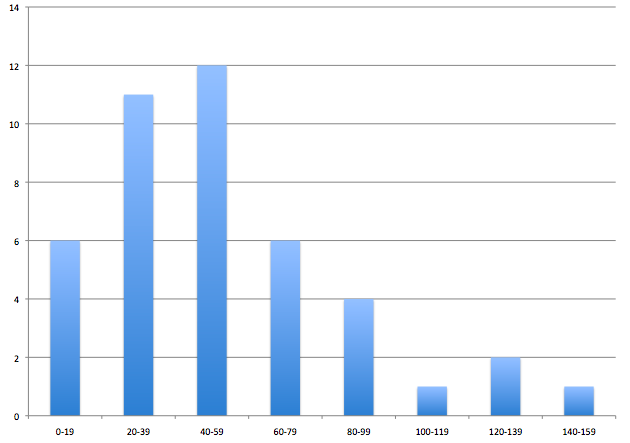
My story: My first post was in August 2007. I’ve written 422 posts since then — not including this one. The average number of visits for my first couple months was 15 and 14 visits/day respectively. It took me until July 2008 (11 months) before I broke the 1,500 visits in a month. It took Kate Nowak 10 months. What you’ll notice is that if you keep chugging away at it, your numbers will go up. Just by the sheer fact that you have been writing more. So more people will stumble upon it. And more google searches will end up on it.
5. Watch what you write. Okay, so I said write for yourself, and I went on and on about it. But you are making this public. So the best rule of thumb: don’t write anything you wouldn’t want your kids, your administration, or a potential employer to see.
My story: I stick to this. I don’t write when I’m angry. I sometimes write when I’m disappointed – but mainly with myself.
6. Perfection isn’t attainable. I know some bloggers talk about having a ton of posts in draft form. Writing and revising. And revising. Heck, if you have an idea, just take the 30 minutes to pound it out and press PUBLISH. Agonizing sucks, and isn’t worth it for something you do for fun. As a lark.
My story: I write, I publish. Sometimes two or three things in a day! Sometimes only once in two weeks. I don’t let a schedule dictate anything. But sometimes, when it’s been a week or two, and I haven’t written anything and I have some spare time, I try something. I sit down in front of my laptop and for 10 minutes, I think if I have anything to write about. Usually I come up with something. The only time I let time linger between when I write something and when I post it is if I hesitate pushing that publish button — which is a sign to me that there is something in it that I’m not comfortable with. Usually something that relates to #5.
Obviously this is what works for me, and it may not be your style. I just really want to say: DON’T STRESS ABOUT IT. Just have fun with it, and don’t worry about it too much, and have fun with it. Oh wait, I said that twice. Well, I meant it.
[1] I sometimes think that some ed grad student should stumble upon our little community and write about its evolution from 2006-present. I got this thought probably because I was trained as a historian for a few years, before I became a teacher, and this is exactly the type of grad student seminar research paper that a sociologist or information scientist who joined our seminars talked about writing. Then we’d talk about Foucault and I’d want to bash my head against the heavy wooden seminar table while I attempted to figure out what “the form making a sign and the form being signalized are resemblances, but they do not overlap” meant. I digress. These posts would be good research fodder for the grad student. [Update: this post and comments at dy/dan would also be good fodder.]
 which would make
  .
. . An absolute value equation cannot equal a negative number because absolute value is the distance from zero and is always positive [my correction: or zero].
 without using your exponent rules. Explain it to someone so they can understand it simply!
 is true. You can assume
  and
and  are positive integers. Explain it to someone so they can understand it simply!








 Continuous Everywhere but Differentiable Nowhere