Mathematical Communication

Just some good books about Math, for those who like Math

The math department, every year, gives awards to four students (some with some monetary compensation for college, some not). I was put in charge of thinking of some books to give with these awards. I sent my initial thoughts to my department head:

For the Math/Science award, I suggest:

*D’Arcy Thompson’s On Growth and Form is full of beautiful prose, and relates the sciences to mathematics. The actual science is wrong, but it is considered a classic piece of literature.
*Anthony Zee’s Fearful Symmetry about the important — crucial — role that mathematical symmetry plays in modern physics. A super-well written book for the layman.

For all other awards, I put out there:

*Silvanus P. Thompson’s Calculus Made Easy has a deceptive title. And it was written in 1910. But almost all accounts agree it is one of the best textbooks around. Even for those who might have thought they understood the conceptual undergirdings of calculus, this book will illuminate them further, without any obtuseness.
*Douglas Hofstadter’s Godel, Escher, Bach is standard reading for all math lovers everywhere.
*Calvin C. Clawson’s Mathematical Mysteries is one of the best and most accessible popular math books I’ve read.
*G.H. Hardy’s A Mathematician’s Apology is quite good at explaining what a mathematician actually does philosophically when he works, written by one of the most important mathematicians of modern times.

My final recommendation differed slightly:

Award 1: Timothy Gowers’ The Princeton Companion to Mathematics

Award 2: Douglas Hofstadter’s Godel, Escher, Bach; Thomas Kuhn’s The Structure of Scientific Revolutions; Bruce Hunt’s The Maxwellians; Silvanus P. Thompson’s Calculus Made Easy

Award 3 & 4: G.H. Hardy’s A Mathematician’s Apology

I really enjoyed thinking through which books might be appropriate. Also I didn’t want to give something I hadn’t read. But this process reminded me of all those books about math out there that I haven’t read (yet), but have really want to. Like Polya’s How to Solve It and David Foster Wallace’s Everything and More.

I posted this book award stuff on twitter, and got some great reactions. (Read from the bottom upwards.)
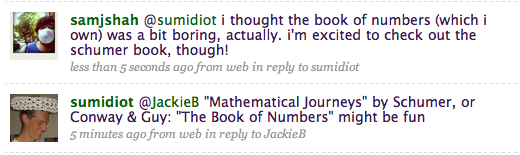
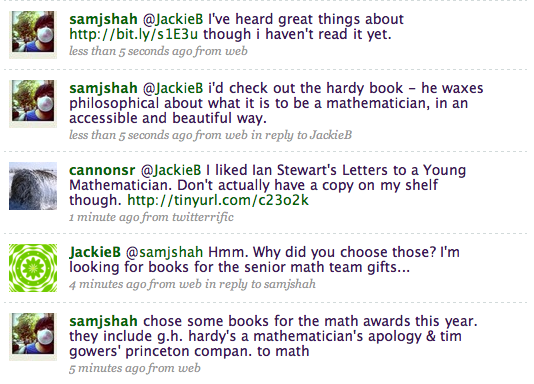
picture-4

picture-1

And then I thought: hey, you all must have a favorite math or math-y book that you’d want to have your favorite students read. I’d love to know your favorites! (Plus this list could help inspire me to do some quality reading this summer!)

Precious Moment

Today I had one of those great moments which put an impossibly huge smile on my face. Today I had about a zillion student meetings. I had no free periods the entire day! One of the meetings had to take place while I was on “front hall duty” — manning the table where kids sign out to leave the school building for lunch.

While I was helping this student — and if I say so myself, doing an amazing job of explaining the really conceptually hard Fundamental Theorem of Calculus Part II — one of the people who works at the school, the mother of one of my former students, passed us and then doubled back to speak to us. She said “Wow! I just had to say that this image is so great. This is such a great thing. A second semester senior and a teacher working so hard. This is amazing. I wish I had a camera.”

I took stock of the situation, and grinned. I patted my student on the shoulder, made two fists and pumped them in the air, and said “Yeah!”

Teaching seniors is hard. But if you set clear expectations and help them reach them, you too can be as great a teacher as I am. (Just kidding.) But yeah, my faith in my kids’ is on the upswing.

Kepler’s Laws, reprise

You might recall that in my multivariable calculus class (four students), we’ve been turning a really badly written section in our textbook on Kepler’s Laws into a great learning experience. The section was really unclear, the authors didn’t motivate any algebraic work, nor did they relate the equations to any conceptual understanding of what was going on.

We decided — well I decided, but my students agreed to play along — to rewrite the textbook to make it clearer. We wanted to focus on motivating each step of the derivation, we wanted to organize the derivation in a more sensible way, we wanted to be explicit with each of our calculations so the reader isn’t left wondering “where the heck did that come from?”

My students got into the project. Heck, I got into the project. We spent about 5 class days working on it. Most nights I didn’t assign homework. One night, I asked students to each individually outline how they thought the rest of the paper should go. Another night, I asked students to proofread what we had written for stylistic and conceptual inconsistencies. We finally came up with a formula describing all conic sections — which describes how the earth moves around the sun. We didn’t get to actually derive Kepler’s Laws (see below for why).

The students are really proud of this paper. They want to send it to the math department head who left last year, the publisher of the textbook, and their calculus teacher who retired last year. (We will send it to all three!) We embarked on this together (I didn’t know anything about this section; I was going to skip it but the students really wanted to cover it), and I let them do a lot of the thought work themselves. It’s hard to let go as a teacher, because I have this drive to explain and clarify everything when someone doesn’t “get it.” But these kids are advanced enough that they can grapple with the material, ask each other questions, and be okay with getting stuck. And I suspect it is precisely because of this, because they did it, that they feel ownership of the paper.

Two of my favorite parts of the paper:

picture-3

picture-4

Our current draft is here.

Their next “problem set” isn’t like the others. I pretty much said: “we learned how to read the book, and make sense of that which we thought we could never figure out. Now your task is to each individually finish his paper off. We’ve gone 2/3 of the way to the end together. Go try to do the last 1/3 yourself. With this formula we came up with, your textbook, the Internet, and your wits, write the final part of this paper. That’s right: you derive Kepler’s Laws.”

Their problem set it due on Friday. I’m excited to see what they do with this!

If you’re wondering what our class looked like when we were working together on this paper:

Imagine four students, sitting at a square table. Each has photocopies of the relevant textbook section in front of them. I am sitting at the front of them, laptop on, with Lyx (my LaTeX editor) open. The screen is being projected so the students can read what I’m typing. I prompt: “so what do we want to write?” and we’re off. The students talk with each other about the section — not only asking questions and answering each other on the mathematical content, but about how the section should be presented. One might say “I think we should say something about how vector b will actually be crucial to understanding everything. The book introduces b and then forgets about it and never really explains it.” Another might respond, “Yeah, we should devote a whole section of our paper to explaining b.” And they’re off. I sometimes interject to ask questions, or to get them on the right track, but it’s rare that I’m directing. Finally, when I see they’re coming to some sort of consensus, I say “so what am I going to type — what’s my heading? The introductory paragraph explaining what you’re planning on doing?” And then one of them will say “In this section, we will introduce a new vector, b, which will end up being unchanging over time. This constraint on the motion will …” And then another student might say “maybe after ‘unchanging over time’, we should say “no matter where the earth is or what speed it is moving at.”

And we’re off to the races. This goes on for 50 minutes. Which always seemed too short. Each day we got about 1 to 1 1/2 pages (single spaced) written. At the very end I scanned in the images that one student drew as we worked our way through the material.

This project was hands down the best thing I’ve done in any of my classes all year, in terms of student learning.

Taking the Twitter Plunge

So I’ve decided there is possibly a vibrant teaching community that I’m not familiar with, because I had decided to ignore Twitter while getting the year in order. So here I am, going to take the plunge.

My twitter page is: http://twitter.com/samjshah

I want to join a group of high school math teachers. I found a whole bunch of blogs by math teachers that I follow regularly. Let’s see if I can find the same on Twitter.

And if you have a Twitter account and want to say hi, feel free! Right now I’m twitter-lonely.

Kepler’s Laws

In my multivariable calculus class, we spent last Friday reading the textbook as a group, trying to understand the section on Kepler’s Laws. We got done showing that if there is a sun-like object and another object with a particular initial position and velocity, it will either fall into the sun, be an circle, be an ellipse, be a parabola, or be a hyperbola.

Today we were going to move onto using this result to derive the three Keplerian laws of planetary motion.

But then I decided to scrap that. Because even though we read the book and followed the text, line by line and equation by equation, we lost sense of what we were doing. We lost sense of the conceptual underpinnings for each equation. We didn’t know what motivated the book to make the moves it made. It’s largely the book’s fault, which is really unclear — if you’re a high school student and not used to having your book say “we leave this as an exercise to the reader.” (Seriously, it did that.)

One of the things you’ve heard me say is that I want to foster the skill of students learning to communicate math well.

So, I decided to scrap the plan of moving forward, and we’re devoting two or three days to

WRITING OUR OWN TEXT EXPLAINING THE DERIVATION OF KEPLER’S LAWS.

We started out the class outlining a basic structure to it (Part I: What we want to show; Part II: Initial Conditions; Part III: Gravitational Pull; etc.). Then the four students started talking about what they wanted to say. (One agreed to draw the diagrams we’re going to include in our text.) I just sat up front, and when they decided, I typed it up in my LaTeX editor — projected so that students could tell me to fix or reorder something. Sometimes I prompted them (“you told me to write \vec{v} but you never told the reader what that is” or “does it matter if the initial velocity weren’t orthogonal to the position vector?”). And it took us 50 minutes to get about a third of the way done.

But you know what? It is working. They’re talking, they’re thinking, they’re arguing with each other, they’re asking questions. And they’re learning to work through things, and explain them to someone else.

I was so pleased. Hopefully the next few days go as well.

Concepts and Problems

In my classes this year, I’ve been really concertedly trying to emphasize that students need to really understand concepts and explain ideas in written form clearly. Today I’m faced with a conundrum about how students are connecting concepts with the problems we’re doing.

On my Algebra II quiz, I asked:

Explain — using complete sentences and proper mathematical terminology — why \sqrt{-16} doesn’t have a meaning [in real numbers], while \sqrt[3]{-8} does.

I was really, really, really pleased with my class’ answers. In the course of their explanations, almost students mentioned that \sqrt[3]{-8}=-2. Literally on the same page, however, was a set of radicals that I asked students to simplify. One of them was, gasp!, \sqrt[3]{-8}. It was an oversight on my part and I will probably change if I use parts of this quiz next year. Can you see where I’m going with this?

There were a few students would could do the conceptual work — who even showed that \sqrt[3]{-8} was -2 in their written explanation — who didn’t get the exact same question right below it correct.

Color me flabbergasted. (What is that, a pukey yellow?) It’s just so hard to figure out what was going through their heads.

‘Splanations

Coming up with math explanations for students that don’t always “get it” can be tough. You have to be thinking on your toes, and you have to make your explanations understandable. It’s not always easy to succeed.

Two Recent Examples:

How would you explain to a student in a non-accelerated Algebra II (or even non-AP Calculus class) why it is that when you solve \log_(x+2)+\log(x-2)=\log(5) in the standard algebraic way, you get x=3 and x=-3? Why is it that you generate the extraneous solution, x=-3 that you then have to eliminate, because it can’t “plug into” the original equation? Where does that extra solution come from?

How would you explain to a student — without using the formal definition of a limit — what a limit is? So that they understand it intuitively. Now ask yourself: would your explanation work for the constant equation f(x)=6? What would you say to a student who says “Why is the limit of f(x) as x approaches 0 equal to  6? The function has already reached 6. It isn’t approaching 6.”

And for those of you who want to prove your mathematical mettle, here’s a question that recently circulated through our math department. What’s the answer, and how would you explain it to a stuck student?: 

Suppose that a function f is differentiable at x=1 and \lim_{h\rightarrow 0} \frac{f(1+h)}{h}=5. Find f(1) and f'(1).