Continuous Everywhere but Differentiable Nowhere

Entries from May 2008

mix cd club

May 31, 2008 · No Comments

This year, my first year of teaching, has left me little time for a social life. Let’s just say: I’ve pretty much resigned myself to having one day a week to myself — Saturday– and on principle, I refuse to do work on it. (Confession: I’ve been known to break that rule…)

Because of this weird life of mine, I decided to be proactive and create a “mix cd club.” Every two or three months, a bunch of us get together with some awesome mix cds we crafted on some theme (chosen by yours truly) and exchange them at a local watering hole.

This round’s theme was: Time Travel
(In honor of a recent watching of Bill and Ted’s Excellent Adventure.)

And I decided to do the somewhat morbid:

“songs that I wouldn’t mind being played at my funeral.”

  1. scream and shout (polyphonic spree)
  2. breathe me (sia)
  3. round here (counting crows)
  4. i will follow you into the dark (death cab for cutie)
  5. 1234 [feist cover] (jack penate)
  6. somewhere over the rainbow (israel kamakawiwo’ole)
  7. what a wonderful world (louis armstrong)
  8. suddenly everything has changed [flaming lips cover] (the postal service)
  9. apologize [ft. one republic] (timbaland)
  10. neighborhood #1 (the arcade fire)
  11. the funeral (band of horses)
  12. a fond farewell (elliott smith)
  13. the world at large (modest mouse)
  14. i hear the bells (mike doughty)
  15. we’re from barcelona (i’m from barcelona)
  16. girls (death in vegas)
  17. light and day (the polyphonic spree)
  18. pink trash dream (the polyphonic spree) [only 31 seconds]
  19. introitus: requieum aeternam (mozart)
We’re meeting up in 4 hours. I can’t wait. I love delicious beverages and good music. (And for those of you who haven’t discovered muxtape: samjshah.muxtape.com)


UPDATE: So at the first mix cd club meet up, we all gave the bartender an extra copy of our cds. At the second meet up, I swore that my mix cd was being played — I heard like 7 of my songs (some popular, some obscure) played in a row. This time, again, I heard a few of the songs from my cd. Guess what? I got confirmation that my cd is on constant rotation in the bar. When we offered the bartender copies of our cds, he thanked us and asked “who made the ‘listen me’ cd? because I put that on all the time.” That was at least 6-8 months ago. I grinned.  

UPDATE 2: Tracklistings of all cds here

Categories: Uncategorized

Matrices, Social Networking, and Algebra II

May 30, 2008 · No Comments

At the tail end of the fourth quarter, my students and I grew tired, weak, and weary from trigonometry overload, so we did a short one week lesson on matrices and systems of equations. I taught them how to add, subtract, and multiply matrices — by hand, and on their calculators. Then, I decided I wanted to bring some “real world” stuff to them. 

So I decided to do a lesson on matrices and food webs [click here to view the assignment]. I pretty much stole it wholesale from some website or another (my motto: beg, borrow, and steal!), made a few changes, and let them go at it. And even though I don’t know how interested all of them were with the assignment, I was actually extraordinarily pleased at how well they did on it and how engaged they were in the classroom [1]. They talked, debated, and came to some pretty solid conclusions. My role in the classroom was relegated to going around and asking them questions like “so you answered the fourth question… can you tell me what the 2 in that matrix represents?”

You know, just to make sure they were getting it.

And they were. 

One of my favorite moments was when a group asked me “do you add or multiply the matrices?” and I asked them “what do you think?” and then they got to arguing about it for 3 minutes before they came to the right conclusion.  

Literally five minutes after finishing this activity in my first class, I realized that all the social networking sites (MySpace, Facebook, and the like) can be analyzed in the same way as food webs. Hello six degrees of separation!

So at the beginning of my next class where we were going to do food webs, I first drew a bi-directional network on the whiteboard with three teachers and one student. The student I chose is one who I felt I could poke fun at because he pokes fun at me. Of course I made up funny relationships between all my characters. So, for example, I said that the student liked teacher A, but teacher A didn’t like the student one bit — she told me that she thinks he is too rambunctious. And so forth. It was a tiny, fun little network, with all these fun little stories behind each relationship, and we made a tiny, fun little matrix from it. Then we moved on to the food web activity.

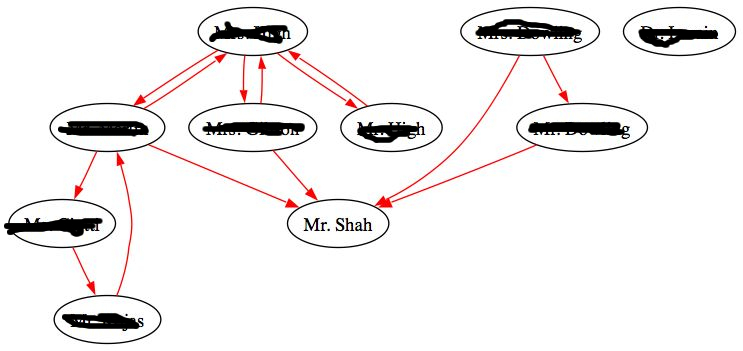
After class, I thought: why not do this whole social network thing next year? So last night I made up a fake set of relationships among teachers at my school and then created a network: 

It’s pretty funny actually. I have one husband who likes his wife, but the wife doesn’t like her husband, and other strange relationships. And to accompany it, I made a draft of a worksheet to use next year [click here for draft]. And you know what: I think it’s pretty good. [2]

Besides food networks, and friend networks, I had two more ideas:

  1. Actually make a small celebrity network using IMDB, connecting them only if they’ve been in the same movie. A la Kevin Bacon. Then using that matrix to calculate the degrees of separation.
  2. Have students pick an airline and a bunch of cities it serves. Look at all the flights of an airline on a particular day — and make a matrix representing the number of flights that are made between all cities that one day. Some cities won’t have direct flights between each other — but that’s when you use the square of the matrix, to find which cities are accessible to one-another via one stop over. And you can take the cube of the matrix to find out which cities are accessible via two stop overs. And so forth. 

Actually, I really like the second idea for some sort of take-home student project, where we also learn and use some basic Excel. Hmmmm….
And you were wondering what my last post was all about! Ah, gentle reader, I would not leave you hanging for too long.

[1] What was interesting to me about this assignment was although I saw them all working and thinking and grappling, showing true engagement unlike other times when I’ve failed, they didn’t show a true *interest* in the topic. Which makes me question the whole equality that teachers and administrators often believe in implicitly: student interest = student engagement.

[2] Although I might make two changes: (a) not make the network bi-directional (if person A is friends with person B, then person B is friends with person A), and (b) focus more on how to figure out how many degrees of separation someone is from someone else.

Categories: Uncategorized

Social Networks

May 29, 2008 · 1 Comment

I promise I’ll bring this back to teaching and math, but not in this post. In this post, I wanted to show you something I made a few summers ago with one of my friends. It’s a graphical representation of a social network she’s embedded in.

(Click picture to make bigger.)

Each node is a person. 

Each different color/style of line represents a different relationship. 

  • best friends
  • friends
  • crush (one person with a crush on another)
  • crush (both people have crushes on each other)
  • relationships
  • hookups
  • questionable hookups (meaning: my friend is pretty sure there has been a hookup, but there has been no confirmation)
  • kiss 
  • for sure enemy (this is often only in one direction)
  • questionable enemies (meaning: my friend is pretty sure that at least one person secretly hates another, but there is no confirmation)
  • broken relationships
  • labmates
  • roommates
  • former roomates
  • has a crush but won’t admit it to themselves or others
Admit it. It’s pretty awesome. 
This is a prologue to a soon-to-be-written post, but also to let you know of this great piece of software (for macs only — sorry!) that I found to create these kinds of charts, all those summers ago:
It’s pretty fantastic, free, and can do a lot of different types of graphs! So math teachers out there, add this to your exponentially-growing list of “cool internet stuff that maybe I’ll use one day.”


Categories: Uncategorized

I hate protocols

May 27, 2008 · 1 Comment

In my school, lots of meetings have “protocols.” What, you say? Protocols?

Protocols are a highly organized, structured way to accomplish tasks which involve lots of people.

My school frequently uses two.

One protocol my school loves to do in various meetings is called “Critical Friends Group.” One person spends 5 minutes presenting an assignment (or shares some of their students’ work and the assignment that led to that work) to a group of 8-15 other teachers. Then everyone thinks about the assignment silently, with reference to one or two key questions (e.g. “what kinds of thinking skills would a student need to complete this task successfully?”). One by one, each teacher asks the presenter a question about the assignment — something like “how many days did you give students to work on it?” and “did you have a grading rubric?” Finally, after the initial questions are answered, each person makes an analytic comment about the project — with the presenter just listening. If there is enough time, everyone can make a second comment. Finally, the presenter responds to as many of the comments as he or she wants. There is no interrupting or discussion.

That’s an example of a protocol. It’s a highly structured method to elicit specific feedback on a particular project or assignment.

Another example of a protocol is something called a “chalk talk.” There are one to four questions or statements on various boards around the room. Everyone gets a marker and writes their comments down on each of the boards. Then everyone makes a second pass and writes down comments on the already written comments. No one is allowed to speak — this is done in total silence.

And I tell you, when I first heard about protocols, I thought: hey, an efficient way to get very specific information back from a group of people. The concept of the protocol is good.

I’ll even admit that the information gathered from some of the protocols are good. 

But I don’t care. I hate them. And here’s a list of the reasons why:

1. It’s infantalizing. I really feel like the formal procedures treats its participants like young children the way they’re set up. It’s hard feeling to explain. Maybe it’s the markers that are put out to write with, or the too-rigid environment that’s set up. But I don’t feel like a capable, intelligent adult.

2. I don’t feel like my voice is being heard. With the “chalk talk” for example, I often feel very strongly about some of the questions asked. They will ask, for example, “what can we do for professional development next year?” and I have a lot of very specific ideas. I am given only 5 or so minutes to write it down in marker (or pen if I’m lucky) — and I usually haven’t thought about the question beforehand, so I feel like my thoughts aren’t yet fully formed. My ideas are now ill-formed, poorly-written, and scrawled on a giant sheet of paper with about fifty or sixty other comments. The worst part is that people feel obligated to write — so something I’m passionate about, something that I care deeply about, is often sitting next to statements written by people who write because they have to. They don’t care (I’ve talked to them; I know) and they wouldn’t put anything down if they could. But they do and now my contribution is floating in a massive sea of detritus. It forces fake engagement. (Plus, let’s be honest, I doubt that anyone seriously looks at these pages. If anything, they glance at them, take a few notes, and make a memo.)

3. It stifles dialogue. And actually, I think that’s what they’re designed to do. They are structured to have a very specific goal. So, for example, the Critical Friends Group protocol will engage with one or two specific questions. And the “discussion” is centered around them. But the problem is that there is no “discussion” really. Everyone gets to speak while everyone else is silent. Only the presenter gets to respond, and then only to a few people. It’s a bunch of sound bytes, with serious discussions about teaching ripe for the having, yet never had. 

4. It doesn’t account for the individual being smart. Critical Friends, for example, is used to help a teacher improve an assignment. However, here’s my issue. Let’s say you do an assignment and it doesn’t go so well. You do Critical Friends, making, say, 8 people spend 50 minutes analyzing your assignment. You improve the assignment. Great. But here’s where my problem is.

If you had initially critically thought about your assignment and come up with ways to improve it the following year, I’d say that chances are, you’d come up with some pretty insightful ideas. And then you do Critical Friends, and you get, say, a few more good ideas that aren’t already on your list. Is it worth it? You’ve spent 50 minutes of 8 other people’s time to get a few different ideas/perspectives. But I contend that having a few informal conversations with other teachers about your assignment would have given you those few additional ideas/perspectives that you hadn’t thought of. In a cost-benefit analysis, it just doesn’t seem worth it. You can get the same result, I’m guessing, without spending all this time.

5. I get the feeling that it’s a safety net for meeting leaders who don’t know how to lead a meeting. Certainly this is not universally true. But I think I’ve become so jaded that I hear this advertisment: “Don’t know what to do with this meeting? Don’t have a way to get everyone involved and engaged? Make everyone miserable with a protocol! Force them to think, write, and ‘discuss’ so you can say you are engaging everyone, without truly engaging anyone!”

Of course, I go on this diatribe, knowing full well that leading a meeting is hard work and I don’t have a lot of answers. You have a lot of different people with a lot of different ideas and strong opinions that you need to rally together. You need to make sure everyone’s voice gets heard. You have to strive to engage your audience, without making them resent spending their time with you. You have to come to some sort of closure at the end. And that’s hard work. Moreover, there are a lot of people at my school who say they find immense value in them. (Though I wonder how much true take-away value these meetings have had; has anyone come out knowing how to advise their advisees or teach their students better? Probably, but I’m betting the number is few, and that there are a heck of a lot more people who feel their time was completely wasted.)

And guess what? That’s teaching. Leading a meeting requires almost all the skills that a good teacher must possess. And I often complain about the meeting formats at my school. But at the same time, I am always wondering: how could I have led the meeting differently? [1]

The answers are few and far between, but I know they exist. I’ve come up with a few ideas — some which involve straight up, good presentation. I’m okay not “dialoguing” and just getting the information I need. Also, I’m okay with an informal small group dialogue led by a facilitator which is allowed to veer in different directions of conversation, depending on the interests of the participants. 

Does anyone enjoy any of the meetings at their school? Are any of them not a waste of time, as determined by a cost-benefit analysis (how much take-away value have I gotten versus how much time I’ve spent getting that take-away value?).

The catalyst for this post after the fold.

[1] The answer to that would probably partially be the answer to how to keep a class of 10th and 11th graders with varying ability levels and interests engaged in math class. It’s not easy (at least not for me), but I believe it’s possible, and that’s what I striving for. It takes a lot of preparation beforehand. And I only really succeed every so often.

(more…)
Categories: Uncategorized

Indiana Jones… Sigh.

May 26, 2008 · 2 Comments

Indiana Jones IV had so many problems with it that even the extraordinarily high level of suspension of disbelief that I’m able to endure was taxed in the first five minutes… 

And although I can say a lot about what has made it so horrifying, I’d rather just show you one prime example: the inability to distinguish between the villanesse and Willy Wonka.


But to make yourself feel better, you can watch this new 3 minute and 19 second Weezer video which verges on genius, which is the opposite of Indiana Jones IV.

Categories: Uncategorized

Answer to my generalized MMM6 question

May 22, 2008 · No Comments

So I posed the more generalized question to  Monday Math Madness 6, which read: 

Start with 500 gallons of mayonaise.
1) Mix in 3 gallons of mayonaise and 7 gallons of ketchup. Stir until completely mixed.
2) Remove 10 gallons of the mixture.
3) Repeat steps 1 and 2 until the mixture is approximately 40% mayonaise and 60% ketchup (200 gallons mayo, 300 gallons ketchup).

How many iterations will it take to do this? 

My solution below the fold. 

(more…)

Categories: Uncategorized

Monday Math Madness 6 Solutions

May 22, 2008 · 3 Comments

Here is my proposed solution to MMM6. (Questions, for the uninitiated or forgetful, are here.)

I actually found these problems to be on the easier side (solved both parts in less than 30 minutes), but I tend to be hasty when I work things out, and overconfident in my thinking, so chances are I’m not right on both counts. So here’s throwing caution to the wind and hoping that I got it right.

(Also, if you liked the problem, don’t forget to look for my generalized problem. Solution to be posted soon.)

Part I Solution:

I created a matrix X_0=[500 \hspace{12pt} 0] which represented the [mayonaise, ketchup] initially. I also created a matrix Y=[0 \hspace{12pt} 10] which represented how much [mayonaise, ketchup] I was adding at each iteration. I let k=500/510 which is our “normalization” factor. (You’ll see…)

After the first iteration, we have X_1=k(X_0+Y) which turns out to be X_1=[490.196 \hspace{12pt} 8.804]. You see now what the k does? It makes sure that we have 500 gallons total in the vat.

After the second iteration, we have X_2=k(k(X_0+Y)+Y) which simplifies to X_2=k^2X_0+(k^2+k)Y.

After the third iteration, we have X_3=k(k(k(X_0+Y)+Y)+Y) which simplifies to X_3=k^3 X_0+(k^3+k^2+k)Y.

And you can see the pattern. After the nth iteration, we will have

X_n=k^n X_0+(k^n+k^{n-1}+...+k^2+k)Y.

Now we’re almost done, believe it or not. We can use k^nX_0=k^n[500 \hspace{12pt} 0] to find out how much mayo is in the vat. (Note that since Y=[0 \hspace{12pt} 10], the (k^n+k^{n-1}+...+k^2+k)Y doesn’t contribute to the mayo.)

We want to find when the mayo is around 250. The mayo after the nth iteration is 500k^n. So we have to solve the equation:

250=500k^n

A simple manipulation (taking the log of both sides) yields n\approx 35.

Of course a simpler way to think about this is to say that you start out with 500 gallons of mayo. After n iterations, you’ll have (500/510)^n 500 gallons of mayo. That brings you to the very last step, which is quickly solvable.

But even though that’s the simpler way to do it, it isn’t the way I started thinking about it. I freely admit that I don’t always find the simplest solution… but it certainly helps when doing generalizations!

What happens if we have add 3 gallons of mayo and 7 gallons of ketchup each time… How many iterations until we get a mixture of 200 gallons of mayo and 300 gallons of ketchup?

My sort-of-involved method works for that! I dare you to try it. You get about 98 iterations. It’s only very slightly tricky, so I’ll write up the solution to that problem in a future post.

Part II Solution

Let’s take the 17 lbs of beef (”it’s what’s for dinner!”).

Let’s have (single,double) represent the number of single and double burgers that Nortrom can eat. We know that these combinations are (1,8), (3,7), (5,6), (7,5), (9,4), (11,3), (13,2), (15,1), (17,0). Let’s see how many different ways that Nortrom can eat one of these combinations of single and double burgers.

Well, let’s look at (7,5). This is 7 single burgers and 5 double burgers. How many ways are there of ordering them? Clearly there are \binom{12}{7} ways.

Let’s me be clear about this. If Nortrom eats 7 single burgers and 5 double burgers, Nortrom will be eating 12 burgers. We just have to find the number of different ways he can do this. Nortrom, before eating them, placed them down in order of eating them — in 12 slots. Nortrom puts his first burger in slot 1, Nortrom puts his second burger in slot 2, Nortrom puts his third burger in slot 3, etc. Nortrom has to put single burgers in 7 of the 12 slots. (The rest will be filled with double burgers.) The number of ways to do that is \binom{12}{7}. [1]

So then we have, using our combination of single and double burgers listed above: X=\binom{9}{1}+\binom{10}{3}+\binom{11}{5}+\binom{12}{7}+\binom{13}{9}+\binom{14}{11}+\binom{15}{13}+\binom{16}{15}+\binom{17}{17}=2584.

Let’s do exactly the same thing for our 25 lbs of beef!

The combinations are (1,12), (3,11), (5,10), (7,9), (9,8), (11,7), (13,6), (15,5), (17,4), (19,3), (21,2), (23,1), (25,0).

This leads to a similar conclusion:

Y=\binom{13}{1}+\binom{14}{3}+\binom{15}{5}+\binom{16}{7}+...+\binom{24}{23}+\binom{25}{25}=121,393.

Huzzah!

[1] As a quick aside, note that \binom{12}{7}=\binom{12}{5}. This is because if you have 12 slots and you have to put double burgers in 5 of the slots, then the rest must be filled with single burgers.

Categories: Uncategorized

Faculty Bio

May 20, 2008 · No Comments

Today I was asked to fill out a little “faculty bio” of myself. In my school, students list their top 3 choices for advisers each year, and by some mysterious process that probably involves a Sorting Hat, the students get portioned out into homerooms. The students make their choices after reading the various faculty bios. 

Here’s what I submitted.

  1. Department: Math
  2. Classes you will be teaching next year: Algebra II/Trigonometry, Calculus, Multivariable Calculus
  3. Two of my Favorite books: Drawing Theories Apart: The Dispersion of Feynman Diagrams in Postwar Physics (David Kaiser), The Secret History (Donna Tartt).
  4. Last book read: Dead Souls (Gogol)
  5. Favorite Movie: Igby Goes Down
  6. Favorite thing to do with your homeroom: Relax and prepare for the day. Put large ships in small bottles. Thumb my nose at those who don’t love “Veronica Mars.” Force my advisees to do really hard math problems. I mean, really, really hard. 
They probably think I’m joking.

Categories: Uncategorized

Some Places To Visit On The Interweb

May 20, 2008 · 1 Comment

I’m a blog junkie. I now read blogs daily, and I want to point out my favorite posts. Partly as an archive for myself, partly to share with others some great things out there that I’ve been struck by. 

So without further ado, here I go:

  1. On Nailing/Blowing Assessment (dy/dan)
  2. End-o-Year Calculus Projects (Math Teacher Mambo)
  3. The Function Machine Game (Let’s Play Math)
  4. Teaching the Long Tail (Math Stories)
  5. Math Teacher Bingo (3 Standard Deviations To The Left)
  6. Competing the Square (Coffee and Graph Paper)
  7. Math & Art / Big Numbers (The Exponential Curve)
  8. Teflon Teacher and How Much Do They Change (Certain Uncertainty)
  9. We Know You’re Blogging (On The Tenure Track)
  10. Exceedingly Lame Final Question and Counterexamples (The Number Warrior)
  11. Quitting Teaching College (An Educator’s Blog)
  12. Classroom Management vs. Discipline (Catching Sparrows)
  13. A Motivational Experiment: Reflections on a Mohawk (I Want To Teach Forever)
  14. Help Wanted: Active Summer Learning With Technology (Dangerously Irrelevant)
Lucky 14. With that, I’m out.

Categories: Uncategorized

Senior Letters Made of Sap

May 19, 2008 · 2 Comments

Everyone is bringing food, and we’re going to play Apples-to-Apples. Monday will be the first time my calculus class will be doing something almost-totally non-mathematical (except for the one time we watched “Numbers” before winter break). I’m convincing myself that this is okay because I have the deluxe edition of Apples-to-Apples with blank cards; we’re going to be throwing in some calculus terms.

I work them hard, and they’ve met the challenge. So we’re celebrating on Monday, and we’re going to hear presentations of everyone’s calculus projects on Tuesday and Wednesday. And then: it’s over. 

I didn’t think I’d be maudlin, but I am pretty much all sap at this point. I decided to write a letter to each of my senior students thanking them. (Well, ahem, actually I wrote one letter to the whole class.)

We often expect to hear thanks for our work. But as you well know, teaching goes both ways, and I wanted to thank my students for their work. Not just for their mathematical work in class and at home, but for their positive attitude and humorous good-nature as we fought tooth-and-nail against the beautiful beast that is calculus. Being a new to a school, and being a new teacher, was made so much easier because of them. 

In the envelope with that letter, I’m including two additional things. 

  1. Their first day’s homework assignment — this form which they filled out (stolen from dy/dan).
  2. A juxtaposition of two quotations about Nature and Wonder. Many of my students have their grillzs all up in the humanities. I am not trying to convince them to be mathematicians and scientists. But I want them to see that the two are not mutually exclusive. So I will be giving them the poem and quotation below the cut.

I wouldn’t let them get away with having no homework. So I’m leaving them with one final homework assignment, playing on the theme of “the letter”: write a 1-page letter to yourself a year ago, giving your “old” self advice on how to succeed in this course. 

After the next three days, they’re gone.

Sigh.

(more…)

Categories: Uncategorized