Month: June 2016

Senior Letter 2016

Each year, except for one, I’ve written a senior letter to deliver to my calculus classes (when I taught them) and my multivariable calculus classes at our last meeting. I pretty much always give the same sentiment — the life of the mind is important. I always crib a bit from previous years (the perils of being in a time crunch!). I wasn’t going to post it, because it is pretty much the same sentiment year after year. But this year, a student came up to me at prom and said that it meant a lot to him, and got him questioning a bit more about what his future might be. (Usually I hand it out and that’s it.)

So without further ado, this is my letter from this year.

***

May 27, 2016 – June 2, 2016

Dear STU,

It’s Friday evening, 9:53pm, and I’m at home listening to Kurt Cobain and his guitar. I know what you’re thinking, and sorry, nope: no showtunes today. Nearby is the book I just put down. It takes place in the nineties, the U.S. is entering a proto-grunge phase, and Nirvana is a recurring theme. The nineties is also when I was in high school and so every so often — usually when one chapter ends and I take a mental pause to regroup — I’ll get flashes of forgotten high school memories. You see, I have a terrible memory. It’s almost comical how much I don’t retain. Almost. So those moments where some feeling-rich memory is drudged up — the heart-pounding anticipation of a wildly-liked senior picking up friendless new-to-town sophomore-me in his car to go to a mock trial practice, or the awe of being perched on the roof of a house with a friend where every word carried into the night sky crackled with deeper meaning — I let them wash over me. Recalling them with any vividness get rarer and rarer as the years pass. (That’s something no one tells you about growing up. Your experience of the world dulls — from vibrant neons to faded pastel watercolor. Your memories become mottled with gaps, like a desiccated leaf chewed up by hungry pests.)

Why am I telling you this? As I now reminisce about me in the nineties, I know you are reminiscing about your lives too. Packer will become a temporary line on your resume, and then — soon into your working lives — not even that. (No one includes high school on their CVs.) You’re moving on, growing up, and you’re losing something and gaining something. You are adults and you are not adults. You are who you are and you are not (yet) who you are.

As you know, in physics there is a wave function. It’s a probability function describing all the possible states of some system. For example, is a particle here or there or waaaay over there? And — here’s the kicker — that wave function is the best that we can do to describe things. The system isn’t knowable in any better way. The function within it has all these possibilities, some more probable than others but still, oh so many possibilities. “How many?” I imagine asking you one day in S202, and in unison I hear you all replying “Infinite!” And left alone, the infinite possibilities undulate in time, directed by Schrodinger’s equation. Until one instant it isn’t. It collapses. All possibilities reduce to one actuality. Why? How? The why is easy: someone tries to find out more about the system… a measurement is taken. (A box is opened to peek at the cat.) And in that measurement the wave — and all the possibilities — is destroyed. (The cat is either alive or dead.) The how is harder: how does a collection of probabilistic states turn into a single state? That it happens is known, when it happens is known, but how it happens is unknown.

You — right now — are infinite possibilities spread out before you. Right now, you can’t even know what they all are, but they exist. The way you move through the world, the choices you make, the person you strive to be, those all shape the landscape of those possibilities over time.

Like you perhaps, I had grand designs when graduating high school. There were so many things I wanted to accomplish, so many things I wanted to learn. But one thing I did know — the thing that had the largest chance of becoming true — was that I wanted to become a high school math teacher. I truly never know if that nugget surprises students when I share it with them. I always think it does, because in my time at Packer, I’ve only had one student tell me they wanted to be a teacher (and now they are!). But here’s the thing: even then, I knew I loved math. Not in a small way, but in a way where I could work on problems for weeks and be in pure bliss. In a way that when I figured something out, I would force my poor mother listen to me outline how I cracked the mathematical nut — even though she had no idea what my excited explanations were all about. I wanted desperately to share with the world that feeling, of the frustrating and seemingly intractable journey ending in deep insight and a joyous satisfaction. I couldn’t not share that love with others! I wanted others to have that joyous satisfaction too.

I told my teachers this. And one — the one who looms larger and larger as I get further and further away from high school — got this about me. It was Mr. Parent, my junior and senior year English teacher. He occupies a special place in my limited memory because he was the first person I met who truly and fully embodied the life of the mind.  The engine that drove this man was intellectual curiosity, and to bear witness to that sort of person – and his unbridled passion – had a lasting impact on me. At the end of my senior year I bought him a book and wrote him a letter explaining how much he meant to me. In that letter, I offered up a quotation by Richard Feynman, physicist and boyhood hero:

I was born not knowing and have had only a little time to change that here and there.

If someone asked me what I wish for my students, I would answer with a pat: “to be good, and to be happy.” I can’t speak to being good part. That’s for you to figure out. But I suspect for you seven, because in you I see parts of me, one path to lasting happiness is to continuously follow your intellectual curiosity. That is our common bond, and one that I have been grateful to have had the opportunity to bear witness to from the first day of class until the very last day. Because we share that, I hope that you remember in the most bleak of days: there is something magical about the world around you. Keep an eye out for the magic. It appears as questions… and there are so many questions! How can we – billions of years later – know about the earliest moments of the universe? Where does matter come from? How can the world be probabilistic (quantum) in nature when everything feels so causal? How do we know about the smallest worlds we cannot even see? Why are there rainbows on the surface of an oil spill? How do rubber bands work – how do they come back to their original shape? How can we – on this planet – know how far things are, and that there are other galaxies out there? How is it that the natural world somehow can be encoded through simple and elegant mathematical formulas? Does that imply that math is somehow encoded in the universe, and it is being discovered rather than invented? Does the fact that we keep on digging in mathematics and are still drawing connections among disparate sub-fields imply that there is some grand unifying structure undergirding everything mathematical and physical?

Mr. Parent walked up to me on my graduation day and handed me a letter in return — a letter I treasure to this day, keeping it ensconced between the pages of my yearbook. In response to Feynman, he returned one of his own devising: “Stephen Hawking speaks of the thermodynamic, psychological, and cosmological arrows of time that define existence as entropic movement from past to future in an expanding universe. And that seems to define the hero’s journey: the personally expanding possibilities revealed in a courageous life bounded by and aware of entropic time.” I personally read this as an intellectual quest: you – dear students – are in a world that is growing in knowledge and is constantly reshaping itself around you. And you – dear students – have only a lifetime to enjoy it. And I mean “only a lifetime” because the world is vast and time runs short.

As you quest, don’t be afraid of failure. Let failure be a marker of pride, because you tried. You know me, I don’t know much about sportsing, but I do know that you miss 100% of the shots you don’t take. Set the bar slightly higher than you think you are capable of achieving and work extraordinarily hard. Harder than everyone else around you.

Wave functions collapse. But the possibilities of our lives only collapse when we are no more. You are an infinity of possibilities, remember that. You have so much time, and so little time. Make it meaningful.

Always my best, with sincerest best wishes,

Sameer Shah


Our Math-Science Journal

A super short blogpost, letting you know about the 2015-2016 issue of Intersections, our school’s math-science journal.

intersections.png

Another teacher and I started this journal four years ago (this is the fourth issue). And each year we took less and less of a role, as we trained leaders, taught them to organize themselves, and got them to look for new members. Next year, though, we’ll have to be more hands on because we have only a few people who were on the staff for one year only. The new leaders have some great ideas for next year!

With that, I’m out. Hey, I did say it was a super short blogpost.

Multivariable Calculus Projects 2015-2016

Each year, I have students in my multivariable calculus class do “fourth quarter projects.” We continue working with the material during classtime, they have regular nightly work, but I cancel all problem sets and tests. Instead, students choose a project topic they are interested in pursuing that has some relationship to the course (even if the relationship is a bit tenuous). I want the project to be one of passion. Their entire fourth quarter grade is based on these projects. This year, my kids came up with some amazing projects — some of the best I’ve seen in my eight years of teaching this course. (Some previous years projects are here, here, here, and here.)

An Augmented Reality Sandbox


Earlier in the year, I showed my student a video of an augmented reality sandbox that I stumbled across online. She showed interested in making it. It takes in a mapping of a surface (in this case sand in a sandbox) and projects onto the surface colors representing the height of the sand over time (so red is “high” and blue is “low”). The cool part about this is that the projection changes live — so if you change the sand height, the projection updates with new colors. Level curves are also “drawn” on the sand.

Here are some videos of it in action (apologies for the music… I had to put music on it so the conversations happening during the playing with the sand were drowned out):

The student was going to design lesson plans around this to highlight concepts in multivariable calculus (directional derivative, gradients, gradient field, reading contour maps) but ran out of time. However upon my suggestion, during her presentation, she did give students contour maps of surfaces, turned off the projector, had students try to form the sand so it matched the contour map, and then turned the projector on to have students see if they were right or not.

During the presentation, one student who I taught last year (but not this year) said: “This is the coolest thing I’ve seen all year!” and then when playing with the sand: “I AM A GOD!” Entrancing!

Harmonograph

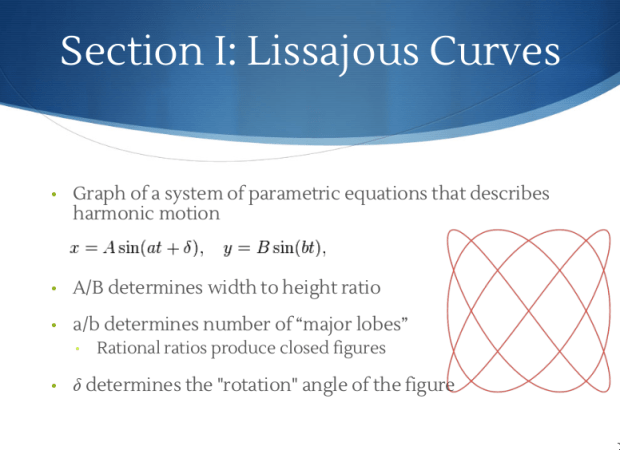
In my first year of teaching this course, a student was entranced by lissajous curves when we encountered them. These are simple parametric equations which create beautiful graphs. I then suggested for his final project that he create a harmonograph, which he did. Seven years later, I had another student see the original video of my student’s harmonograph, and he wanted to build his own! But he wanted his to have a rotary component, in addition to two pendulums which swung laterally. So he found instructions online and built it!

lissajous.png

Here are some of the images it produced:

And here is a video of the harmonograph in motion:

(You can watch another video here.)


During the presentation, the student talked about the damping effect, how the pendulum amplitudes and periods had an effect on the outcome, and how lissajous curves were simply shadows of lissajous knots that exist in 3-space. Because of the presentation, I had some insights into these curves that I hadn’t had before! (I still don’t know how mathematically to account for how the rotary pendulum in the student’s harmonograph affects the equations… I do know that it has the harmonograph — in essence — graph the lissajous curves on a somewhat rotating sphere (instead of a flat plane). And that’s interesting!

Teaching Devices for Multivariable Calculus

A student was interested in creating tools for teachers to illustrate “big” multivariable calculus ideas… Contour lines, directional derivatives, double integrals, etc. So she made a set of five of super awesome teaching manipulatives.  Here are three of them.

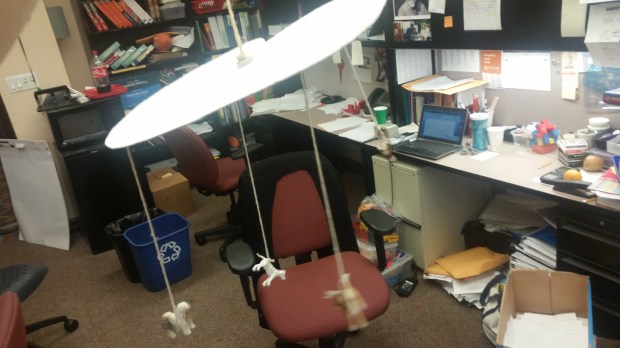
The first is a strange shaped cutout of poster-cardboard-ish material, with four animals hanging from it. Then there is string connected to a magnet on top, and another magnet on the bottom. If you hold up the string and you aren’t at the center of mass, the mobile won’t balance. But if you move the magnet around (and the student used felt around the magnet so it moves seamlessly!), you can change the position of the string, until it balances. This is a manipulative to talk about center of mass/torque.

20160602_163115.jpg

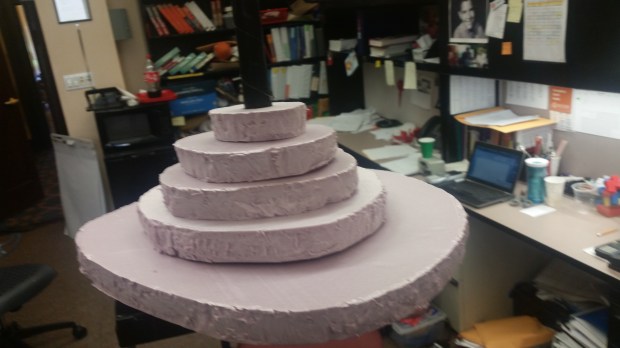
Another is a set of figures that form “level curves.” At first I was skeptical. The student said the manipulative elow was to help students understand countour plots. I wanted to know how… Then the moment of genius…

20160602_163217.jpg

You can change the height of the level curves to make the “hill” steeper and steeper, and then look straight down at the manipulative. If you have a shallow “hill,” you have contour lines which will look far apart. If you have a tall “hill,” you have contour lines which look close together.

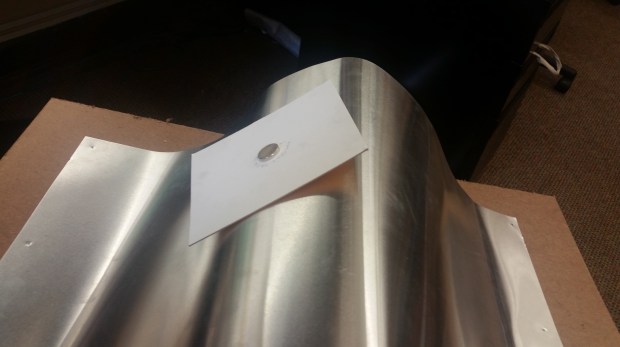
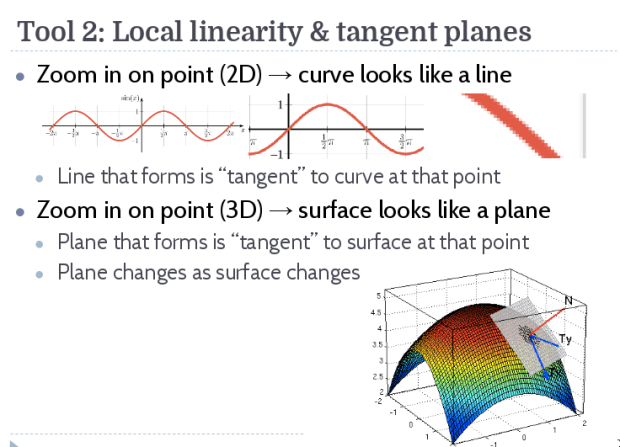
Finally, a third manipulative showcases the tangent plane (and it can move around the surface because of magnets also). I can see this also being useful for normal vectors and even surface integrals!

20160602_163518.jpg

tangent plane.png

Cartographic Mapping

Two students decided to work together on a project dealing with cartographic mapping. They were intrigued by the idea that the surface of the earth can’t perfectly be represented on a flat plane. (They had to learn about why — a theorem by Euler in 1777.) They chose two projections: the Gall Peters projection and the Stereographic projection.

They did a fantastic job of showing and explaining the equations for these projections — and in their paper, they went into even more depth (talking about the Jacobian!). It was marvelous. But they had two more surprises. They used the 3D printer (something I know nothing about, but I told them that they might want to consider using to to create a model to illustrate their projections to their audience) and in two different live demos, showed how these projections work. I didn’t get good pictures, but I did take a video after the fact showing the stereographic projection in action. Notice at the end, all the squares have equal area, but the quadrilaterals on the surface most definitely do not have equal area.

An added bonus, which actually turned out to be a huge part of their project, was writing an extensive paper on the history of cartography, and a critical analysis of the uses of cartography. They concluded by stating:

We have attempted, in this paper, to provide our readers with a brief historical overview of cartography and its biases.  This paper is also an attempt to impress upon the reader the subjective nature of a deeply mathematical endeavor.  While most maps are based around mathematical projections, this does not exclude them from carrying biases.  In fact, we believe there is no separation between mathematical applications and subjectivity; one cannot divorce math from perspective nor maps from their biases.  We believe it is important to incorporate reflections such as this one into any mathematical study.  It is dangerous to believe in the objectivity of scientific and numerical thought and in the separation between the user and her objective tools, because it vests us, mathematicians and scientists, with arbitrary power to claim Truth where there is only perspective.

Beautiful. And well-evidenced.

Deriving the Hagen-Poiseuille Equation from the Navier-Stokes Equations

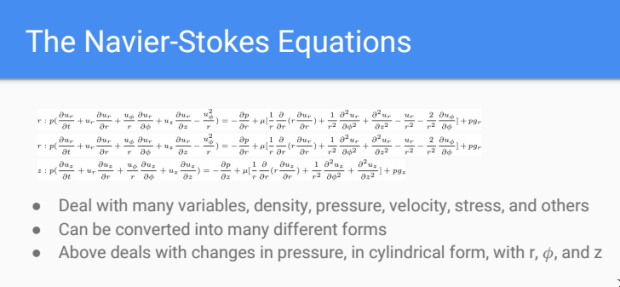
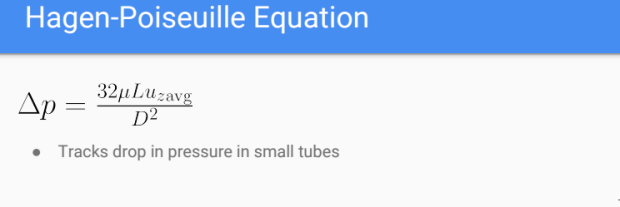
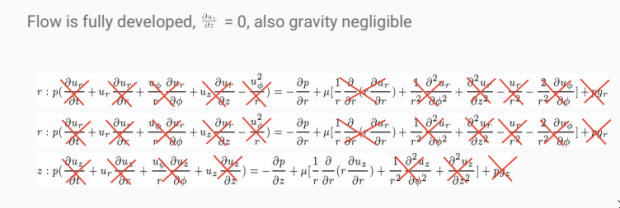
One student was interested in fluid dynamics. So I introduced him to the Navier Stokes equations, and set him loose. This turned out to be a challenging project for the student because most of the texts out there require a high level of understanding. Even when I looked at my fluid dynamics book from college when I was giving it to him as a reference, I realized following most of it would be almost impossible. As he worked through the terms and equations, he found a perfect entree. He learned about an equation that predicts the change in pressure from one end of a tube of small radius to another (if the fluid flow in the tube is laminar). And so using all he had learned in his investigation of the field, he could actually understand and explain algebraically and conceptually how the derivation worked. Some of his slides…

ns1ns2ns3

It was beautiful because he got to learn about partial differential equations, and ton of ideas in fluid dynamics (viscosity, pressure, rotational velocity, sheer, laminar flow, turbulence, etc.), but even needed to calculate a double integral in cylindrical coordinates in his derivation!

The Wave Equation and Schrodinger’s Equation

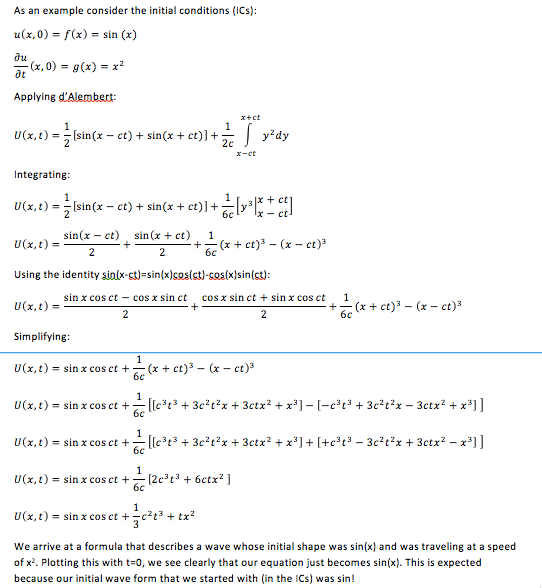
This student works in a lab for his science research class — and the lab does something with lasers and quantum tunneling. But the student didn’t know the math behind quantum mechanics. So he spent a lot of time working to understand the wave equation, and then some time trying to understand the parts of Schrodinger’s equation.

In his paper, he derived the wave equation. And then he applied his understanding of the wave equation to a particular problem:

neat.png

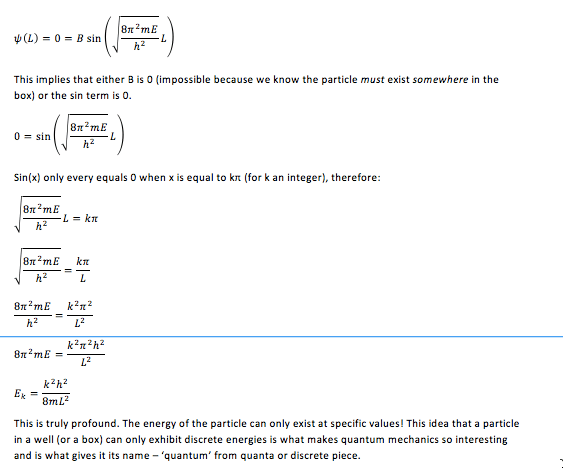
He then tackled Schrodinger’s Wave Equation and saw how energy is quantized! Most importantly, how the math suggests that! I remember wondering how in the world we could ever go from continuousness to discreteness, and this was the type of problem where I was like “WHOA!” I’m glad he could see that too! Part of this derivation is below.

schrod.png

Overall, I was blown away by the creativity and deep thinking that went into these final projects. Most significantly, I need to emphasize that I can’t take credit for them. I was incredibly hands off. My standard practice involves: having students submit three ideas, I sit down with students and help them — with my understanding of their topics and what’s doable versus not doable — narrow it down to a single topic. Students submit a prospectus and timeline. Then I let them go running. I don’t even do regular formal check-ins (there are too many of them for me to do that). So I have them see me if they need help, are stuck, need guidance or motivation, whatever. I met with most of them once or twice, but that’s about it. This is all them. I wish I could claim credit, but I can’t. I just got out of their way and let them figure things out.