The Problem: Wasting Class Time Reviewing Trigonometry
Last year the Advanced Algebra II kids did a boatload of trigonometry, and this year I had to make sure my kids had a strong grasp of the basics (it’s been ages since they’d seen it) before we delved into trigonometry this year in Advanced Precalculus. In previous years, I always did a “trig review unit” which I always felt like wasted time. I like to use classtime to give kids things where they have to rely on each other — but during the review unit, kids didn’t need each other much. Different kids needed to review different things. I found ways around it, but overall, it felt like wasted time.
The Solution: Mix Review A Little Each Night During the Prior Unit (Which Posed Another Problem…)
So the other teacher and I decided that while we were working on sequences and series, we would also give kids some basic trig questions each night, maybe 10-15 minutes worth. Although I can’t see myself using this curriculum in my classroom the teach the material for the first time, I really love eMathInstruction’s packets. They are well-thought-out, and their problems highlight drawing connections among tables, graphs, and equations, and they often give forwards and backwards problems.
So each night I gave a selection of problems from one or two of these lessons — all topics they had worked on last year — and had kids do them. I chose the problems and lessons based on the specific things I needed kids to remember for what we were doing this year. And then the next day, I gave the answers and let kids resolve any difficulties.
But I wanted to be thoughtful about this. It was review, but I needed to make sure that kids really had these basics down before we jumped with both feet into the depths of trigonometry. And remember, all of this was happening during a unit on sequences and series. And I was afraid without some sort of feedback mechanism, I was going to finish this review and find that kids didn’t interalize any of it, or regain the fluency with trig basics that they had last year. So I worked with another teacher (who has been acting as my “teacher coach” this year) to circumvent this problem.
The Solution To The Problem My Solution Generated: Short Daily Feedback Quizzes
This is how it worked…
Let’s say on Friday students were asked to complete review problems from Lessons #1 and #2 from the review packet. Then on Monday, I give each group the answers, have them check their own work and talk with their group to resolve any difficulties (and if that doesn’t work, ask me!), and then the rest of the lesson is continuing on with sequences and series.
Then on Tuesday, we’d start class with a short 3-5 minute check-in super basic quiz on the trig review that was due on Monday and we had already gone over. It might look like this:

The back of the quiz would look like this (kids flip to the back when they’re done):
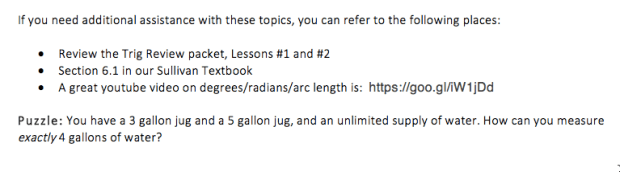 Then we have the rest of the class on Tuesday, consisting of going over the new trig review answers for a few minutes, and then working on sequences and series.
Tuesday night, I’ll mark up the quizzes. They are worth a whopping total of 1 assessment point (most of my assessments are 30-40 points). But here’s the catch: the score is either a 0 or a 1. To get the point, you need to get all parts correct. I’m okay with that because this is an advanced class and these questions are super basic. This is feedback for the student: do they really know the basic material, or do they merely think they know the basic material? [1]
On Wednesday, we’d start class with a short basic quiz on the review trig material we went over on Tuesday, kids would get their quizzes from Monday, and we’d go over the review trig material due today (before continuing on with sequences and series).
A note about timing… Most of our classes are 50 minutes. So about 4 minutes were spent taking the brief quiz, about 5-8 minutes were spent going over the trig review work and resolving any difficulties, and the remaining time was spent on the current unit of sequences and series.
At the very end of all the trig review, I had a mini-assessment on all the trig review material.
Framing The Quizzes
When presenting the daily quizzes to students, I expected a lot of groans. Thankfully I didn’t get any audible ones, which I attitribute to taking my time framing the plan for them. I wanted them to understand the thinking and impetus behind this approach to the review material. I wanted to be transparent.
First, I acknowledged that it was a long time ago (last year!) that they had worked on trig. So it would be unfair of me to expect them to know things like 

Second, I talked them through the idea behind the daily quizzes. I made sure that kids understood they would be short and only on material they had reviewed and had time to practice first. I highlighted that the quizzes served three purposes.
- That they were low-stakes feedback for you on what you truly know and what you don’t know.
- They will provide specific places for additional help if you find you don’t know something.
- They were feedback for me on what y’all are good with and what you need work with — so I know to talk publicly about anything I’m noticing the whole class needs help with.
I did mention the grading, but I didn’t put much emphasis on that. The score wasn’t super important, except as feedback.
You might have noticed that the back of the quizzes gave specific places for students to get help with the concepts/ideas on the quiz. This was an idea my teacher coach and I generated together. The conversation we had was about feedback in general. We teachers can be good about giving feedback, but we never teach students explicitly how to use that feedback. What do they do with it? By providing specific resources/places for kids to go to get additional help (along with their teacher and classmates, of course), we thought this might highlight that we really do want these quizzes to be part of a feedback loop.
The Feedback
I took data on the quizzes. You’ll note that before each 1 or 0 are a few columns. Those are the concepts being asked. An “x” means that the student got that part incorrect. That data helped me look for trends, and what was more challenging for students, so I knew if I had to explicitly talk about any concept/idea in class.
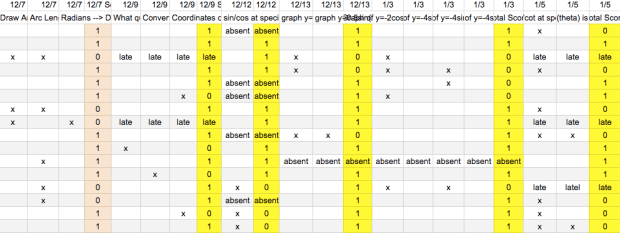
I was planning on also using this feedback later. I was going to look at the assessment kids took at the end of the review, and see if there was any relationship between kids’ performance on the assessment and these feedback quizzes. I didn’t get a chance to do this, and truth be told, the average was so high for the review assessment (89%) I suspect it would have been a waste of time.
I also wanted to know how students felt about this process. This was an experiment for me, but to know if it succeeded, I needed feedback from students. I wanted to know (a) if they found the feedback quizzes were helpful, (b) if the feedback quizzes changed their practice in any way, and (c) if they used the feedback from the quizzes in any way. So my teacher coach and I wrote this short and pointed set of questions for them:
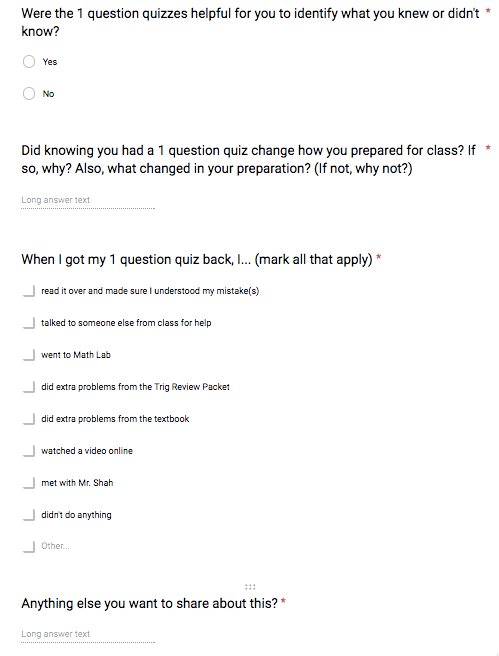
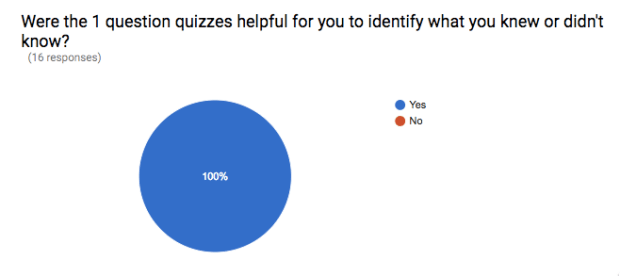
The results were interesting.
When asked if their preparation changed or not, it was interesting. Most kids said their preparation did change a bit, but even kids who said that it didn’t would then go on to say something that indicated that their preparation did change (highlighted in red)!


This is what kids did with the feedback (see list above from survey to see what each bar corresponds with):

And finally, here’s what kids wrote in the “anything else” box:

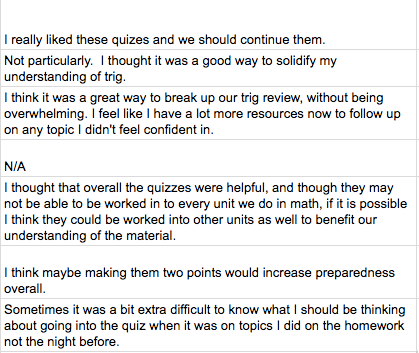
Overall, a success! Not only because kids found them useful on the whole, and because their practice changed because of them (for the better), but also because they did quite well on the trig review assessment (as I noted above, earning an 89% average).
More than figuring out how to deal with the annoying “how to review trig from the previous year before starting on trig in the following year” problem, this whole enterprise was an interesting excursion into feedback for me. I was hoping to find a way to create a feedback loop that was doable (and this was! it only took 10 minutes each day to mark up the simple quizzes) and created a change in student practice (which it did, because knowing there was something small students were accountable for each day changed how most kids prepared just a little bit).
To me this post and this experiment isn’t really about trig, but about now having another tool (daily feedback quizzes) in my teacher toolbelt to pull out at appropriate times.
[1] I debated whether I wanted to put a grade on these at all, or just let them be feedback with no score attached. I went back and forth about this for a long while. But ultimately, I knew that attaching a score, no matter how minimal, to the quizzes would effect more change than if I didn’t. But after introducing it, I didn’t mention the grade/score once when talking about them. I would mention common mistakes I noted and talked about ways to get extra practice with something or another. I kept my focus on the notion of feedback, and doing something with that feedback.


 radians is a half rotation about the circle. Then we can see that each pizza pie slice is
  ,
, ,
,  , and
, and radians. [The “top” half of the pizza is divided into two, four, three, or six pieces! And the top half is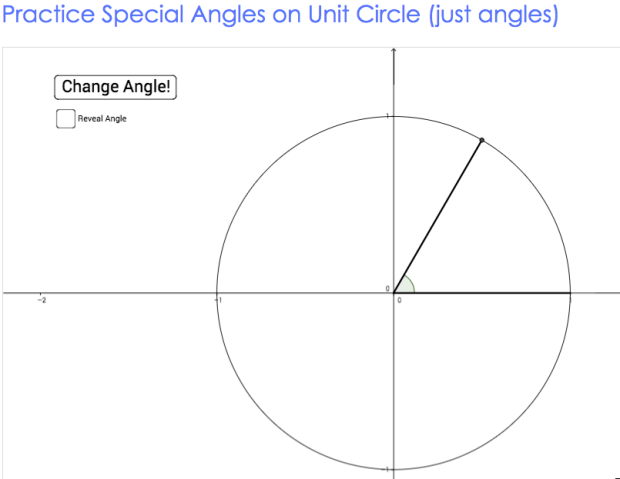
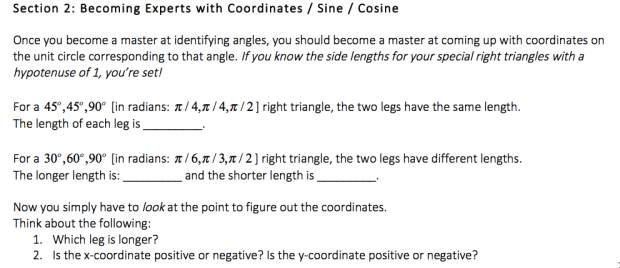
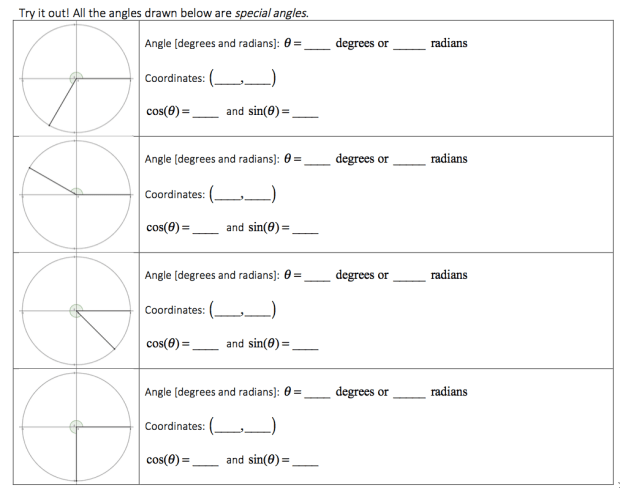
 . They hopefully would have mastered that from the previous exercise. They also will see that if they would draw the reference triangle, the x-leg is shorter than the y-leg, so they know the x-coordinate must be
  (but negative), and the y-coordinate must be
  (but negative).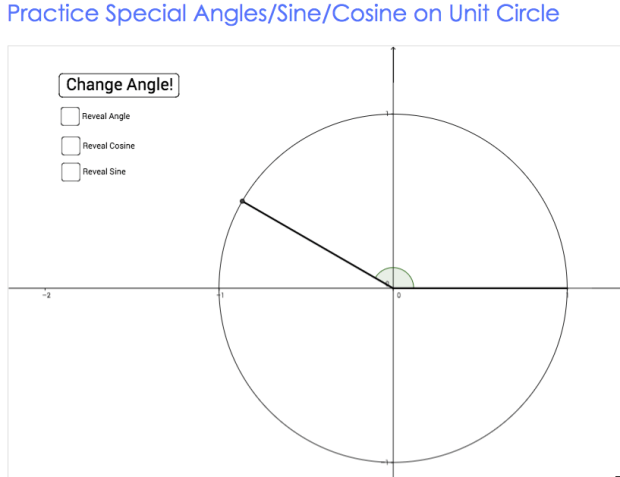
 and
and  . No one is going to be giving them nice pictures!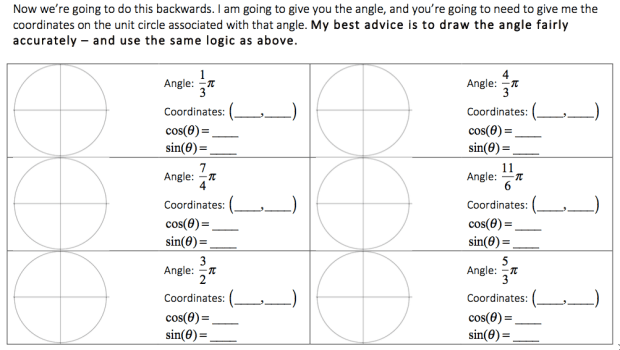
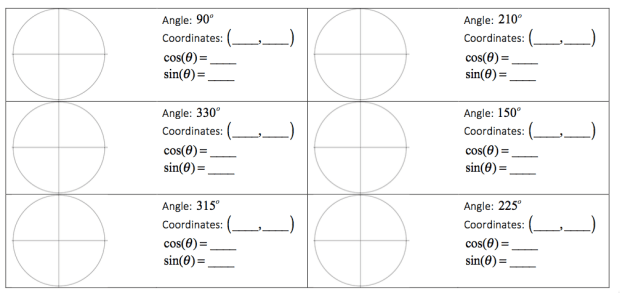

 and
and  (the term number and the value of the term), but it wasn’t a huge number. I actually was pretty proud of that.


 Continuous Everywhere but Differentiable Nowhere