I’ve taken away a lot of valuable ideas from the Klingon summer program. I wanted to distill them into a really strong set of reflections, but I’ve found I haven’t been able do that because I am still trying to play and tease them and turn them into some sort of coherent philosophy which I can envision being enacted in my classrooms. So as opposed to most of the blog posts I tend to write, I’m going to go a bit theoretical, and ask for your help to come up with concrete ways to show these things happen.
The first thing I’ve been struggling with, and I now see as one of my biggest weaknesses as a teacher, is the lack of attention I’ve given to bridging the gap between “the taught curriculum” and “the learned curriculum.” What’s strange is that I thought I had been giving that a lot of attention — and was one of my strengths. Here’s the idea:
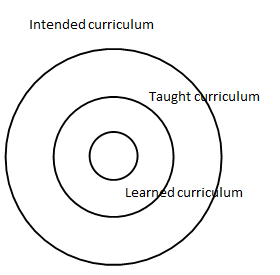
We all have a plan of what we want to cover in a year, in a class, or in a small bit of a class. That’s our “intended curriculum.” Then we go about and teach stuff. That’s our “taught curriculum.” Then there’s actually what our kids learn. That’s our “learned curriculum.” It has been kinda obvious to me since my first year teaching that there is always going to be a gap between the taught curriculum and the learned curriculum. These commonplace catchphrases are things I’ve heard over and over in the blogosphere…
Just because you teach it, it doesn’t mean they learn it.
Teaching is not the same as student learning.
So the goal of teaching is to minimize the gap between the taught curriculum and the learned curriculum. And I thought I was doing that. I see myself as being cognizant of the mistakes that students tend to have in thinking, I work on developing their understanding rather than having them rely on algorithmic/procedural learning, I teach my classes at the pace of my students — and alter how far we get with the material based on how much time I see them needing.
However, I have come to realize that I have been missing a gigantorific thing, because I’ve had some sort of blinders on. Especially egregious because this has been the central idea and nexus of the math teacher blogosphere for over a year now. I’m embarrassed to say: I don’t have any idea if I’m being successful at reducing the gap between the taught curriculum and the learned curriculum.
In other words, if asked how I assess student understanding in the classroom before tests, I wouldn’t have a good answer. Yes, I do that whole I look at their faces thing (which tells a lot) (but some of them are good at playing the game with their faces too) and I do the whole check yo’self before you wreck yo’self thing (questions which have students solve a problem after we have gone over a concept and done one together as a class) and I do the whole let me ask you a question thing and I very occasionally do the whole “put your head down and raise the number of fingers” where 1 finger is ‘totes got it’ and 5 fingers are ‘what just happened?’ …
But when it comes down to it, if my department head came to my class three-fourths of the way through, and froze the kids (okay… okay… no… she can’t do that… only I wield that power with my magic unicorn wand!) and asked me “what is the level of understanding of each kid in the class for the material you covered yesterday?” and “what is the level of understanding of each kid in the class for the material you covered today?” I wouldn’t be able to answer her with much confidence.
I don’t have strong systems to formatively assess my kids understanding.
Yes, there you have it. I said it.
Now I need to find ways to do this. I am currently thinking of giving short quizzes at the start of every class and exit slips at the end of every class. I would like to pilot out clickers at my school. And I would like to come up with more intentional questioning which can get to the heart of whether a student understands a topic or not (meaning: I have these questions prepared before class and I can whip out when I’m ready to check their understanding).
But more than anything, I’d love to hear ways you come up with ways to formatively assess kids understanding during a class or even outside of classtime. Big, small, thoughts on how to form questions that get deep to the heart of the subject matter, ways to figure out what every kid or what most kids know?


 Continuous Everywhere but Differentiable Nowhere