On Twitter, in the last day or two, teachers are returning to their schools for the requisite start-of-the-year-teacher-meetings. I have three weeks before that happens (phew), and I’m now ready to buckle down and set my sights on the start of the year. I found out officially what I’m teaching for next year, and it’s the same as what I taught this year.
1 section of Algebra II; 2 sections of non-AP Calculus; 1 section of Multivariable Calculus
My goals for Algebra II and Calculus are ambitious [1], so tonight I’ll briefly outline just one of them: Algebra II.
Algebra II: The History
For those who have followed my blog from the beginning, you’ll know two years ago when I started teaching Algebra II, the curriculum was kind of insane. We were doing so much — rational functions and the rational root theorem, a heck of a lot of trigonometry, and who knows what else — that the kids were simply following the motions. It was too much. Plus the textbook was written at way too high a level for where our kids were at. With the entrance of a new department head, we reviewed the curriculum and recognized that were were duplicating half of what students covered in precalculus.
So last year we took a hacksaw to the curriculum and asked what our kids needed to know, what they were going to see in precalculus, what was crucial and what was extra ballast. There was blood, lots and lots of squirting blood from every section of the curriculum. Nothing was safe! But out of the massacre, we came up with what I think was a tight curriculum — one that was paced well, one that allowed our kids to really understand ideas instead of procedures. The only regret I have from this year’s curriculum is that we required our kids to buy the old textbook, since we barely referred or worked out of it. (I work at an independent school, where the students purchase their own textbook.) I created and/or provided most everything we did.
Algebra II: The Future
Next year, we’re going to take this course to the next level. There are three ways we’re going to try to do this.
1. We have a new textbook (Holt, Algebra 2), which serves all my anticipated needs. The students can buy a hardcopy or an e-book, which is a nice option for them. (The e-book is much cheaper too! I think $15.) The best part of the book, though, is the online homework help. Check, for a moment, the homework help for Chapter 3, Lesson 1 (click the image below):
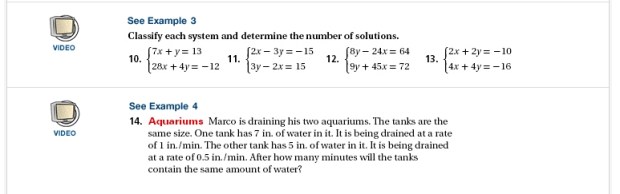
Wow – right? The videos! The text! Clear, amazing. And the problems aren’t the exact problems from the book, but almost the same problems. So students are truly getting guided practice, and not simply given the answers.
I’m going to assign only around 10-15 homework problems a night, but I’m going to expect absolute perfection, because of this additional resource which students can use to target their own misunderstandings.
(2) To emphasize mathematical communication, we’re going to institute a class blog. Mathematical communication was one of my goals last year, and I tried to include at least one “explain…” on every assessment. However, I think we need to practice more frequently. Inspired by the likes of David Cox and Darren Kuropatwa, and blog posts like Jackie Ballarini’s, I’ve convinced myself that this could be the solution.
To be clear, I’m not envisioning this really expansive web-hub for the class. It’s going to be very limited. I want student scribes (individual or in pairs) to record what we did in class each day. Record and explain. That’s all. I don’t expect and won’t require the rest of the class to read it — though they may want to as a quick review before an assessment. Honestly, I could very well ask for the daily notes to be written on paper and turned in. The online aspect is simply to make it easier for me to keep track of all these notes. Also, I want to teach my students that they can write equations and create graphs with their computer! (We’re a 1-1 laptop school, and as of last year, I learned that even my multivariable calculus kids were typing x^3 in MS Word instead of learning they had a built-in equation editor!) Details on how this is going to be rolled out will be forthcoming… like, um, when I come up with them.
(3) Homework… homework, homework, homework. I talked with the other Algebra 2 teacher, and we’ve decided — after reading over the awesome and extensive homework survey results — to really choose our homework carefully and limit the number of problems when they are coming out of the book. We had a long-ish talk about creating different “levels” of homework like some of the respondants recommended, but when push came to shove, we decided that it made a lot more sense in an accelerated class, which our class is not. So, for now, we’re assigning easy and medium level problems and expecting homework perfection on them.
However, one thing we’ve noticed is the absolute MESS that our students make of their class notes and homework. Although they are sophomores and juniors, their ability to take class notes, show clear and organized work on problems, and keep all their work together in one place, is virtually nonexistant.
Okay, okay, not for all of ’em, but a lot of students have never learned the skills of being organize in math. So the other math teacher and I are going to require each student to have a 3″ binder (kept in their lockers, or in the classroom) and a folder. When we’re done with a unit, students will — in class — place and organize their homework and notes and assessments in this binder.
Here’s the kicker. The student’s homework grade is going to be divided into two parts: aperiodic daily check of homework (walking around the classroom and giving students a 0-3 score on their homework) and a binder check. The binder check will happen twice in the first quarter (to get students used to the expectations), and then at the end of the second, third, and fourth quarters. On the day of the binder check, students will bring in their binders and be given a list of 15 things they have to find in their binders:
Homework assigned 9/21/2009; Section 2.5, #32
And students will have to circle this homework problem and their solution in red, and then put a mini post it tab on that page so I know to look there when I collect the binders. Then the problem will be graded on correctness and work shown.
And two added bonuses of these binders? Students will have all their assessments in one place when studying for the midterm and final. And I can have these binders on hand for parent-teacher conferences and for comment writing — both of which will be a much more powerful source of information than my gradebook and scattered notes.
So that’s the plan. Now the real question is if I can pull all of this out of a magic hat before school starts.

[1] MV Calculus was such a success last year — by any metric I want to assign — that I plan on doing the same format and let the course grow organically out of the personalities of the kids in it. Last year I had 4 students in that class. This year, I only will have 2.
UPDATE: I’ve uploaded a draft of the new curriculum here. We added a few more things from what we did last year, but it is largely the same.
 I’m really proud of this graphic design. Click on it and see it in full size glory!
 and
and  are non-negative, just because I got lazy). Apologies if there are any mistakes.
 Continuous Everywhere but Differentiable Nowhere