Author: samjshah

Summer Vacay

So clearly I haven’t posted in forever – and I’ve been feeling slightly guilty. Not guilty about not posting, but about not feeling bad about not posting, actually. I’ve been having a really awesome summer, taking my rests and enjoying my days. I haven’t done much math teacher work at all (yet). I plan on ramping up in the next few weeks, but I wanted to just say: I’m not gone for good, but I’ve been taking a much needed respite from blogging (and reading blogs). This summer I’ve taken off my teacher hat for many weeks and am enjoying that experience.

I’ll be back, and catch up reading and start up writing. So see you all soon!

A Great Calculus Problem… that is Powerfully Related to Geometry

I’m sitting in a building at Exeter, digesting lunch and waiting for the next session to begin. I’m at what has so far been a really valuable math teacher conference. What impresses me most, besides the amazing and neverending supply of food that they offer, is the population of teachers that come. Many of the teachers I’m talking with have 20+ years of experience in the classroom.

Over the next few days I’m going to use this blog to talk about some of the tidbits of interesting problems I’ve been presented with, to good resources or programs that I was introduced to, to neat ways to present topics in class, to ideas that I’ve been inspired to think about.

I’m going to start with a nice calculus problem — probably good for a AP Calculus BC class, but there is definitely a way I could show this problem to my non-AP class.

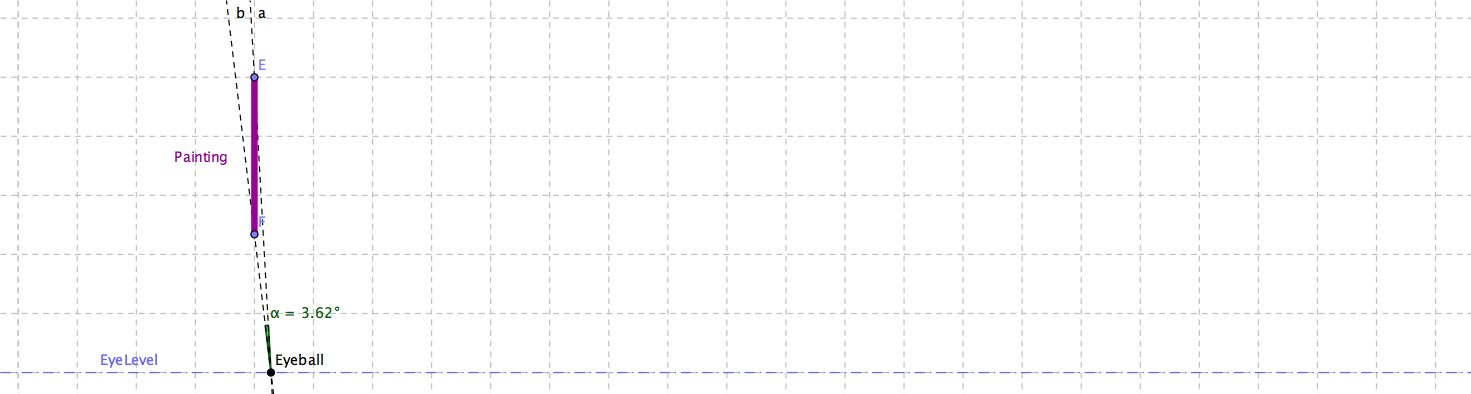
Here’s the problem. You’re in a museum and you’re looking at a painting which is hung above eye level. (There is a specific painting which is hung high in the entrance room at the Brooklyn Museum that I think of with this problem.) You are standing some distance away from it. The question is: what is the largest angle (\alpha) that you can get as you walk forwards and backwards? (See diagram below for setup.)

PictureProblem

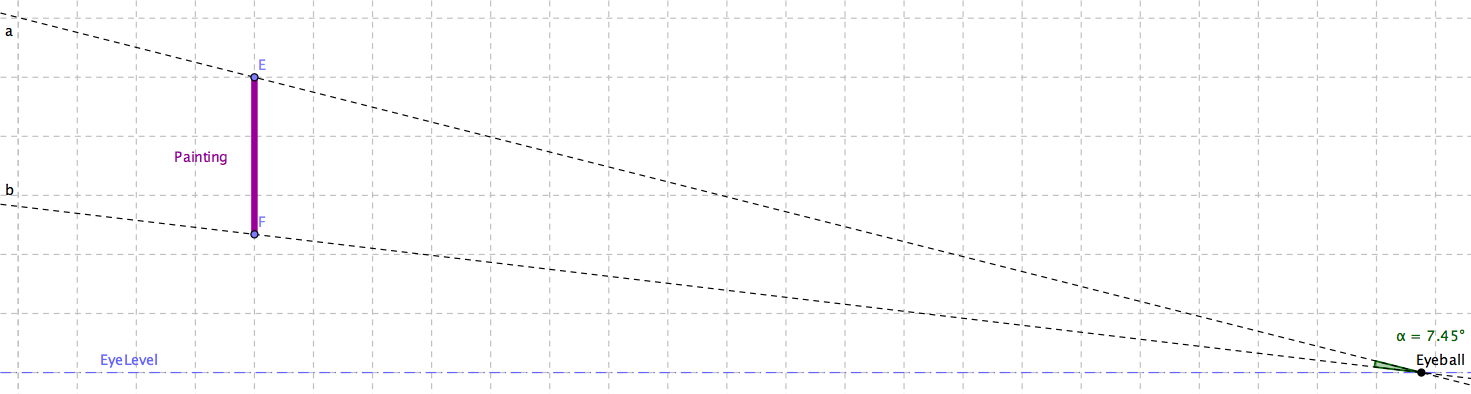
So to be clear, as you move the eyeball forward and backwards along the dashed blue line, what’s the largest angle you can create? Of course if you walk right up to the painting, or far away, the angle is going to decrease to 0. If you can’t see that, look at the diagrams below.

PictureProblemNear

PictureProblemFar

So of course there has to be some perfect distance that will give you the maximal angle. You see where this is going…

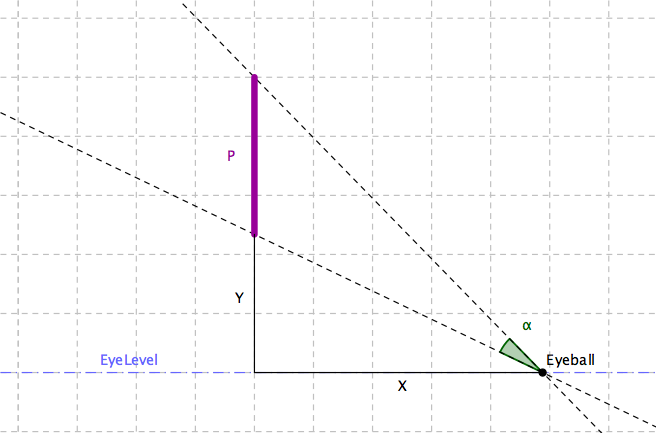
Find that maximum angle! (Use the variables in the diagram below.)

PictureProblemGeneral

Of course this doesn’t have to be a painting. It could be, as the speaker pointed out, an overhead view of a hockey rink, with the painting being the goal, and the eyeball being the player with a puck. Where does the hockey player have the maximum angle to shoot and make it into the goal?

I want you to have the fun of solving it, but the solution I came up with was:

\alpha=\tan^{-1}(\frac{P}{2\sqrt{Y(P+Y)}})

(I can help you with that if you want. Just throw your questions or cry for help in the comments.)

However, there is something pretty amazing about this problem, something that is powerfully seen with geometry software like geogebra or geometer’s sketchpad. Check out the sheet I made and see what happens as I bring the person close to the picture and look for the optimal angle? When you look at this, try to see if there is a geometry connection to our solution for the largest angle…

Vodpod videos no longer available.

more about “Geogebra_Picture_Problem“, posted with vodpod

Do you see the geometry connection? The optimal angle exists when the circle created by the top of the picture, the bottom of the picture, and the eyeball is tangent to the line of sight. Now my charge to you — which would be my charge to my students — is to (a) explain in words why this is true and (b) use geometry to calculate this optimal angle. You know, this work is an exercise for the reader. I mean, I’m not going to do everything for you. Sheesh.

My Teaching Portfolio: Selling and Archiving

I wanted to revise my teaching portfolio. I decided to think backwards and start from what the goals of my portfolio were and then see what I could do to achieve them:

  • A site for me to “sell” myself, if I ever go on the job market.
  • A site for me to archive the evolution of my teaching career. My blog acts as that, in a haphazard way. The portfolio sorts through the detritus and organizes it.
  • A site for me to express my personality and teaching style.

What I came up falls short of the third piece, but I think it is successful on the two parts.

If you want to check it out, feel free: Sam Shah’s Teaching Portfolio

And just so you know, my Teaching Philosophy as is now is actually just filler. I mean, I believe all that, but I haven’t written a formal one yet.

B30089BABC910237E9DFD6CD067B5412

HOMEWORK SURVEY RESULTS

If you’re really dying to see what our results are, click here. If you can manage to read the prologue, avoid that mouse button and forge on!

I’m writing this after my second year of teaching. Even though in many ways I’m a neophyte, there is one thing I am sure of. The majority of math teachers out there don’t know how to “do” homework. Myself included. Do any of the following sound familiar?

“I just walk around and look to see who has attempted the homework. I don’t have time to collect and grade each students’ homework.” “I don’t want students to feel penalized if they get home and are completely lost and just couldn’t do the work completely, but I also don’t want them to develop a sense of ‘learned helplessness. I want them to learn to figure things out when they are stuck.” “I want homework to be both a site for practice — so students can naturalize the skills that are introduced in class — and a place for me to know where my kids are at in terms of understanding; it’s a place for students to assess if they know something and it should be a place where I assess the state of the class. Right now it’s not doing either really well.” “I hope that one day homework in my class will partly be about problem solving skills, but at the moment, that’s a pipe dream. It’s just practice of the routine problems we do in class, not really getting my kids to think for themselves. One day I’ll figure out how.”

And of course, the questions:

“How much homework should I assign, if any at all?” “Should I make all my own homework, or just assign problems from the book?” “How much time should I spend at the beginning of class going over homework?” “How much do I really think homework should be worth in terms of the final grade?” “Do I grade homework? If so, on completion or correctness or both?” “How do I grade homework?” “Thinking through the whole homework thing backwards, what really is the point of it? Can I use that answer to come up with the amount and kinds of homework I assign, and how I factor homework?”

These all are things that pop into my head from time to time, and then in the immediacy of creating another lesson plan or writing another email, get pushed to the wayside. I mean, at least no math teacher I have talked to has a system they’re totally happy with in terms of homework. Might as well just do what everyone else does and push on.

And indeed, at least from my 2nd year teaching perspective, this seems to be the general attitude.

So I decided to harness the power of the web, and using Google Docs, my blog, Twitter, and a few emails, asked math teachers to fill out a short survey on how they “do” homework. (My blog plea is here.) The survey questions are way at the bottom of the post, below the fold.

This survey was designed to be open ended, and above all, practical. I wanted to “see” the life of a homework assignment — from its inception to its role in the classroom to its place in a students’ grade. I wanted to let teachers say whatever they wanted to say about homework. The philosophical debates will have to rage elsewhere.

There were a whopping 40 responses. I, in fact, was gunning for 20. I mean, the survey was narrative (so it takes a bit of time to fill out) and restricted to math teachers. So that’s awesome.

Now the question is: what to do with the data collected?

I haven’t read through it yet; I wanted to look at it at the same time y’all did. I’ll be reading it over in the next few days and cobbling together bits and pieces of what other teachers have written about — bits and pieces that will work with my teaching style and in my school — into a cohesive plan for homework next year.

What you’re going to do with it is anyone’s guess. My hope is that you read through the data, pass it along to other math teachers, come back here, and write down your thoughts in the comments below. I don’t expect a conversation will start here, but I’m darn tootin’ hoping one will.

So without further ado, click below for the survey results, or view the PDF below.

homework survey results

(Survey questions are below the fold.)
(more…)

Renegade Comic Newspaper

On the last day of classes, one of the seniors anonymously (but with the approval of the administration) put out a fake newsletter titled The Kaleidoscope. I don’t know why, but I got all swelled up with pride when I was mentioned in it a few times. The newspaper is full of inside jokes — jokes that only people at my school would get, or in the case of where I’m mentioned, jokes that only kids in my classes would get. But since I consider this blog a communication and archiving tool, I’m going to put the exerpts from the newspaper here. (I would also like to say to readers that my school is not religious in any way; it is in a historic church. So “chapel” just refers to meetings that we as a school have in the chapel.)

Last Rights of Last Chapel Gives Seniors the Rare Chance ot Draw Attention to Themselves

During the incredibly nostalgic “last chapel” for the Class of 2009, current study body president David “Nightfire” Palgon took extensive time out of a long block of jam related announcements to outline what this year’s student council had been working on. “After much deliberation, extensive research and statistics gathering, an MSA basketball tournament, four bake sales and a year’s worth of early morning meetings, the student council has outlined in the utmost detail a plan to put new pencil sharpeners in every classroom.” At first the chapel was filled with stunned silence, and then, like the flapping of a thousand pelicans’ wings, applause echoed from newly cleaned, non-religious stained glass windows to rarely used organ, to the strange, hieroglyphic, snowflake patterened lights. In no time at all, students were on their feet, broken and dulled pencils raised above their heads in celebration. “It’s about time!” yelled estatic long time anti-pen advocate and calculus teacher Sameer “Worchestershah” Shah. “I’m going to call my high functioning Aunt Derivative, send her some pie, fibenachos and a DXie chicks album and tell her about the pencil sharpeners! I’ve had the absolute maximum a person can take with pens!”

The article continues, but you get the point. And yes, I am a vehement anti-pen advocate in my classes. I do not, however, have any idea why my middle name is “Worchester” or why there is a picture of a Worchester bottle next to the article with my name under it. But I like it. Another article is about the student-faculty judiciary committee.

In the Court of Lawlessness: New SFJC Disciplinary Strategy Raises Concerns about Questionable Interrogation Tactics

“It was horrible!” chimes a confused [StudentName]. “I was late to school. Not too often–once, twice, eighteen times, and forced to go to SFJC. I had to get to school at 5:00am and when I refused to acquiesce to their demands they forced me to watch videos of old activity periods. I couldn’t take it…”  She buries her head in her hands and bemoans her early sign in.

[…]

“It’s really tough,” mumbles a disgruntled Sameer Shah, who recently misplaced an attendance sheet and was forced to follow a sophomore around for a whole day. “The new SFJC punishments, which apply to both students and faculty,” Shah continues, “effectively involve a role reversal.” If a faculty misbehaves he or she must do homework, papers, study for tests, worry about finals, do clean-up duty, and has sign out privileges revokes. But if a student breaks a rule he or she must grade papers, attend TALL Tuesday afterschool meetings, get fired, or in the most sever instances, serve as cafeteria monitor for middle school lunch.

I have to say that this newspaper is hilarious, especially if you got o my school… It’s like the author(s) wrote down every funny thing about our school — from our strange Pelican mascot to the fact that it has taken over a year to work through the red tape to get new new pencil sharpeners in each classroom — and wordsmithed it to priceless gems. I literally was laughing out loud at every sentence. They tap into that very thing of what it means to really go to and live our lives at our school. That’s a hard feat to do. It’s also why you probably read everything above and were like “ummm, Sam, these are NOT funny.” To that I bite my thumb at thee.

Student Reflections on Calculus

Nearing the end of the school year, but when things are still in full swing, I ask students to write a letter to themselves… to themselves at the beginning of the year. The letter should outline things that they learned about the class, about me, about whatever in hindsight that would be helpful for them to know to be successful in calculus class. [1]

I promised them — crossed my heart, hope to die, and all that — that I wouldn’t look at them until after final grades were in, so they should be SUPER honest.

What I get from these letters is not only insights into my students, but more than anything else, deep insight into me as a teacher. It also reveals a lot to me about my about students. Without further ado, here are the relevant excerpts [2] of each of these letters which I’ll be handing out on the first day of class next year. (And before you ask, some of the things in these letters are inside jokes between the class and me.)

[1] At the beginning of this year, I handed out excerpts from the previous class’s letters.

[2] I pretty much included everything relevant… the good, the bad, and the ugly… the stuff I cut out either identified the student or were fluffy sentences that had already been captured.

How do you deal with homework?

UPDATE: Survey results here!

We talk a lot about lesson plans on our blogs, but there is the huge issue of homework that we don’t discuss frequently. Partly because the discussions easily lose concreteness and get philosophical (why do we assign homework? how do we make sure the homework as meaning?).

However I’m struggling with how I’m doing homework in the classroom everyday. I can get dragged into a too-long discussion about homework problems in class, and I still don’t know how to grade homework in a way that I am not killing myself by collecting it everyday.

The few teachers I’ve talked to about this have shown me that this problem — of finding a good homework system — is pretty universal. A recent post at Kiss My Asymptotes reminded me of this too.

It’s like no one I know has a good solution on how to “do homework well” in the math classroom. That’s crazy to me. I mean, how can that be? And I just know some people must have good ideas/methods. Which is why I’m just casting a wide net looking for what everyday teachers do in their everyday classrooms. If I can collect a bunch of different ideas from different teachers, I can put that out there to show the different ways we do homework. Maybe we can pick and choose bits from other teachers that inspire us!

Because of this, I thought:

We should all band together and make a list of how we deal with homework in the classroom.

So I’d love you forever if you could spend a few minutes filling out this short survey, and I’ll post everyone’s responses soon.

Without further ado: THE SHORT SURVEY!