Author: samjshah

Course Expectations for an Unusual Course

So next year — as you might know from various posts this summer — I’m teaching Multivariable Calculus. I’ve spent this summer trying to refresh myself with the subject, which has remained dormant in a portion of my brain which has been unused since 1999.

The thing that has been weighing on me is how different this course is, in terms of both content and in terms of the class makeup itself. Here are the things I was grappling with when designing the course:

  1. The course will have only 2-4 students in it.
  2. The students are going to be pretty advanced who have shown they can do high school level math, and well. [1]
What I want students to get out of the course:
  1. The obvious and the most crucial: I want the students to understand the basics of MV Calculus
  2. I want students to acquire and master problem solving skills. By the end of the course, I want students to see that math problems can require more than 1-3 minutes each, and there are wrong directions that need to be taken.
  3. I want students to learn that math can be a collaborative activity. I want to foster a class atmosphere where we all are working together to conquer the material.
  4. I want students to learn to communicate math effectively — both in written form (in terms of writing the solutions to problems) and in verbal form (in terms of explaining concepts).
  5. I want students to become familiar with the use of computer software to help solve problems which don’t have algebraic solutions (or involve a lot of manipulation).
With these goals in mind, I designed the course. [I think I dealt with all but #5, which is because I haven’t yet learned how to use SAGE Notebook (here). But when I do, I will incorporate questions and tutorials in the problem sets.]
But I’m nervous. It’s so different that I wanted to solicit any feedback. So if you have the time (and desire), take a peek below at the course expectations and tell me if there is anything that looks like it won’t work. (Or if there is something that looks like it will work well.)
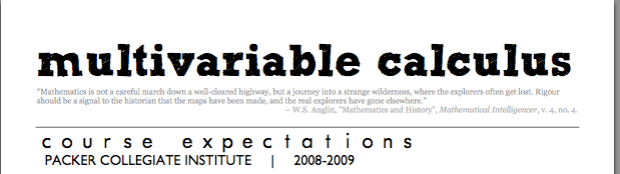
(download pdf here or by clicking picture above)


I initially had designed this course with no tests, but I added in a few out of the fear that students — especially seniors who are going to be bombarded with work from other classes — would easily turn this course into a “back burner” course. Meaning that they would go home with a lot of homework and decide that the one course they could sacrifice (or do halfheartedly) would be math, because there was so little accountability.
And if you’re curious what the problem sets might look like, I am copying two questions (both cribbed from Anton) below.
[1] I haven’t taught any high school honors/advanced courses yet, so this is new territory for me.

Digication $latex \neq$ Digital Portfolio

UPDATE: I have given up on digication and created my portfolio at wordpress: samjshahportfolio.wordpress.com.

As the summer winds down, I’m looking at my to do list — parts of which have languished because they were left unattended. One item was to check out digication, this site that my school subscribes to which allows students and teachers to make online portfolios. (My first attempt at a portfolio didn’t really turn out great. And then boxtr.com deleted all my files. Suck.)

I spent a number of hours today trying to knock “explore digication” off my list, and lo and behold, I now havethe embryo of a digital portfolio.

Yes, it needs more content. Yes, the organizational structure isn’t there. But hey, you gotta start somewhere.

However, if anyone else out there is so inspired, let me please save you from digication. It has all the functionality of… well… a lobotomized WordPress blog. Ummm. Yeah… Actually, that’s exactly right. I’ll explain in a bit. So here’s the deal. I was looking for something which could organize a lot of content easily, which had a good file manager, which was fully customizable with lots of themes/skin options, and which would hook up nicely with lots of the new websites out there (e.g. vimeo, slideshare).

Some problems with digication:

  1. There are two types of “modules” — picture boxes or text boxes. If you have pictures, they get displayed. Great. But if you want to make them links? Oh, you can’t. Or if you have a text box and want to insert a picture in it, the picture can be at most 500 pixels long. In other words, you are using a website which is supposed to let you create a website about who you are, but the website sends ninjas to your home to tie your hands behind your back and force you to swim in a very salty pool.
  2. You can’t mess around with the HTML code. Which doesn’t sound so horrible, right? You have a nice WYSIWYG editor, which allows you to change font colors and sizes with the click of a button. However, let’s think of something totally crazy, like maybe wanting to put up a slideshow from slideshare, or a video on vimeo, where you have to put some embed code in the HTML. You can’t. So you’re stuck only putting in videos from the sites youtube and teachertube, which are built in options. Not going to happen, buddy.
  3. You can’t change the background, or any of the style. You can upload one banner picture (see mine above), you have about 6 fonts to choose from, and you can’t change the fonts of the page titles. There is also a lot of wasted space (especially on the left hand side of the page).
  4. There isn’t a good file manager (that I could find anyway). Okay, let me rephrase. I couldn’t find any file manager. So say you upload a picture, and then decide to put it in a different page. Well, unless I’m missing something (and I hope I am), you have to delete the picture and then re-upload it on the other page. (Seriously.)
  5. I wanted to have the RSS feed of this blog import to one of the pages of the portfolio, so you could read the blog there. Mainly so everything is current. Well, I couldn’t figure out how to make that happen.
  6. You can create various “header” pages, and then sub pages within them. (So, for example, I have a page on Technology, and under that, I have a page on SmartBoards.) Great! But you know what would be even better? I want sub-sub pages. Because wouldn’t it be nice to have, say, a page under that called “Algebra II” or “Calculus” which contains my SmartBoards from those classes?
  7. You can’t load PDFs for display and scrolling.
I know I could make a way, way better portfolio on a WordPress blog, because it would allow me to do most of the things I can’t do in digication (except for maybe #6). See, for example, my Multivariable Calculus Resource Page, which I created on a WordPress site but is not anything like a blog. Now imagine that with pictures, videos, worksheets, teaching philosophies, etc.! Phew! Good stuff.
But hey, I’ll stick with this for a while, because my school is paying for it. And I hate to see money go to waste.

A new problem based on ye olde problem of yore

I tried to make up my own problem along the lines of this problem, but wanting it to be slightly different.

Let x^4=7+4\sqrt{3}. Show that x+\frac{1}{x}=\sqrt{6} exactly.

Coming up with your own problems is so much harder than solving problems.

(If you need help, see the solution to the problem linked above. The general method I used for solving this problem is the same method I used for creating this problem.)

A Mathematician on Mathematics

I want to share with you an article I found on ArXiv written by mathematician Steven Krantz for mathematicians on mathematics in the larger university context. [Paper on ArXiv; or get it here.] It’s a good read for mathematicians, yes. It makes a convincing charge that the isolationist tendency of mathematics (specifically the individuals, the departments, and the profession) can’t remain so. But it’s also a really good read for high school math teachers who want to know what professional mathematicians do, how they think.

Abstract: We consider the question of how mathematicians view themselves and how non-mathematicians view us. What is our role in society? Is it effective? Is it rewarding? How could it be improved? This paper will be part of a forthcoming volume on this circle of questions.

A choice excerpt to get you interested:

When we meet someone at a cocktail party and say, “I am a mathematician,” we expect to be snubbed, or perhaps greeted with a witty rejoinder like, “I was never any good in math.” Or, “I was good at math until we got to that stuff with the letters—like algebra.”

When I meet a brain surgeon I never say, “I was never any good at brain surgery. Those lobotomies always got me down.” When I meet a proctologist, I am never tempted to say, “I was never any good at . . . .” Why do we mathematicians elicit such foolish behavior from people?

Krantz first came on my radar when I was writing a research paper on rhetoric in Wolfram’s A New Kind of Science. To this day, I have not forgotten his review of that book: the most vicious piece of academic writing I’ve come across. Ever. Krantz knows how to pack a wallop, with rhetorical aplomb. (Plus, I agree with almost everything Krantz had to say damning Wolfram’s book.)

A Problem of Yore

I was browsing old math journals a few days ago and got caught up in looking at puzzles/challenging problems sent in by professors to The Mathematical Gazette (the original publication of the Mathematical Association).

I got engaged in battle with a problem from it’s first year of publication (No. 1, Vol. 7, April 1896 – if you have JSTOR access, see the original problem here). The journal stated that it was a question “from recent Entrance Scholarship papers at Oxford and Cambridge.”


I think it’s a darn good problem, so take a stab at it. I’ll type my solution to it below the fold, but maybe you’ll get a better one? (I went down two wrong roads before I came up with this one…)

(more…)

Stunning photographs of the LHC (or get a load of the new Teilchenbeschleuniger)

The Big Picture (from the Boston Globe) has a series of stunning photographs of the Large Hadron Collider, about to go into business! If you don’t know what the LHC is or what it does, you should definitely watch this amazing and short TED talk by Brian Cox.

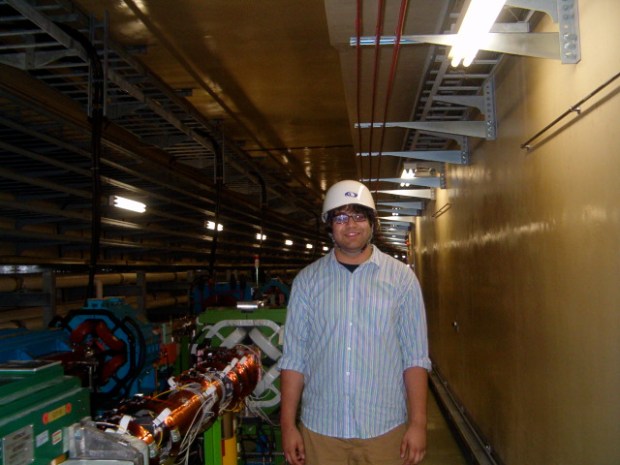
Even though I doubt I’ll get to see this machine in person, I was given the opportunity to visit the KEK (the National Laboratory for High Energy Physics) in Japan in the Summer of 2006. Because it was summer, and it was too expensive in the summer months to run the monster, I got to take a tour of the belly of the beast, and it was stunning.

Aesthetically beautiful. A meshing of the absolutely miniature (particles), the hardware-store size (the magnets that hold the beam of particles to a confined track), and the enormous (the detectors). There’s something almost absurd with it, like using the elephant in the room to find a needle in the haystack. (It’s so absurd that not even a single metaphor can capture it.)

I wish I were an expert on Particle Physics. In fact, I wanted to write my dissertation on the history of particle physics (somewhere in the time period from the 1940s to the 1970s). But alas! I think I shall always have to sit on the sidelines, heroicizing while remaining ever befuddled.

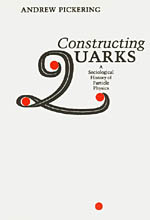
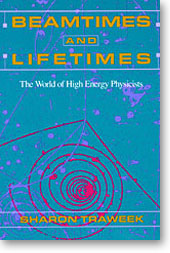
In honor of LHC excitement, my favorite book recommendations for the history of 20th century physics are below (click for more information):

Kaiser: easy-medium read | Pickering: hard read | Galison: easy-medium but long read | Traweek: easy read

A picture of me in the KEK wearing a hardhat and grinning uncontrollably? Priceless.

A mind boggling maximization problem!

So I encountered what I think is a horribly wonderful (and did I mention horrible?) problem. It took me forever to solve, because I kept getting different solutions and I didn’t know which was right and which was wrong and where my errors might have come from. But in the end, I think I finally got it right. The error was a silly sign error which made everything nice.

Here’s the problem [1]:

A length of sheet metal 27 inches wide is to be made into a water trough by bending up two sides as shown in the accompanying figure. Find x and \theta so that the trapezoid shape cross section has a maximum area.
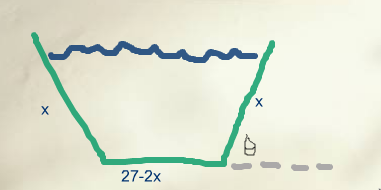
I don’t want to tell you what I got for the answer, in case you want to try it out for yourself, but I will tell you this: I was able to get a maximum area of \frac{243\sqrt{3}}{4} square inches.

(And if you are banging your head against a wall, and need a solution for peace of mind, shout out in the comments. I’d be happy to type out my solution. I just don’t want to spend the time if no one cares.)

Update: I had \frac{1453}{8}(\sqrt{2}-1)\sqrt{2\sqrt{2}-1} posted as the answer, but again, I noticed a second silly sign error. I have never made so many algebraic errors on an problem as I did with this one.

[1] From Anton’s Calculus, 8th edition, Chapter 14, Section 8, Number 44