Quotes from Calculus

calculus quotes

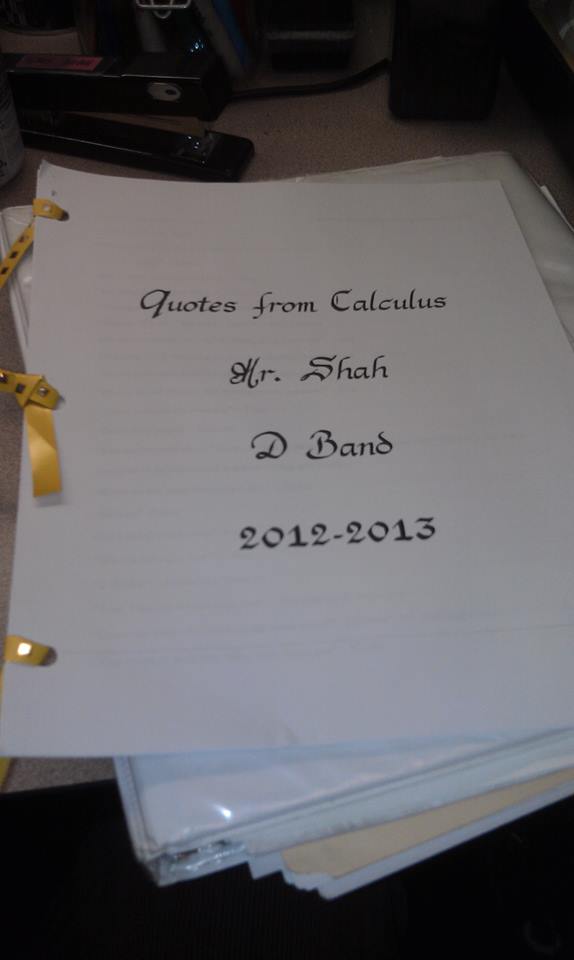
Seniors are done with classes. (The rest of the Upper School is preparing for final exams this week, and finals are administered next week.) Yesterday one of my calculus students gave me this 12-page booklet she prepared. All year, she had been writing down quotations from class — from students and from me. This was her final product. 

I don’t think it would be right to include the student quotations, but below here are some that are attributed to me. I remember some of them, and some of them I am clueless! Most of them won’t make any sense to you, gentle reader. Oh well!

“Derivatize!” — Mr. Shah

“Laughing is the only thing we can do, otherwise we would cry” — Mr. Shah

“Does this make the diddy [ditty] make more sense?” “P. Diddy” — Mr. Shah and Stu

“There’s still 2 minutes left, keep working” — Mr. Shah

“Fish, fish, fish, fish, fish, fish. 6 fish!” — Mr. Shah

“You can harangue him” — Mr. Shah

“It’s just depressing as a teacher when students admire clocks” — Mr. Shah

“I have 3 declarations, is that okay?” “No” — Student and Mr. Shah

“Sorry that you’re so sensitive” — Mr. Shah

“Anyone taking Latin here? Too bad. Ha! It’s in Greek.” — Mr. Shah

“Crust” — Mr. Shah

“”You need parentheses or else you’re gonna die” — Mr. Shah

“Oh no he didn’t!” — Mr. Shah

“Are you having special difficulties?” — Mr. Shah to Student

“Uh-uh boo boo” — Mr. Shah

“Jesus!” “Jesus!” “Hey, let’s keep religion out of this” — Student, Student, and Mr. Shah

“You’re a whack sharpener” — Mr. Shah to Student

“What if I put formaldehyde in this? And then spit in it?” — Mr. Shah to Student

“What’s the point in the spit? After the formaldehyde she’d already be dead” — Student

“That was my fault for listening to anyone but my brain” — Mr. Shah

“I have hearing” — Mr. Shah

“How was your weekend Mr. Shah?” *silence* “Oh, okay” — Student

“I got 99 problems and they’re all problematic” — Mr. Shah

“Who wants to volunteer to factor out these 100 terms?” *silence* “No one?” — Mr. Shah

“What… what’s the derivative of tan(x)?” “This isn’t happening” — Student and Mr. Shah

“Make your life easiah!” — Mr. Shah

“Yes sir” “I prefer your majesty” — Student and Mr. Shah

“Hey! Hey! Hey! This doesn’t sound mathy” — Mr. Shah

“Draw the boxes” “Why?” ” Because I order it” — Mr. Shah and Student

“When I see these things, I get like heart palpitations” — Mr. Shah

“Let’s come up with our own definition of genius” — Mr. Shah

“The baby mama rule, ugh! You guys have me calling it this instead of the inception rule” — Mr. Shah

“I pick one kid in every class to blame for everyone getting sick. I blame Student” — Mr. Shah

“Student die!” “Did you just tell Student to die?” “No I said duck!” — Mr. Shah and Student

“A long, long time ago… in a classroom right here” — Mr. Shah

“So what’s the derivative?” “With the letter? I can’t do it with letters” “Yo, pass it over here” — Mr. Shah, Student, and Student

“Doing it all at once is a little cray cray” — Mr. Shah

“We’re so close to being done” “We’re not done yet?” — Mr. Shah and Student

“Where is my pencil honey boo boo child” — Mr. Shah

“That’s bad news bears” — Mr. Shah

“Hush! No questions. We’re imagining” — Mr. Shah

“My favorite flowers are ranunculus” — Mr. Shah

“Do we have this sheet?” “Yes… but I don’t want you to take it out” “So how are we gonna do it?” — Student and Mr. Shah

“Do you have your phone in your hand?” “Never have I ever” — Mr. Shah and Student

“A baby, in a baby, in a momma” — Mr. Shah

“Student, I’m asking you this because you’re snarky” — Mr. Shah

“Derp!” — Mr. Shah

“What if I just say give me the Riemann Sum?” “You won’t” — Mr. Shah and Student

“Did I do well?” “No coach, you didn’t” — Student and Mr. Shah

“I put a little doo-hickey on the right side” — Mr. Shah

“I have a QQ Mr. Shah” — Mr. Shah

“Hush yourself child” — Mr. Shah

“Repetitious and tedious” — Mr. Shah

“Hey, fight me!” “Don’t tempt us” — Student and Mr. Shah

“Can’t you read it? More a exact!” — Mr. Shah

“He’s doing his thing” “What’s his thing?” “He’s running” “Attempting to run” — Student, Mr. Shah, and Student

“We should look at this and say…” “That ain’t right” — Mr. Shah and Student

“Holy Mother… Superior” — Mr. Shah

“They’re full of hogwash” — Mr. Shah

Intersections, a high school math-science journal

At the end of last year, a science teacher and I came up with the idea of creating a math-science journal for students to publish their work in. Our school has a literary and art journal and even a foreign language journal. But there is no forum for students to show off their more mathysciency work…

There was a secondary reason for wanting to start it. We are in the middle of implementing our school’s strategic initiative, and that involves doing more project-and-problem-based-learning, and more interdisciplinary work. We thought that by having the journal, it might help drive some of these curricular changes by encouraging teachers to assign rich problems or projects that could be submitted to the journal.

It took a long time and a lot of work of many people to produce, and I wanted to take this post to outline the process of it’s development. However before I do that, take a moment and head over there and check it out! And if you want to see a few specific articles, here are some that I think you might enjoy to whet your appetite: the very model of a modern natural satellitea challenging chalkboard problemb-text, counting art, running in circles, transcendent fractions.

intersections

The Initial Stages

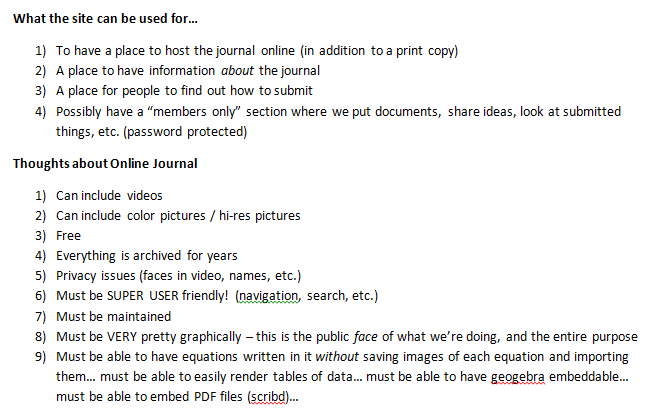
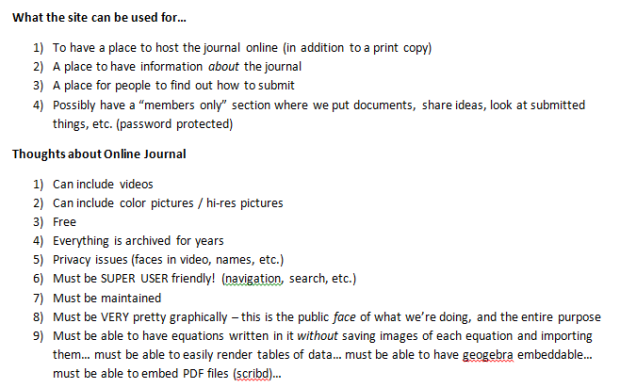
The other teacher and I crafted an initial document outlining what we thought the journal could look like, after brainstorming. We did this at the end of the last year. The one thing we both agreed on is that we didn’t want the journal to be ours but we wanted it to be the kids. These were just our initial ideas, but that’s all. When kids would get involved, they would take charge of what the journal would look like.

Here’s the document.

This is also the document we both shared with our head of school, our division head, and our department heads (math and science). We realized that if we didn’t have the support of these people, it wasn’t worth going forward with. But (as one would expect) they were all ecstatic about the idea. We also got permission to take some of the math department meeting and some of the science department meeting to introduce the journal to get teachers on board. I made a little slideshow with some ideas for how we could use it as a department, in an attempt to get the buy in from teachers. We encouraged teachers to make assignments next year that students could submit. Or if a student had an ingenious question, we could encourage them to research it and submit it to the journal. Or a student who had an out-of-the-box way of thinking about a problem, they could submit that. We emphasized that we wanted a low barrier for participation. We didn’t want kids to feel like they had to write a huge research paper or do all this independent work or be the best and the brightest to submit.

We knew without teacher buy in this would have been dead in the water…

But we both have awesome colleagues, and everyone was on board.

Getting Kids Involved 

So at the end of the year, after we saw this was something other people were willing to get behind, we sent an email about to a number of kids. We figured for the first year, to get it started, the other teacher and I would reach out to individual kids we thought might enjoy the process. (We figured that after the journal was established, the student editors would decide how the leadership would pass from year to year.) So we made a list of kids in various grades (because we wanted kids in various grades) and emailed them to see if any of them were interested. We got four responses, and so it worked out perfectly…. two juniors and two sophomores. Yay!

This was all at the end of last year. We left for summer.

And then we came back. After about a month into school, we had our first meeting with the editors.

Initial Stages with Kids

I looked at our meeting notes for the first meeting. They included us brainstorming a list of all the possible things that could go in the journal. Brainstorming names for the journal. Brainstorming all the clubs and classes that do things that we could envision having connections to the journal (e.g. computer science club, trebuchet club, earth club, math club, chem club, the science research seminar, the math applications elective).

Creating Structures and Actionable Goals

We came up with adjectives to describe the journal, and listened to various ideas. And through our discussion, we were able to come up with a name for the journal. It just kinda popped out. This was important because we needed to start reaching out to others about it, and we needed something to call it.

We brainstormed ways to promote the journal (ideas: a facebook group, individually reaching out to clubs, having students make presentations in department meetings to get teachers on board, getting t-shirts made).

And we left with the following list of things we knew we needed to do.

goals

The next big thing for us is that we needed to create a website where we could send people to, so they could learn about the journal.

The Website Gave Us Direction

It actually turned out to be that working on the website is the thing that gave concreteness to the abstractness. I met with a student who was going to lead the website effort after school. We did some planning:
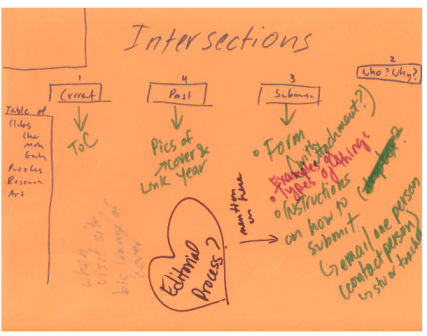
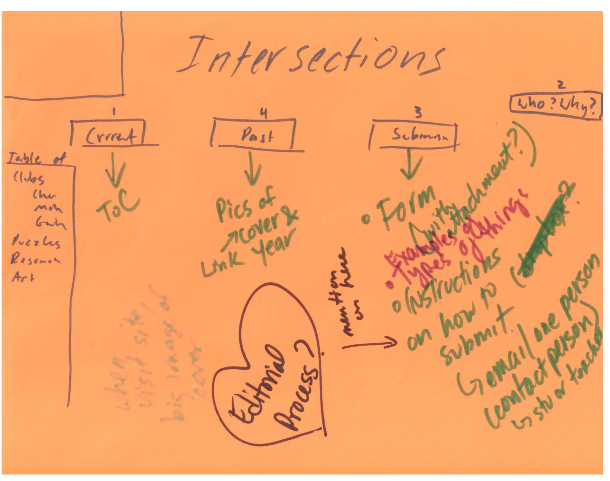
brainstorming

brainstorming2

And as we did that, we realized that we needed a statement of purpose for the site written by the student editors, as well as an explanation as to why they agreed to work on it. In addition, we agreed that we needed to have a page with some example ideas of what students could submit, and finally, we needed a submission form and a method for students to submit.

So at our next meeting, coming up with these things became our focus. We needed these things for the website, yes, but we also needed these things ready so we could start soliciting submissions.

It took a while, but eventually we created a way to get submissions (a form that students fill out and email to one student editor, who was going to be our submissions pointperson), a statement of purpose and a video trailer expanding upon it, and a page filled with the types of things that students can submit. We also started working on coming up with ideas for the cover and for the logo.

Soliciting Submissions

We still didn’t have an editorial policy. Would we accept everything that was submitted? How would we edit these articles? What if there were mistakes, or the submission was really unclear? However, we quickly realized we couldn’t make those decisions in this first year without having seen what sorts of things people were going to submit. So we tabled those more theoretical discussions and decided it was time to start soliciting submissions from students. We had the website, we had a process for kids to submit. Now we just needed to get buy in.

To do this, the students decided to reach out in various ways. Each student editor decided to become responsible for soliciting submissions from different groups.

Math teachers. Science teachers. Numerous Clubs. Various classes working on things.

And they did. And now that we had our website up, we could direct people there.

We also had signed up for a “Community Meeting” presentation. Every other week, the entire high school gathers together while a club or group gives a presentation about something or another. To get the word out, the kids created a 10 minute presentation to share with the community what the journal is all about, what sorts of things can be submitted, and how they can actually submit. The big thing we kept on remembering when designing this was that we wanted the journal to appeal to all students. As we had decided earlier, we wanted a low barrier for participation, and the kids emphasized that.

We also had come up with a submissions deadline, and we made that public for the first time.

They kids rocked it, and gave a hilarious and informative presentation.

Waiting… but not Patiently

Now the word was out. Teachers knew about it. Clubs knew about it. Students knew about it. We had to wait for submissions.

But we weren’t passive. The kids brainstormed projects that students already had done in class, and went to those teachers. The kids heard when someone was going to submit something, and encouraged that student to follow through. I encouraged more than a few kids to take something they were interested in and turn it into something they could submit. We kept an unofficial ongoing list of people working on things that we knew were going to come to us, and for a few months, the student editors were each responsible for getting those people to follow through.

And through this process, the editors were being proactive, and because of that we got a good number of submissions!

Putting Everything Online

We got a lot of great things, and we didn’t want to turn anything away, so we accepted all the articles that came to us. The student editors came up with a way to divy up who was going to edit each article, and they were going to have a second editor double check the work.

A couple editors took put the initial drafts of the articles online (a very time-consuming task), and then everyone else helped out with fixing things up and formatting them.

And finally, we came up with a way to divy up the articles into four different categories, I taught the kids how to make menus on the website, and then I let them go at it. You can imagine how much work that involved. But without a single complaint, they put everything online.

Celebrate

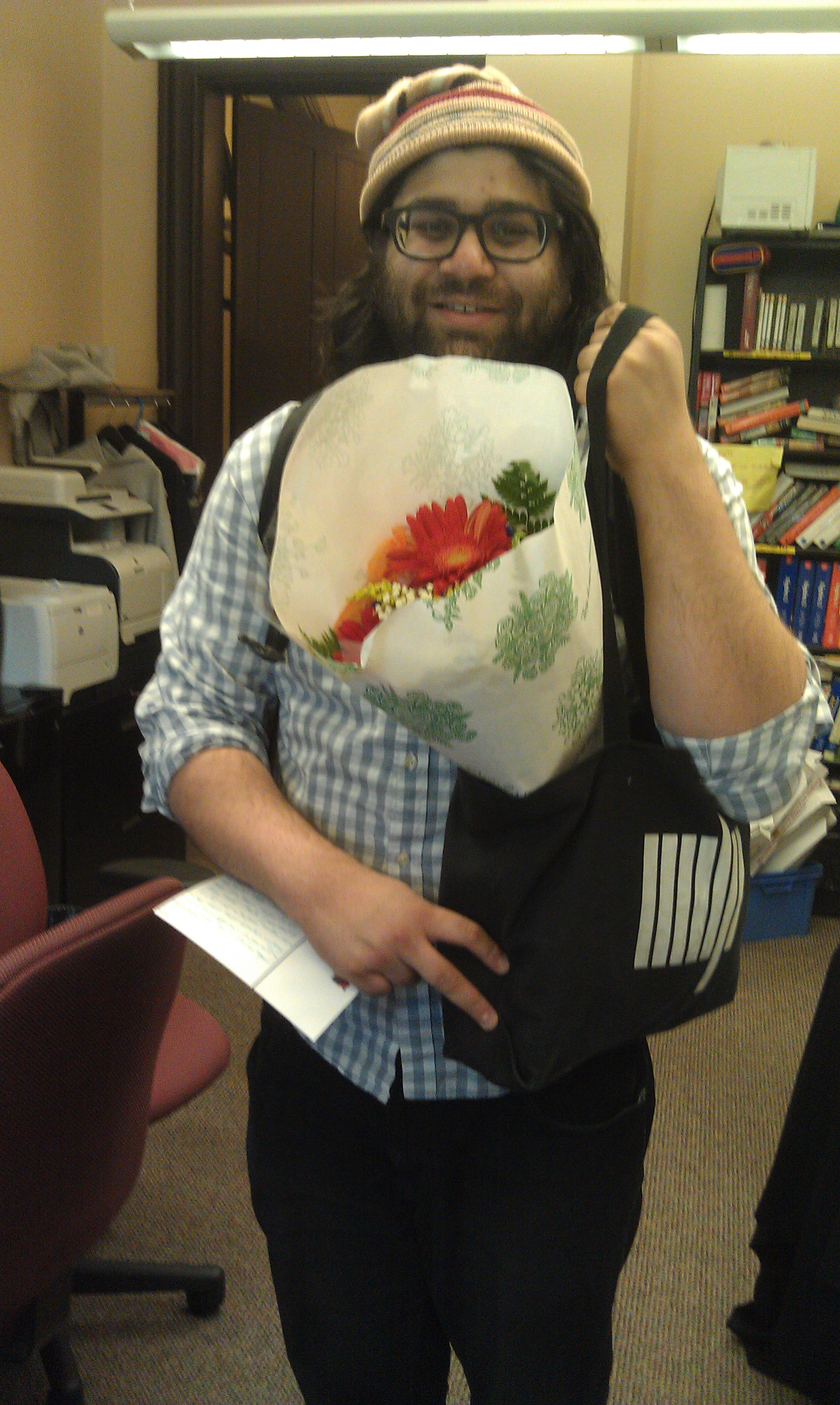
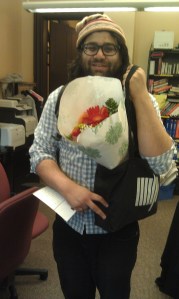
To launch Intersections, we planned a pizza party. We invited all people who submitted articles, as well as all the math, science, and computer science teachers, and the head of the upper school and the head of school. A ton of people came and partook in the pizza delight. The kids had planned a presentation to talk about the process of putting the journal together, and to highlight a few of the things in it. At the end of their presentation, the kids had secretly brought flowers for me and the other teacher!
flowersatschool

Most importantly, the launch party was the time where the kids who put in so much of their time for this journal were able to be seen, and get recognized for their hard work.

It was a primary goal of this project — for both me and the other teacher — to have this be a very student led enterprise. For it to be meaningful, they had to be in charge of it. They had to make the big decisions. They had to take responsibility for doing much of the heavy lifting. And I was more than impressed. They not only rose to the challenge, but surpassed every expectation I had. When we would talk about one thing, they not only would do it, but then have twelve more ideas that would come out of it, and do those too.

Fin.

Post Script

There are lots of next steps with this. The biggest thing that I feel needs to happen next year is to have more teacher participation. Although a few teachers clearly mentored students and encouraged them to submit, I feel we could have done a lot better on that front.

An Animal Problem

One of our math club leaders gave out this problem as the final problem of math club for the year. I had never seen it before, and after she handed it out, a number of math teachers were in a tizzy about finding the solution. So instead of planning for classes, we enjoyed working on this problem. But we got it! HUZZAH!

Here’s the problem:
In how many ways, counting ties, can eight horses cross the finishing line?

So we fully understand the problem, let me list all possibilities for three horses: Adam, Beatrice, and Candy. No, wait, those are better names for unicorns:

1st: A   2nd: B   3rd: C

1st: B   2nd: A   3rd: C

1st: A   2nd: C   3rd: B

1st: C   2nd: A   3rd: B

1st: B   2nd: C   3rd: A

1st: C   2nd: B   3rd: A

1st: AB (tie)   2nd: C

1st: AC (tie)   2nd: B

1st: BC (tie)    2nd: A

1st: A   2nd: BC (tie)

1st: B   2nd: AC (tie)

1st: C   2nd: BC (tie)

1st: ABC (tie)

That comes out to 13 different ways these horses unicorns can finish the race.

That’s the answer for 3 unicorns. What’s the answer for 8 unicorns?

(FYI: If you want to know if you’re on the right track… I have 541 for 5 unicorns…)

Some Random Things I Have Liked

The Concept of Signed Areas

In calculus, after first introducing the concept of signed areas, I came up with the “backwards problem” which really tested what kids understood. (This was before we did any integration using calculus… I always teach integration of definite integrals first with things they draw and calculate using geometry, and then things they do using the antiderivatives.)

I made this last year, so apologies if I posted it last year too.

[.d0cx]

Some nice discussions/ideas came up. Two in particular:

(1) One student said that for the first problem, any line that goes through (-1.5,-1) would have worked. I kicking myself for not following that claim up with a good investigation.

(2) For all problems, only a couple kids did the easy way out… most didn’t even think of it… Take the total signed area and divide it over the region being integrated… That gives you the height of a horizontal line that would work. (For example, for the third problem, the line y=\frac{2\pi+4}{7} would have worked.) If I taught the average value of a function in my class, I wouldn’t need to do much work. Because they would have already discovered how to find the average value of a function. And what’s nice is that it was the “shortcut”/”lazy” way to answer these questions. So being lazy but clever has tons of perks!

Motivating that an antiderivative actually gives you a signed area

I have shown this to my class for the past couple years. It makes sense to some of them, but I lose some of them along the way. I am thinking if I have them copy the “proof” down, and then explain in their own words (a) what the area function does and (b) what is going on in each step of the “proof,” it might work better. But at least I have an elegant way to explain why the antiderivative has anything to do with the area under a curve.

Note: After showing them the area function, I shade in the region between x=3 and x=4.5 and ask them what the area of that bit is. If they understand the area function, they answer F(4.5)-F(3). If they don’t, they answer “uhhhhhh (drool).” What’s good about this is that I say, in a handwaving way, that is why when we evaluate a definite integral, we evaluate the antiderivative at the top limit of integration, and then subtract off the antiderivative at the bottom limit of integration. Because you’re taking the bigger piece and subtracting off the smaller piece. It’s handwaving, but good enough.

Polynomial Functions

In Precalculus, I’m trying to (but being less consistent) have kids investigate key questions on a topic before we formal delve into it. To let them discover some of the basic ideas on their own, being sort of guided there. This is a packet that I used before we started talking formally about polynomials. It, honestly, isn’t amazing. But it does do a few nice things.

[.docx]

Here are the benefits:

  • The first question gets kids to remember/discover end behavior changes fundamentally based on even or odd powers. It also shows them that there is a difference between x^2 and x^4… the higher the degree, the more the polynomial likes to hang around the x-axis…
  • The second question just has them list everything, whether it is significant seeming or not. What’s nice is that by the time we’re done with the unit, they will have a really deep understanding of this polynomial. But having them list what they know to start out with is fun, because we can go back and say “aww, shucks, at the beggining you were such neophytes!”
  • It teaches kids the idea of a sign analysis without explaining it to them. They sort of figure it out on their own. (Though we do come together as a class to talk through that idea, because that technique is so fundamental to so much.)
  • They discover the mean value theorem on their own. (Note: You can’t talk through the mean value theorem problem without talking about continuity and the fact that polynomials are continuous everywhere.)

The Backwards Polynomial Puzzle

As you probably know, I really like backwards questions. I did this one after we did  So I was proud that without too much help, many of my kids were really digging into finding the equations, knowing what they know about polynomials. A few years ago, I would have done this by teaching a procedure, albeit one motivated by kids. Now I’m letting them do all the heavy lifting, and I’m just nudging here and there. I know this is nothing special, but this course is new to me, so I’m just a baby at figuring out how to teach this stuff.

[.docx]

Green’s Theorem and Polygons

Two nights ago, I assigned my multivariable calculus class a problem from our textbook (Anton, Section 15.4, Problem 38). Even though I’ve stopped using Anton for my non-AP Calculus class, I have found that Anton does a good job treating the multivariable calculus material. I think the problems are quite nice.

Anyway, the problem was in the section on Green’s theorem, and stated:

(a) Let C be the line segment from a point (a,b) to a point (c,d). Show that:

\int_C -y\text{ }dx+x\text{ }dy=ad-bc

(b) Use the result in part (a) to show that the area A of a triangle with successive vertices (x_1,y_1),\text{ }(x_2,y_2), and (x_3,y_3) going counterclockwise is:

A=\frac{1}{2}[(x_1y_2-x_2y_1)+(x_2y_3-x_3y_2)+(x_3y_1-x_1y_3)]

(c) Find a formula for the area of a polygon with successive vertices (x_1,y_1),\text{ }(x_2,y_2),...,(x_n,y_n) going counter-clockwise.

Today we started talking about our solutions. We all were fine with part (a). But part (b) was the exciting part, because of the variation in approaches. We had five different ways we were able to get the area of the triangle.

  • There was the expected way, which one student got using part (a). This was the way the book intended the students to solve the problem — and I checked using the solution manual to confirm this. What was awesome was that even though we as a class understood the algebra behind this answer, a student still asked for a conceptualgeometric understanding of what the heck that line integral really meant. I knew the answer, but I left it as an exercise for the class to think about. So we’re not done with this problem.

  • There was a way where a student made a drawing of an arbitrary triangle and then used three line integrals of the form \int_C y\text{ }dx to solve it. In essence, this student was taking the area of a large trapezoid (calculated by using a line integral) and subtracting out the area of two smaller trapezoids (again calculated by using line integrals). Another student astutely pointed out that even though we had an arbitrary triangle, the way we set up the integral was based on the way we drew the triangle — and to be general, we’d have to draw all possibilities. You don’t need to understand precisely what this means — because I know I”m not being clear. The point is, we had a short discussion about what would need to be done to actually have a rigorous proof.

  • There was a way where a student translated the triangle so that the three vertices weren’t (x_1,y_1),\text{ }(x_2,y_2),\text{ }(x_3,y_3) anymore… but instead (0,0),\text{ }(x_2-x_1,y_2-y_1),\text{ }(x_3-x_1,y_3-y_1). Then he used something we proved earlier, that the area of a triangle defined by the origin and two points would involve a simple determinant (divided by 2). And when he did this, he got the right answer.

  • Another two students drew the triangle, put it in a rectangle, and then calculated the area of the triangle by breaking up the rectangle into pieces and subtracting out all parts of the rectangle that weren’t in the triangle. A simple geometric method.

  • My solution involved noticing that \frac{1}{2}(ad-bc) is the area of a triangle with vertices (0,0),\text{ }(a,b),\text{ }(c,d). And so I constructed a solution where a triangle is the sum of the areas of two larger triangles, but then with subtracting out another triangle.

The point of this isn’t to share with you the solutions themselves, or how to solve the problem. The point is to say: I really liked this problem because it generated so many different approaches. We ended up spending pretty much the whole period discussing it and it’s varied forms (when I had only planned 10 or 15 minutes for it). I liked how these kids made a connection between a previous problem we had solved (#28) and used that to undergird their conceptual understanding. I loved how these approaches gave rise to some awesome questions — including “what the heck is the physical interpretation of that line integral in part (a)?” In fact, at the end of class, we were drawing on paper, tearing areas apart, trying to make sense of that line integral. All because a student suggested that’s what we do. (Again, I have made sense of it… but I wanted the kids to go through the sense making process themselves… their weekend work is to understanding the meaning of this line integral.)

I don’t know the real point of posting this — except that I wanted to archive this unexpectedly rich problem. Because it’s not that it is algebraically intensive (though some approaches did get algebraically intensive). Rather, it’s because it is conceptually deep.

Ellipses

What are the ways we can generate ellipses?

We’ve been working with ellipses. I have talked about some of these this year. Others I haven’t. But I like this list for future reference.

  • The polar equation r=\frac{1}{1-k\cos\theta} gives rise to ellipses if 0<|k|<1
    ellipse1
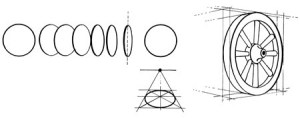
  • An ellipse arises out of squashing or stretching a unit circle horizontally or vertically (or both)ellipse4
    which means that algebraically…the rectangular equation is (\frac{x}{\square})^2+(\frac{y}{\triangle})^2=1
  • An ellipse arises out of looking at a circle straight on (so it looks like a circle) and then tilting that circle.ellipse3
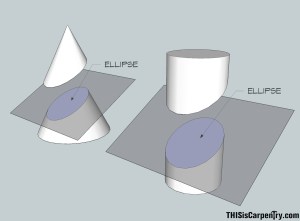
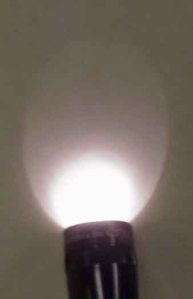
  • Ellipses can be created by taking a cone (or cylinder) and slicing it at a variety of anglesellipse2This is equivalent to shining a flashlight at a wall at an angle:ellipse5
  • The set of points from two points (called foci) which have a set sum of distances from these two pointsand for a cool video illustrating this (alongside the reflective property of ellipses):
  • Drop a planet in space near a massive object, and give it an initial push (velocity)ellipse6
    [
    not drawn to scale, obvi.]

CUPCAKES! ALGEBRA II! BEST ACTIVITY EVAR!!!

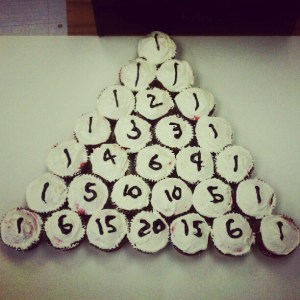
Now that I have gotten your attention, I’m sorry. I don’t have the best activity ever for an Algebra II class that involves cupcakes. But fine, you want cupcakes. Here.

cupcakes

Now for the reason why I lieeeed to you. You know it’s gotta be big, and important. It’s this. I need you to read this, and take a moment, and actually consider it.

We have a math department chair opening at my school, and you or someone you know might be the person who would be perfect for it.

So I have a lot to say. I should probably note at the top that everything I’m saying is my own opinion, and this post doesn’t come from my school or my department. Just me. Now to the other stuff… I am not someone who wants to go into administration. And my colleagues also love being in the classroom full time. We tend to love our little classroom universes, and even though we engage in the bigger picture of the curriculum-at-large, our primary interest is being intellectually stimulated by classroom teaching. So we want to find someone from the outside who can see the bigger picture and wants to shepherd a bunch of thoughtful and awesome-face teachers as we push forward into our next step.

If this even remotely sounds like something you’ve been toying around with, keep on reading.

For some background. I teach at Packer, a fantastic independent school in Brooklyn Heights, New York City. The school is a Pre-K through 12 school. There are so many wonderful things about my school, I don’t know which to list. It is not religiously affiliated, but we are housed in an old church — and there is a chapel where we have meetings, and this chapel has beautiful stained glassed windows. The architecture is Hogwartian. There are about 80 to 90 kids per grade, and class sizes tend to be around 12 to 16 (though sometimes things go under or over). The school underwent a comprehensive renovation of the “Science Wing” and this summer it is going to renovate many of the Upper School (high school) classroom. The kids all have laptops, and all the rooms currently have SmartBoards, but next year they will be upgraded to Sharp LCD boards (and some will have ENO boards). When it comes to teachers being able to get “things” they need to teach, we do. Similarly, I have never been turned down for any professional development opportunity I wanted to pursue, and have always been fully funded. There is a commitment to teachers on that front.

The school is in the middle of an ambitious 5 year strategic plan, which includes a special component involving math and science excellence.  For me, the most exciting thing about the strategic plan is that teachers are thinking more and more about the importance of the process of acquiring knowledge. For me, that’s exciting because I have been wanting to move towards a more “how do we do math?” approach rather than “here, let me show you how to do math, now do some problems.”

Now to speak specifically about the math department, and why I think it’s worth considering. The math department head is in charge of math in grades 5 through 12 (middle school is 5-8, upper school is 9-12). That would mean being the head of 13 or so teachers.

We’re a really well-functioning department, where everyone gets along and are friends with each other. When we’re feeling wonky, I might be in the office with TeacherX , and we’ll close the door, put on the Sound of Music, and we’ll spin around in our chairs. (Because we both love the Sound of Music.) And every single time anyone is going to the photocopier, they ask if anyone else in the office needs something copied. And we all buy diet coke and chocolate share it with each other. We do site visits to other schools to see what they are doing. And teachers of the same class meet regularly. We share materials all the time. We pose puzzles to each other. And we bounce ideas off of each other.

What I’m trying to say is: that would be a concern of mine… coming to a new school and not knowing how the department is. I can say that we is aweeeesome.

I personally see us at a crossroads, and one where someone could come in and do some great work to take us to our next step.

We’ve come a long way in coming up with a solid and coherent curriculum. We have been trying to push our curriculum to get students to articulate their reasoning more… We have made “writing in the math classroom” a goal of ours for the past two years. And although we’re all very busy, we have made a goal to visit each others’s classes a number of times (I think 8?) before the school year ends. (That reminds me… I need to try to a few observations soon!) And we’re now in the process of thinking: how do we get problem-based learning in our classrooms?

And this is the crossroads we’re at. How do we bring our teaching, and our curriculum, to the next level? (I think this is a question the whole school is asking, because of the strategic initiative.) For me, that means learning to focus on letting go more, and developing curricular materials which continue to push students to focus on the fundamental ideas and less on procedures. It means getting kids to do the heavy lifting. It means trying to deconstruct a curriculum so I can figure out what the essential mathematical idea is, and then find ways to really bring that to the forefront. That’s all for me. Different teachers are at different places in their career and have other ideas on what they need to do to get to the next level. But the takeaway for you is that we’re interested in the craft of teaching, and looking to forge forward as a department.

That isn’t to say that everything is all roses all the time. What place is? And better yet, what place filled with teenagers is?

But it’s a place which I’ve been happy and proud to call home since I’ve started teaching. (It is suppose it’s actually a second home to me, since I spend so much time here!) The school took a chance on me — a young kid with only student teaching experience — and gave me a place to grow professionally. I was allowed to experiment with standards based grading (this is my third year doing it in calculus). I felt like I needed to switch one of my courses last year because I was feeling stale with it, and just plain tired, and that happened. I asked for funding to go to multi-day out-of-state conferences and I have always been approved.

The school is going through changes, as we work towards the strategic plan. And I think our department can, with someone with passion and vision and a strong work ethic, help us take our work to the next level!

Our department head is leaving because of reasons unrelated to her job here. And this timing of this is — at least for independent schools — late in the game. That is why I want to reach out to you guys. A perfect audience of math teachers! If you can see yourself or someone you know in a place like this, working with meeeee!, get into gear and apply!

We want someone awesome, and I’m 200% sure that the teachers in the department will do everything we can to support whoever we hire in their new role. You won’t be walking in alone, but rather with the support of everyone in the department who wants you to succeed, and will do everything we can to make that happen. We are a department and we look out for our own.

Because of the lateness in the hiring season, please please please don’t wait a few days before getting around to it. It is (in my opinion) a one-in-a-career opportunity, but the window is not going to be open for long. We are going to be working on this hire ASAP. 

The job posting and instructions about sending your information are here.


I’m turning off comments.