Families of Curves

When I put out my call for help with Project Based Learning, I got a wonderful email from @gelada (a.k.a. Edmund Harriss of the blog Maxwell’s Demon) with a few things he’s done in his classes. And he — I am crossing my fingers tight — is going to put those online at some point for everyone. To just give you a taste of how awesome he is, I will just say that he was in NYC a few years ago and agreed to talk to my classes about what it’s like to be a real mathematician (“like, does a mathematician just like sit in a like room all day and like solve problems?”), and have kids think about and build aperiodic tilings of the plane.

Anyway, he sent me something about families of curves, and that got my brain thinking about how I could incorporate this in my precalculus class. Students studied function transformations last year in Algebra II, and we reviewed them and applied them to trig functions. But I kinda want to have kids have some fun and make some mathematical art.

First off, I should say what a family of curves is.

family

That’s from Wikipedia. A simple family of curves might be y=kx which generates all the lines that go through the origin except for the vertical line.

lines

I made this in Geogebra with one command:

Sequence[k*x, k, -10, 10, 0.5]

This tells geogebra to graph y=kx for all values of k from -10 to 10, increasing each time by 0.5.

Okay, pretty, but not stunning. Let’s mix things up a bit.

lines 2

Sequence[k*x+k^2, k, -10, 10, 0.1]

Much prettier! And it came about by a simple modification of the geogebra command. Now for lines with a steep slope, they are also shifted upwards by k^2. This picture is beautiful, and gives rise to the question: is that whitespace at the bottom a parabola?

Another one?

sin

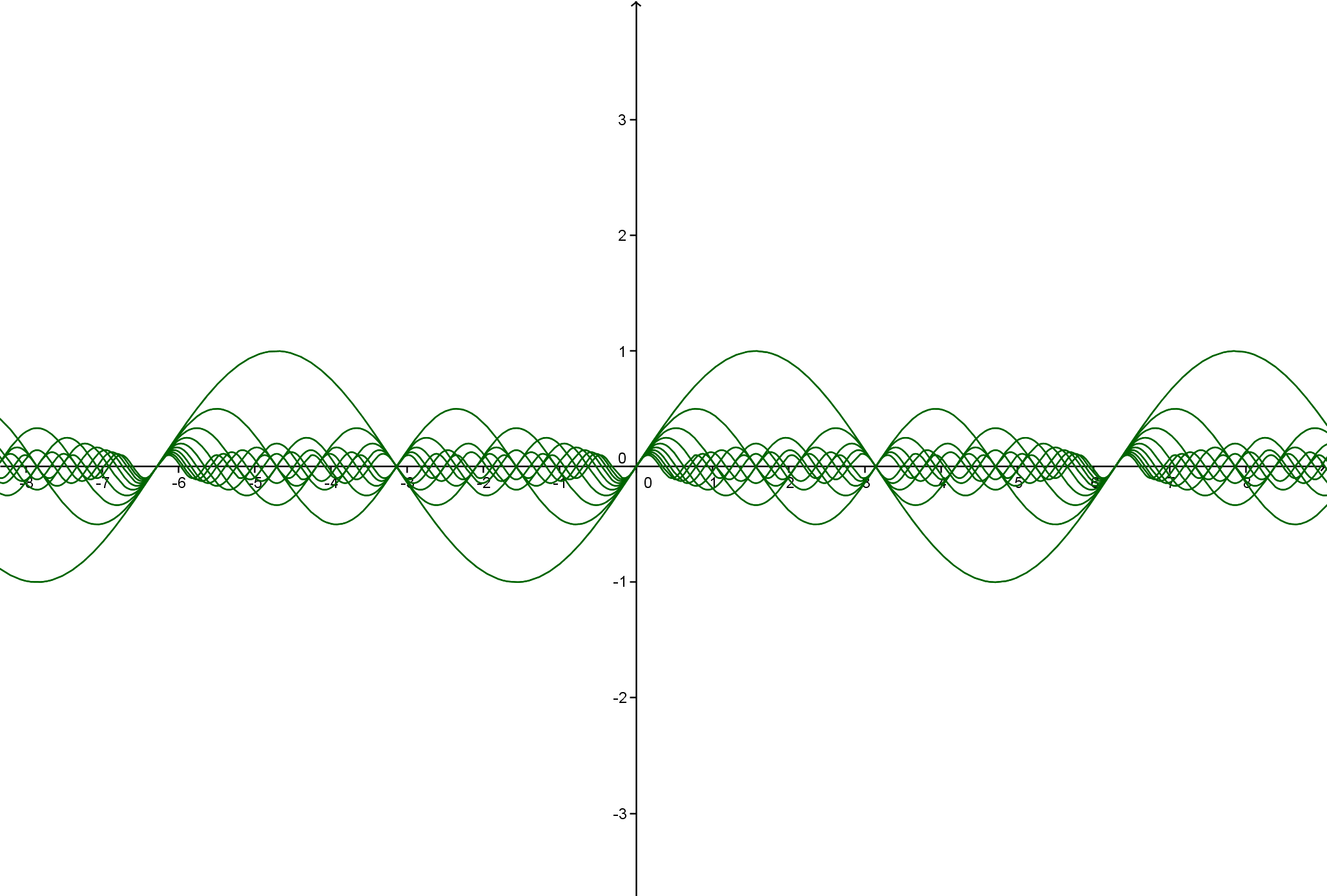
Sequence[1/k*sin(k*x),k,-10,10,0.2]

And finally, just one more…

tan

Sequence[1/k*tan(x)+k,k,-10,10,0.1]

Just kidding! I can’t stop! One more!

sec

Sequence[k sec(x)+(1/k)*x,k,-10,10,0.25]

What I like about these pictures is…

THEY ARE PRETTY

THEY ARE FUN TO MAKE

THEY ARE SUPER EASY TO MAKE & TINKER WITH

THEY MAKE ME WANT TO MAKE MOAR AND MOAR AND MOAR

And then, if you’re me, they raise some questions… Why do they look like they do? What is common to all the curves (if anything)? Does something special happen when k switches from negative to positive? What if I expanded the range of k values? What if I plotted the family of curves but with an infinite number of k values? Do the edges form a curve I can find? Can I make a prettier one? Can I change the coloring so that I have more than one color? What would happen if I added a second parameter into the mix? What if I didn’t vary k by a fixed amount, but I created a sequence of values for k instead? Why do some of them look three-dimensional? On a scale of 1 to awesomesauce, how amazingly fun is this?

You know what else is cool? You can just plot individual curves instead of the family of curves, and vary the parameter using a slider. Geogebra is awesome. Look at this .gif I created which shows the curves for the graph of the tangent function above… It really makes plain what’s going on… (click the image to see the .gif animate!)

sec animation

Okay, so I’m not exactly sure what I’m going to do with this… but here’s what I’ve been mulling over. My kids know how to use geogebra. They are fairly independent. And I don’t want to “ruin” this by putting too much structure on it. So here’s where I’m at.

We’re going to make a mathematical art gallery involving families of curves.

1. Each student submits three pieces to the gallery.

2. Each piece must be a family of curves with a parameter being varied — but causing at least two transformations (so y=kx^2 won’t count because it just involves a vertical stretch, but y=k(x-k)^2 would be allowed because there is a vertical stretch and horizontal shift).

3. At least one of the three pieces must involve the trig function(s) we’ve learned this year.

4. The art pieces must be beautiful… colors, number of curves in the family of curves, range for the parameter, etc., must be carefully chosen.

Additionally, accompanying each piece must be a little artists statement, which:

0. Has the title of the piece

1. States what is going on with each curve which allows the whole family of curves to look the way they do, making specific reference to function transformations.

2. Has some plots of some of individual curves in the family of curves to illustrate the writing they’ll be doing.

3. Has a list of things they notice about the graph and things they wonder about the graph.

At the end, I’ll photocopy the pieces onto cardstock and make a gallery in the room — but without the artist’s names displayed. I’ll give each student 5 stickers and they’ll put their stickers next to the pieces they like the most (that are not their own). I’ll invite the math department, the head of the upper school, and other faculty to do the same. The family of curves with the most stickers will win something — like a small prize, and for me to blow their artwork into a real poster that we display at the school somewhere. And hopefully the creme de la creme of these pieces can be submitted to the math-science journal that I’m starting this year.

Right now, I have a really good feeling about this. It’s low key. I can introduce it to them in half a class, and give them the rest of that class to continue working on it. I can give them a couple weeks of their own time to work on it (not using class time). And by trying to suss out the family of curves and why it looks the way it does, it forces them to think about function transformations (along with a bunch of reflections!) in a slightly deeper way. It’s not intense, and I’ll make it simple to grade and to do well on, but I think that’s the way to do it.

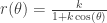
What’s also nice is when we get to conic sections, I can wow them by sharing that all conics are generated by r(\theta)=\frac{k}{1+k\cos(\theta)}. In other words, conic sections all can be generated by a single equation, and just varying the parameter k. Nice, huh?

PS. Since I am not going to do this for a few weeks, let me know if you have any additional ideas/thoughts to improve things!

Projects and Project Based Learning: HELP! AAACK!

What I’m going to ask you at the end of this post: I’d love any links in the comments to examples of awesome projects and examples of project based learning for the math classroom. I’d love any projects that you think are actually really good, and any and all examples of project based learning (good or bad).

***

This isn’t a post about something I’m doing in the classroom, but rather me soliciting resources from all y’all so I can do something different in the classroom.

But my basic sentiment at the moment is: AAACK! HELP! AAACK!

Setup: My school is jumping on the Project Based Learning bandwagon. However, no one has been able to give me good examples of what real Project Based Learning in the math classroom looks like. However, no one has yet been able to give me a satisfying example of Project Based Learning in math.

I found this online (thanks twitter) which appears to separate Project Based Learning from Projects:

PBL

It’s all very good sounding. But I am a concrete thinker and I haven’t been able to come up with a hundred examples of Project Based Learning. Honestly, I haven’t even seen one that I’d say “hey, this is awesome.”

Also, I am not really good with doing projects in general. I don’t do a lot of them (for a variety of reasons).

So, as I said: I’d love any links in the comments to examples of awesome projects and examples of project based learning for the math classroom. I’d love any projects that you think are actually really good, and any and all examples of project based learning (good or bad).

Mainly I’m just trying to wrap my head around this. I still am unsure what to think about this move my school is making, and if it makes sense for the math classroom. But for now, I am keeping an open mind.

Grinning

Today I was grinning irrepressibly.

Last week I received an email from the current faculty adviser to the disciplinary committee — what we call the Student-Faculty Judiciary Committee. It read:

Dear Mr Shah,

You have been referred to the Student Faculty Judiciary Committee for Violation of Dress Code. Your hearing will take place on Tuesday, 4 December, during F band, in the Faculty Lounge. (This is the space above the cafeteria.) If possible, your superhero will join you in the hearing as support. Please arrive on time, and feel free to contact me if you have any questions about your appearance before the committee. Should you be ill on the day of your hearing or need to be absent for any reason, you must contact me via email. Otherwise, the committee may deliberate and reach a disciplinary response in your absence.

For those of you who need some background, I served on the committee for four years… two years as a faculty representative (going to the hearings, giving my thoughts, voting) followed by two years as the faculty adviser (leading the committee). It was hard work. Four years of early morning meetings, dealing with challenging student issues (and sometimes challenging students). We disagreed. We argued. And in the process, in these early mornings, I saw some of the best things I could have possibly hoped to have seen as a teacher. I saw students who came before the committee reflect. I saw students serving on the committee grow in their thinking about responsibility and consequences. I saw committee members show empathy while simultaneously keeping the big picture in mind. I saw students disagree with students, and teachers disagree with students, and students disagree with teachers, and teachers disagree with teachers… and come out the better for it. And I saw, year after year, a committee of students and faculty who were dealing with confidential and difficult and rarely good things band together to form a tight group with a real sense of purpose. To me, the committee truly has been a concrete instantiation of the best kind of work a school can do, and we did it well. [1]

That’s what the committee is all about.

I walk to the faculty lounge. I look up the stairs, and I see a student waving. As I walk up the stairs, I see a ton of people all there and they all start clapping. It was a thank you pizza party in my honor. I got this grin, and the whole time I walked up those stairs, I thought: this is a highlight of my teaching career thus far. There were the current students on the committee, and the current faculty members on the committee, all the old students who had previously been on the committee (who were still at the school), all the old faculty members who had been on the committee, some of the deans, the Head of the Upper School, and even the Head of School. There were many 20 people there, clapping. It was overwhelming. I shook some hands, and I gave a little speech, and we all broke bread together.

I will admit to experiencing symphony of emotions.

One was sadness. Of course I’m happy that I get to sleep in more often and it’s important that there is new leadership and new voices, but seeing everyone made me miss the camaraderie that we had. I also felt guilty. Why hadn’t I created a thank you celebration for the former faculty adviser when I took over the SFJC? She did more in her years to bring the committee to it’s modern form than anyone — she has been the biggest inspiration and mentor I’ve had as a teacher. I also felt undeserving, because so many people do so many great things at our school that go unrecognized. But mostly those feelings were all undertones, and the main feeling in my symphony was elation. And I kept thinking stay in the present, enjoy this, soak it up, because it won’t happen again soon.

So I stayed in the present. I enjoyed every moment. I continued to grin. And I was just so happy.

I’ll end with one thing that someone who had been on the committee for years said to me, a precocious student who loves history. He said that he was thinking that my leadership was analogous to Earl Warren’s leadership in the Supreme Court. Those who know my obsession with the Supreme Court would know why I loved that analogy, and those who know the Warren Court would know why that is such a compliment.

[1] I should also say one of my most trusted colleagues brought me onto the committee, and basically made the committee what it was. My primary goal while serving on the committee was to not let her good work disappear.

Venturing into the Unit Circle and Graphs

One of the super fun things about teaching a new course is that I get to think through what you teach from scratch. It’s also one of the hardest and most frustrating things. Because it’s new, I have nothing to fall back on! But because it’s new, I have fresh new vistas open. The world is my oyster.

Recently I’ve been introducing trigonometry to my precalculus students. They had been exposed to right triangle trigonometry, but other than a two days beyond that last year in a rushed unit that they don’t remember, nothing else.

So for a short while I’ve been creating new materials to teach trigonometry. I’m going to post them below and explain the intention of each of them. For almost all of them, I had students work in groups, and I would circulate. We would come together and talk as a class, but they were doing most of the heavy lifting. My favorites are Sheet 1, Sheet 6, and Sheet 7… so if you’re just looking for a few good things… I have embedded .pdfs of each of the sheets, but if you want to download the .doc files so you can edit, they are waaaay at the bottom.

My Trigonometry Unit (so far)

Sheet 1: This sheet is the introduction to trigononometry. I didn’t call it that. I wanted students to start seeing circles, angles, and draw the connections themselves. As they did this, they naturally had to build triangles and review their right triangle trigonometry (SOH-CAH-TOA) to answer the questions. They also were forced to start thinking of angles in relation to circles, instead of just angles in relation to triangles. As we progressed through the unit, I very explicitly started talking about moving away from the triangle to understand angles and towards the circle…. But for this sheet, I didn’t say anything of the sort.

Sheet 2: This is a sheet that is our first official foray into trigonometry. It is intended to remind students their basic right triangle trigonometry, and how to use that to find both sides and angles. It also has students derive the formula for arc length and the area of a sector. If I wasn’t teaching the advanced class, I don’t think I could have expected students to have derived the formula on their own — but for my kids, this was easy. We haven’t yet talked about relating trigonometry to the unit circle yet. But we are looking at angles in relation to circles. (Sorry about the scanned images… I hand drew stuff in this.)

Between the previous work and the next work, I gave an impassioned diatribe called “WHY DEGREES?” where I argued with brio that radians are the most natural and beautiful way to measure angles. I think I got students to at least recognize that there is something elegant in them. At the same time, I got to introduce the unit circle — because the unit circle is the thing we use to define radians! At this point, I start emphasizing the use of the unit circle to all our angle work.

Click to see the rest (there are a lot of Scribd documents embedded)…

(more…)

Now that _A Day In The Life_ is Over…

Tina Cardone took the time to create a Tumblr with all the A Day In The Life submissions…  and she summed up all the suggestions/thoughts that people had for doing something similar in the future. If you don’t know what this is all about, here is the information and my contribution. I am going to copy her blogpost below (it can be accessed here):

***

Day in the Life: Recap and Moving Forward

THANK YOU for reading, writing, sharing your day or spreading the word.  Since the last update there have been 14 new submissions, which puts us over 50 total!  And it sounds like there are still more coming.  I’d love for this initiative to continue expanding, so I created a tumblr.  The latest submissions are below, but from now forward contributions will only be posted onDITLife.tumblr.com.  I’d never used tumblr before but now that I’ve set one up it seems most appropriate for sharing links.  You can still follow it by RSS and read the posts in google reader or similar, but it’s also searchable by tags and maybe we will discover a new community of tumblrs who can join the twitterblogosphere!

Now that the “Day in the Life” week is officially over, what’s next?  I’ve asked for ideas and come up with a few of my own.  I’d love to hear your feedback on these, other ideas and volunteers to kick these off!

  • Re-blog, re-tweet, share on facebook and send this to big people/media (Justin Reich, Dan Meyer, Diane Ravitch and Arne Duncan were mentioned specifically)
  • Continue getting new people to share a Day in their Life (try to reach different circles of educators)
  • Personally I found this challenging to do, so repeating the experience of logging an entire day is unappealing, but posting a snippet like I did on Sunday is doable.  Lots of short clips is just as good (better?) than a full day.  There’s a submit page if you’d like to contribute directly to tumblr.
  • Record yourself reading part of your DITLife post, it’s interesting to hear the voice behind the screen.
  • Make a video of yourself telling a story, no longer than 2 minutes, of something that happened to you that shares some aspect of teaching; good, bad, whatever.
  • Find a student to interview you, where the student asks questions they’re curious to know about, and the teacher responds. Then the teacher posts a podcast of the interview. (This wasn’t my idea, but I was talking to students about grading just the other day and it was interesting to hear their questions!)
  • Find another teacher to interview you on whatever and post a podcast of the interview.
  • Give awards to contributors: most papers graded, most hours at work, most uses of technology…
  • Compare our days to TV/movie teachers
  • Compare to each other (what was everyone doing at 7 am, noon, 3 pm, 8 pm?)
  • Running list of all the roles we play
  • Instead of recording everything in one day, record one thing every day and create a report a la Nicholas Felton
  • Link this initiative anytime you see anyone attacking teachers
  • Map where you go in a day or week (I know I never see some teachers since I don’t walk the same paths they do!)
  • Ask people what prevented them from participating (is that you? please comment!)

I also got requests for future themes and gathered a few ideas for those:

  1. The best lesson I taught this year.
  2. What I want PD to look like.
  3. If I was not a teacher I would be a ___.
  4. Classroom tours (started in June, I want to see more photos!)
  5. Teachers take a photograph of something meaningful that they’ve gotten from a student, and describe what that is and why it matters to them.

Thanks to Sam, Kate, Ashli, Julie, Greg, Kirsten, James, Jonathan, Lisa and Tom for their contribution to these lists.

Unit Circle Plates

I take no credit for this. I’m teaching Precalculus for the first time, and the other teacher also teaching it has been doing this for years. We introduced the unit circle and then had students make these precious unit circle plates.

It took about 10 minutes at the end of one day, and another 15 minutes at the start of the next.

In order to make them, I gave students a sheet of paper with the unit circle on it, and dots at the relevant points on the edge. I had students draw the angles in, write down the angles in radians and degrees, and calculate the points in the first quadrant. Then I had them use symmetry arguments to get the points in the other quadrants. Then they cut the circle out, glued it to a paper plate, and stuck a pipe cleaner in the center to become the terminal angle.

Because I was rushing through the curriculum faster than I hope, I had studentsuse the unit circle plates to find the sine, cosine, and tangent of some special angles, and then I had them put the plates aside. That’s all the use we got out of them thus far. So right now, I’m not sure if the time was worth it to build them. However, I think when we get back from Thanksgiving, when we start solving trigonometric questions, I’m going to have students pull these out and use them at the very beginning… Keep things concrete. And as we progress through the lesson, ween them off.

With the plates, I can see starting simple, with questions like:

\sin(\theta)=-\frac{\sqrt{2}}{2}

They’ll see there are a couple of solutions. I’ll give some questions with one solution, with two solutions, and no solutions!

Then a little harder:

2\sqrt{3}\tan(\theta)+4=6

And then finally maybe something like:

Approximate, as best you can, the solutions to:

\frac{1}{3}\cos(\theta))=\frac{2}{15}

(Which will take some critical thinking skills, and some guesstimation.)

And then we’ll figure out how to solve these without the unit circle plates… and look at the graphs… and all that good stuff.

Just a thought. And, of course, we can use the plates to construct the basic shape of the graphs of \sin(\theta) and \cos(\theta) and \tan(\theta). If you can think of any other good uses for the plates, lemme know!

Wednesday, November 14, 2012

My name is Sam Shah, and I am a math teacher in Brooklyn, New York. And this is a day in my life.

(If you don’t know what this is all about, read up.)

Prelude to this day: This day is Wednesday. I had been feeling awful since last Thursday, but I slogged through school that day, and the next day, and slept and rested the entirety of Saturday and Sunday (with some planning on Sunday). I made it to school on Monday, but I was not recovered, and so, finally, thankfully, I decided to stay home on Tuesday. I woke up at 5am on Tuesday, decided I couldn’t go in, that I needed to rest more to recover, and wrote up sub plans.  I stayed in bed all day and the sickness dissipated. I felt better. This day is Wednesday, and this is the day I return to school after being sick.

Wednesday, November 12, 2012

5:50am: I wake up naturally, even though my alarm is set for 6am. It is a bit earlier than I am used to getting up, but here’s the rub: I was sick on Tuesday and left my laptop and school materials at school on Monday. And although I had planned my other classes, the one class I had not prepared was Precalculus. I mean, I knew what I needed to do, but I just needed my laptop to get it ready. So I woke up early to get to school early, to finish planning for first period. So I wake up naturally, and jump to it. I shower, go through my daily ablutions, throw on clothes and at 6:37am I walk to the subway. It’s light out and even though I’m not fully well yet, it feels good to be out of bed and going somewhere. It’s slightly earlier than I usually take the subway and there aren’t many people waiting for the train. Nice.

6:57am: I arrive at school. I huff and puff up the stairs to the fourth floor, and as usual, there are two other math teachers already there working. These two colleagues of mine arrive super early. They are super human. And they live farther away from the school than I do. Dedicated. I hunker down at my desk and think “Okay. Okay. It’s going to be okay. You have one hour to get things together.” I focus. I spend the next hour crafting a SmartBoard for the Precalculus lesson I have to give first period. I had already pretty much planned in my head, but it needs to be made concrete. It’s not all that glamorous, but it is organized, and will make sure that students are in a classroom where there is a flow and there is a clear direction to what we’re doing. Part of the class involves students creating their own “unit circle” so I put colored pencils, the blank template they will be using, and a ruler in each group’s folder (this saves me time in class). As it’s gets closer and closer to the start of homeroom, I get more and more stressed out about finishing everything. But I do finish everything.

8:08am: Instead of homeroom today (I am a tenth grade adviser), there is a special meeting for 10th graders held in the chorus room. It is about spending their junior year abroad in China, Italy, France, or Spain. Later this day, sophomore students will hear about two other study away opportunities — both in the united states. I’ve seen this presentation before. A few times. And each year I’m struck by how impressive it is that some of our students study away for a semester or year in high school. And also… why can’t the presenters be more dynamic and have a better script? It goes slightly over, and I refuse to be late to any of my classes because I am a stickler about punctuality (my class time is my class time) so I leave and head up to the room I teach in first period (I teach in three different rooms this year).

8:35: I start Precalculus class. I fire up the smartboard, have kids put their nightly work in a folder for me, have kids start a warmup reviewing some of the material from the previous class (arc length and sector area), and ask two students to remind me to return tests from last week back at the end of the period. Yeah, I’m bad at remembering to hand tests back, but kids are anxious about them so they always are chomping at the bit to remind me. The class lesson goes almost as planned.

Go over the warm up. I emphasize that students should not memorize formulae but think them through. They should make sense, not just be given down from on high. They work thoughtfully at their tables (groups of 3 and 4).

Very quickly go over questions from the previous night’s work.

Ask “What is 1 radian?” I am pretty sure I stole that from Kate Nowak’s blog. Get a few answers, but no one says “the angle carved out by going a distance of 1 on a unit circle.” I feel a little disappointed, as I introduced radians in the previous class and tried to emphasize where radians come from.

Introduce the idea of the speed of something going around in a circle. At one point, I actually run around in a circle. Well, quickly jogged. I don’t run. I have students read something aloud. We work through something together. I have them work in their groups on solving a few additional problems while I walk around and listen. I don’t intervene much. At the end, I ask students to articulate why the linear speed of something going around in a circle is dependent on the radius of the circle, but not the angular speed.

Start to create paper plate unit circles. We start to construct our paper plate unit circles, filling in the template and using different colors to represent different things. We run out of time, but I am not stressed. We will just finish them up first thing in the next class.

Return assessments. I hate doing this, especially when I know there will be kids who are disappointed with their score. It’s when I’m passing back assessments in this class that I think “I wish I could do Standards Based Grading in all my classes.”

9:30am: I rush down two flights of stairs and start my Multivariable Calculus class. This class only has 6 students in it, and we go at their pace. Today we are starting to work on curvature. I had planned the class traditionally, but as I start it, I deviate from my admittedly lackluster lesson a bit. I asked a few conceptual questions which gave students pause. Such as: “True or False: A circle has constant curvature.” And “True or False: A circle has 0 curvature.” Those questions generate short but  good discussions. And I go off track and draw a picture of an ellipse and we sketch a graph of the curvature of the ellipse based on our understanding… and then we see the true graph and lo and behold! They are one and the same! A student asks a good question about the steepness/narrowness of the peaks in the graph of the curvature of the ellipse and two students come to the rescue and answer that. At the end, I introduce the idea of the circle of osculation and relate it back to a simple warm up problem we did with curvature — and for me, this was the most beautiful and satisfying moment of class. I love the circle of osculation.  After going over it, I don’t think the students love it as much as I do. As I write down some circles on the board, I think to myself how awesome it would be to make an art project which involves a beautiful curve with tons of circles of osculation. I also think about if we have crazy wackadoodle curves/surfaces in 3d, if spheres of osculation would make sense. At the end of each class, our class has a tradition where the student-who-loves-photography takes a picture of all our whiteboards, and I use his camera to take a photograph of all the students posing. We have photographs for every day. We still don’t know what we are going to do with these photographs. 

10:20am: It is now time for break, which is 20 minutes. In this time, I do a number of logistical tasks. I convert my SmartBoard notes to PDFs and post online for kids to access. My computer kept not wanting to convert things to PDFs and I have a whole interior monologue cursing SmartBoard. It finally works. I post the homework for kids to access. I removing the rulers that we used today in constructing our unit circle from the precalculus group folders. I write up the answers for the work that I collected from my precalculus students, so that I can start grading their work. Just as I finish, break is over.

10:45am: On Wednesdays, at this time, we have something call “Activity Period” which is usually filled with a speaker visiting, a musical performance by students, dance performances by students, and other such things. Today, for the sophomores, Activity Period involves going to listen to two more study abroad program presentations. As a sophomore adviser, I go to the room with the presentations to see if I am needed to help out. I am not, so after making sure everything was hunky dorey, I return to my office to start grading the precalculus homework I collected earlier in the day. And I spend the entire period writing down feedback (and grading) these assignments. I think how much time this takes, and I wonder if the kids get anything out of the feedback I provide. But I at least get some solace when I think that at the very least collecting and carefully looking through their work lets me know where my kids are at. It is formative feedback for me. And so I read. And read. And read. Because I require lots of explanations. I do not finish.

11:40am: Lunch is upon us. And although usually I have lunch free to eat and unwind, today I have a meeting with four students and another teacher. We are working together to put together our very first issue of a math science journal at our school. The kids show up and we chat while we wait for the other teacher, who was stuck in another meeting. The kids are totally excited about this journal, and they have done a lot of work for it. I start the meeting without the other teacher, and we go around the table talking about what we have accomplished in the past week. We almost have our cover. Our logo is being worked on. Ideas for a short video are bandied about. The other teacher arrives, and we start talking about the school wide presentation we will be making soliciting submissions. All the while, I’m eating my lunch. Because I didn’t have time to wait in line, because of this meeting, I just grabbed a soup and a PB&J. I am ravenous because I haven’t had time to eat breakfast today. I leave this meeting overjoyed. These kids are dedicated and passionate and continually remind me how lucky I am to get a chance to work with them this year. I haven’t seen a group of kids quite like this before since I started teaching.

12:35pm: I go up to the classroom I teach one of my calculus classes in. I walk in and a student asked me how I am feeling (because I was out yesterday). That small gesture on their part made me happy. For some reason, my name is written very largely with blue chalk on the back chalkboard. I don’t know why, but sure, okay, why not? I start the lesson, deviating a bit from how I originally planned it:

I hand out photocopies of solutions. The problems involve the formal definition of the derivative, and are very detail oriented. I give students a chance to compare their answers to the solutions. I ask a few pointed questions.

We make a list of functions and derivatives. By this point, we have applied the formal definition a whole bunch of times. So we make a list of the functions and their derivatives. Students see a few small things, but don’t see any big patterns.

I acknowledge and build on their frustration. By this point, we are frustrated with doing this. For every function we want to find the instantaneous rate of change, we have to go through 7 lines of algebra … a lot of which is tedious? Wouldn’t it be nice if we saw some patterns and then could take derivatives without using limits? I go through this. I emphasize that our goal in the next two days is to save us from this tedium. They buy in.

Students take out their computers. I get them started on an activity I pretty much took wholesale from Robert Talbert, on using Wolfram Alpha to discover the power rule, and explain conceptually why it works. Students work judiciously for the rest of the period. I hear good conversations happening, and a few very distinct “a ha” moments. I ask them to finish the packet for the next class. One student says “thank you, Mr. Shah” — and she has said that at the end of every single class this year. I again think how grateful I am.

1:30pm: I meet with a student briefly about a question he had with my grading of a problem. I finally finish putting feedback and grading the precalculus homework that I collected! Huzzah! I enter those grades in the gradebook. I go to the learning center to look for a test that had gone missing. (The proctor had misplaced it, but I found it.) And I quickly scribe a thank you note for a colleague in my department who made photocopies for me and said to let him know if I need anything. (Because I was out sick yesterday.) The small things matter, and every so often, when I think about it, I like to acknowledge them.

2:25pm: I have a standing meeting on Tuesdays to meet with the other calculus teacher and for us to talk about the class, see what is upcoming, strategize about ways to teach material, and write assessments together. Because I was out, we meet during the last period today. We spend most of the period writing our next assessment. I am particularly proud of one question that we crafted. It is a simple question, but it gets to the heart of what we’ve been doing, and will let us know if the kids really understand what is going on. We pretty much spend the whole period talking about calculus.

3:15pm: School is out! There is hustle and bustle in the hallway. The lower school math learning specialist pops in to ask me a question about something that he’s been working on with some younger kids — about prime numbers. We talk through it, and he leaves with some ideas. Right as we’re finishing up, a student pops in to ask me about her grade — and we go through it. I had made a calculation error, so I thank her for talking with me. Because she is a senior, and quarter grades are being mailed to colleges if students apply early, I call the registrar to see if it was too late to make the change. (It isn’t.) I make the change.

3:45pm: And then… then… I unwind for 10 minutes. Spinning around in my chair, chilling.

3:55pm: I decide to start back up with work. I run to the learning center to drop of an assessment for a student who is going to be absent and wanted to take it early. I start to get a really bad headache, probably from still being under the weather, and take two tylenol. I write a couple emails to parents to keep them in the loop on something they should be informed about. Getting the wording right is important, because this is my first contact for these parents.

Finally, I start working on my calculus lesson for tomorrow. I’m working assiduously, and then another colleague stops me to kvetch. I am always game to listening to that, because it’s important to vent. I listen, empathize, and then spend a bit of time helping this colleague on an activity she’s going to be doing in Algebra II involving resistors — an activity I did last year (and which I stole from Megan Hayes-Golding).

Calculus planning continues. And continues.

6:00pm: I finish planning calculus, and I check my email. It’s from a calculus student responding to something I sent him. And it says: “I’m really having a lot of fun in this class and I am enjoying learning.” I smile, even though deep down I know I wrote something complementary to the student and this was probably just a polite response.

Finally I start the gigantor task which I’ve been dreading. I have to create a new precalculus lesson. This is the first time I’m teaching this course, and have no materials to draw from. And there are certain lessons which you know are crucial, and the first one introducing unit circle trigonometry is key. I don’t want to mess it up. I try think through what the big idea I need to get across in the lesson are, and I realize there is just one: we are breaking free of triangles and seeing the supremacy of the circle when dealing with trigonometry. By this time there is only one other teacher in the office with me. We are using each other to stay motivated. I ask her for advice on how to introduce this topic as she has done this many times before, and I get great suggestions. I incorporate them into my SmartBoard. I also notice that the book does not have questions that correspond with what I want to focus on, so I also create a set of problems for students to work on that are more aligned with what I am emphasizing.

8:00pm: I hear a ding indicating a new message in my inbox. Then a second. I see I’ve gotten response emails from both sets of parents, and I reply back to them. Crafting emails takes time. Quickly, I put the finishing touches on planning precalculus, including putting the pipe cleaners and paper plates in folders for students to have quick and easy access. Taking time to organize myself now means less wasted time in class.

8:15pm: I order Chipotle online. I go to pick it up, and around 8:45pm I take the subway home. I arrive home at around 9pm. I eat while watching The Real Housewives of New York reunion show (part 2). I get ready for bed. I put on C-SPAN and listen to Obama’s speech, and fall asleep. It is 11pm. I have the alarm set for 6:30am.