There has recently been this awesome arts & crafts trend that has been happening with math teachers on blogs. Lots of talk about hobby lobby and the container store and puff paints and spray paint chalkboards. I used to be crafty, but no more. I’m too manly to be crafty. [1] But I do feel like I have a fairly good sense of design. So I figured I’d join in with my first installment of Made 4 Math Monday.
I should probably preface this by saying this is not math specific.
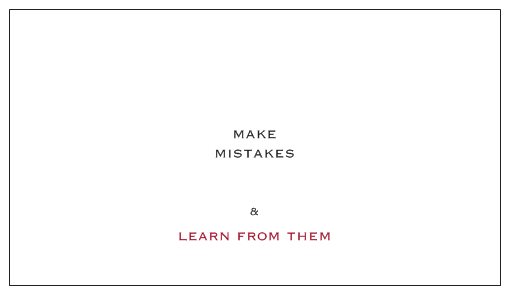
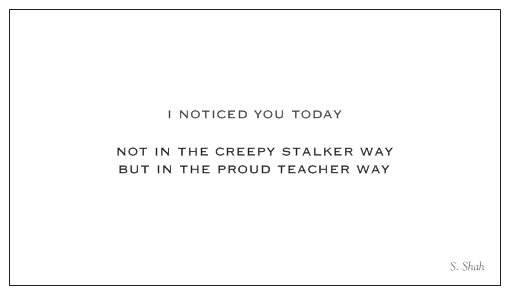
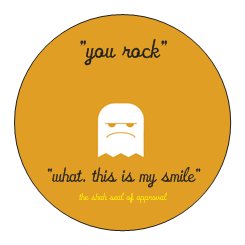
My favorite of the things I ordered were specially designed business cards. I ordered some fun ones for me to use when I’m out on the town, but I also designed some for me to carry around the school, in the classroom or outside the classroom. It’s definitely a novelty thing that will wear off, but I’m amused by them. Can you imagine being a kid and having a teacher sort of flick you a card as you’re leaving? Or just hand you one in the hallway? Or if you were being funny bad (but not seriously bad), have someone hand you one of these? The first card is more like a motto I want to instill in my kids, especially because I’m doing standards based grading.
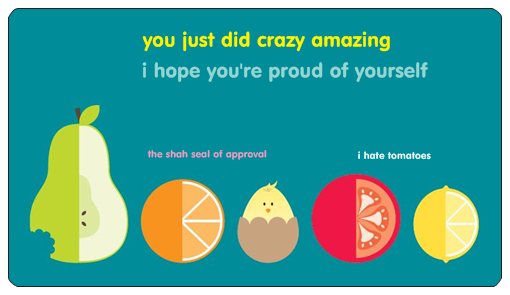
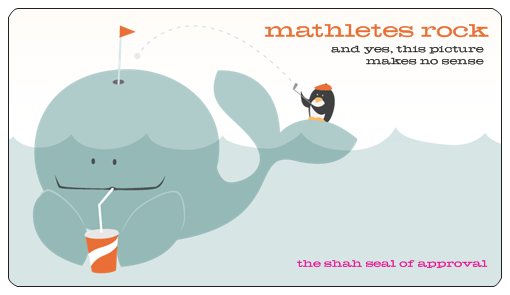
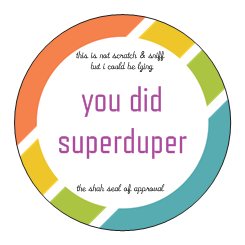
In order to get free shipping, I had to order more. So I designed stickers (I’m getting 24 of each sticker). I should say I had limited time to design them so they aren’t exactly the best things I could have come up with. But they’re good enough.
Now that I’m looking at these, I’m wondering if I couldn’t make better stickers which weren’t all about achievement. But maybe a sticker for someone who just bombed something… something to make them smile, and feel encouraged. Or for someone who clearly put a ton of effort into something even if they didn’t do superduper. Anyway, thoughts for the future.
I still had a little more money to spend for my free shipping, so I also ordered 10 cards (the outside, then the inside).
The card is not my favorite, because I could have done a much better job and come up with a much better concept if I had more time. But here’s the thing. I always keep blank fancy cards at my desk to write thank you notes to people who have helped me out in small and large ways. Unfortunately, I forget I have them, so it hasn’t become normalized behavior. But since I will have fancy personalized cards, I think I will be more excited to use them and so I have high hopes this could become a thing that I do, instead of just intend on doing.
I hate having to wait to see how all this merchandise looks (it’s going to take up to two weeks to get to me!), but I’m uber excited about it.
As for costs, I had a groupon that cost $20 for $80 worth of merchandise. But for some reason, I had $10 off my groupon. I also had to order an extra $25 for free shipping. So for all of this (I ordered eleven different business cards, even though I only showed a few here), I only ended up paying $35.
And with that, my first Made 4 Math Monday is out.
My session at the Twitter Math Camp conference was on designing a website for newbies who may have heard about the use of twitter and blogs for math teachers, and are intrigued enough to find out more. The website was supposed to have twin purposes:
To convince those who are on the fence to try out twittering, reading blogs, or writing blogs.
To make the entrance to our online community easier, with instructions and advice.
Lots and lots and lots of great ideas came up at the session… and then when I got home, I spent a day and a half creating a simple website, with the help of a lot of people, including @jacehan and @JamiDanielle, who worked on one of the most important pages of the site. Props to them!
Personally, I can see this site being used in a couple of different ways. If there’s a newbie who is interested, we can give ’em the site to help them get started. But also, if you are ever asked to give a talk about the math twitter blogosphere or how this community can be useful, this could be one of the resources for your talk!
Before you go off running to the site, I have one last important thing to say. There is a list of blogs and twitterers on the site, divided up by various categories. These are not comprehensive, nor were they meant to be! The point of the site is to make joining up easier, and providing lists of 30 blogs that deal with Algebra I or 45 twitterers who teach middle school math is totally overwhelming. So if you’re on the lists and wrongly categorized, just let me know in the comments to this post! And if you’re not on the lists and want to me, throw your info in the comments below (including what lists you think you belong in) and I’ll see about adding you. (But no promises.)
With that said, without further ado:
(drumroll please)
PS. I’m not looking for advice on how to expand the site, or ideas for changes to the site, right now. I’m feeling a little burnt out. So if there are broken links or misspellings or something that is totally unclear, throw those in the comments most definitely! But otherwise, I’m going to wait a while before changing things…
I just got back from Twitter Math Camp (TMC), after an uneventful flight home, after a super eventful time in St. Louis.
I have a lot to say about the content of the conference itself (program of the sessions offered here), but I wanted to take some time to pound out my initial reflections about what I just experienced… which is something that transcended the content I was picking up. To begin, here’s a tweet from today, after we all said our final goodbyes and scattered to various modes of transportation.
Now to backtrack. The fuse of this conference was lit three years ago when the twitter world started exploding with math teachers from all over, who couldn’t not think about math instruction at all times of the day (and night). Okay, maybe not exploding, but there were a ton of blogging math teachers who decided to start communicating in a more real-time way, and three years ago I started seeing twitter become saturated in a way that cool things were resulting organically. A sustainable, supportive community was forming (complete with inside jokes). One ongoing joke was about us hosting a “conference” on a cruise ship… so we could have a vacation and have it paid for by our schools as professional development.
Sarah_IC@druinok Twitter cruise would be fabulous. I’ve learned so much from all of you!
jreulbach@druinok Why isn’t NCTM doing THAT? conference on a cruise. I am so in! [0]
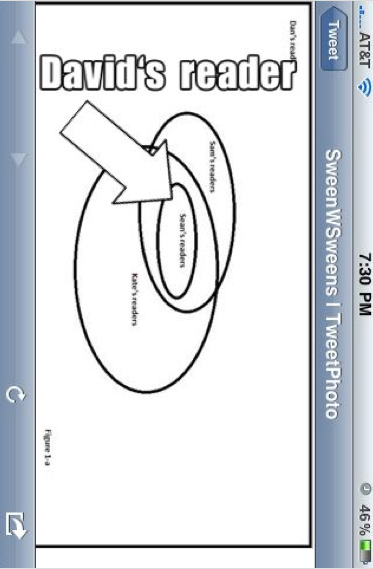
And then this joke became a reality of sorts [1]. And a few months ago, some of us decided to actually do it — have an official meet up, instead of the informal meetups that were happening when one or another of us was visiting friends in San Francisco, or driving through New York, and getting coffee with each other (and hoping that the person we were meeting wasn’t a krazypsychokiller).
So, through the hard work of a lot of people, and the spearheading of two lead organizers, an actual conference came together. It started out, at least in my mind, with the idea that we might be able to get a dozen people together for some fun and informal teacher talk. And initially, that’s what happened. A few hardcore people signed up. And then more. And then more. I remember checking the registration list and being surprised when we hit 20. And, to cut a long story short, when registration closed, we had 40 people from the US and Canada all flying and driving to St. Louis for our first Twitter Math Camp conference.
How did this happen?, I wondered. I mean, most of the participants were coming from public schools and many weren’t getting a lot (or any) funding. So, even with sharing a hotel room and assuming basic transportation costs, it was going to run more than $500. It was in the middle of the summer, which meant that a lot of people had to leave their families (some leaving their kids for more time than they ever have before! 5 days!). And most participants had never met each other in real life.
But the fact that so many people decided to come (and others were insanely jealous because they couldn’t come) is a testament to what we have done in the past couple years. We’ve formed a group that has become more than a professional development tool, more than just a way to get this or that resource or steal this or that idea. It’s a close-knit community of people who care about each other.@sophgermainsaid it well:
I did write a crappy little blog. Then Dan read it, then Dan posted about it. Then I started twitter stalking all of you. I said a couple things and feigned shyness for about a week. (It does not come naturally to me, i.e. I am inclined towards being obnoxious.) Then I just started talking and you talked back. And I was part of something. I was part of a community. […]
So I just wanted to take a moment and say even though I wasn’t there [at TMC]; you are the best. This community of people has made me a better teacher but more than that a better person. You have all helped formed my opinions on education and taught me how to be a teacher. You have reaffirmed my belief time and time again that there is no shortage in the world of hard working dedicated teachers.
Thank you for making me laugh, thank you for helping me find a job, thank you for reading my cover letters, lessons plans, resumes, and this crappy little blog. Thank you for helping me love my job. Thank you for being my real life friends. [ed note: underlining mine]
It is so clear to me that we have become this wide group of friends who have our real lives and virtual lives totally intertwined — where we have emotional (and not just professional) attachments with each other. You see, the core commonality among all of us is a passion for sucking a little bit less as teachers each year. And for those of us who have this passion, our lives are truly centered around our jobs. In other words, you can’t really know me without referencing me as a teacher. It gets to the core of who I am. So it’s no wonder that we all get each other.
Without a doubt, the conference was for and about becoming less sucky teachers. But as a virtual community, it was also a chance to change how we talk about each other.
Sample interaction before TMC12 (BTMC):
[Me laughing, while looking at my phone…]
NYC Friend: What’s so funny?
Me: Just something my friend said.
NYC Friend: Which friend?
Me: Um… you wouldn’t know them.
NYC Friend: Is this one of your stupid twitter friends?
Sample interaction after TMC12 (ATMC):
[Me laughing, while looking at my phone…]
NYC Friend: What’s so funny?
Me: Just something my friend said.
NYC Friend: Which friend?
Me: You wouldn’t know them.
NYC Friend: Is this another one of your stupid twitter friends?
Me: YES BUT I HAVE MET THEM IN REAL LIFE SO THEY ARE FRIENDS EVEN BY YOUR STUPID TWENTIETH CENTURY STANDARDS.
At the conference, we were connecting in ways we couldn’t connect online. For example, there’s this glorious picture of someone connecting with me:
(Just to be clear, this picture is not what it looks like. I can’t have my reputation sullied through a misreading of this picture. THIS WAS A JOKE. GEEZ. GET OVER IT.)
It was like we were on first dates, which felt our fiftieth-gazillion dates. Because we all KNEW each other. We knew about each others’s schools, kids, husbands/wives/bfs/gfs, movie and music preferences, deepest fears (SPIDERS!!!)… and still wanted to meet. I think the highest praise I can give is that the overwhelming feeling of nostalgia I had after leaving from this four day conference was greater than the nostalgia I had after leaving the amazing three-week PCMI conference.
Every session that I attended was great. (But of course the best session was the one I led!) I learned about interactive notebooks and foldables, about the concept of “flow” in the classroom and how to disrupt the hidden pedagogical contract that schools have with kids, and about teasing kids with motivating questions and problems. I was re-inspired to use geogebra in the classroom, and reconsidering the notion of what a flipped classroom might look light. And we had a lot of time to formally and informally share tricks of the trade. Whether it be how to get cheap giant whiteboards and use them effectively in the classroom, to saying “What questions do you have?” instead of “Any questions?”, to being consistent in asking a kid who says something disparaging to someone else say “two nice things about them… go!” and in asking a kid who says something disparaging about themselves to say “two nice things about yourself.”
This, in itself, is powerful. There were concrete and useful takeaways for my classroom practice. But what made it all the more powerful for me is that I was getting these ideas from teachers I knew personally and trusted. Everything was vetted. And anytime I need more information, or resources, or have questions, I can just send an email, tweet, or comment on a blog. And I can give back by sharing my experience with the things I take from others. Our community is dynamic and responsive and open to ideas and change, and we’re all on equal footing. And that only comes from us being friends. (And the fact of the matter is collaborating with friends is waaaay more fun than with colleagues-who-aren’t-friends… and who doesn’t need a lot of fun and smiles in their lives?)
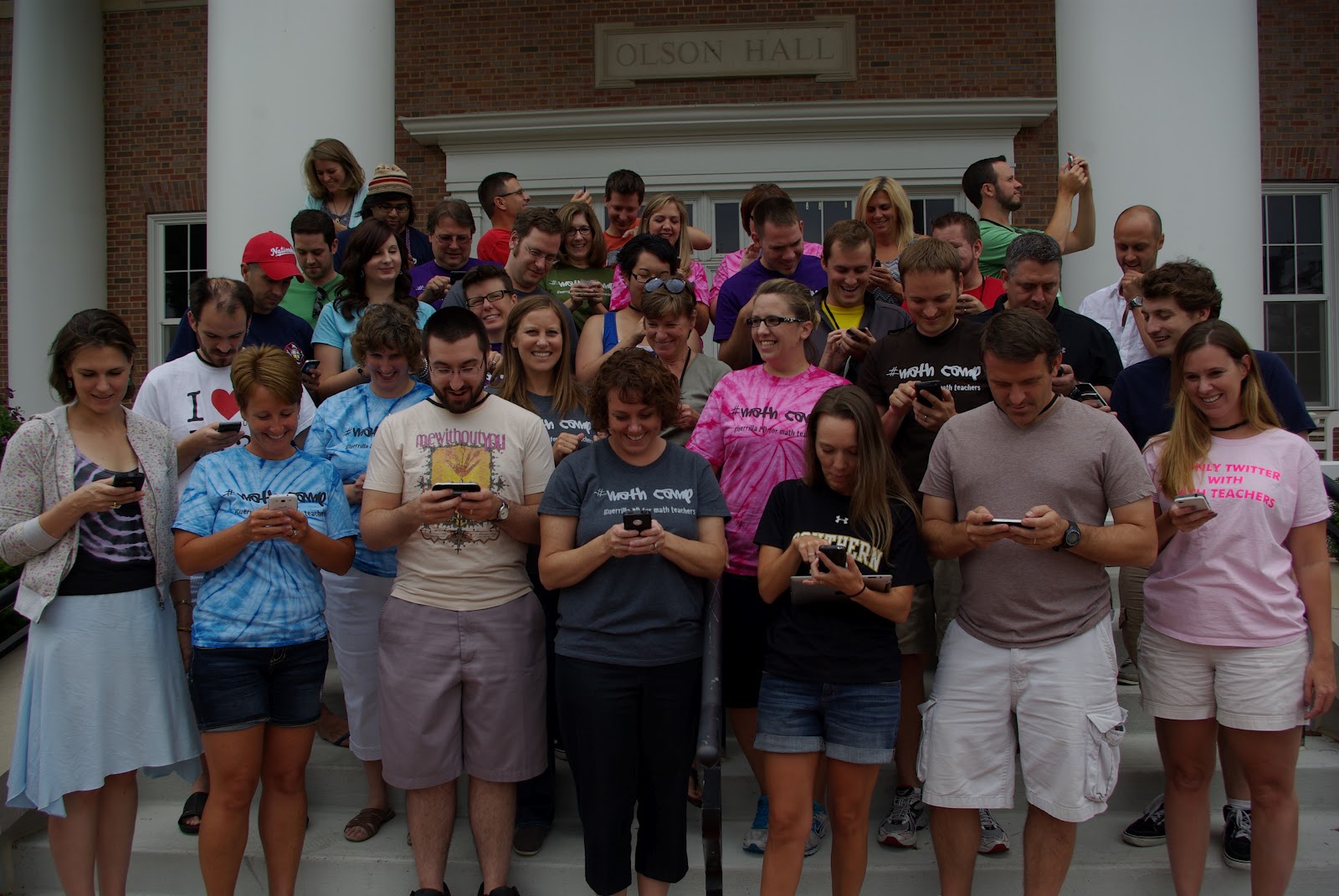
But the sessions were only part of it, and I would argue, the less important part. We broke bread together while rehashing old memories together, as old friends do. If anyone felt that what we had wasn’t real, watching me give @approx_normal a piggyback ride at the Budweiser Brewery Tour, seeing @jreulbach excitedly show us and an entire movie theater how to cheerlead-dance before a showing of Magic Mike, seeing the almost English-teacher-level of hugging that was happening in the last few days [2], would change anyone’s mind.
My favorite thing at the conference was the laughter. It didn’t matter if you were going to a session, if you were in a group hanging out in a hotel room, if you were out for dinner, or if you were in the restroom alone — you were always surrounded by laughter. (Okay, maybe not the last one… creepy!) It was the nervous laughter of meeting for the first time, the giddy laughter of realizing the person you were anxious and intimidated about meeting was awesome, the snort-worthy laughter accompanying stories about teaching that only those in the trenches could get, the uncontrollable laughter when we all finally let our hair down and let our true personalities fly…
I’ll end with the collective work of some tweeps:
I sat alone in my class,
Hoping my students would pass,
Prepping was kicking my ass
But help was on the way
I started searching the net,
To find a way to connect
Found teachers I’d never met
and I was on my way
Dan’s blog was poppin’,
G-Reader, feed not stoppin’
Each day, I would drop-in
Guess it’s time for hop in!
Hey, I just found you,
And this is crazy,
But here’s my ID,
So tweet me, maybe?
It’s hard to reach out,
Please don’t flame me,
But here’s my ID,
So tweet me, maybe? x2
Oh holy crap can it be,
Nowak responded to me,
Blogging math celebrity,
She’s twitter royalty
I beg, and borrow and steal
No reinventing the wheel,
What are these urges I feel?
Nerdy math sex appeal
Hal-lo-ween was awesome
Dull worksheets,
I could toss ‘em
My i-deas could blossom
Now it’s time for Math Camp, baby!
Hey, I just met you, all in person.
Twitter Math Camp,
this was the first one
It’s hard to teach right,
in i-so-laaaaaation,
So here’s some PD,
just like va-ca-tion x2
Before I came onto your sites,
I must’ve taught so bad,
I must’ve taught so bad,
I must’ve taught so so bad
Before we came onto your sites
we must’ve taught so bad
and you should know that
It was so, so sad
I loved free pizza, and the brew-ry.
You know my ID,
So tweet me, maybe?
Ci-ty Muse-um, or the Card’s game,
So tweet me sometime,
I won’t be too lame
So, thank you Shelli,
thank you Li-sa.
Don’t want to go home – so glad to meet ya
Now that it’s coming to an end
we’ll miss you so bad
we’ll miss you so bad
I’ll miss you so, so bad
Before you came into our lives
I must’ve taught so bad
And you should know that.
So tweet us, maybe?
[0] Another, prior, conversation.
samjshah i’m jealous, all. can we plan to go to a conference together next yr? maybe we should just plan our OWN small conference abt blogging?
samjshah that last tweet was for everyone at NCTM and everyone else who is JEALOUS of them. im kinda serious about hosting a conference. NYC?
k8nowak@samjshah How about next Wednesday?! j/k. I think some prior coordination to invade a conference would be nice.
SweenWSweens@samjshah I’m in, got such an idea in October, but was waiting for more street cred to suggest it.
SweenWSweens@samjshah@k8nowak I see Kate’s idea and raise October Baltimore NCTM. Also, NYC is prolly too far north for them VA and NC peeps.
SweenWSweens@samjshah@k8nowak Any1 else close ? The Internet is so weird, everyone is so spread out. How do the tubes bring things so from so far away?
A response to Bowman’s post. Read other letters to new teachers which are cataloged here.
***
Dear person about to enter the classroom as a fulltimeteacher,
I love you. Okay, fine, not quite true — maybe respect, like, or lurve is more appropriate — but you have a passion for something and you’re following it. I don’t know if that passion is for the subject you teach, or for working with kids, or the deeply interesting intellectual puzzle of how to get someone to understand something, or for (in the booming Wizard of Oz voice) the Betterment of All Mankind. Regardless, this thing that brings you to the classroom is wonderful, because it puts you in the same ranks as those wonderful teachers that loom large in your past who inspired you and who helped you recognize that what they do has some worth. (Unfortunately, it also means you’ll probably have a bank account similar to those teachers. Sigh. Yeah, that will continue to suck, newteacher.)
Now some background on me. I was only a first year teacher once, at a school that is in all likelihood not your school. And my kids are are certainly not your kids. And all of this colors my thoughts. So take everything with a grain of salt, and I’d say if anything resonates with you in your gut, maybe that’s the thing that worth listening to. So you have some context, my school is an independent (read: private) school in Brooklyn. The class sizes are small (usually 12-16, rarely more), and the kids are fairly well-behaved. I have been here for five years, and it’s the only school I’ve known as a non-student-teacher teacher. Still, if this doesn’t sound similar to where you’re going to be starting and your gut tells you to stop reading, first: just for now, ignore what I said about going with your gut. Second, there are truisms for all schools and all students, which is why I have had so many awesome conversations with zillions of colleagues in all parts of the world in all sorts of schools.
Introductions over, and let more be added to the heap of unsolicited advice you’ve already gotten. There is something to be said for the fact that so many people are giving you unsolicited advice. Let’s talk about going out on your first date. It’s awkward and uncomfortable and when you tell your friends/parents/strangers/stuffed-animal you’re nervous, they all want to stroke your hair calm your nerves and tell you how they know everything is going to be alright. And then, to show you that they know everything is going to be alright, they’ll tell you some awkward and embarrassing story to make you feel better — because the hidden truth that they’re trying to say without saying it is: it won’t go at all the way you have pictured it a thousand times in your mind, and you’ll be too self-conscious, and the illusion of that perfect date will shatter. And they give you a ton of unsolicited advice. But they say this because they care, and because alright means you’ll survive. And you will. (And in case this wasn’t clear, that is what your first year will be like. It’s an analogysimile analogy-simile-metaphor-thingie.)
You: “How annoying! Yet another jerk telling me that the first year of teaching is going to be hard and is going to suck. Hooray, thanks for that.” But what I want to say is: everyone is saying the same thing, which means that everyone went through it, and everyone is saying it to you out of lurve because they totally want you to succeed. We all do. And we don’t even know you. So I’ve said it now officially. The first year of teaching is hard.
Unsolicited and Probably Unhealthy Tiny Piece of Advice #1: Work a lot.
It pays off. Seriously. The more time you put into your lesson planning, the better your lessons will be. The better your lessons will be, the more respect you’ll get from your students (and colleagues). I don’t know if this is healthy advice or not, but I’m giving it anyway. I remember working everyday until 9pm or 10pm each night. I thought that was normal. (I had three different courses to prepare for, and had very little material given to me, so I don’t know if I had much of a choice, honestly.) But it paid off with relatively good student behavior and a fairly productive classroom. I learned that students reserve respect for teachers who constantly demonstrate that they care about student learning. And there is no way to better demonstrate this care than by planning good classes. And more importantly, I had learned to create two curricula on my own. And there is almost nothing that will throw you into the deep end, and have you coming out of the other side stronger, than doing that. It was also super intellectually stimulating, and I thoroughly enjoyed doing it. The best part: the next year I had a lot less work to do because I had created some strong core materials, and I was able to stop working so late.
Of course I don’t want you to burn out, so find some balance. But push yourself, and recognize that it will pay off in the short-term and in the long term.
Unsolicited Tiny Piece of Advice #2: Be passionate, even when you’re not.
I don’t care if you’re teaching what you consider the most useless and boooooring topic in the universe (rational root theorem, anyone?). Go into class with a smile, with energy, and be excited about this really cool thing about polynomials. Fake it, if you can’t make it. One of the pieces of feedback that I continually get from students is that my passion and excitement for mathematics comes through, and some students even say it is infectious. Um, honestly, the quadratic formula or the y-intercept do not an excited Mr. Shah make. I mean I know these things and have for years… yawn. But your students don’t, and you can capitalize on that freshness!
And if you aren’t someone who is naturally good at showing excitement, one thing you can do: inflect your voice. Modulate it. If you don’t know what I mean: say “this is a really exciting sentence” in monotone. Then say it again but raising and lowering your pitch randomly. THIS IS HUGE (even if I called it a tiny piece of advice). It is the difference between having students hang onto your every work, and having students with their heads on their desks. At first, this faux passion might seem like you’re not being yourself. Get over yourself. You can be a better self, at least when teaching.
Unsolicited and Important Piece of Advice #3: Don’t make a mountain out of a molehill
If you’ve gotten this far, good on me! I figure now everything is solicited, because the browser tab is not closed. Anyway, I wrote more about this before, so read it. And actually, here’s a follow-up post.
Solicited and Important Piece of Advice #4: VENT
I wrote about this before too, but I’m going to copy and paste it here. I don’t know why I didn’t do that for #3, but I’m too lazy to fix it.
Okay, I think venting is one of the most important thing you can do as a new teacher. You’re going to be facing a lot of things and you’re going to get frustrated. With students, with administration, with other teachers. I mean, you have to keep it professional, but you should find a few trustworthy friends (preferably new-ish teachers) and complain your heart out.
Not conventional wisdom, I know. But one of the things that happens to first year teachers is that there are periods when you get dejected. You feel like you suck. Heck, you may even suck. (I feel that way all the time, and I totally crash and burn often enough.) And kids are getting to you. Maybe one in particular. And the pressure is building up. And your systems that you so carefully thought out aren’t working. The worst thing you can do is keep all this inside. It’ll start eating you up. You’ll start crashing and burning, and feeling trapped and alone.
The best thing you can do is VENT to some close friends. Because as soon as you say it aloud, it stops being your private shame. Think about it. When something bad happens, like you go to the mall and you try on pants and realize, oh! that size doesn’t fit you anymore. You can either internalize it, be ashamed, and go about your business obsessing over it. Or you can make a joke about it and tell your friend who you’re shopping with. (As long as your friend isn’t a judgmental jerk.) It stops being this horrible thing, and it just starts being this thing. Okay, not a terribly good analogy. But trust me on this: venting is healthy. Keeping things to yourself, going it alone, being afraid to talk about problems, is the foundation for failure, methinks.
(Just a caveat: vent with those you trust who aren’t judgmental jerks, and be somewhat professional when you vent.)
Completely Stolen Advice #5: Think About Why
Approximately Normal has advice for student teachers, which I think is superuberamazeballs… even though it is for student teachers, the ultimate message about understanding hidden norms in the classroom is key. And figuring out how to make your own (hidden) norms is important. You are cultivating an atmosphere, a small culture. You should think intentionally about the culture you want.
Observe, observe, observe. You might be thinking, “DUH…” but it’s more than that. If you begin student teaching after the first days of school, there are hidden norms in the classroom than an unobservant person might miss. Don’t think about what YOU’RE going to be doing for lunch, or after school, or the coming weekend. PAY ATTENTION TO EVERYTHING!!! How do students enter the class? Are they “bookin’ it” to get there on time or is it more like, “meh, whatevs – be thankful I showed up”. Does the MT have a “do now”/”bell activity”, but more importantly, WHAT KIND? How is it done? Is it review or a challenge to get them thinking? Is it multiple choice? Do kids start right away or socialize before it’s started and how do they complete it? What happens when students are late? What if a kid has to use the pencil sharpener? Is talking during class allowed? And if so, under what circumstances? How do kids let the MT know a bathroom/water break is needed? Are kids allowed to “zone out”? How does the teacher let kids know when they’re doing what he/she wants? Or more importantly, what he/she DOESN’T want? How does the lesson flow? Are there “brain breaks” for students to collaborate? If there is technology (calculators, voters, etc.) available to students, how is it distributed to the students and collected? What is the attitude with kids about learning? Is it engaging or the attitude “whatever – just tell me what to write down”? Do kids talk when the MT is talking? Are kids trying to sneak text? Do kids pack up before the bell rings? This is just a fraction of the things you need to look out for before it’s YOUR turn to take over.
So I said you should think about the culture you want in your classroom. The question you should have is how? And you know I can’t answer that. It’s so specific to your school and your kids. But I can tell you how you can answer that question. Find a couple teachers in your school that you look up to. Invite them out to coffee (on you! and let them get a pastry too, okay?) and ask them. They’ll let you know. Who can say no to coffee?
… because she broke the mold. (Bonus points, Kate? EXTRA CREDIT?)
You want to be amazing all the time. You have a crush on Shawn, Bowman, Kate, Dan, whoever. You are a polyblogist. I get it. Me too. Me too.
But I want you to know that your lessons don’t all have to be interactive and flashy and you don’t need to do projects for every unit. People post their best stuff on blogs a lot, and you think they’re all amazing, but you don’t see what’s really going on in their classrooms. I’ve talked with enough bloggers to know that for most of us, we lecture a lot. I personally sometimes feel like a fraud because if people came into my classroom and saw what I did on a daily basis, it wouldn’t compute with what they read on the blog. Not because I’m trying to deceive, but most of what I do isn’t flashy or innovative. I probably lectured exclusively for the first three years of teaching. My sister (who is also a teacher, and is extraordinary at what she does) gave me some good advice whenever I would call her telling her how I felt like I didn’t measure up. “Go small, make baby steps. Decide you’re going to try to do one interactive thing in one of your classes each week.” I liked her philosophy of baby steps. Whenever I feel boring, I get out of my rut by actually making a small baby-step goal and doing it. It works.
Advice #8: Ignore the Echoing Voice
A kid says something offhanded. Mutters something under his or her breath. I remember in my first two years of teaching, I took everything personally. A student would say something, and it would bounce around in my head for hours. I can’t even tell you the number of nights I couldn’t fall asleep because my mind would wander back to this or that remark.
I don’t have a solution for you, if you experience this like I did. Ambien? For me, the only solution was time. After two years of teaching, I realized that almost everything that a kid said that I took personally was not about me. It took me a long time to grow a thick skin. It went hand in hand with my realization that being liked is not the same as being respected. And you can’t do nada in the classroom if you aren’t respected.
Important Advice #9: Be Consciously Building Your Reputation At School
You made it down here, which means you get my most shiny gems. Here is one of them. You want to be thinking very consciously about how you act in your first year.
I’m not only talking about how you teach in the classroom. I’m talking about everything else. Whether you think about it or not, everyone you work with (this includes maintenance staff!) is going to have to file you away in some category in their brains. Decide what you want to be known for, and then go for it. If you want to be considered reliable, then be don’t only do what’s asked of you but do a little bit more. If you want to be considered kindhearted, randomly bring in cookies for people — just because. If you want to be considered friendly, make sure to make eye contact with people when walking in the hallway and make a sincere “hello! how are you?” and then listen to the answer without interrupting and making it about you. (You jerk.)
In the classroom, if you want to be considered organized and prepared, have everything ready everyday you enter the room. If you want to be considered approachable, reach out to students early on. If you want to be considered funny, build jokes into your lesson (if you aren’t good off-the-cuff… I’m terrible off-the-cuff).
First impressions are important. Cultivate good impressions in your first year, and you will reap the rewards every year hence. (Did I just use the word “hence?” Thine brayne needs to reste soon, anon and all that.) Your reputation is all the capital you have at your school. That is so important that I will repeat and italicize that: your reputation is all the capital you have at your school. And it gets pretty firmly set in your first year.
I love what I do because I love what I do. But I also have come to love going to work each day because I have colleagues who have become friends, and we have so much fun twirling around in our chairs, singing Sound of Music, and laughing at all our daily mishaps and adventures.
My Final Advice Gem #10: You’re Going To Have Problems, Lots and Lots of Problems
I’m coming full circle year. I started out by saying teaching in your first year is hard. I noted that everyone who is going to give you advice is saying the same thing. People talk about “surviving” their first year, and then a couple years later, how they can’t imagine leaving the classroom.
What can you do to have a smooth first year?
Nothing.
Here’s why. In your first year, you’re going to be in reactive mode. You don’t know what the problems are going to be, so you can’t anticipate them and fix them. You don’t know if you’re going to have an issue with students not bringing pencils to class, or not doing their homework consistently, or cutting class, or whatever. You don’t know what problems to expect so you can’t prepare for them. You’ll be reacting. And I promise you that you’ll be asking everyone around you for help and advice and that is good.
But I can also promise you (okay, not like I’ll put money on it, because as I pointed out, I don’t have much, but you know what I’m saying) that your second year will go better, and your third year will be infinitely better. You won’t be reacting, but you’ll be proactive. You’re not only going to be able to anticipate the problems, but you also will have a repertoire of moves you can make to deal with them.
Conclusion
I’m not a gloom and doom type. I lurve you and all that, remember? I can honestly say that I thoroughly enjoyed my first year of teaching. I have hilarious memories of my classes and my kids. I remember when I was teaching my first 7th grade class and I held up a notebook as an example of what they should have for class, and I got three questions: “Does it have to be red?” “Does it have to be xx pages?” “Does it have to be from Staples?” How cute was that last question? But I who had never taught thought that my sweet 7th graders were mocking me! Ha! (They weren’t! They were just that clueless.) Or when the skylight in the hot small room my calculus class was crammed into had the sun shine on the bottom of the SmartBoard screen, and slowly crept up, making part of the SmartBoard unusable? That was fun, because each day we had a race with how much I could cover before I had to switch to the whiteboard. And the student who wanted to become a teacher, and did her final project creating and teaching a lesson in class. I have great memories. I also have some painful ones, which included taking a student into my office and yelling at him. I… I don’t yell, and I yelled at him how I cared about him but he didn’t care about himself, and that I didn’t know what else to do.
So not to pull a Dan Savage on you, but It Gets Better… even when you think it’s going well. And when it isn’t going well (and there will be times when you will feel dejected and like a failure), It (too) Gets Better.
Teaching rocks. You will rock.
Remember why you came to the classroom, because it’s easy to forget in the day-to-day. Let that guide you.
Lurve,
Sam Shah
Unsolicited Advice Giver and Unicorn Enthusiast
First off, I want to say that I took this wholesale from the North Carolina School of Science and Math. Thank you NCSSM. They have a conference each year on high school math, and each time I’ve gone, the speakers I’ve liked best are the actual teachers at the school. So any good things you might want to say about this, please don’t say them to me. This is the product of the hardworking teachers over there. So please, please check out the NCSSM project here. All I will be doing in this post is talking about how I coopted it for my classroom.
So the year came to a close in my calculus class. And in the last week, I wanted to try something new. And there was a confluence of things that led me to this.
I had students teach themselves how to find the area of two curves previously, when I was out sick, but then I didn’t do anything with it. I had also just seen an interesting piece on wealth inequality which piqued my interest. And I had heard of the Gini Index and the Lorenz curve before but had never pursued it seriously.
So here we are, the perfect time to go whole hog. And when doing my massive internet search, I came across NCSSM’s awesome activity and realized it was better than anything I could devise on my own. I really loved the scaffolding of the packet.
To start out class, I laid out the objective. I showed some photos from Occupy Wall Street. We read the protester’s posters aloud. And we focused on one of them: “This is not the world our parents wanted for us, nor the one we want for our kids.” I focused on that, because it implied that there was a difference in the world from the previous generation. The protester, and others, have been saying that the rich are getting richer while the rest of us are not. And my question to the class is: do you think this is true?
We talked about it generally, and I followed it up with a conversation about how we might decide if the distribution of wealth were different now than it was later. Students shared their thoughts in pairs, and they came up with some good ideas. Many pairs talked about making a histogram (wealth vs. number of people with that wealth). Others talked about comparing the top 5% with the bottom 5%. We shared our ideas as a class. I liked making them think about how one might decide this, because the answer is: there are many ways, but they all are going to involve math. We also talked about how we could compare one wealth distribution to another — and then we realized that it became tricky, fast.
I then had them make conjectures on the actual distribution of wealth in the US. And then I showed them the true answer. The true distribution shocked them.
The best part of the discussion was around what kids picked for “what they would like it to be.” We got to talk about capitalism and socialism and oligarchies. I made it really clear that I wasn’t here to make a case for one type of economic system or another. (Though some students had some strong opinions of their own.)
This initial prelude set up the remaining 2 days kids spent working on this. It gave them our overarching question (“Is income truly becoming more and more unequally distributed in the past 40 years? Or is it propaganda used by Occupy Wall Street protesters and sensational journalists?”) And off then went.
I basically made the most minor revisions to the NCSSM document and gave it to my class…
Each day, I had a goal that students had to reach, and if they didn’t they were asked to finish it at home. (At most, they only had 5 minutes of work each night. It was the last week of classes, and I wanted it to be more relaxed.) We talked at the start of each class, and I had them work in pairs. We had mini breaks/discussions to talk about big ideas. One of these included the trapezoidal rule. When introducing Riemann Sums a month or two prior, we only did them as left and right handed rectangles. But we saw how bad those approximations would be in this case where we only had 5 divisions… which necessitated the use of the trapezoidal rule. I didn’t teach my kids it, but they could do it. And some found a quicker formula to find the area, because they got sick of calculating all the areas of the trapezoids together. Huzzah! One student make a calculator program to calculate the Gini Index because it became tedious to do the calculations.
We ended the packet by just going through the US Gini Indexes for the last 40 years. We didn’t do the part asking for an investigation on other countries.
Results
We did this informally. I threw it together, I framed it in the context of Occupy Wall Street, and we went off. I didn’t collect formal feedback from my students on this (it was the last week), but I had a number of students individually let me know how much they liked it. A couple told me it was their favorite thing all year — and they loved that this had applications. One told me they spoke with an economist last summer and they were talking about economics and calculus, and the economist was talking about the Lorenz curve — but the student (at the time) didn’t understand it. I love that we could clear that up!
Also, I had two teachers observe my class the first day we started it, and I had them participate, and they said they enjoyed thinking about the questions and working on the packet.
Using This in the Future
I love the idea of using this in the future. I hope to do so next year, earlier in the year. I think I need to make the packet a little more conceptually deep, and ask some probing questions as we go along.
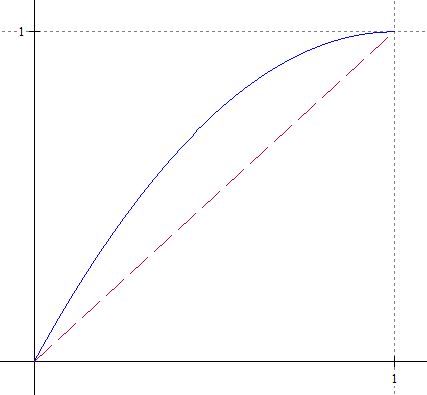
One type of probing question might be to ask students to draw figure out what a Lorenz curve looks like for the Gini Index to be 0 and what a Lorenz curve looks like for the Gini Index to be 1 (the packet just tells them that). Or to explain why the Lorenz curve cannot go above the line y=x. In other words, why it can’t look like:
I also think it could easily be extended to be a good poster project. One obvious idea is having students pick two countries, do a little research on them and come up with a hypothesis for which has more income inequality and justify it without mathematics. Then they would calculate the Gini Index for each. Finally they would make a poster showcasing their hypothesis and their findings.
Additionally, I could have each of them (after our in class work) read the section in the book on the Trapezoidal Rule, and make part of their poster explain this rule and how it works for any general function divided into N equally spaced rectangles. (Since I don’t formally teach it, nor do I think it needs to be formally taught.)
Alternatively, I could have students (especially since we analyzed a program which calculated Riemann Sums) see if they could come up with a program that would calculate the Gini Index.
As a personal note for next year: Oh yeah, I have to remember to make a distinction between wealth inequality and income inequality. I kept conflating the two, but they are very different and I need to make sure I get that across.
I gave my kids a google form to fill out with their thoughts on Standards Based Grading this year in calculus. My instinct is to interpret them for you before presenting them, but I’ll hold off. For context, I teach at an independent school where most kids are motivated to do well, partly because of internal motivation and partly because of grades for college. I teach the non-AP calculus course, which means I get a wide variety of students… from those who really really don’t like math but feel they need calculus on their transcripts to those who kinda like math (and maybe a few who really like math, but those are the exception). My calculus classes have on average 12 students in them. The students at my school do learn to speak up for themselves, so I think for the most part, the comments are probably fairly accurate representations of what they are thinking.
First, I asked what they felt about the grading system after the 1st quarter, and after the 3rd quarter. Then I asked about what they took away from it.
Then I asked for some numerical information on: how the grading philosophy worked, and if they collaborated outside of class more or less than other math classes. (Promoting a culture where I am not the sole authority in the classroom — and outside of the classroom — was important for me.)
Finally I asked for what they had to do differently in this class than in others, whether they think they would have done similarly if they had a traditional grading system, and what they think I should keep and what I should change.
In the first quarter, I wrote 64 reassessments
In the second quarter, I wrote 54 reassessments
In the third quarter, I wrote 55 reassessments
In the fourth quarter, I wrote 40 reassessments
… and compared to last year, things went so so so much more smoothly logistically. Writing the reassessments didn’t take as long, I felt the work I was putting in was paying off.
In any case, I could analyze things, but I’ve already done that in my mind. My conclusion: although not perfect, this was a wildly successful year for Standards Based Grading in calculus.
PS. As I always say to the students on the disciplinary committee I run, “we do the best we can with what we have, and then we move on.”
So it was the Old Math Dog who pointed out that I never wrote a post explaining how I deal with the issue of kids not knowing basic algebra in calculus. I started this practice two years ago (when I also started standards based grading) and I have seen a remarkable difference in how my classes go from my life pre-bootcamps to my life post-bootcamps…
An issue in any calculus course — and I don’t care if you’re talking about non-AP Calculus or AP Calculus — is the student’s algebra skills. They might see and have no idea how to solve that. Or they might not know how to find . Or they might cancel out the -1s in to get . It depends on where they are coming from, but I can pretty much guarantee you that every calculus teacher says the same thing to their classes on the first day:
Calculus is easy. Algebra is hard.
In my first three years of teaching calculus, I started with how all the books started, and all my calculus teacher friends started: a precalculus review. Then we went into limits.
The problem with that is that we might review some basic trigonometry, and then we wouldn’t see it again for months. And by then, they had forgotten it. And who could blame them. The precalculus review unit at the beginning of the course wasn’t working.
As I transitioned into Standards Based Grading, I looked at everything I taught really closely, and I honed in on the particular skills/concepts I was going to be testing. And since I’d taught calculus for a number of years prior, I knew exactly where the algebra sticking points were. Thus was born The Algebra Bootcamp.
Before our first unit on limits, I carefully analyzed what things I needed students to know to understand limits to the depth I required. I then looked at all the skills and thought of all the algebraic things, and all the old concepts, they would need in order to understand limits. And from that, I crafted an algebra bootcamp, and I made SBG skills out of just those limited skills.
For example, here was our first bootcamp (which, admittedly, was longer than most of the others, because we were settling in and I was gauging where the kids were at):
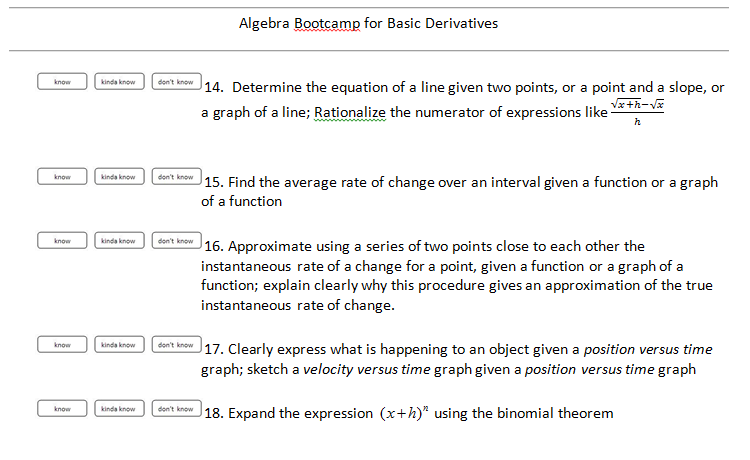
and I did the same for other units… just the targeted prior knowledge that they tended to not know or struggle with…
Notice how they tend to be very concrete and specific? Like “rationalize the numerator” (because I knew we were going to be doing that when using the formal definition of the derivative) or “expand using the binomial theorem. Very specific things that they should know that they are going to be using in the following unit. It’s kind of funny because it is a hodgepodge of little (and often unconnected) things, and they have no idea why we’re doing a lot of what we’re doing (why are we rationalizing the numerator? why are we doing the binomial theorem?) and I don’t tell them. I say “it’s our bootcamp… once training is over you’ll see why these tools are useful.”
It is called “bootcamp” because I am not reteaching it from scratch. I’m reviewing it, and I go through things quickly. I only do a few of them in the first quarter and maybe the start of the second quarter. By that point, we’ve done what we needed to do, and they die off.
The reason that this has been so effective for me is because students aren’t having to relearn old topics/algebraic skills while concurrently learning the ideas of calculus. We review these very specific things beforehand so that when we approach the calculus topics, the focus is not on the algebraic manipulation or remembering how to find the trig values of special angles or what a piecewise function is… but on the larger picture…. the calculus.
Remember: calculus is easy, it’s the algebra which is hard.
So we took care of the algebra beforehand, so we can see how easy calculus is.
My kids in the past two years have made so many fewer mistakes, and we’ve been able to really delve into the concepts more, because I’m no longer fielding questions like “could you review how to do X?” Doing this has also forced me to think about what the purpose of calculus class is. The more I teach it, the more I take the algebraic stuff out and the more I put the conceptual stuff in. For example, I don’t use , , and in my course anymore [1], because I wasn’t trying to test them on their knowledge of trigonometry. Doing these bootcamps coupled with standards based grading has forced me to keep my eye on what I really care about. Students deeply understanding the fundamental concepts of calculus. And I think you can do that without knowing how to integrate just fine. [2]
[1] With the exception of for the derivative of .
[2] I teach a non-AP calculus, so I have this luxury. But it’s nice. Each year I strip more and more stuff off the course and add in more and more depth. And I am glad that I understand depth to mean something other than “more complicated algebra in the same old calculus problems.”










 first dates, which felt our



 and have no idea how to solve that. Or they might not know how to find
  . Or they might cancel out the -1s in
  to get
  . It depends on where they are coming from, but I can pretty much guarantee you that every calculus teacher says the same thing to their classes on the first day: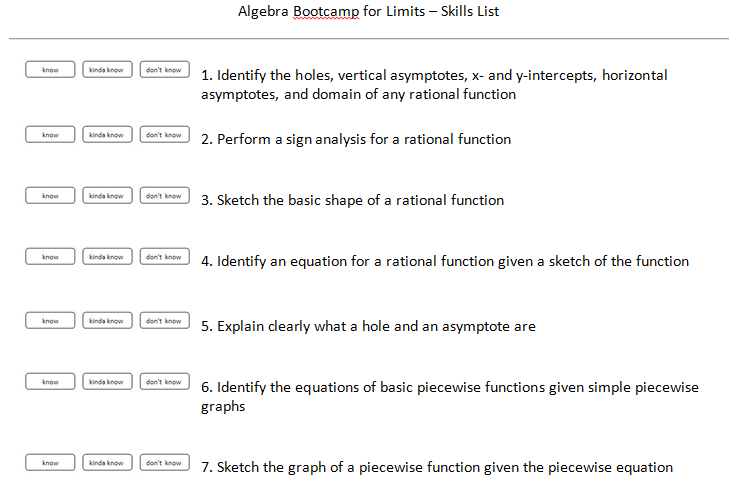
 using the binomial theorem. Very specific things that they should know that they are going to be using in the following unit. It’s kind of funny because it is a hodgepodge of little (and often unconnected) things, and they have no idea why we’re doing a lot of what we’re doing (why are we rationalizing the numerator? why are we doing the binomial theorem?) and I don’t tell them. I say “it’s our bootcamp… once training is over you’ll see why these tools are useful.”
 ,
,  , and
, and  in my course anymore [1], because I wasn’t trying to test them on their knowledge of trigonometry. Doing these bootcamps coupled with standards based grading has forced me to keep my eye on what I really care about. Students deeply understanding the fundamental concepts of calculus. And I think you can do that without knowing how to integrate
  just fine. [2]
 for the derivative of
  .
. Continuous Everywhere but Differentiable Nowhere