How Much and How Little: Exit Slips

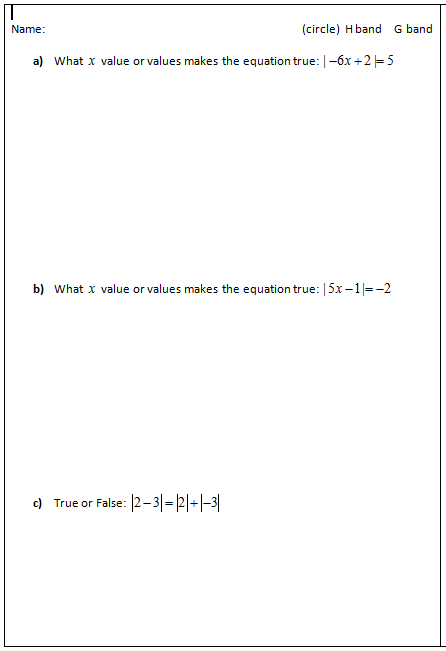
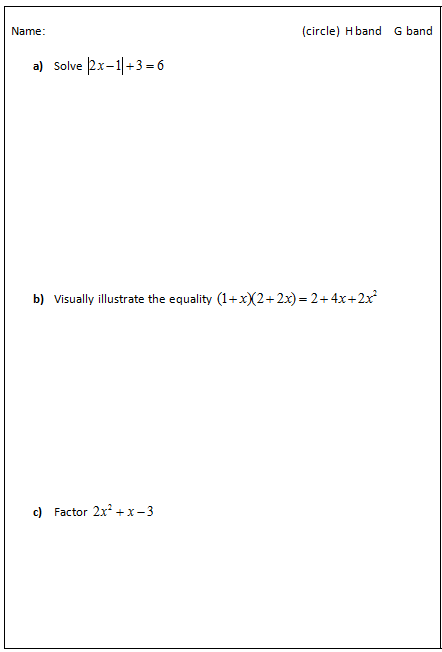
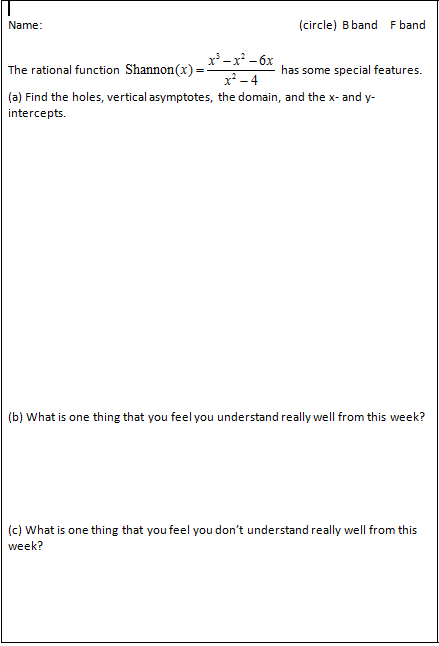
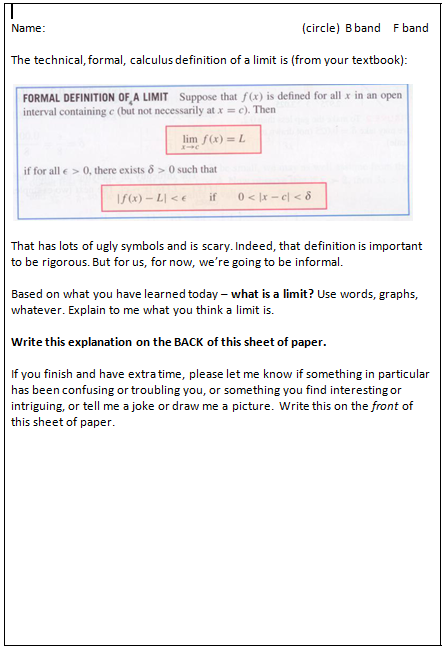
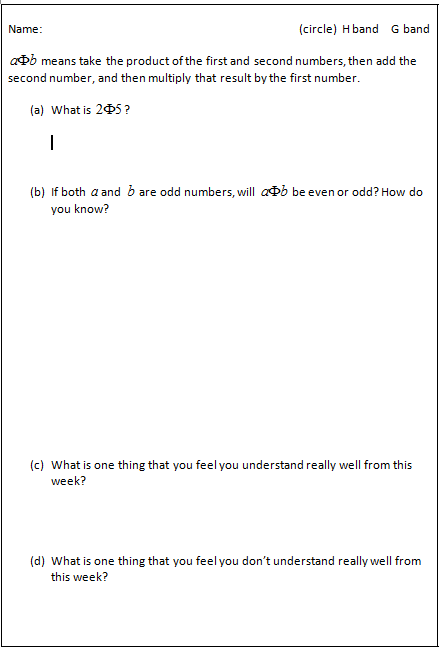
This year I’ve been trying to use “exit slips” at least once a week in my classes. They’re to let me know whatever I want to know. Do my kids have any questions? Did they take away what I hoped they’d take away from class? Can they actually solve a problem we were supposed to have mastered a couple days ago?

What they’ve really done for me is highlighted how little my kids learn — especially my tenth and eleventh graders — in class. And how much more time I need to build into my plans to have them practice problems and ask each other questions and, well, basically go through that time to struggle in front of me. Of course where that time will come from, I don’t know. But I need to find it.

But I’m amazed and horrified that I have never done this before. It’s the most eye-opening thing to be able to know exactly what your kids can do. And even when I felt like I did a bang up job in a class, and I thought my kids were getting it from walking around and watching them work, how there were a good number that didn’t. A good number that I wouldn’t be aware of before the summative assessment.

Anyway, I thought I’d share with you the exit slips I’ve used in my Algebra II and Calc classes. I repeat to my students that these aren’t a test in any way. They’re for ME to know what they’re understanding and what they’re not so I can better help them. And they’re for THEM to get a sense of how well they understand stuff we’ve done in class, so they know if they’re on top of the material or not. Plus I get to identify and address misconceptions, and also bad notation!

Without further ado:

Algebra II

Calculus

If you use exit slips, or something similar in your class, please throw down any tips you might have for what works for you — what kinds of questions you put on there, what are the types of questions to avoid, what specifically and concretely do you do with the information once you’ve gathered it, etc.?

Absolute Value

So I taught absolute value equations in Algebra II. And so far I think things have gone fairly well. I read Kate Nowak’s post on how she did absolute values, and I thought I would change my more traditional introduction to them… but I didn’t. I realized that the way Kate was motivating it (with the distance on the numberline model) was great, but I felt I could still get deep conceptual understanding with the traditional way she eschewed in her post.

So I stuck with that.

I used exit cards to see how they could do… and they were okay.

But after learning how to solve |2x-3|=5 or |2x-3|=-10, I asked kids to solve things like 2-5|5x+6|=5 or something similar. Many students said on their home enjoyment:

2-5(5x+6)=5 or 2-5(5x+6)=-5.

It is unsurprising to me, and yet, it makes me want to throw up. Because what’s coming more and more into focus, and I’m sure you’re going to hear me complain about this more and more in the coming months, is how reliant students are on “coming up with rules” and “applying rules” — without thinking. They desperately want unthinking rules. And this year, because I can’t handle throwing up all the time, I’m vowing to really not give rules to them.

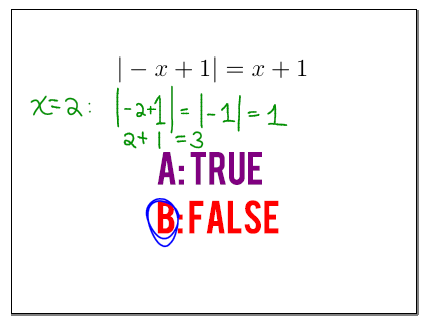
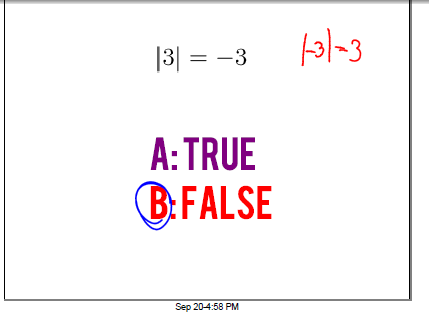
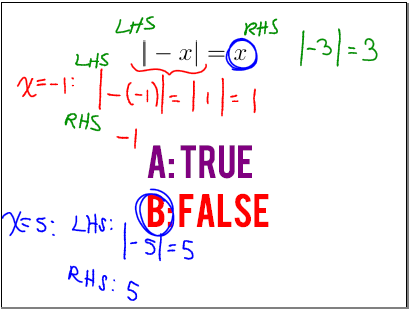
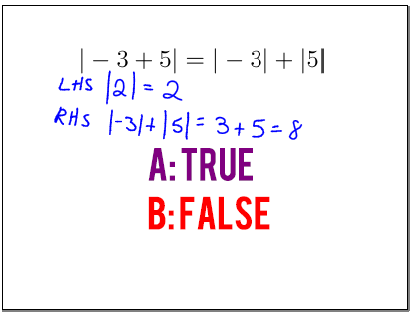
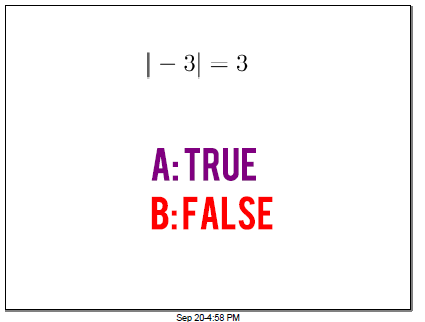
I really got to the heart of this “I LIKE PROCEDURES” thing with them with a true-false activity that I did, using my poor man clickers. I think this exercise highlighted how dependent my kids are on procedures and coming up with simple rules that help them in the short term… but that can hurt them in the long term… It’s a bunch of True-False questions. And when we talked about each one of them, my class saw concretely how reliant they were on misconceptions and false rules. EVERY SINGLE QUESTION led to a great short discussion.

So here they are, for you to use. Sadly, I don’t have the blank slides to share with you, because my school laptop is not with me at home now.

These were great for asking “so who wants to justify their answer?”

Putting ME First

This is a weird short note I’m going to be writing. It’s basically an apologia, and a defense, for my lack of posting in the first few weeks of school. This is PRIME time for posting, because this is the time we’re setting up routines, finding ways to create a rapport with our classes, and still excited about trying new things.

And yet, I’m not posting about it.

I wanted to tell you the reason why. For the past four years — since I’ve started teaching — I’ve put school first. In almost every aspect of my life. And I think it was necessary for me to come into my own as a teacher. That time… it was time well spent. My first year of teaching, I would work until 10pm or 11pm each night. It wasn’t healthy, but it was necessary. Looking back I’m surprised I didn’t burn out. But I was in love with designing lesson plans. And each year, there was something that would cause me to stay late and obsess over something or another. Even last year, when I was first starting out standards based grading in calculus, I recall staying at school until 8pm or 9pm on many nights, and it wasn’t months later that I figured out ways to streamline things to get me out of the building faster, and still serve the students well. The point is: I’ve devoted my life to teaching, at the expense of doing other things.

This year… at least this first quarter… I’m trying something new. I’m putting ME first.

(me at math prom on Saturday night)

I’m allowing myself to go out with friends on weeknights. I no longer am turning friends down for dinner because it’s a Wednesday. (Do you believe that I used to never go out on weekdays? Until this year it was so rare for me to accept an invitation to do anything on school nights.) I’ve gotten myself a theater subscription. I’m still reading up a storm. I’m reminding myself of the non-school-things that are a part of me! This is the year I can do it, because I’m teaching two preps (not my usual three) and both are classes I taught last year. Next year that’s bound to change. So I want to take advantage while I can.

I told my sister (teacher extraordinaire) this and she said she was so happy I made this decision. She told me she thought I was working myself silly, and she thought more than once in the past four years that I was going to burn myself out.

I also want to encourage y’all to make a similar pledge: to put yourselves first, before school. It’s something that’s made me so much happier, and also a better teacher. Because I’m constantly in a good mood. I don’t know how to describe it, but I feel happier. Things that used to annoy me, they still annoy me, but they roll off my back more easily. I have a better perspective on things, because I don’t have the time to obsess about the little things. And I know I have a dinner with friends, a gallery opening, a trivia night, a book reading, waiting for me at the end of the day.

The Problem That Never Fails

Hi.   I’m Anand Thakker, a teacher at the Park School of Baltimore.  Sam has been generous enough to invite me to make a guest post here, in honor of the new math teaching blog my colleagues and I are starting.   We’re psyched to be joining the conversation.

So, having dispensed with that bit of shameless self-promotion, I thought I’d share with you the problem that never fails.  This is the problem I used for my sample lesson when interviewing for jobs four years ago.  It’s the one I almost always use on the first day of class, and it’s also what I give to parents on back to school night.  Because… well… it. never. fails.  Seriously.

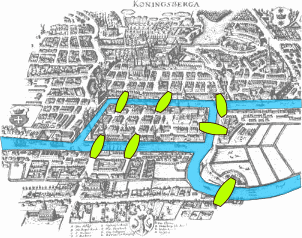
The perfect, ineffable jewel of a problem to which I refer is the classic Bridges of Konigsberg problem.   Here’s the story, in case you don’t know it:

(image from wikipedia) 

As shown in the image above, the town of Konigsberg once had seven bridges.  Back before some of these bridges were bombed during WWII, the residents of the town had a long-standing challenge: to walk through the town in such a way that you crossed each bridge exactly once—i.e., without missing any bridges, and without crossing any of them twice.

So, why is this problem so great for a high school classroom?  Well, first of all, whenever I tell this rather contrived tale to my students (or their parents, for that matter), they are inevitably scribbling on their scrap paper before I can even finish.  It’s a compelling puzzle, simple as that.

Before long, students have redrawn the thing enough times that they’re annoyed with all the extra time it takes to draw all the landmasses and bridges, and so they simplify it:

(image from wikipedia)

Voila: in a completely natural fashion, they have reduced the problem just like Euler did.  At this point, I usually bring them together for a moment to appreciate what’s going on here: reducing a problem to its essential components, finding the simplest way to represent the underlying structure of the situation.  (And I also mention to them that this is precisely the move that Euler made when he invented graph theory based on this initial problem.)  Even if they never went any further, this is already a nice lesson in problem solving.

[SPOILER ALERT: notes on the solution below the fold]

(more…)

Reports from the Front

So I’ve comfortably slid into the new year. I can’t say the transition has been all laughter and involves me skipping and trololo-ing. There’s an energy drain that comes when you have to be “on” all the time — and it’s no truer than at the start of the year. If you’re me, you’re on hyperdrive, being very purposeful in what you do and say, because you know that this is when you’re building your reputation with your class. (Just as kids are building their reputation with me, by what they do and say.) And that is the most important thing for me at the start of the year. I want them to see what I value, but enacting it.

Yesterday I had one of my favorite teaching moments. One of my students, who I happened to have taught in a previous year also, said when she arrived to class: “When I realized I had to leave for class I started singing I’m off to see the wizard, the wonderful wizard of Shah.” I heart my kids so much, because… well, I just do. They’re awesome. I promise if they come to me saying they don’t have a brain (“I am just not a math person”) that I will give them a brain (because isn’t that what wizards do?). I will also give them courage (pronounced coo-raj like the french) and confidence. At least I will try.

Our school mascot is the Pelican (ferocious! fierce! or not…) and I want to feel like this at the end of the year:

Honestly, I feel like I’ve been doing a pretty good job in some areas and a crusty job in others.

Rational Functions in Calculus

Example of a crusty job: In calculus I am teaching rational functions to prepare us for limits. I am really focusing on getting kids to understand why. In particular, I’ve been working on getting ’em to understand what a hole truly means, and what a horizontal asymptote means (and no, it is NOT a line a function gets closer and closer to but never touches) and why they might arise. The problem is that this sort of work is hard and takes time and my approach just wasn’t super effective. It was too me-centered, and I didn’t design a way for them to grapple and discover… instead I just kinda gave and explained, in the guise of student questioning.

Still I did get one amazing question which I have to type here so I can use this to provoke discussion and investigation in a class next year…

Why is it that holes appear at the x-value that makes the numerator and denominator of a rational function equal 0, but vertical asymptotes appear at the x-value that makes the numerator non-zero but the denominator 0?

And then to muck them up, after we come to some sort of understanding, I will ask a follow up question:

Graph f(x)=\frac{x}{x^2}. At x=0, you have f(0)=\frac{0}{0}. You’d expect that to be a hole, but … SHOCK! GASP! EGADS! … ’tis not. Explain.

(This came up in one of my classes, and it was precisely at that moment I realized how deep and complicated rational functions are, and how they are just blind algorithms to my kids. I hate that students use procedures and rules to memorize how to find x-intercepts, holes, horizontal asymptotes, etc… but that’s how we teach ’em so I shouldn’t expect any differently.)

I wonder if I asked students in AP Calculus BC to explain why f(x)=\frac{x^2-1}{x-1} has a hole at x=1, could they give a comprehensive answer that doesn’t rely on the fact that “a factor cancels from the top and bottom”? I’d bet not. That makes me sad. I don’t want to be sad.

This is good stuff. I could have introduced it and had my kids muck around with it in a more meaningful way.

The other hard thing that I’m finding, as I really really highlight why, is how much longer things take. I’m okay with it, because I’m not teaching to an AP exam. But it’s a change I have to get used to and honor, but that’s not going to be easy for me.

I have a couple great concept questions on tomorrow’s calculus assessment, so we’ll see if all our discussions about these things have actually made an impact on student learning.

WHY?

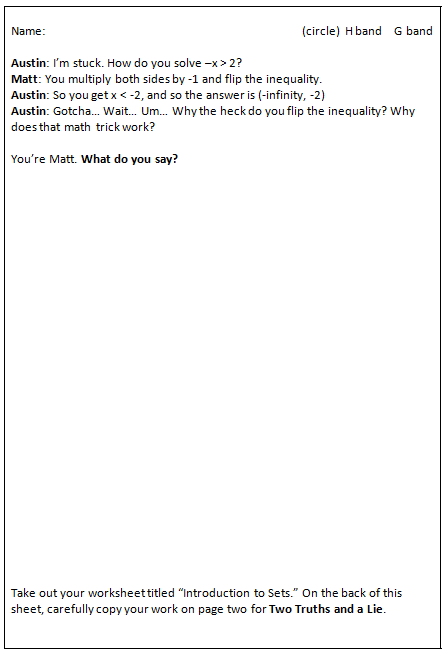
Today in one of my Algebra II classes, I used an exit card. We briefly went over why — when working with inequalities — you “flip the direction of the sign” when you multiply or divide by a negative number. I waited a day or two, and then I put the following on an exit slip for them to fill out at the end of class:

I am unsurprised by what I got back. About 1/3 of the kids said “you only switch the direction of the inequality when you divide by a negative number, so matt is wrong.” Almost all of the rest said “when you divide or multiply by a negative number you switch the direction of the inequality.” Only two actually got close to a meaningful solution.

So why am I unsurprised? Because this kind of explanation is new for them. They really haven’t been asked — at least not on a regular basis — to justify their reasoning. It’s a procedure. They “think” they understand it, but when probed, they don’t. Also, more importantly, I’ve realized they have no idea what the word “why” means in math. They think stating the rule is the why. It’s become clear to me in the past year that they don’t know that when I ask them why, I am not asking them for the rule but for the reason for the rule.

The great thing is: this was formative assessment. Without it, I wouldn’t have known that about 1/3 of the kids didn’t even fully know the “rule” for inequalities. And that those kids don’t see that multiplying by -1 is the same as dividing by -1. I also wouldn’t be able to talk specifically with them about what why means in math, and what a comprehensive explanation might look like.

Last year I put concept questions like this one on tests, but that was problematic. Kids usually did poorly on them, and they wouldn’t have a chance to really revise their response because their grade was fixed (I don’t do SBG in Algebra 2). So the feedback loop was stunted: kids saw their score on these kind of problems, they quickly read the comments, and never revisited it.

(I should also say that we did talk about these sorts of concept questions during the lessons too — they weren’t just sprung on them at the time of assessments.)

I’m in debate how to follow this up, after I have my in-class conversation with my kids. Right now I’m leaning towards making a graded take-home “paper” where students answer this question as comprehensively and clearly as they can. And if they want, after I comment on it, they can revise and resubmit. This closes the feedback loop. And I figure if I do this a few times early in the year, I’ll get dividends later on.

Emails! 

I always have my kids fill out an online google docs survey at the start of the year. It has logistics (e.g. do they have the book yet? what’s their graphing calculator’s serial number?), but it also asks them some questions about their thoughts on math, their hopes and fears, anything else they’d like me to know, whatever. It’s really useful because you get, with a few questions, exactly the things you need to know in order to start getting to know your kids as math learners (and as people, yadda yadda, blah blah).

In previous years I wrote special emails only to students who said things in their survey that I thought needed a response. Like a student sounding especially nervous about class, or who has a learning difference and wants me to know what sort of things work well for them. However, this year I decided to respond to all surveys. I have already done all my calculus students, and I hope this weekend to get my Algebra II students done too. It takes a surprisingly long time to do it, but I enjoy it. And I hope this is one of those small things that I do that shows these kids, who barely know me, that I care about them and that I’m going to be listening to what they say.

Integrity

Tomorrow is the first calculus assessment. It’s only a 20 minute thing (I’ll let ’em have 30 minutes though…). Beforehand, I’m going to talk with ’em about integrity. I tend to overplan things, but I want this to be a more spontaneous discussion that revolves around the ideas of respect and trust. So in opposition to my own inclinations to overthink this, I’m going to wing it in the hopes that it will be more powerful that way. Then I’m going to start ’em on the test, and leave the room for about 10 minutes. (I won’t be far, because we’ve been having lots of firedrills.)

And yes, like last year, I’m going to continue to have my kids sign these integrity statements. (And I even have another teacher doing it also!)

It’s not that I think it will stop cheating. But I do think that talking and reminding them about it semi-frequently, they at least know that integrity means a lot to me.

With that, I’m done. I’ve almost finished our first full 5-day week of school. Huzzah!
And So It Begins…

The year in full swing, and it feels like I’ve been teaching for days upon days, even though it has only been two days, so I suppose I should have said “day upon day.” It shocks me (BZZZ!) that a person can go from lazing about, jaunting off for coffee, picking up a book and reading it through in a day, watching an entire season of real housewives of (insertanycityhereandit’sprollytrueforme), going to the restroom whenever you please… to being trapped in a building (no AC!) with a hierarchy, having to answer to a lot of someone elses, having inhaled and not having the opportunity to exhale until hours later. And then you remember: oh yeah, I have to plan for the next day.

So it’s like I’ve never left. And I love it. There are things I cringe at, but heck if seeing my kids and my colleague friends, and getting to think about how I can do what I do but less sucky: it’s thrilling. I suspect this glow will be gone in a week, so don’t worry: my normal self will return soon enough.

Glow Self:

I just wanted to talk about the first two days of Algebra II. I usually start out the year with a honest but (upon reflection when I looked at it a few days ago) boring exhortation about mathematics and why it’s useful, beautiful, interesting. Then I talk a bit about the course expectations. And then we jump straight into talking about sets. I did it this way because I wanted to dive right in and show them what I valued: doing math. This wasn’t going to be a class where we get derailed with non-math things.

Well, I was unsatisfied with that, because it was boring. A boring set of slides with me speaking (albeit with a wildly inflecting voice, which can make anything less boring), followed by possibly the most boring topic: union and intersection of sets. It also was me lecturing about sets.

This year I vowed to take risks in how I teach. Less lecturing. Less partner work. More group work. More deep thinking and problem solving. And since I made a post saying some of the things I wanted to try, I decided to scrap everything and start anew.

I looked through the Park School of Baltimore’s curriculum and found a perfect thing to transition us into sets: mathematical symbols.

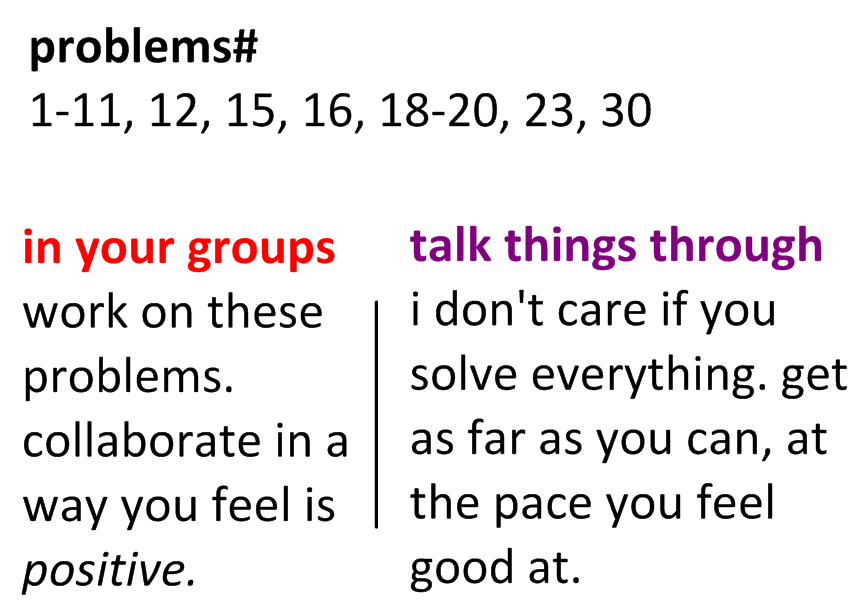
So on the first day, I sat kids down in their seats, I explained how they were to move their chairs to get in their groups. I asked them how they were feeling, I told them my goal was to make them feel good about math. Then, suddenly, I asked students to get in their groups. I projected the first page of the Park School packet that I photocopied. We did one part of one problem together (I had kids read the problem aloud and work in their groups to come up with the answer). Then I set them free, after handing out the packet, with only the following instructions.

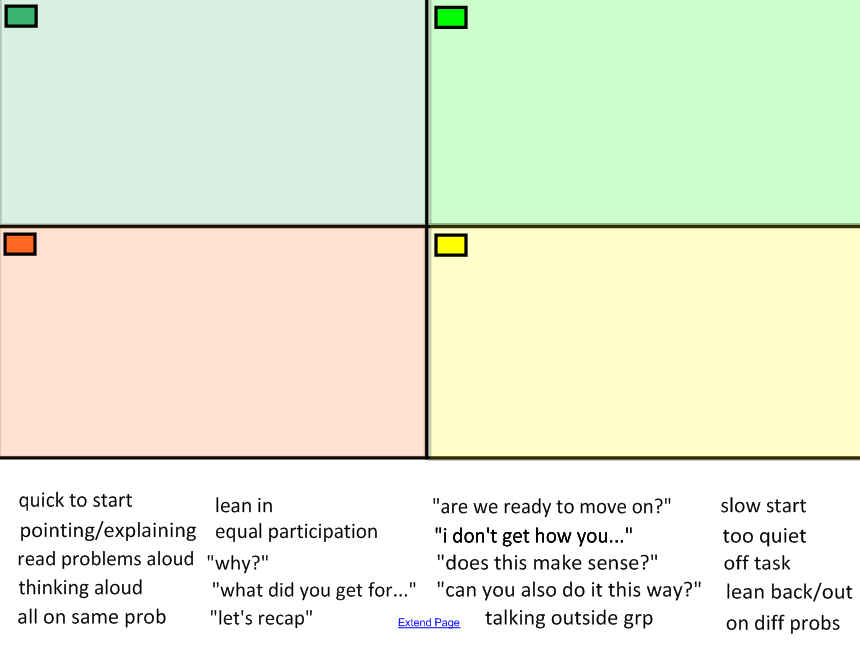
Then they started (some faster than others) and I went to the following SmartBoard page [update: here if you want to download it]…

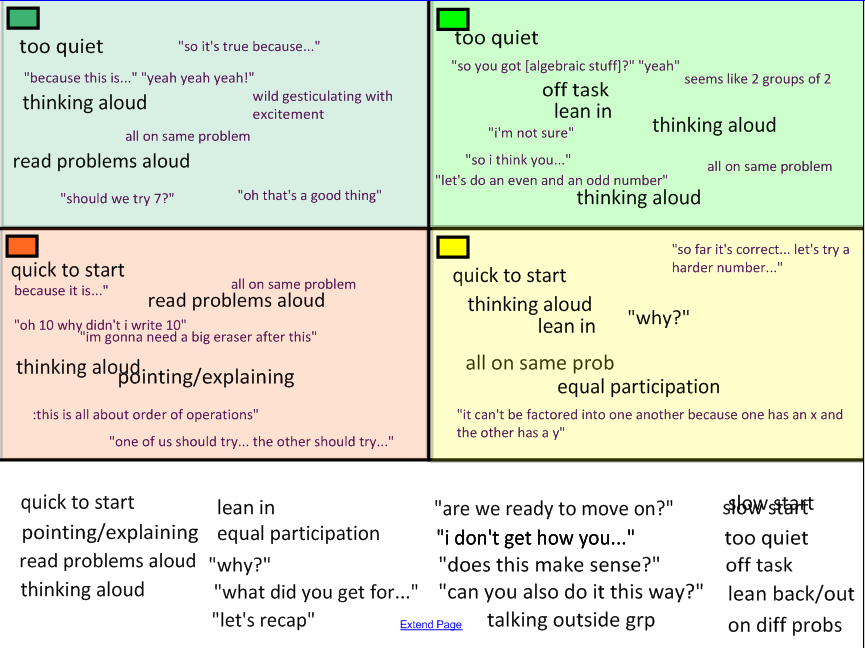
… and started the participation quiz (what I’m calling “groupwork feedback”). [To understand what comes next, you have to read the link above.] I didn’t explain anything. I just typed and dragged and typed and typed and walked around. Kids would ask me questions, and I would just shrug. They stopped asking me questions and started relying on each other and their brains. I didn’t stop groups which were off task. One group of four broke up into two groups of two, and then rejoined. I just kept on filling in the grid, not talking about it.

Honestly, the idea that I would have to be filling in this grid scared me. I didn’t know if I was going to be able to do it. I didn’t know if I would have the heart to put “off task” if a group were off task. I didn’t know if I could keep up, or if I could hear the kids talking, or keep track of everything. But it was easier than I thought. Students worked for about 30 minutes. I think that’s the right amount of time, because I wouldn’t have gotten a critical mass of feedback if they had worked any less.

Then I stopped them. What I noticed after doing it in two classes is that engaging in this type of observations of groups is super interesting and helpful for me. I had a good sense of which groups knew how to do groupwork already and which groups didn’t. I heard some great conversations, really great conversations, about some rich problems (“does it mean that the only way to get an odd number is with …”). I saw group dynamics at work (especially the difficulties that present themselves with groups of 4). I also saw that one of my two classes already has a good handle on how to work in groups, and the other is going to need some time and coaching.

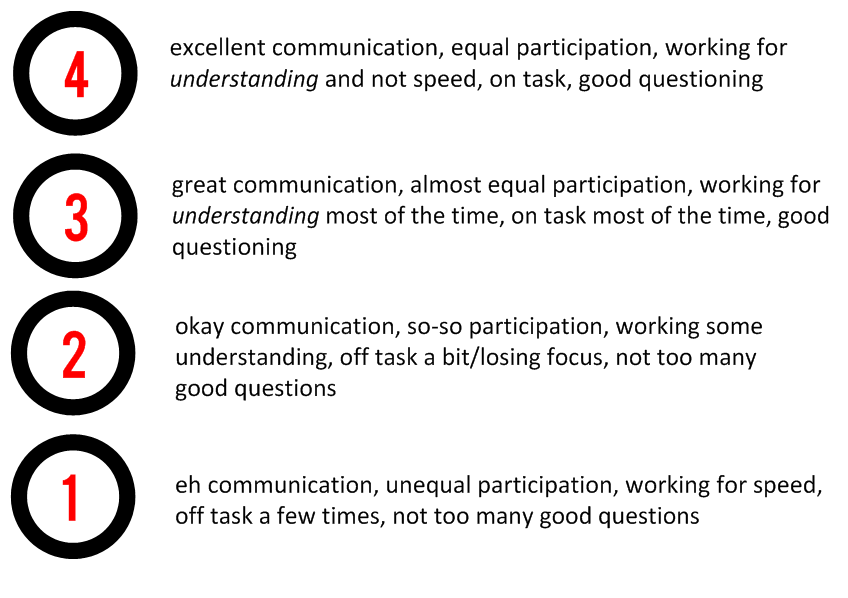
We spent 12 minutes talking about the results. We talked about if “I don’t know” is a good or bad thing to have on that chart (it depends…) and finally I asked groups to look at this thing that I whipped up (not great, but I needed something) and to classify themselves, and to think of some ways they could improve and think of some things they did well. And we went around and had each group explain.

Although terrifying, I’m glad I did it on the first day. It was scary to try something new (new problems! groupwork feedback!). I feel confident that I showed my kids what I hope to value in the classroom this year. Communication. True thinking. Independence. Collaboration in the learning process. (I don’t see the last two things as contradictory.)

That was the first day. Today (the second day) I saw only one of my classes. And what I did in it didn’t unfold nearly as well, in my opinion. I wanted kids to present their solutions. The night before I had them do a few more problems on their own, so I gave groups 8 minutes at the start of class to talk through their work, telling ’em that they were going to be asked to explain.

Then I had individual students come up and explain their work for some of the problems (after a short discussion on how it’s great to not get something and to have misconceptions / confusions, because that’s where we learn, and a discussion on how to be a good audience for the explainers).

They put their work up under the document projector. And talked. But what I learned is: I need to work on having students be effective presenters. And how to encourage the audience engage with the presenters more. And how to balance me intervening versus letting the student go on. (It’s hard for me to let go of the “explain” part of class.) So now I know I have to work on this. (Luckily I was meeting with my teacher friend mentor for lunch, who does a lot of modeling work in her classroom, and she had a lot of good things to suggest. )

So there we are. I’m trying to be very intentional (thanks @bowmanimal for the word) in how I start the year. I also printed out “exit slips” for my classes tomorrow because my goal is to get formative feedback at least once a week in each class. And I tried to do “What’s the Question?” (known in my class as “Que es la Pregunta?”) in Calculus to activate prior knowledge on rational functions. However it kinda totally fell flat. It did what it should have, but it wasn’t as enjoyable/fun as I hoped. I think I might need to rethink how I set it up.

And there you are. Some words on the first couple days of school.

The Clock, Counting Down

It’s Monday night and the first day of classes is Wednesday. I am teaching only two preps this year — the first time since I started teaching! I have a couple Algebra II classes and a couple Calculus classes. Also for the first time ever, I’m in a single classroom for all of my classes. It’s not a pretty classroom, really, and it is one of two rooms in the entire school with chalkboards (ugh! chalk!), but it’s mine! And I share it with another math teacher. So go me.

The past few days have gotten me to school, doing lots of logistical things. Like making minor revisions to my course expectations (here they are from two years ago, and not too much has changed) and my calculus SBG rubric (a 5-point scale, now, taken almost wholesale from @cheesemonkeysf), and photocopying them.

I made a few small changes to how I’m grading in calculus: now 80% of a student’s grade will be their SBG score, and 20% will be projects/problem sets/groupwork. Basically it’s an “other” category which will involve synthesis, problem solving, and less-routine-thinking. Although 20% might not seem like too much, I don’t have all these things lined up (I do plan on doing a lot of Bowman’s activities tho!), and I didn’t want to overwhelm myself this year by having to create all this new stuff. After much deliberation I decided not to grade homework, even though students last year clamored for it in their evaluations.

In Algebra II, the grading will be pretty much the same as in previous years, except we are integrating problem sets into the mix. So we are having 70% formal assessments, 10% binder checks, 10% home enjoyment (“homework”), and 10% problem sets. More about the problem sets as they develop, but I think they’re going to be heavily related to the habits of mind work that the Park School of Baltimore engages in. I honestly think that when their curriculum is finally published (I’ve gotten to see a bunch of it), it’s going to change how so many of us teach.

I figure I’d share a few concrete things I plan on doing throughout the year, with my emphasis on formative feedback, growth mindset, and habits of mind.

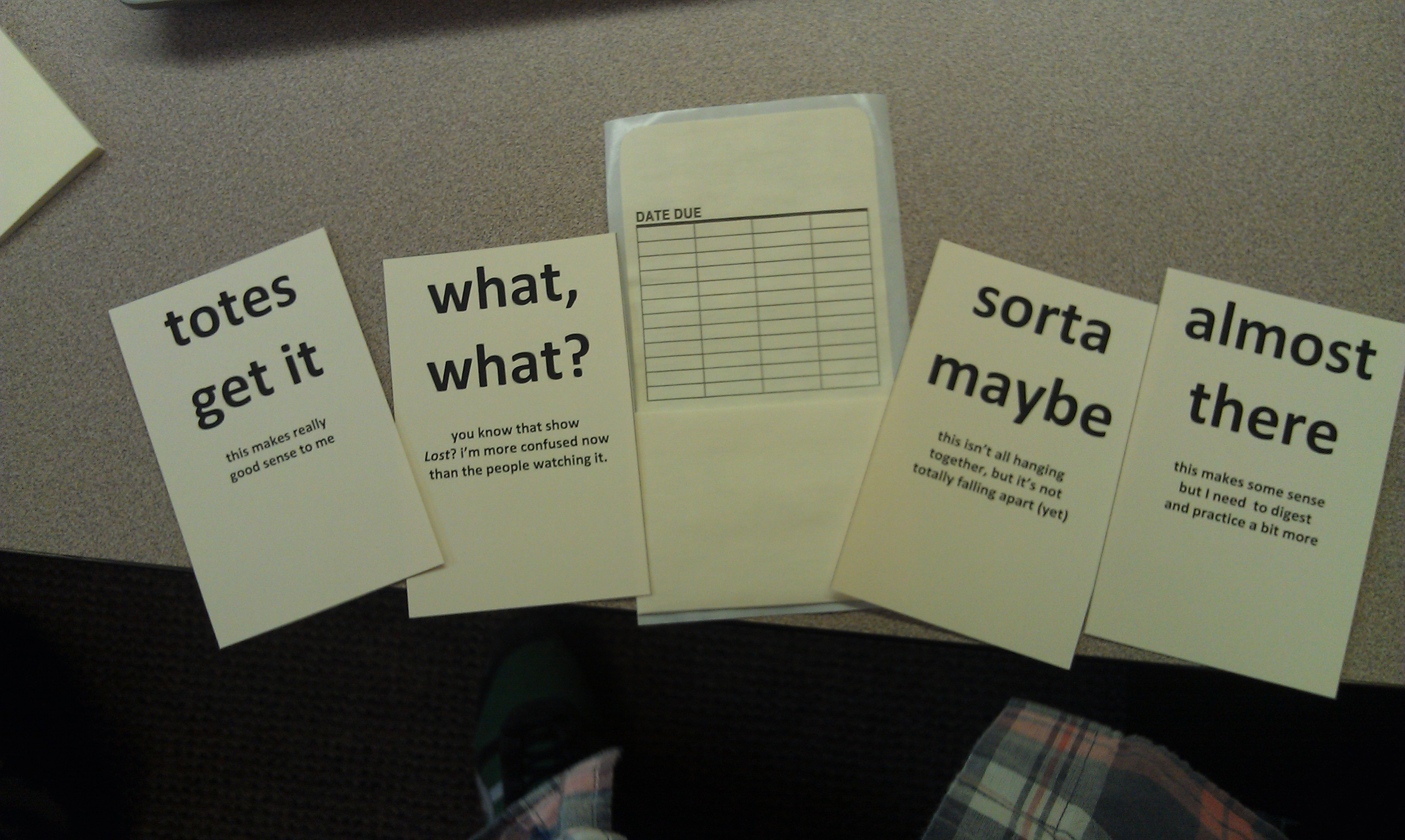
(1) To gauge where students are at, I created these pretty cards which I will use to get feedback and how kids are feeling about the material. So after maybe I have them do a sample problem, or do a think-pair-share, I’ll have ’em throw up a card to lemme know where they’re at — and from that I’ll know whether to move on, whether to switch partners for the remainder of the class (pairing someone who gets it with someone who doesn’t), or something else.

(2) But it would be crazy to have these cards, and not make them even more useful.

So these are the backs of the same cards. And so I can throw up a multiple choice question on the board, and have kids hold up their answers. Or anything that involves choices. If you’re going to do this, just know you shouldn’t write As on the backs of all the “totes get it” and Bs on the backs of all the “almost there” etc., because you don’t want anyone influenced by what other’s have up.

And yes, these were partially inspired by the fantastical Kate Nowak, and I’m really excited about them.

(3) @mythagon has an amazing way to get kids to start talking at the start of class: what’s the question? I can see it being really fun, get kids talking, and amazing for activating prior knowledge. I’m so doing this.

(4) Kate Nowak trying to instigate fights in her classroom by using good questions. I am going to try to instigate fights! FIIIIIIGGGGHHTTT!

(5) I have miniwhiteboards, but I’ve never really used them except occasionally and poorly in my seventh grade class in my first year of teaching. I want to use them, but want your advice on things that work. I was going to have kids do “check yo’self before you wreck yo’self” questions (math questions directly related to something we covered in class, right after we cover it in class) on them — and hold them up and I can walk around and see where we’re at. But there’s gotta be more and better uses.

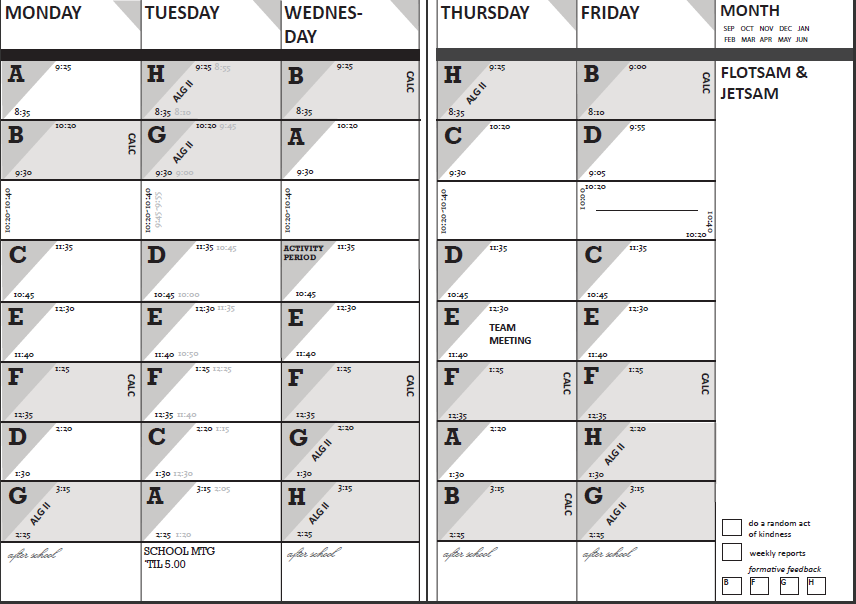
(6) I designed my planner (as I do every year) (and yes it’s beautiful and coveted by many)… and this year because of my emphasis on formative feedback, I made a small checkbox at the bottom which will help me see if at least once a week I either gave kids feedback (non-graded), or if I got (non-graded) feedback from my kids to help see where we go next.

(7) I hope to use exit slips this year at least once a week, either to check my kids’ understanding of the material we’ve been learning or to check in on my teaching. One idea I had was to have a coordinate plane, where the x-axis goes from booooring to engaging and the y-axis goes from no idea what’s going on to this is all coming up roses, and having kids mark down where they are.

(8) I historically tend not to do a lot of group work. Mainly partner work. This year I’m going to try to get more voices into the mix, and have students do things in 3s and 4s occasionally. But kids don’t know how to work in groups, and what it means to be working together effectively. And that’s because they’re not really taught. Which is why I love the idea of participation quizzes.

(9) I hope to put up a short agenda and a goal or two for the day, on the board, everyday. Where we go and what we do shouldn’t be a mystery. I always think it should — we’re unfurling mathematics, and in the unfurling we get the beauty — but that’s not how someone learning the material thinks or how they can organize information. They want a destination and to know how we’re getting there. I get that. When I’m in a class, I want that. I only want things unfurling in very special cases.

That’s about all I got for ya now. More to come as the year gets underway.