There is nothing worse than being sick…

… except for being sick for multiple days and through a long weekend. I got sick on Wednesday night, and it’s hung around me — not getting better and not getting worse — for days. I have taken two days off of school (luckily, since I teach mostly seniors and they are done with classes, I did not miss too much) and now I am in the middle of a three day weekend.

If I’m not cured by Tuesday, I’m going to freak out. Not because I don’t want to miss more school (there isn’t too much on my plate, believe it or not). It’s mainly because I can’t stand being sick. My eyes hurt so I can’t read. I am weak so I can’t do work. And I’m whiny, which is why I’m writing this blog post.

There’s another reason too. I want to let all of you out there know that there’s something I need to belatedly add to my “Singing the Praises of Kate Nowak” post. I want to add: she’s a good friend who helps you wallow in your own pity party. Yes, Kate read that I was sick on twitter. And she, from practically another state, had soup delivered to me. And it was from one of my favorite restaurants. An amazing surprise, from an amazing friend. Thank you.

I will make a list of the blog posts I want to write to help me remember these are things I should work on:

  • This year’s multivariable calculus projects
  • A post describing how I did SBG this year, along with the good, the bad, and the ugly.
  • Finish up the line of best fit series I haltingly start and stop
But if I don’t, it probably means I’m too tired and sick to do anything.

Senior Letter 2010-2011

Today was the last day of classes for the seniors. I had a fun day planned, where we spent most of the time laughing. I love laughing with these kids. This year has been a great year with the seniors and I’m still in the pnumbra of their glow. As it was the last day of class, I gave out my senior letters. (By the way, I love that @sarcasymptote is doing it too! I love that his kids cherish his letter, which is heartfelt and heartwarming. I don’t know if any of my kids cherish their letters in the same way his kids do — no one has ever mentioned them to me again — but I write it for me, not them.)

Now that I have handed them out, I can share with you this year’s letter. The message is always the same, every year, because when I think of what’s most important I can’t come up with anything more important: knowledge is awesome.

PS. I’m always super critical and I wrote and rewrote this dang thing like 4 times. And I’m still not totally happy with it. But it’s good enough for me, for now.

Nothing here nor there

This is a post with things neither here nor there. Mainly because I’m too tired to come up with something focused and comprehensive.

1. I’ve been cribbing a lot from Kate Nowak for my logarithm’s unit in Algebra II this year. I used her Log War cards again, to great success, and I cribbed one of her smartboards and converted it to a partner worksheet for kids to discover the log laws. So three cheers for Kate Nowak! I also had students read aloud @cheesemonkeySF’s translation of Napier’s introduction in class. So three cheers for @cheesemonkeySF and Napier!

2. I am feeling anxious about my senior letter this year. What am I going to say? I’ve started and deleted it twice.

3. I have had (and continue to have) a lot of social events on my calendar. This is not good considering all the work I have to get done.

4. I’m getting a little anxious about my multivariable calculus projects. I have 5 students to keep track of, and I don’t have a good sense of where a few of them are. I just sent out an email to the rest of the math department inviting them to join us for the project presentations/project share.

The Multivariable Calculus Class would like to formally invite you to hear about the work we’ve done this last quarter on our final projects. The students in this class have independently worked on:

1. Stu 1: Explaining foundational college level economics with a focus on utility functions
2. Stu 2: Building a model of a 3D hill-like function and using that model to teach some fundamental multivariable calculus topics
3. Stu 3: Building a beautiful origami sculpture (5 intersecting tetrahedra) and using multivariable calculus to figure out the optimal size of paper to use so the sculpture perfectly interlocks
4. Stu 4: Building a machine that can measure the area of any irregular (and regular!) figure — because it is enacting Green’s Theorem
5. Stu 5: Building a special instrument which does something special with sound (I am not saying more for the element of surprise) — an investigation which delves into physics, partial differential equations, and fourier series.

If you are free, we would love to have you join us as we share the projects we’ve worked on with each other.

Stu 1’s project will be presented on Monday, May 16th at the start of B band (9:30-10:20)
Stu 2’s and Stu 3’s projects will be presented on Wednesday, May 18th at the start of B band (8:35-9:25)
Stu 4’s and Stu 5’s projects will be presented on Friday, May 20th at the start of B band (8:10-9:00).

We are in the room S201.

Always our best,
Stu 1, Stu 2, Stu 3, Stu 4, Stu 5, Mr. Shah
The Multivariable Calculus Class

5. I am doing this summer program called the Klingenstein Summer Institute. Part of what we were asked to do is to videotape one of our classes. I did it, and I’m not going to watch it (they say not to). Right afterwards, I actually thought it went fairly well… although my timing was off, I felt the class was solid. Of course, we were asked to reflect upon the class. And the more I thought and parsed and analyzed, the more I came to the realization: the class wasn’t actually very good. It wasn’t bad, but it wasn’t very good.

They also asked me to email a headshot for a facebook they are compiling. I attached this gem from years ago.

That’s because in most of my photos, I look like:

so my selection is limited.

6. I am getting more and more excited about the second summer program I’m doing called the Park City Math Institute. I did it last year, and it was fantastic, times a million. I can’t recommend it highly enough.

7. I was told today that some kids in a senior homeroom were randomly singing my praises. Which made me melt a little. Okay, a lot.

8. I’ve been listening to this GLEE song on the way to school to wake up and get psyched for the day. I haven’t been sleeping a lot, so this is needed.

9. Today I went to a used book store that was going out of business and bought Volume 1 and Volume 2 of Polya’s Mathematics and Plausible Reasoning. Hardcover. Pristine condition. First printing. Beautiful. (I also bought a copy of Jude the Obscure and Surely You’re Joking, Mr. Feynman. I think I own both, but I love both. And they were only a few bucks.)

Two years later… the SFJC…

Today was our school’s activity award ceremony (not the academic award ceremony). I don’t enjoy talking in front of large groups of people (yeah teachers! who! hate! public! speaking!). When making any announcement in front of my school, I write it all out, and I read from my paper. I did the same thing for today’s activity awards — but I practiced it a few times so it didn’t sound totally robotic.

What did I give awards for? No, not for math club. (Another teacher did that.) I gave certificates of appreciation for the committee members on the student faculty judiciary committee. For two years, I served as a faculty representative on it. And this year (and next year), I am the faculty leader — in charge of it completely.

I wrote about it in 2008 when I first started, explaining what the committee does and why I decided to be a representative on it. In short, it has 8 students (2 elected representatives from each grade) and 3 faculty members on it. We meet whenever there is a violation of community standards. This can be academic integrity violations, disrespect to another member of the community, being late to school too many times, not signing out properly when leaving the building, or anything else. Every violation which is “serious enough” gets sent to us by the dean. There is no in house disciplinarian.

The most awesome thing is that the committee that deals with discipline is 8 elected students and 3 faculty members, and everyone only gets ONE VOTE. Although I might call the meeting to order, students are the ones who truly have the power.

For each incident that gets referred to us, the committee talks to the student involved. We try to understand exactly what happened, and we try to get the student to reflect about their actions in a broad way. Let’s be honest: it’s hard for teenagers (and even us, sometimes!) to think outside of themselves. And students questioning students about their actions, that can be powerful. We aren’t super confrontational (e.g. “how could you have done something so awful to someone else? WHAT WERE YOU THINKING?!”). Instead, we try to guide students to be more aware of their thought processes (e.g. “why might the school have a policy about lateness?” or “who was affected by your actions?”). Once we’re done talking with the student, we discuss what we’ve heard. We try to come up with a recommendation that will help students. What’s amazing is how lively and thoughtful our discussions are. We aim to have consensus, and very often we can find common ground and reach it. I love the fact that I’ve been swayed to think differently by a case by an argument a student puts forth. They have insights I don’t. (And sometimes, I offer a broader perspective that they might not have.) [1]

Let’s think about what being on the committee means if you’re a kid. You already don’t get a lot of sleep. You’re probably involved with a number of other clubs. And you’re asked, sometimes for a week or two in a row, to show up everyday 40 minutes before everyone else. This year, we’ve met over 30 times. (Some cases take more than one day.) Think about it. These kids are AH-MAZ-ING. They put in time to take on this really challenging leadership role. It’s draining. And because cases are confidential, their work isn’t very visible.

So I wrote a 2 minute speech which captured how I feel about them and their work. It originally was twice as long, and had a lot more specifics in it, but I had to cut it down.

My high school was very different than Packer. Let’s say you wanted to leave class to go to the restroom. You had to get an ugly, heavy hallway pass from the teacher. Part of a teacher’s job included roaming the hallway finding kids outside of class and saying “where’s your pass.” Honestly, it was a great high school. I loved it. But what I see at Packer, which wasn’t in my high school, is the great amount of trust that exists among adults and students in the Packer Community. The existence of the Student Faculty Judiciary Committee is emblematic of that trust.

So to me, the unsung heroes of Packer are the student members who serve on the SFJC. Although we try to be as transparent as possible, much of what we do is confidential – so you don’t get to see all that goes on behind the scenes.

In the hearings, your elected representatives ask the insightful question that often resonates with the person who appears before us. And when we deliberate, time and time again I am shown such thoughtfulness about the cases we hear, and empathy towards those who come before us. The committee members help others see the importance of acting with integrity. I feel strongly that these students should be recognized for their dedication, their thoughtfulness, and their infinite willingness to arrive at school early to listen to their classmates.

I will give you your certificates later, but right now please stand when I call your name. Hold your applause to the end.

[NAMES]

Please give these students a great round of applause.

(pause)

I would like to specially recognize the seniors on the committee – Student A and Student B. They have served on the committee for three years. That’s way too many donuts, and a lot before school meetings. I’ve seen them grow into two of the most thoughtful, empathetic, and passionate people I’ve known at Packer. As student chairs this year, they have modeled what a leader should be to the younger members on the committee. They have always acted with the utmost integrity, and in every case, they stand up for what they believe in. They are not quiet voices, and for that we are grateful. We are in a better school because of them, and I can’t imagine Packer without them next year.

Student A and Student B, thank you.

It has been a lot of long hours on my end this year. Running the committee is so much more work than I imagined when I agreed to take it on. And it also has shown me how hard it is to be a really good leader.

[1] To be clear, sometimes students come before us and we listen to what they say, and we believe that they didn’t actually violate any community standards. But when we do find someone clearly violated a rule or core value of the school, then we generate reflective questions and have thoughtful conversations.


Fundamental Theorem of Calculus

This is my 500th post. I started writing something off the cuff about where I was and how far I’ve come as a teacher since I started blogging (which is when I started teaching). But then I realized that in the past two years (I’ve been teaching for four), I’ve stagnated in my evolution, and I got all depressed and wrote something that would probably resonate some of you, but also that would elicit pity comments. And I those depress me more.

So instead (DEFLECTION ALERT!), I thought I’d post something I came up with last year to deal with the Fundamental Theorem of Calculus, Part I.

Although it is easy enough to tell kids “this is what is says, this is how you apply it” (and they can do it), what I have always had a problem with is explaining: this is what the FTC PT I means, and this is why it works. [1] The reason? It’s freakin’ scary! There are lots of variables being thrown around… I thought I posted it last year after writing it, but apparently I did not.

I came up with a guided worksheet that breaks down the ideas into individual pieces, and helps students work through it:

Excuse the fact that it keeps on referring to FTC Part II… I always conflate which is which.

Regardless, I was pleased at how much better my kids last year understood the theorem. They understood the idea of the dummy variable. And that the integral was simply giving an accumulated area from some starting value to some indefinite, variable value in the future.

I’m hopefully going to start this tomorrow, so keep your fingers crossed.

[1] The cop out way is to only explain: “it’s the derivative of an integral, and since they undo each other, you’re left with the original function.” I feel doing so elides the mechanics of what’s going on. It’s a surface-y (and useful to some degree) way to think about it, but it lacks depth.

Why I’m Useful

Sometimes I feel like I’m so hyper-into-teaching that it can be annoying to my colleagues. Like: they mention something to me (a program, a website) and about 95% of the time, I know about it. Annoying. Or I’ll be excited about something I’ve come up with and I’ll share it with then — and then I’ll be like “why am I geeking out about this?” and feel bad for geeking out on them. And sometimes when I don’t want to work, I will be like “hey, blah blah blah blah blah” and I’ll parasite my colleagues free time.

But I use some of my powers for good too. Sometimes I can troubleshoot tech questions. I love working on intractable math questions. And once in a blue moon, someone asks me how I might teach [X] — and then I really go crazy because that’s the type of question I love, and something I haven’t done in a while because I’ve been so busy with a billion other things.

All of that is to say: I can be useful.

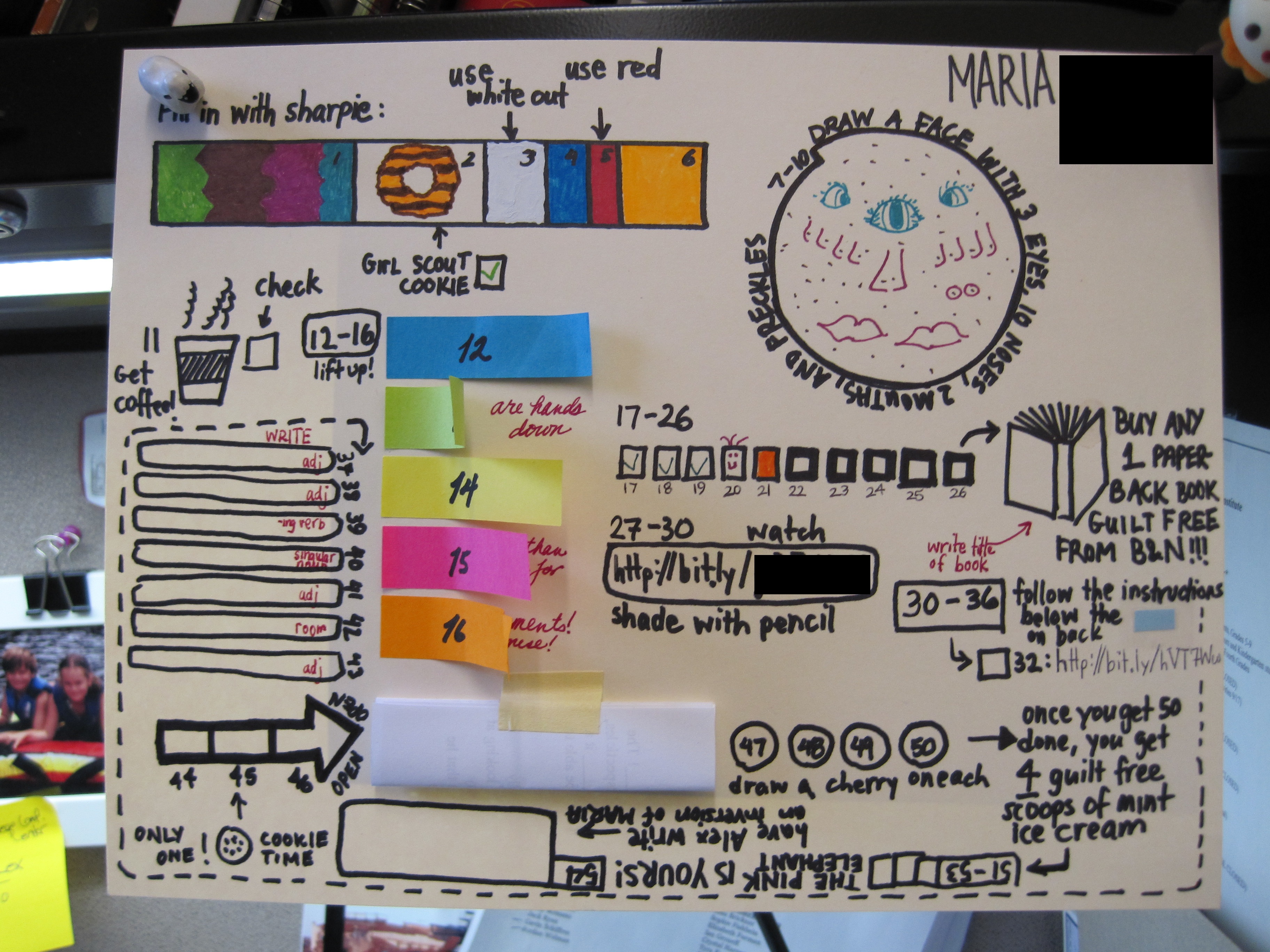
One of my favorite things I’ve done for one of my colleagues was during last week — comment time. We write narrative comments on each of our little angels, and it’s intensive and long, and my colleague had 64 kids to write on. She needed some motivation. So I made her this gem:

As she write more comments, she got to fill in more things — and every so often there was a surprise for her! (The last 10 comments, the home stretch of 55-64, were on a separate index card for her to fill out.) How fun as this to make? I am proud of it, and she said it helped her!

So there. I do kinda rock sometimes. I know it.

Geometry

On Friday, last period, I was giving a test in my calculus class. This week has been really l — o — o — oooooo — ong because we had to write and proof narrative comments on our kids. It’s consumed me for last weekend, and this whole week. So it felt good, on Friday, to be done.

I was antsy. Right before the last period, I saw another math teacher, and I told her I wish I were doing something other than proctoring a test. She said “we should switch! you should teach my geometry class!” At first, I was all like nooooooooo and that’s crazy but then I said “what’s the downside?” (I told her I could only do it for about 30 minutes because I wanted to field any questions my kids had.)

So I went. I taught geometry. I was teaching sectors and arc length. It was weird being in a new classroom, with kids I didn’t know. But it was that weirdness that was fun. I’d point to a kid in a blue shirt and say “hey you, blue shirt, what’s the …”

What was great was that I wasn’t really following a script. So I first showed them how to get the area of a circle if you know the circumference… this little trick:

Then I threw up three circles on the board, and I shaded in a 90 degree sector, a 120 degree sector, and a 212 degree sector. I asked them to find the areas of these pieces in partners. I told them I wasn’t giving them any help — so they have to use their brains.

They did that fine. A few struggled with the last one, but their partners helped. I then asked them to come up with a formula for the area of a sector with radius r and angle \theta. They did great!

Then I did the same with the arc length for the three circles. They used their knowledge (use the proportion of the whole circle!). Some partners came up with the formula first and then applied it to the circles, and some solved for the arc length of the circles and generalized it to the formula and saw the connection.

Finally, we re-wrote the general formula for both, and I said they should NOT memorize them. They should think about the logic we used to come up with them, and use that logic to come up with the formula.

It was fun to do this sort of impromptu teacher exchange. I think if we did this every so often (planned or unplanned) and the new teacher could just do a little strange song and dance, it could liven up a class. I’m pretty sure my kids would LOVE to get a new teacher for a day. It’s like an alternate reality for a day!

P.S. The math teachers had planned on switching classes on April Fools day, and start teaching without acknowledging any students’ comments or mentioning anything about it, but April 1st fell during Spring Break.