Singing the Praises of Kate Nowak

See Kate.

See Kate blog.

I have been given the great honor of writing our dear Ms. Nowak a letter of recommendation. One thing I wanted to do was talk about how Ms. Nowak is core node in our little learning community here. She writes, and tweets, and responds to emails. Indeed, she is our fairy blogmother.

I was hoping to enlist… I mean… coax a few of you to write a few sentences about Kate. Specifically how Kate has impacted you as a teacher — in a large way or a small way. Whether it be that she provided you with resources, great advice, gotten you started blogging, talked you through a dark time, showed you games that work splendiferously in your classroom, gave you the secret to perfect skin and eternal youth, kept you interested and excited in teaching, whatever. I’d love to include these in my letter, so that we may sing Her praises as She deserves them to be sung.

So throw them in the comments. This will probably be a temporary post, taken down after I have completed the letter of recommendation. So throw them in the comments soon! (HURRY HURRY HURRY!)

New Resume, New Year

I am applying for two programs this summer, the Park City Math Institute (again) and the Klingenstein Summer Institute. For these applications, one of the things I needed to do was revamp my resume. When I first applied for teaching jobs a few years ago, my resume was mainly academic stuff (e.g. college and grad school stuff). I hadn’t much experience (a couple years as a Teaching Assistant in grad school and my teaching practicum for certification in college).

Now I’m about to hit my four year mark of teaching (at the end of this year). And having things like “organized a conference on the interdisciplinary connections between history, sociology, philosophy, and science” doesn’t actually have much relevance to what I do. Cutting things out, and re-ordering and re-organizing everything, was a strange process for me. It was like I was saying hey you, yeah you, that part of your life is over! And it is. And I’ve known it for a while. My decimating my resume was just another instantiation of that.

Doing it also reminds me that I’ve actually accomplished a lot in three and a half years. It strange to think how far I’ve come, not only as a teacher, but as a member of my school’s community. I mean: hello, as I type this, I’m wearing my school’s logo-ed sweatpants. I never bothered to get a pair of sweatpants (or any logo-ed item) from UCLA when I was there. And I spent more time in LA than I have currently here. That says something.

Anyway, without further ado, my new resume:

Please, no “wow, you’re great” or “you have major mental issues” comments. You can make wording or formatting or font or design suggestions. In fact, they would be appreciated. Also if you know of any stunning teacher resumes (in terms of look/design) online, throw them in the comments if you can!

And yes, I know, I know, resumes suck and online portfolios rock. Which is why I have one which I semi-regularly update. It isn’t a “reflective portfolio” showcasing growth or anything like that. (That’s what this blog is for.) It’s just to remind me of the good stuff I’ve done.

Math is not a spectator sport…

… so why do I teach it like it is?

My classroom is mainly me standing in front, talking. A typical day goes like this:

Me: Check your home enjoyment answers with the answers on the board. Be sure to correct your work, and talk with your partner if you get something wrong but you don’t know why it’s wrong.

[Hand raised, and I walk over there: Hello child. What’s going on? Oh you want help? Did you ask your partner? No? Oh. Okay. Bye.]

Me: Okay, are there any questions?

[A couple minutes pass when we go over unresolved questions.]

Me: So today we’re going to build off of what we did yesterday…

Then I start teaching with a back and forth: me, student, me, student, me, student. Blarf. (I know, I know, I complain about this a lot, because it’s something I need to really work on. ) I usually introduce a new topic, ask a few questions, work through a sample problem with student input, and then have students work with their partners on a similar “check yo’self before you wreck yo’self” problem. Then we move on. [1]

I’m the authority in the classroom. The kids don’t see each other as authorities. Not really, not in any meaningful way. [2] That’s my fault. I don’t let them be authorities.

A couple weeks ago, in one of my Calculus classes and my only Algebra II class, I was ahead of schedule. So I introduced the material in the same sort of way, but then instead of me talking, us doing a problem, them doing a problem… me talking, us doing a problem, them doing a problem… I streamlined it. I talked and we did a few problems together, and then I let them at it. I give them their homework and let them start tearing through it.

I loved it. I mean, they were doing math. They were having trouble. But because they were in class, and not at home, they turned to their partners and talk. [3] I wasn’t the sole authority when they got stuck. They felt more comfortable talking with each other in this informal situation, instead of talking in The Big Scary Everyone Is Looking At Me back and forth we have when I introduce new material. And what I loved watching is that the kids themselves are seeing each other as authorities.

(They were simply happy that they get to actually spend time in class doing their homework.) (And I was happy they can have less on their plates for when they get home.)

Most of you out there are probably horrified that I’m just latching onto this idea now: give them time to work in class. Trust me. It’s not a new idea for me. I mean, obviously I always try to have my kids working independently in class. But I tell ya, it isn’t easy to do:

1) I suspect that most new teachers feel guilty letting kids work on homework or problems in class. They feel like they need to be “teaching” (which means: lecturing). I know when I first started teaching this was chronic. I would plan my 50 minutes to a T. (Whatever that means.) Even to this day I have remnants of that fear. A week ago, I gave my Calculus kids 20 minutes (out of 50) to work on their homework problems. Part of me still felt like I was doing something wrong. Like I was wasting valuable class time. Like I hadn’t prepared enough. Which wasn’t true. I had planned those 20 minutes. I have to catch myself.

2) More significantly, it’s hard to get through jam-packed curricula and have much class time to work on problems. I mean, let’s say you wanted to teach Absolute Value Inequalities in a single day. (Which, in some years, we have to do.) To get kids to the point they can work the problems, they either need:

a. 50 minutes talking through the concept and building their understanding so that they can conceptually understand the problems and the solutions, or
b. 25 minute lecture on the procedure to solve Absolute Value Inequality problems.

The first plan involves a lot of student thinking and discussion and a little doing. Mainly watching. Then the student will go home and practice problems with the knowledge they’ve gained from class. They’ll be alone at home struggling through if they run into problems. The second plan leads to a good amount of time for students to work out problems. But most wouldn’t know what’s going on — and they would memorize a bunch of rules. However they would get to work out problems in class, so that if they have trouble, they can find out what they’re doing wrong before they go home and struggle.

Clearly I tend to opt for the 1st. I could get through so much more if I dove straight for the method/procedure. But that’s not the way I roll.

I know this setup is a false dichotemy — plan a or plan b. There are probably lots of alternatives that I just haven’t yet seen.

My name is Sam and some days I feel I could be doing infinitely better at my job.

[1] Okay so this isn’t totally true. There are days where we deviate. But I’m illustrating a point here, so I’m going to gloss over nuances.

[2] Getting kids to see each other as authorities in the classroom was one of my goals this year. I feel like it has actually happened to some degree in calculus. My kids are helping the heck out of each other inside and outside of class. And I ask ’em to talk to each other before coming to talk to me.

[3] If they were at home, I’d hope that they use some of the strategies we talked about for when they get stuck. But I know that for many of them, it is wishful thinking. I’m trying to teach my students to be students. To learn how to learn well. But it’s hard and you can’t force it.

Cribbing

Recently I’ve been using some great resources that I’ve cribbed from you guys. I want to throw out there some kudos:

1. Kate Nowak for her Line Activity (modified for my class)

2. Maria Andersen’s Multiple Derivatives and Power Rule Format card activities (here)

3. Robert Talbert’s use of Wolfram Alpha to investigate the power rule in calculus.

And to give back. None of these are really special in any way, but I figure I’d share ’em in case you find them useful:

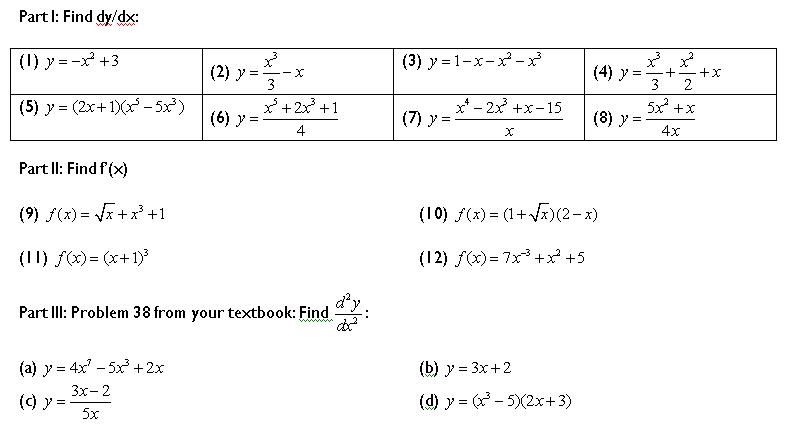
1.

A short but effective worksheet on getting students to realize the power of the power rule (pun!) — by applying our class motto take what you don’t know, and turn it into what you do know

You can probably see what this worksheet is trying to get students to do. We haven’t yet learned the product, quotient or chain rules. But heck if I have students who don’t recognize that \frac{x}{3} is the same as \frac{1}{3}x. Or that you can simplify \frac{3x-2}{5x} into \frac{3}{5}+\frac{2}{5}x^{-1}. This worksheet is meant to get my kids to see how they can simplify and use the power(ful) rule! As you can see, our class motto is coming through loud and clear: take what you don’t know, and turn it into what you do know.

2.

For those teaching lines in Algebra II, and think — “they’ve seen lines before! I want to just jump right in!” — here’s a review sheet I created which has worked well last year and this year. Nothing fancy, but practical.

3.

When having students first understand derivatives, I made this worksheet which they can do in class and finish out of class. It exploits this awesome calculus grapher:

It’s rather simple looking, but my kids loved the site. Also, the last page (of observations about the relationship between the function and it’s derivative) actually usually generates a really lively and interesting class discussion. I’ve tended to generate a class list of all observations on the board — no matter how obvious they might be. The point is: derivatives are rich fodder when students first encounter them.

Thanksgiving

Thanksgiving has passed, and I have been lucky enough to spend it with my sister in Massachusetts. On the way to Thanksgiving dinner, I whined “I hope this isn’t one of those places where everyone has to go around the table and say things they’re grateful for.” My sister grimmaced and said that she wouldn’t be surprised if it happened — she and her friends are those kind of folk. She then told me that I was a pretty unemotional person which explains why I kinda don’t like things like that.

I agree — halfway. I can be emotional, but I’m not one of those people who enjoys being mushy for tradition, or because it’s expected. I tend to find it grating when people say “I love you” or “you’re my best friend” to me a lot. If you have to say it that much, maybe there’s something about you that doesn’t mean it? Or maybe I’m simply standoffish.  [1]

That being said, I feel like I want to say some things I’m grateful for, probably precisely because I haven’t been asked to do it in some awkward social way. These are going to be teacher-based things.

1. First and foremost, I am grateful for my students. They are each coming to me from different places, and I’m sure they all have very different feelings about me, about math class, and about math. That’s okay, because that reminds me constantly that these math students are individuals. And just as I try to teach them about independence and responsibility (in addition to curricular content), they challenge me — by each being so different, with different strengths and weaknessess — to be a better teacher. I’m especially grateful for my Calculus students, who have given me their patience and faith as I’ve thrown them a curveball in their senior year: a new way of being assessed and graded, and to learn about their own learning strengths and weaknesses.

2. My colleagues — both IRL and not IRL. My “in real life” colleagues have become some of my closest friends, because they’ve seen me and supported me at my lowest lows. They’ve gladly provided help when I needed, taking over classes on days I had to be absent or making emergency photocopies for me when time got away from me. They let me vent when I need to. And they let me help them, which sounds like a weird thing to be thankful for. But I feel satisfaction and joy when I can help one of them out. My “not in real life” colleagues I thank for keeping me intellectually stimulated. Like the cosmic background radiation, you guys keep whirring away in the background of my mind – powerful and ever-reaching, yet whose effects are almost imperceptible until you start looking a little bit closer. Then you’d see the profound secondary effects that you have on everything I do.

3. My school. It’s awesome. There are times I get frustrated with this thing or that thing. But I like to see the big picture, and the big picture is this: I like being at school. Yes, it’s a job. But for me, it’s a job I love going to. I might not always agree with a policy, or think that we’re not going in the totally correct direction, or that this or that situation wasn’t handled well. That’s going to be true anywhere. But what’s nice is that I can speak up about my thoughts if I feel strongly about them, and I feel like I will be heard.

4. Things. The photocopy machine. So many of you have such horror stories with your inability to photocopy things that I have stopped taking our working machines for granted. File folders & binder clips. They. Complete. Me. Free coffee. For obvious reasons.

[1] Thankfully (haha), no one suggested that we state things we were thankful for, and by the end of the night, I was fast one-night friends with everyone at the dinner. They totes rocked.

Edublog Nominations

Drumrollllll please…

Here are my 2010 Edublog Award Nominations…  (my 2009 nominations are here)

Best individual blog: Shawn Cornally’s Think Thank Thunk

Shawn’s blog arrived on the scene in Februrary 2010, and has quickly won over the math teacher blog community. He’s a staple read. Why? Clearly he’s a compelling writer, with posts chock full of quotations inspiring enough to lift and emblazon on classroom banners. But it’s more than that — than the inspiration dripping from every post for the readers to hold out our cupped hands and collect. It’s that Shawn arrived on the scene with a simple philosophy about the classroom, and built a whole curricular and assessment-based regime around it. The philosophy is this: LET KIDS LEARN! GIVE THEM FREEDOM AND THEY WILL LEARN TO THRIVE. This philosophy lends itself perfectly to Standards Based Grading, and his work, coupled with Dan Meyer, Matt Townsley, and others, have led to a wholesale shift in the math edublog community. At the very least, spearheaded by Shawn, Standards Based Grading led to serious, questioning, and respectful conversations around the nature of assessments. And for some of us, it has led to a wholesale reorientation of how we view the classroom and how we think about learning. Did I mention that Shawn only started blogging in February 2010? His blog is a Tour de Force.

Best individual tweeter: David Cox / @dcox21

Reason: He’s always there, and his snarkiness is always on, ready to go! If you need any convincing, check out any of these “Favorite Tweet” posts. He also tweets about teaching.

Best new blog: Shawn Cornally’s Think Thank Thunk

Reasons: listed above

Best resource sharing blog: Mimi’s I Hope This Old Train Breaks Down

Reasons:  I don’t think Mimi gets the recognition she deserves. She has created countless amazing resources for her classroom, and shares them. These worksheets and activities are inspiring enough that… well, let me put it this way… she teaches Geometry, and I dread the day that I have to teach Geometry, but knowing I have Mimi’s stuff at hand makes me think teaching it could almost be fun.

Best teacher blog: Kate Nowak’s f(t)

Reasons: Kate is our Fairy Blogmother. Her blog doesn’t have a singlular focus, but that’s part of its charm. Kate blogs about whatever, and not knowing what’s coming next is part of the appeal. One post might be on special right triangles in dollar bills, and the next her trying to work through the muck and mire of Standards Based Grading. Kate also spends time drawing new people into the blogging community, and she even wrote a post on how to start a math teacher blog that I dare say spawned quite a few new faces in our expanding circle. Her blog is a perennial staple, read and admired by all.

Best use of a PLN: Riley Lark and his Conference on Soft Skills

Reason: Riley Lark created what I think is the first Virtual Conference for the online math teacher community. In general most of the posts that we write, and read, deal with curriculum — and how we get our kids to know it, and how we know they know it. Riley saw a gap in the conversations. We don’t talk about those other things we do as teachers to be effective: those things we do to connect with students so they know we’re there for them, and we want them to be there for us. The relationship building that goes on in the classroom… we all do it tacitly. He asked us to make explicit what we do implicitly. This conference started with 5 “speakers” and blossomed into 17 “speakers,” each writing with our own voice. Riley called upon our PLN and our PLN responded.

Lifetime achievement: Dan Meyer’s dy/dan

Reason: He’s part of the first generation of math teacher bloggers. His cause celebres have changed, but his overarching goal is the same: to get others to think about ways to engage students in the classroom. From focusing on design, to focusing on assessing, to focusing on his What Can You Do With This (WCYDWT) series, to focusing on pseudocontext, Dan has asked provocative questions since 2006. He asks teachers to re-look at what we’re teaching, and asks us to pique the curiosity of our students. Specifically, his mantra (though he has never put it this way) is don’t put the cart before the horse. Don’t teach the concept and the method of solution, without motivating the need for the concept. Grab your students’s curiosity by showing them they need a concept, so they want to learn the concept. And let me tell you, it is easier said than done… but Dan makes it look effortless. He has inspired the second wave of math teacher bloggers, which have since inspired the third wave. Yes, in online terms, 2006 – present is a lifetime.