Reading Math

My Algebra II kids don’t like to read the textbook. Heck, neither do my calculus students. This isn’t surprising. It’s extra work and it’s hard. My class also makes it hard for them, because I do not use the textbook as a skeletal structure for the course. I teach mainly out of my own materials, and use the book more as a supplement.

But that doesn’t mean that I don’t want them reading math. Kids are never taught to “read” a math textbook. If they ever do approach a math textbook, they approach it like a history book. The read it linearly. They also read it passively. Their eyes glaze over. They read words, but they don’t try to connect the words to the equations or pictures. They don’t read with a pencil in their hands. They hope for some Divine Knowledge to descend upon them simply by having the book open and their eyes on it.

That doesn’t work. We all know this. Reading math is an active thing.

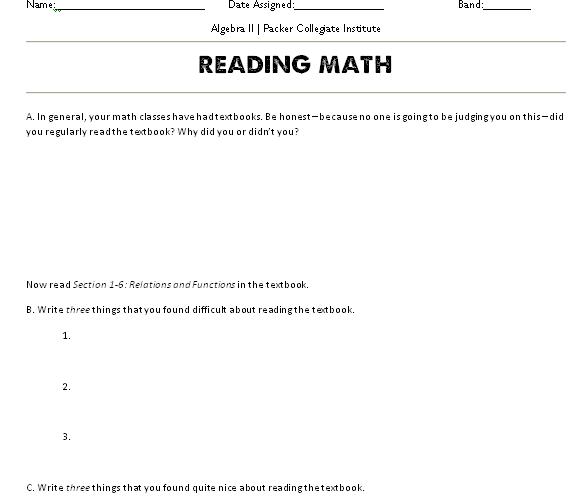
And so recently I’ve started talking with my class about it. To start this process/discussion, one that I hope continues, I gave my students a worksheet to fill out (see above). I love the honesty with which they responded.

For question A, some representative responses:

“I read what was assigned to me but did not read anything extra.”
“I find that textbook reading is pretty boring, so I don’t do it unless I have to.”
“I did not because I had assumed I wouldn’t learn things I needed. All I would do was look at examples.”
“No, I find it difficult to understand math when reading it in paragraphs; it makes more sense to me with a teacher.”
“I did not generally read my math textbooks. I did, however, always look over the example problems.”

Some responses for Question B:

1. The writing can be confusing, wordy, and not thorough
2. The book is BORING
3.  Small print
4. Too many words for math
5. Outdated examples

Some responses for Question C

1. Everything is all in one place
2. Have a glossary
3. Can read at own pace; refer pack to the text when I get stuck
4. Sidenotes! Diagrams! Pictures
5. Real life examples
6. Definitions clear
7. Key terms are highlighted
8. Wide range of example problems with step by step instructions
9. Colors!

I hope to do more as we go along. I might have them learn on their own, using the textbook (and the online video help) a whole section or two. There’s no reason they can’t learn to use the book to be independent learners. I will give them class time and photocopies of the section they need to learn, and they will have to figure things out by the end of the class for a 3 question quiz.

I also hope that by the end of the year, we can use their critique of math textbooks for them to write their own textbook. Okay, okay, not quite. That’s way too ambitious for me. Two years ago I had my Algebra II kids write really comprehensive Study Guides for the final exam. This year I might ask my kids to pick some of the hardest material and create their own “textbook” for it. They’ll get to write it in pairs, and then they can share their finished product with the rest of the class. That will probably happen in the 3rd for 4th quarter.

Anyway, I thought I’d share. Since I like to emphasize the importance of mathematical communication to my kids (though I don’t do it nearly enough), I thought I’d talk about this one additional component in addition to getting students to talk and write math… READING MATH!

WELCOME TO THE INTERNETS, a series of tubes

Kate “I’m not snarky” Nowak and Sean “the squirm” Sweeney are working on putting together a…

“Welcome to the internet, math teachers”

page on the internet. As much as I like them, I feel like this project needs a new working title. Because that’s just sad.  In the meanwhile, you should fill out their survey here.

Full confession: I haven’t filled it out yet. But I’m going to, today. So there. THERE. I PUT YOU IN YOUR PLACE FOR CALLING ME A HYPOCRITE.

Aimless Wanderings

I suppose this will have to be a meandering post. I don’t have anything specific to say, so I’ll just do a little free form.

I feel bad that this year I haven’t created any seriously new resources to share. I realized that when @cheesemonkeysf  wrote about how she’s using my “completing the square” worksheets in her class. I remember making them, and how happy I was when I saw my kids finally latch onto the process. I’m sad that I haven’t been playing around with making more resources. The SBG thing has been taking up a lot of time.

Recently in calculus, I have been teaching my students the formal definition of the derivative, and we’ve been chugging through that. I really emphasize this type of work. As one student wrote a year or two ago:

“Mr. Shah likes to go the long way, the real building block method. First you learn the theory, then you learn the original (prehistoric) way, then (then!) you’ll learn the quick fun way. And later still you learn that you could have done it on your calculator all along.”

I take pride in that. And love that the student recognized it. Anyway, in calculus we finally got to the point where I’m having them explore and find some basic derivative rules/patterns on their own. They’re doing this using Wolfram|Alpha. I didn’t write the packet (only slightly modified it), so I can’t share it here. [UPDATE: Here it is, online!] But it is amazing, because it works to get students to understand why \frac{d}{dx}[x^{25}]=25x^{24}. Instead of showing it works for a few cases, it leads students to see why the power rule for derivatives will always work. (Well, the packet only does it for positive integers, but that’s good enough for me.) I also like that I am formally introducing students to Wolfram|Alpha. Two excerpts from the packet are below.
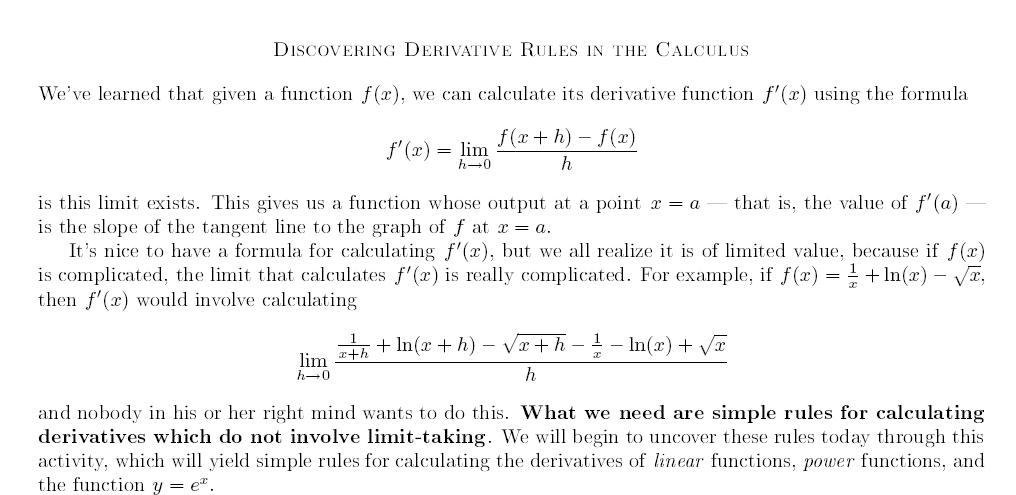

My second favorite quotation from class: “If Google and Wikipedia had a baby that was good at math, it would be Wolfram|Alpha.” (My first was: “Mr. Shah, I hate it when you secretly make us learn things!”)

Something else that has been taking up a lot of my time has been running the Student Faculty Judiciary Committee. That’s my school’s disciplinary committee. Each case probably takes me 3-4 hours of work, and in addition to that, there is a lot of behind the scenes work. I organize each hearing, I write up announcements for student representatives make to their classmates, I plan our monthly meeting, I meet monthly with the Head of the Upper School, and I have a few larger goals for the committee that I want to work towards. Recently there have been a good number of cases, and I work hard to get the cases “closed out” as soon as I can.

Last Thursday, I left school early to attend the wedding of a high school friend. I got to meet up with my besties, from way long ago, in our hometown. I saw my old house, and visited some old haunts, and marveled at the fact that I was still close with these people. I remember the awkwardness of going to a new school (my family moved after freshman year) and the fear (and slight thrill) of not knowing anyone. And the overarching question: will I make friends? That snapshot juxtaposed with the snapshot of me being silly with them at this wedding — priceless.

While at this wedding, I had my multivariable calculus students read the awful section in the textbook on Kepler’s laws. Then I had them read the paper that my multivariable calculus students wrote two years ago. What was cool was that one of my students this year told me when they looked at the paper, they were intimidated by all the equations and didn’t think they’d be able to figure out what was going on. However, they were able to read and totally understand it. HOLLA! I wish I had the email addresses of the four students who originally wrote that paper so that our class now could write them saying they found their paper useful. Heck, I’m sure I can find the addresses somehow… Also when I was gone, I had my calculus students work on the WebQuest that I wrote last year (http://whoinventedcalculus.wordpress.com/). I’m excited to read what they came up with. I got one batch today, and will get the other batch on Friday. I will read them all en masse over Thanksgiving break.

Over Thanksgiving break, I am also going to be completing my applications for two summer programs. One is the Park City Math Institute (PCMI), the unbelievable three week program I attended last year. The second is the Klingenstein Summer Institute for Early Career Teachers , a two week program that many people I respect have attended and have spoken highly about. It is weird, having to ask people to write you letters of recommendation and compose essays. The Klingenstein program even asks for college and grad school transcripts! I get a small taste of what my seniors are going through with their college applications. If there are any summer programs for math teachers that you love attending/participating in, throw them in the comments. (Two years ago, I attended the Exeter math conference, which was very good.)

I guess I’ll leave letting you know of a math book that I recently finished and thought was very good. Duel at Dawn. Be warned: it is an academic book, meant for a specific audience. In other words, it can be dry if you aren’t used to reading that sort of stuff. But it makes a few pretty interesting historical claims by tying large-scale cultural movements (the Enlightenment and Romanticism) to the development of modern mathematics.

With that, I’m out.

Frame it! Stat!

Below is a reflection one of my Calculus students wrote at the end of the first quarter. My initial reaction: I am going to frame this. (That will happen next week.) My second reaction: there is no better rationale for SBG than this. My third reaction: I’ve supported my kids pretty well. And my fourth and most lasting reaction: how gosh dang awesome are my kids?

***

1. I like the way that even though I was falling rapidly into a hole, and it felt almost impossible to get out, once you talked to me I became proactive and tried my best to do better. I like to continue meeting with you. I also like to continue to participate in class and asking questions. I think asking questions in class was the biggest way for me to better understand the topics.

2. I wish I would have started from the first day of school in this attack math mentality. I was acting very passive and like ‘oh I don’t get it now, but I will later,’ which honestly was the worst thing I could have done. I also wasn’t used to the class setting and the grading system. But once you emailed me and I met with you and I know that this is a class that I have to be in it 100%, and that your method is one that helps us actually learn, it was just beneficial. I needed that scare and wake up class because I was in serious denial. I became more on top of things. However, I had to dig myself out of a huge hole that I put myself in, but eventually the rhythm has become one that I used to. And I’m almost in a weird way glad that I learned the hard way because now I truly understand Math.

Coriolis Whaa?

So I’m a teacher that usually overprepares. I have my lesson set up beforehand. Very little is set up for “free form.” This is even true for my Multivariable Calculus class of 5 students.

To be fair, though, in that class we do generally take a 20 minute tangent here or there. Like today we were resolving the acceleration vector of a vector valued function into normal and tangental components — and we spent 15 minutes deriving them because I just decided we should. Spur of the moment thing. Or a few weeks ago, I gave my student 50 minutes to come up with how to convert between rectangular, cylindrical, and spherical coordinates, with no help. But generally, the lessons are carefully planned out. Here’s an example of my introduction to triple integrals (which we do way later in the year) so you can get a sense:

slideshare id=1597835&doc=mvcalculustripleintegrals-090617102556-phpapp01

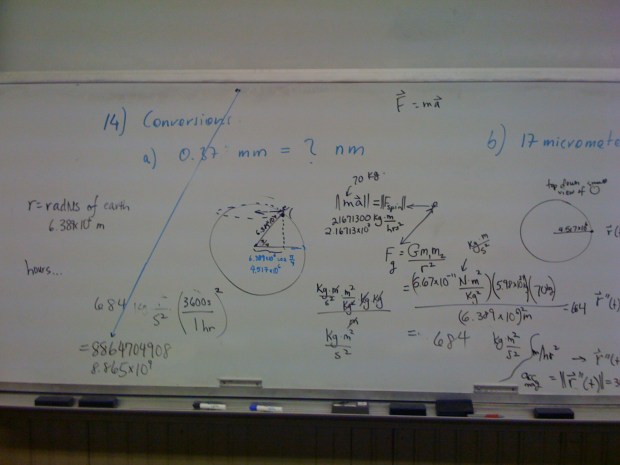
A few days ago, we had gone over the homework and somehow got on the topic of us being on the earth. I honestly can’t remember what prompted it. But we started talking about the force of gravity, which we feel because the earth is so massive. Then I had an insight — a direction we could take the conversation.

We are also spinning: “Does that change anything?”

I stopped class. I paused for 15 seconds, told the students to hush while I considered whether to go down this route. I felt this pang of deviating from my preplanned lesson. We were going to be behind. Do I really want to possibly come to a dead end?

I almost pushed it off. I was going to “leave it as an exercise to the reader” — tell my students they could think about it independently. But just as I was about to brush it off, I thought: WTFrak. Tangents are more interesting and more memorable, when the kids are interested in them.

My kids seemed interested.

So I threw away the lesson I had planned completely, and we went off the cuff, without a known destination in sight.

So back to the spinning earth. I didn’t know. I hadn’t thought about that kinda obvious fact before — we’re spinning, so that should have some consequences

We learned in our previous class that if something is spinning at a constant velocity in a circular motion, it must have an acceleration pointing inward to the center of the circle. So since we are spinning, once around our latitude every day, we must also feel a force pulling us to the center of the circle.

If we model the earth as a sphere, not tilted, and put us at an angle 45 degrees from the equator… we feel a force pulling us to the center of the earth (from gravity), and also a force pulling us directly inwards (centripetal – from rotating) :

But I don’t feel that centripetal force. I jump up, I come down. I don’t feel like I’m being pulled in any other direction.

So we decided to calculate the magnitude of the two forces, and figure out what’s going on.

Awesome.

I left giddy. We figured that the centripetal force was about 1/400 the force of gravity. Afterwards, I did a few more calculations, and realized that actually some of this centripetal force will be in the direction of gravity, so it will feel even less powerful.

I’m leaving for a wedding tomorrow, so I’m having my kids do a formal writeup of what they found. I can’t wait to see it. I am going to show it to their AP Physics teacher.

(As an aside,  I think I’ve found the physics term for what we discovered: the Coriolis force. If anyone knows anything about it, or any good resources on it, let me know!)