Big Teaching Questions

Powerful Talk by @profteacher

So I want to a session led by @profteacher today at 4:30pm. I gave a big shoutout to him on July 11th. He’s a university professor who used his sabbatical year to teach high school math in a public (urban) high school. If you didn’t check it out then, check it out now.

This was one of those emotional talks for me to listen to. And I’m not an emotional person (unless Oprah is on). It was about being a first year teacher. The defeat and the joys and simple observations. I say “talk” but it actually became a rich and compelling conversation among, I don’t know, 30 or 40 dedicated teachers — all at different levels of teaching. It was raw and honest. It wasn’t defeatest or idealist. It was real.

There were two points that were made, that sound like sound bytes. And usually, I’d just brush them off as general platitudes or something. But I know and trust these people, and in this context, these points were deep and rich and I think I’ll probably treasure them.

1. “Teaching is the connsumate act of faith — faith in what you do.” One participant said this, an experienced teacher who talked about how the emotional part of teaching evolves, and after a number of years, she started really believing in this. She continued to say that you won’t be there when a kid gets a college acceptance. You just won’t know how and with whom you made an impact. (In fact, the student might not even be able to recognize it.) That’s where faith comes in. Faith that what we do matters.

2. The presenter said his one big take away from this first year: you need to have students know and feel that they can be successful. The lessons don’t have to be exciting — they can be routine and boring. “Factoring worksheets!” he said, “they will start tearing through them because they know they can be successful.” His discipline problems disappeared when he discovered this. How to do that? Developing lessons through careful crafting and scaffolding just enough — so that students are going through “productive frustration” — where the next step is just within reach. Again, just words. Words I would ignore, if the presenter hadn’t just developed and delivered a curriculum to me for 3 weeks which embodied everything he said. Scaffolded. Carefully crafted. And there was … everyday … engaged, productive frustration.

I’ll write more about that later. But I just needed to jot these two points down in the spare 10 minutes I had before dinner.
Looking past teachers to teaching

Today I attended a session where three university profs — ed researchers — formed an informal panel. There was one important point that came up at the beginning, and became a riff for a few minutes. It was, as you prolly suspected from the really innovative title of this post, about the power of looking past teachers to teaching.

It’s a slight distinction, but crucial to the reorientation that I’m having about teaching.

Some points that came up in the conversation:

  • Replacing teachers won’t change things; replacing teaching methods will.
  • Focusing on teaching and not on teachers is the basis of lesson study (and the Seattle video club I talked about in the last post). It focuses the conversation on teaching/teacher moves.
  • Changing the conversation from teachers to teaching more readily implies that teaching is learnable. So we have to look past individual teachers to the methods of teaching. That being a good teacher can be taught. Another way to think about it: teaching is a complicated activity, rather that something owned by a particular person.
  • There are universal tasks to teaching that we can investigate (e.g. which ideas to privilege in a classroom).
  • It gets us away from the “I taught it but they didn’t learn it” phenomenon. That phrase doesn’t really make any sense when focusing on teaching and not the teacher.
  • The greatest untapped resource we can use in the classroom are our students and their insights. And by focusing less on the teacher and more on teaching moves, we can tap into that.
  • This outlook shifts the conversation away from teacher bashing (but one should also be cautious of going in the other direction of student bashing).

Yes, I know. There are some inconsistencies, and worse, this is all very abstract. And I HATE THAT. But this all tapped into the idea I wrote about recently, about how teaching moves are something that one can pay attention to. One can learn. One can revise. And through this process, hone the craft of teaching.

In other words, the focus on teaching instead of teachers is that it puts the emphasis on the ways teachers can do their jobs by focusing on students and learning.

So that was one part of the talk. In another part of the talk, there was a question about the constant tension between the jam-packed curricula with a zillion micro-pico-standards and getting students to really grapple with big ideas.

One speaker said that we “need more effort and courage” from teachers. I drew a sad face in my notebook next to that.

The second speaker actually spoke articulately, in defense of having common standards in theory [1]. He also said that he doesn’t see the problem as having a zillion pico standards. It’s that we go through all these little ideas that never get added up to any big ideas. His suggestion for dealing with this is to outline learning trajectories, with big ideas as the landmarks on the way. I don’t know what precisely he had in mind, but I figured that it probably involves student drawing connections by working on unfamiliar problems that force relationships among mathematical ideas (e.g. systems of equations with matrices; asymptotes for the tangent graphs and asymptotes of rational functions; absolute value equations and absolute value inequalities; etc.).

The third person then finished up speaking about the Common Core Standards — and eloquently continued the second speaker’s defense of standards.

That’s about it for the maths stuff I want to write about. (It’s late and I have lots to do tomorrow.)

On the non-math side of things, I had a wonderful night BBQing with friends and watching the sky change hughes, from orange, to light blue, to dark blue, to black. As the air got colder and the light retreated, the stars starting coming out, first slowly then quickly. As people left, conversations got less frenetic and more personal. And I left, after being regaled with a shooting star, at peace with Utah.

[1] Having these standards gets us focused on teaching. It also promotes the sharing of ideas; if someone gets it/does it right, then those lessons and approaches will be in demand.

Graduation

Today is graduation for our kids. It’s also officially going to be three years under my belt. You know, as much as I’m feeling very little nostalgia about the year ending, I’m also finally feeling pretty solid with the year. My despair has lessened. I think I did some good for some great kids, and you know what, I’m very okay with that. I implemented an organizational system in Algebra II, I got some pretty spectacular final projects in multivariable calculus, I did the algebra bootcamps in calculus. I also finished my 2 year term on the Faculty and Staff Advisory Committee and finished off my second year as faculty representative on the Student-Faculty Judiciary Committee. I agreed to take over that committee next year. I got the number of students taking the American Math Competition from around 15 to over 100. It’s been pretty good. I’m not nostalgic, but after taking stock, I now don’t feel like this year was wasted — that I should have done more and better.

Happy graduation to me.

On The Dangers of Continuous Improvement

My school has a set of explicitly stated core values. They were derived at one or two faculty meetings in my first year. I remember we broke into smaller groups and talked about values that are, and I quote, “bone deep” at our school.

One of these core values is continuous improvement.

It sounds great when you say it to your kids. I mean, “We’re always working together to get better!” Who dares say that continuous improvement could be anything but positive?

In fact, I do. I have come to see that it isn’t always good.When done right, for example with all those Standard Based Grading enthusiasts who have seen results, it can be powerful. Carrots and all that. But it can be done wrong — and I think I’ve finally come to see the insidious side of continuous improvement.

It implies that we should always be working to do better. It also implies that we are never going to be good enough.

I’m in a bit of a teacher funk — and for those of you who read this, you might know by now that I get this way every so often. And then I do snap out of it. But it’s a cycle. I know some of you out there feel the same way as I do. I read it in your posts and your tweets. The sentiment: “I never knew how much I sucked until I met all of you.”

I have over 120 blogs in my google reader, I follow twitter daily (until a few days ago), and I stand up with all of you and engage when writing this blog and commenting on other blogs and tweeting about interesting things I read. I am constantly engaged and engaging and interested. And for 90% of the time, I love it. I love it because it brings meaning to my vocation — meaning that lies outside of me talking to myself in a self-contained bubble. It encourages me to have high standards and always keep striving to do better and provides me with models which to emulate.

And then, then, I get overwhelmed by it all. Usually brought on by a contemplative realization. Where I feel like I should be improving and I’m not. Where I’m making the same mistakes that I did as a first year, and wonder how is it I can’t overcome them? And where I’m just never going to get to that place where I want to be at.

Which is to be great. Which is where I can reach every kid and have them not hate math at the least, and love math at the best.

And I know it’s idealistic and Sisyphean and naive. And it’s what I want.

It’s the dark side of continuous improvement. Because I start feeling like I’ll never get there, and in fact, I won’t, because perfection is impossible.

I will snap out of it. I always do. But I don’t want to be in this cycle forever. I fear burn out if this continues to happen.

So I’m wondering if I should do what I tell my students to do when approaching a huge task. Break it into smaller chunks. And those into smaller chunks. Then the gargantuan task won’t seem so impossible, because in those chunks is an actionable plan. And then work on achieving some of those chunks.

Here’s my thought: I should make a list of 5-10 goals I want to accomplish next year (e.g. build a sense of community in each of my classes). And break those things into smaller actionable chunks (e.g. concrete actions I can do and check off which will hopefully build a sense of community). And make a sticker chart which I have on my desk — which I can see if I’m actually taking the steps I’ve outlined to achieve those goals. [1]

Perhaps if I do that, I won’t have this insidious and amorphous “continuous improvement” thing looming ahead of me. But something that I can realistically accomplish, and keep track of, and feel good about. Because who doesn’t feel good when looking at a chart full of stickers?

[1] Yes, you SBG enthusiasts out there, like your standards…

Ready for Summer

I’m tired, and ready for my well-deserved vacation to start. I am ready to pack up this year and put it behind me. I have a lot I want to say about my failures, but I can’t write about them here. I’ve tried writing them down for the past hour, but they get too specific, in ways I don’t want to be specific. So we’ll leave it at this:

This year was overall less successful than the year before. I think classroom dynamic has a lot to do with it. I wish I could have gotten a real community feel in one of my classes in particular. We never really bonded, and honestly, I don’t know if we could have. But I could have done a lot better by them if I could have convinced them we were on a team together and that I was on their side. On the other hand, I learned some valuable experiences this year about the importance of consciously building atmosphere. It’s important to develop it early on, and it’s important to maintain.

Rip me apart, please?

So everyone talks about and around assessments, but we rarely actually talk directly at them. Concretely. (By the way, I am using “assessments” to mean tests/exams/quizzes.)

Partly because the abstraction of assessing is so much more fun to bandy about than actually looking at assessments. Partly because some of us probably don’t want our assessments floating around in the electronic ether. Partly because assessments as so context dependent — on what you’ve been teaching you’re kids, and where you’re kids are at. And partly because we probably think our assessments all pretty much look the same.

Personally, I’m not as thoughtful about writing exams as some of my colleagues. I see them carefully construct questions, talk about what skills are getting over and under assessed, and overall, go through their exam with a fine tooth comb. I create mine with more general brush strokes. I never really learned how to write an exam.

I figured if people are interested in having a conversation about what a good exam looks like, I’d jump start it here by including a copy of my latest Algebra II assessment.

I’d like you to rip it apart, with suggestions big and small. From spacing and font issues to wording issues to content issues. Or if you’d just like to throw down your process for writing assessments, or types of questions you really like (e.g. “find the mistake!”), or things you try to avoid, do that!

If you want a little more context for my particular assessment, you can see the “topic list” that I gave my students here.

Soliciting Senioritis Solutions

So I teach three classes of seniors. This year, the senioritis has set in early, and hard. I have kids who are already starting to check out. And instead of finding a positive way to bring them back into the fold, I have just gotten slightly sour, slightly annoyed, and scornful. I don’t like when I do that (though I know sometimes it is necessary). The senioritis isn’t yet in full swing, but at least for one class, it’s impacting the fun and enjoyment I have teaching (and consequently, that the kids might have learning).

So for any of y’all out there, do you have any CONCRETE advice on how to deal with senioritis?

Do you have a come to jesus talk?
Do you get all draconian up in their grill?
Do you collect and grade homework daily?
Do you have a class discussion about the frustration? What would that look like?
Do you have weekly quizzes to make sure stay on the ball and focused?
Do you have an explicit reward system? (If I only have to remind you at most 3 times, we can have a team math contest with a special prize!)
Do you do a project?
Do you make things more group centered — where students work as a team?

In other words, what have you done that works? For the past two years, I’ve talked with my students about how I never lower expectations in the fourth quarter, that I care about them learning the fun stuff at the end of the course, and that they simply need to stay on the ball. But although that generally works for a majority of the kids, I still feel like more kids than I would like have their grades (and understanding) drop in the fourth quarter.  I want to keep all of my kids (not just some of my kids) with me until the end of the year.

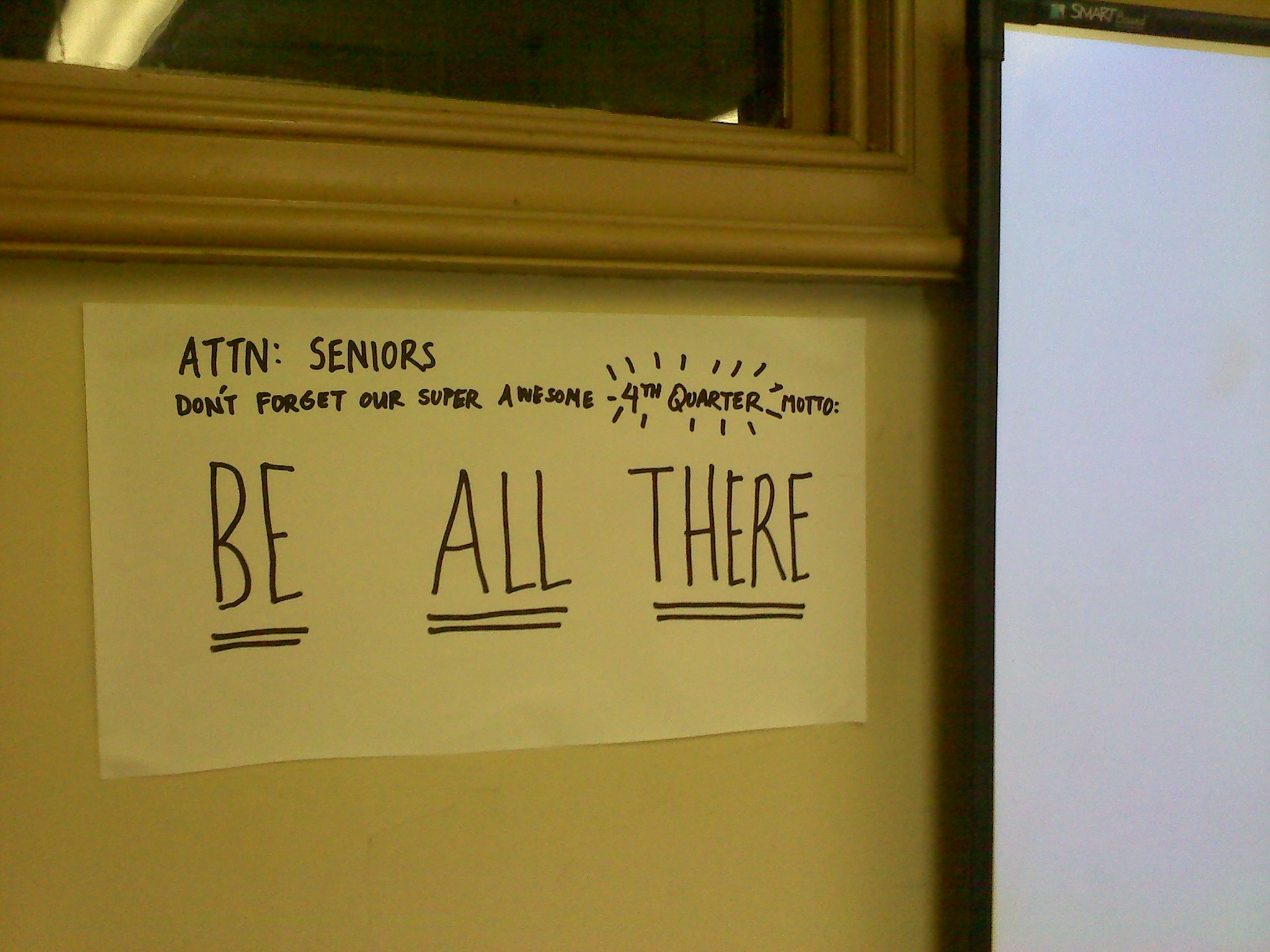
I will soon bring out a new class motto. It used to be “take what you don’t know and turn it into what you do know.” It is now going to be “BE ALL THERE.” I think I will get posters made and hang them in my classrooms, and point to them aperiodically.

UPDATE: I made my poster and hung it up in my classrooms