Big Teaching Questions

When do we get to have fun?

Think Thank Thunk makes me want to throw my hands up in the air. I’m not a good writer, but that sentence was carefully crafted to be pregnant with ambiguity. Because with every post Think Thank Thunk author Shawn Cornally writes, I rejoyce… and I despair. Reading him is like reading Dan Meyer again for the first time (although they seem to have slightly different cause celebres, they actually are saying almost the same thing). It’s all obvious common-sense things. Motivate. Have the kids come up with the questions. Once the hook or need is there, pounce. Capitalize. It doesn’t have to be “real world.” It just has to somehow get the kids internally invested, not just by grades. With a question. And a need for an answer.

I feel inspired by what I could be doing, and like a total lame-oid for what I am doing.

Or as David Cox twittered:
dcox21
.@k8nowak Problem is, I never sucked until I met all you guys. Thanks “everybody.”

Yeah. Thanks guys.

Recently I’ve been inspired enough that I’m going to try to get some curriculum money from my school to spend time coming up with (short) activities to “hook” or motivate my kids for each of the major topics we cover in my classes. That’s not going to be easy.

Reading Shawn and Dan just underscore something I’ve been feeling all year. I mean, I’ve felt this to some degree every year, but uber acutely this year. I became a mathteacher because I wanted to impart that feeling of exhilaration and accomplishment to my students… to show them the beauty and applicability and serious-honest-to-god-creativity that is implicit in math work… to see doing math as fun — a million little puzzles all connecting in these random and unexpected ways.

Or more succinctly: I became a math teacher because I want my kids to experience the doing of math as inherently enjoyable. So I’m asking myself: when did I lose that as a goal in my work, replaced by the singular focus on understanding? Yeah, understanding is great, but that should only be the baseline of my teaching. My standards should be higher, and getting kids who don’t enjoy math to enjoy math (not just tolerate, or be able to do, but enjoy) should be the target.

I know, I’m already feeling sheepish now that all this is typed out. All my idealism is spilling out unfiltered. And tomorrow I’ll go back to the classroom and see that my Algebra II students still don’t know why \frac{x}{2} is the same as \frac{1}{2}x, and my calculus students still don’t know why x^{1/2}x^{3}=x^{7/2}, and I’ll remember why I have such a singular focus on understanding, jettisoning fun for more immediate concerns.

But that’s still probably not going to stop my brain to keep on going to the place it has been stuck all year… asking ad infinitum the question “when do we get to have fun?”

Topic Lists!

Central to who I am as a teacher is the notion that I have clear, consistent, and fair expectations [1]. The teacher I admire most at my school showed me that it can work, if done right. I’m sure at some point I’ll write about that when I craft my current philosophy of teaching. Which is, well, not now.

Now, I want to share with you something my department head does with her classes, and this year I’ve stolen it for my Algebra II and Calculus classes.

Topic Lists.

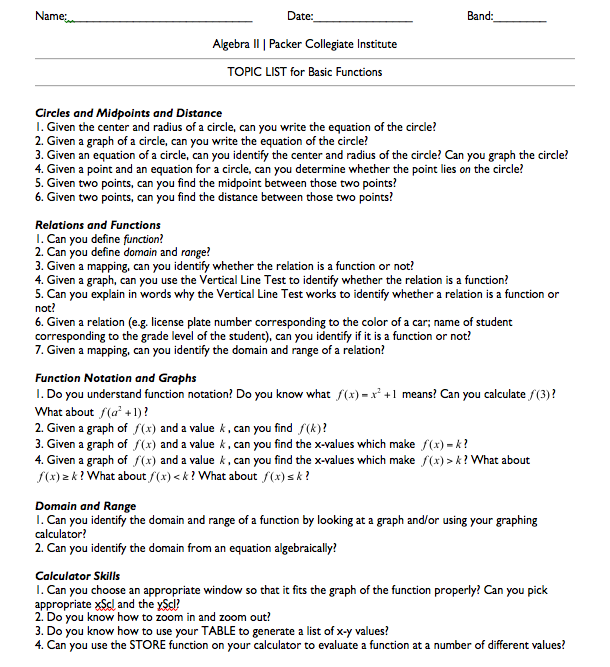
These are lists of everything students are expected to know going into an assessment. I write them up and distribute them on our review days. Here’s an example of one I handed out in Algebra II:

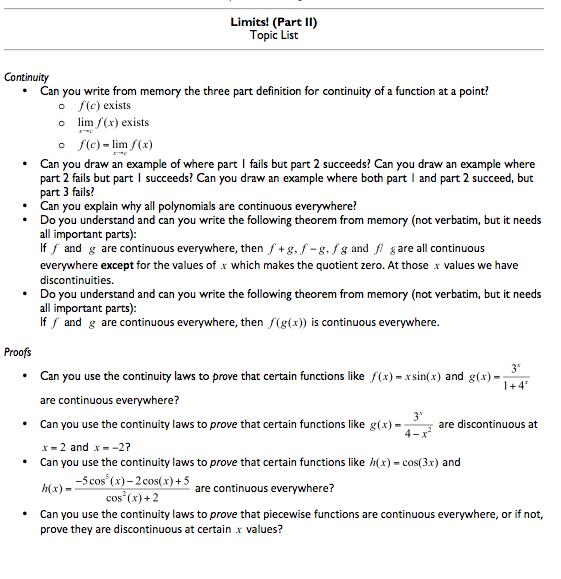
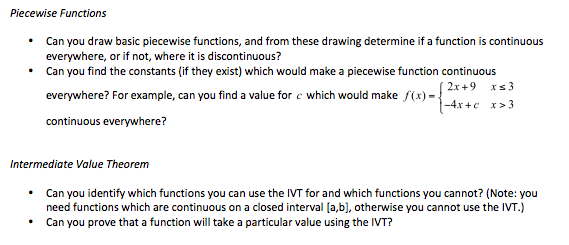
And here’s one from Calculus:

I will admit that at first, I was against doing this. I think it is the students’ responsibility to learn how to study in my class. To learn how to organize the information we’ve learned and create his or her own study plan. And my first thought: HANDHOLDING! CODDLING! PSHAW!

But you know what? I teach the non-accelerated classes. My kids don’t know yet how to organize all that we’ve learned. And things are much harder because I don’t teach out of the textbook. I use the book as a supplement, and (at least in Algebra II) I jump around in it a lot. A LOT. A LOT A LOT A LOT. And I use a lot of my own worksheets, and only assign textbook homework about half the time. So the course is necessarily confusing because the information isn’t all in one place.

For that reason, I feel comfortable giving them these topic lists.

What I like about them is that students know if they’re ready to take an assessment. The can just go through the list, topic by topic, and see if they know how to do that sort of problem. I always tell my kids that the assessment will have no surprises. They know what’s going to be on it. And heck, they SHOULD know what’s going to be on it. With these topic lists, I’m giving clear, consistent, and fair expectations. You know what’s remarkable about it? KID’S LOVE IT. They love organized teachers who are clear and consistent about what they want. [2]

Hey, I know, I know. It’s nothing like the “skills based assessment” that Dan Meyer and his offspring have adopted. But having a list of skills for my students to look at when preparing for my regular assessments is helpful for them. Heck, it’s going to be super useful for me because next year to see exactly what I taught this year, in some sort of codified and consistent form.

[1] The expectations have to also be reasonable and I have to provide the resources to achieve them.

[2] I don’t know if I would give topic lists to my kids if I were teaching the accelerated tracks. I feel if you’re in an accelerated track, I expect you to know how to study. Also, topic lists would probably be less useful because the problems I’d probably include on exams would be ones that force students to think a little outside of the box, and to synthesize information in a slightly different way than they’ve seen before. The topic lists couldn’t account for those kinds of questions, without giving them away.

A letter preserved: where I thought I would be

I did a summer program at Collegiate (a fancy private school in Manhattan) after my first year of teaching. Let’s see, that must have been in June 2008. On the very last day of the program we were asked to write a letter to ourselves, which would be mailed a year later. We were supposed to write some goals down.

Mine letter was mailed to me in June 2009, as promised one year later. I didn’t open it until today, on February 17, 2010. (I was scared to see if I had lived up to who I hoped to be when I wrote the letter.) What I wrote then… it’s a fascinating read.

Dear Sam-in-the-future,

These things are always pretty corny — write to your future selves. But whatever, I have 30 minutes and nothing really to do but this. I’ve just finished the Collegiate Summer Teaching Institute (“new teacher boot camp”) which came on the heels of my first year of teaching. Since it’s summer and I haven’t yet had a day to myself yet, I can say I’m exhausted and ready to return home to Brooklyn.

I can say that after this first year, I’m exhausted but not burned out. My enthusiasm about teaching is still there, as is my creativity (althought I don’t really have to time to think through or actualize my ideas). At CSTI, I got to create a lesson on Matrices, which I did using Facebook and social networks as an example. Meera R. and Antonio W. suggested I develop a unit on it and present it at NCTM. So, with that said, here are some goals I hope you’ve achieved or are on your way to achieving by the end of your next year.

*Join SFJC [Student Faculty Judiciary Committee] or FSAC [Faculty and Staff Advisory Committee]
*Successfully integrate the Algebra II video project in the classroom
*Go to the People of Color Conference (if only for networking)
*Start the non-fiction journal at Packer
*Look into attending the Exeter math teacher conference next summer
*Keep current with my teaching blog
*Talk to people and look seriously into becoming a tech integrator
*Come up with a really solid, investigation-based, computer-loving Multivariable Calculus curriculum
*Finish that damn Calculus curriculum map (ha!)

Just remember — because nobody really tells me this outright — that I am a good teacher. I work hard, I have the instincts, and I can break mathematical concepts down. Don’t let anyone sell me short, and don’t stay at Packer because of loyalty (stay because it is still an amazing place to work), and don’t leave just because I want more money.

Here’s to hoping next year is slightly less exhausing as this year was!

Heart,

Gotta love it. I haven’t achieved all my goals, but I did accomplish a lot on the list. I am a member of both the SFJC and FSAC. I seriously investigated starting the non-fiction journal at my school, but the English and History departments weren’t really gung ho about it, so I had to give it up. I did go to the Exeter conference the following summer (which was amazing, by the way). Heck, I am still writing this dang blog! And I have come up with a pretty dang solid Multivariable Calculus curriculum, which is based on problem sets, but it is definitely not “computer-loving” yet.

One thing that still holds true: My enthusiasm about teaching is still there, as is my creativity (althought I don’t really have to time to think through or actualize my ideas).

We’ll see where my career goes in the future. It’s fun to see where I hoped I’d be when I wrote this a year and a half ago, versus where I am now.

PS. If you want to get a flavor of the Matrices thing that I created, I blogged about it ages ago, but I think this was a much more rough form than what I crafted at the summer program. I think I have a much better and more updated version, if anyone who is teaching matrices wants to see it. Just put something in the comments and I’ll see if I can’t dig it up.

Students write comments on ME

Sometimes I feel like a doctor who doesn’t take his own medicine. I spend a lot of time writing narrative comments on my students — in the hopes that students know that I do care about them and pay attention to who they are and what they do well. But also so they know places they can work to improve themselves.

I ask my kids to write narrative comments on me, and every year I am a total wuss about reading them. First I put them aside on my desk at school, and when I realize I’m never going to read them at school, I bring them home and put them on my desk, letting them sit there. They get bigger and bigger as they sit there. I don’t know what I expect to find in them — but each year I’m so critical about myself and my teaching that I expect these to be as critical. [1]

As an adviser, I sit down with my kids and we read their narrative comments together. We highlight the good in one color and the weaker areas in another, and look for trends within classes. I encourage my kids to read these and use them to improve. I would never let my any of my advisees not read their comments for a couple weeks while they prepared themselves.

But look at me, total wuss. I did.

But right now, as I type this, I have the unread stack next to me. What I’m going to do is to go through it, and publicly make a list of all the things that I do that students say are places of weakness / areas for improvement.

BIG BREATH.

Okay, let’s begin.

Algebra II

  • “I enjoyed the small group tables we used to do… I think bringing back the group work at the tables would be effective and good.”
  • “at times you tend to move rather quickly”
  • “Sometimes [Mr. Shah] moves very quickly through the smart board slides, which sometimes leads to a bit of confusion, but I am generally able to catch up”
  • “I feel that at times you expect us to do a lot of work with little time and without a calculator [on tests]”
  • “One thing that does not work for me is group work”
  • “Sometimes I struggle to keep up with my notes, and then understanding as we go is also hard since I’m trying so hard to take down the right notes”
  • “I do not like the binder checks, since I have a different way to organize myself”
  • “Every once in a while I wish we would move a little more slowly through the material”
  • “My one complaint is the binder check. I do not think we should be graded so harshly on our organizational isues. I end up spending valuable math studying time redoing old assignments that I lost”

Calculus

  • “I do find that [class] can be pretty slow at times, simply because we go through every problem step by step as a class”
  • “Every once in a while I feel the homework takes a little too long but overall it’s a good amount”
  • “I feel [] at times it would be better if you spent a little more time explaining the concept behind how to do problems, rather than simply doing the problems themselves”
  • “I think that you should give more partial credit on tests, because often we understand things but make simple mistakes which really should warrant more credit than given”
  • “I do feel that homework should be counted more than 10% because that’s what I put the most time into”
  • “One thing that makes class difficult for me sometimes is the pace that we move. Sometimes it goes a little fast and I don’t have time to digest everything that you say”
  • “[I]t is really hard to have to learn new things the day before we take a test. If I have questions about the new topic it doesn’t always give me enough time to work out my problems.”
  • “Sometimes his unyielding energy can be annoying, but that’s probably because I’m living on 4 hours of sleep every night”
  • “[T]here isn’t as much in-class review for assessments as I would like, but I know that as seniors it is expected of the class to do a lot of studying on their own”

Okay, so guess what? That wasn’t bad at all! Basically, I feel bad for you because you didn’t get to read all the supergreatawesomethings that were said, which now makes me feel like “hey, I’m not a total failure!” And now I have a list of things that I get to sort though, decide if it is a generally valid point, and if so, what (if anything) I can do to change it.

A few things that immediately come to mind for Algebra II

1. A few of my students feel like I’m moving too quickly. Already I’m thinking “we’re like 3 weeks behind where I was at this time last year!” — so finding a solution won’t be easy. But I think doable. I think it calls for redesigning the routine of the class a bit.

2. One thing I wanted to do last year and earlier this year (but never did) was to design and put a little “WRITE THIS DOWN” icon on the smartboard slides that I thought students should take notes on. Students have difficulty taking notes in a class which uses SmartBoard, because the text is already up there… so unlike when a teacher is writing on a whiteboard and students are copying it, with a SmartBoard students don’t have this lag time

3. I want to bring back more group work in Algebra II! I somehow stopped doing it regularly. The desk configuration in that room is all weird, and I tried something last quarter which didn’t work (groups of 4 are never a good idea), so I think this quarter we’ll institute groups of 3.

4. I refuse to change my stance on the binder check in Algebra II.

Calculus is a lot harder for me to think about changing based the feedback I got, and the varied the personalities and ability level of the students I have in the class. I’ll keep mulling it over and if I have any really strong insights about changes I’m going to make, I’ll post ’em.

[1] Yes, I know, none of my kids are going to be horrible and unkind. They are a respectful and nice group. But I always tell them to be honest — that that is more important to me than them writing empty platitudes — and I have them keep ’em anonymous. So a student COULD eviscerate me.

the evolution of a student teacher

I’m doing a huge shoutout to justagirl24, who has finished her student internship.

I don’t know her, and I’ve tried posting a few (long) comments on her blog — only to have them disappear into the internet ether. But I’ve been following her journey as a student teacher for the past four months. I think her blog, from August 2009 to December 2009, should be suggested reading for beginning student teachers everywhere. I remember having a lot of the same thoughts that she did when I did my teaching practicum at a public high school in Cambridge, MA.

I’ve linked to her blog a couple times on Twitter, but I don’t know if anyone clicked. So to induce you to read, let me whet your appetite by spoiling the narrative a bit. I’m going to show you the beginning and the end of this story.

September 7, 2009:

I’ve come to realize that this is all a chore to me. I don’t want to drive in the morning to school. I hate it. I can’t quit. I wish there was a way to make it better. Sure I can work with other people to come up with solutions, but you know what it’s all up to me to enforce those solutions. And it usually ends in failure for me and my students… That’s what sucks about this, I hate being alone. No one can be there to defend me. I’m the one who needs to stand up and do it. Can I go in and say “I’m still learning, guys and girls.. I’m new at this.. give me a chance to experiment with you”… maybe I can say that.. but I dunno.. right now I have so many things floating in my mind. All I can think about is school and this whole experience. Nothing else.. I need something in my life to make me happy and right now I’ve got nothing. Nothing to keep me distracted.. Nothing to keep my mind from thinking about this “chore”.

December 17, 2009

So it’s the last week.. it’s bittersweet.. I’m sad to go but happy to be done. I’m definitely going to miss these kids. I wanted pictures of all of them, so I have a group shot of every class. For my math10 class, I was handing some last minute stuff back.. and was kind of giving a mini speech.. about how I really enjoyed this internship.. I was starting to choke up.. so I stopped talking.. lol.. It’s bizarre to think that 3 months ago I would make it to the finish line.. But I have.. I survived and endured.. Surely not without any struggles.. This is surely one of the best experiences in my life thus far. I just can’t believe I was considering quitting in the beginning. I think it’s a phase that everyone goes through when they’re thrown into a different and new environment.

This was four months. That blows me away. Four long, hard, rewarding, frustrating, emotional months. So congrats, justagirl24. If you happen to see this… thanks for sharing your thoughts with me. I’ve been there, silently rooting you on. Not in a creepy “he’s stalking me” way. In a “you can do it!” way. And you did.

Now don’t forget to return your classroom key.

Genesis

I am exhilarated. The past two days in my calculus classes have taught me more about teaching (and more about student learning) than any other days this year. I am so engrossed in what’s going on that I feel like I might be at the brink of something big for my teaching… Maybe not, maybe this is just a passing thought, and I might grow bored of this, but right now it feels big. It could be a genesis for me-as-teacher.

As you know, I’m interested in the questions of how to teach problem solving, how to hone intuition, and how to build independence and tolerance for frustration for students. But on a whim, last week, I decided to temporarily throw all those huge questions out the window and just do something, anything, to get students to problem solve. My kids had just had a test on basic derivatives, so it was the perfect time to digress before Thanksgiving break.

So you know where we are… my calculus students had learned how to find derivatives of basic functions, they had learned the product and quotient rules, and they had a bunch of the conceptual ideas down. (For example, they could explain why the power rule works and where the formal definition of the derivative comes from.) But that was it. We focused on finding the derivatives of function after function after function.

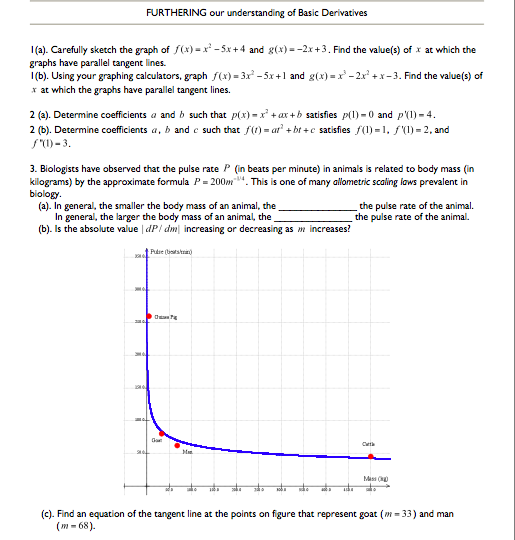
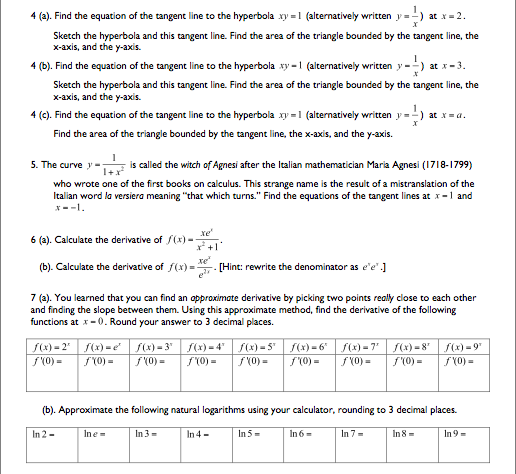
So I gave myself 3 days to do something. I crafted a worksheet with 7 questions. Many just taken wholesale from our textbook, or slightly modified/scaffolded. I didn’t try to find hard problems. I have no interest in throwing my kids into the deep end of the pool [1]. Instead of “hard,” I tried to find problems that were different than any problems they had seen before.

You might look at this sheet and say “yeah, any calculus student who knows how to do derivatives ought to be able to do these questions.” But the first thing I learned in these two days is that that would be a huge mistake. In fact, it was a mistake I made for the past two years. I would assign one of these sorts of problems for homework, and the next day students would come in asking questions, and we would go over how to solve it in class. And by “we” I mean “I” would explain the solution asking students questions along the way. Then my kids would ostensibly know how to solve the problems. And I would move on, knowing they had “learned more calculus” and mastered “one more type of problem they might confront.” And although it may be true, my kids never really had to flex any of their intellectual muscles. They learned another algorithm. They didn’t ever have to struggle, minus a few minutes (seconds?) at home before giving up.

Here’s how these days went.

DAY ONE

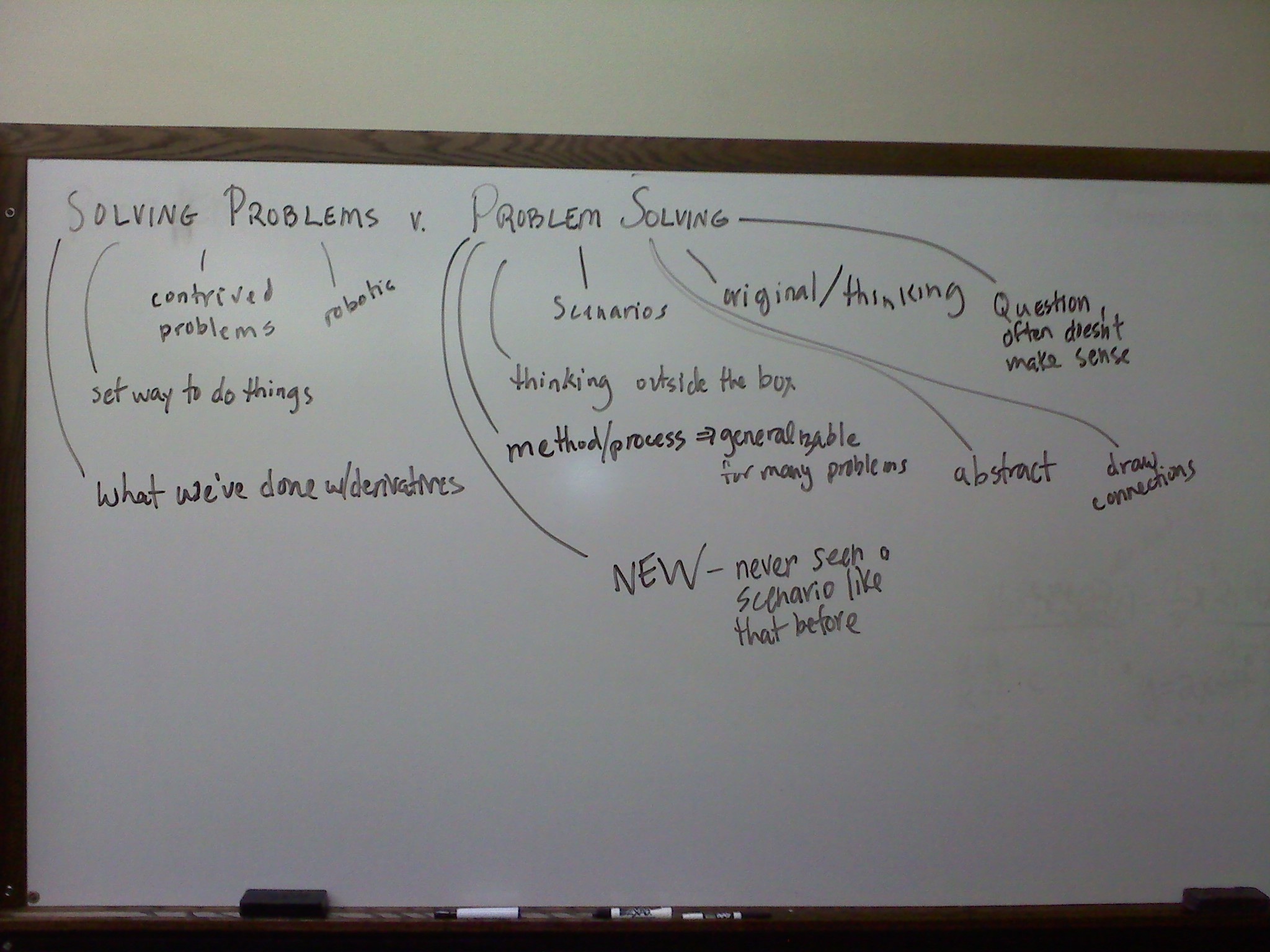
I start out with “SOLVING PROBLEMS v. PROBLEM SOLVING” on the board. I tell students what we’ve been doing in this unit is solving problems. I ask them what they think the difference between the two things are. This is what we come up with:
I put them in pairs. I tell some of the groups to work on problems 1, 3, 5, and 7, and the other groups to work on 2, 4, 6, and 7 — starting with whichever question strikes their fancy. I tell them that I won’t be of much use to them. That they are going to have to use their wit and wiles to do these problems. That they should ask their partners their questions, that if they really get stuck they should go to another group, and if they really, really get stuck, they can talk to me. Although I won’t be of much use to them.

They start working. For the remaining 40 minutes. They are totally on task. They are struggling to understand the questions, and they are trying to explain their ideas to each other. For example, for question 1, some groups just couldn’t understand what the question was asking.

Me: “Did you graph the two functions like the problem said?”
Them: “No.”
Me: “Maybe that will help you understand the question.”
[I come back later]
Me: “Do you understand the question now?”

Or sometimes I would get some student needing affirmation:

Them: “Mr. Shah, for this problem I first took the derivatives of the functions and set them equal to each other and then I solved and got this quadratic and then since I couldn’t factor it I used the quadratic formula.”
Me: “That sounds like a statement. Do you have a question?”
Them: “Well, I guess I’m asking you if I’m on the right track.”
Me: “You know I won’t answer that. Do you think you’re on the right track?”
Them: “I think so.”
Me: “So go with it. Stop worrying about being right at every step. Have confidence. Talk things out. Make mistakes. Whatever. Now stop bothering me.”

I have to encourage a couple of people to work as a team instead of independently, but other than that, my students are killing it. It is amazing. I can’t understand what it is, but my kids are really into this!

One of the groups which is working on problem 4 says “Mr. Shah, now that we’ve done part (a) and part (b) for this question, we’re not problem solving anymore. We’re just solving problems when we’re doing part (c).” I almost cry. My kids are starting to recognize on their own that once they problem solve and get a technique down, they are then only solving problems. They have another tool in their toolbelt with which to problem solve.

At the end of the class, I say “Stop.” Most have only solved 2 or 2.5 questions. I smile and tell them that’s alright, and that they are doing so amazingly that I am not going to assign any homework.

Lessons from DAY ONE:

  • The “easy” questions I chose aren’t so easy, since my kids have never seen questions of that particular form before. As I suspected, this is problem solving for them.
  • The kids who are afflicted by “learned helplessness” (read: who always raise their hand at the first sign of trouble) can think for themselves. In other words, my kids can be independent thinkers if forced to.
  • Kids need time to struggle and grapple and do basic things like draw parabolas and hyperbolas. I assume they can do these things quickly. They can’t.
  • My kids are not to be underestimated. I realized that I regularly underestimate the ability of my kids to think for themselves. Which is one of the biggest reasons it has been hard for me to let go of my teacher-centered class, and lead more of a student-directed class.
  • Many of my kids actually found math fun/interesting! Without the stress of grades and time pressure, they got to enjoy the puzzle aspect of math!

I sent out a survey to my students asking them about this first day of problem solving.

Some of their positive responses (and see this teaser post for my favorite response):

It’s exciting to think that we are finally able to combine a lot of the formulas and other material we learned previously to solve a single problem.

I think it went well. It was tough, but rewarding to get an answer, even though we still weren’t sure if it was correct.

I found the class really interesting because I often find myself neglecting my brain and just accepting what teachers tell me. It’s a nice change of pace to think for myself for once and truly try to understand it.What makes me excited about doing more of this is that I feel the more we do, the more comfortable we will be with doing them.

I think it went really well, actually. I liked the problem solving.

I liked doing problem solving because it was different from what we’re usually doing. It’s also a good way to work on a different way of thinking about things, which I’m always appreciative of.

I think it went well. It’s hard to start out a problem, but then at a certain point things start to click.

It wasn’t bad, it was good working in groups so that we can bounce ideas off of each other. It was good applying the things we learned previously.

Im excited to be able to do harder problems, and it makes the easier problems look and feel alot easier.

It’s really interesting and challenging. Solving these problems is like solving puzzles because you already have the pieces, but you need to find a way to piece them together so they form a whole.

I like working with a partner on problems. i think that these problems feel very comprehensive which is fun.

There were no negative responses. There were anxieties though. All of their anxieties about problem solving boiled down to two things: grades and their ability to actually do the problems since there is no set method to solving them.

DAY TWO

I start out the class reminding the kids about problem solving. I talk about their survey responses, and the anxiety about grades. I tell them to mitigate their fears, whenever we problem solve I will always give them a choice of problems to work on, I will let them work in pairs (at least for now) so they can bounce around ideas, and that I will grade them on more than just answers. I will grade them on their formal writeups and the clarity with which they explain their approaches to the problems, even if none of their approaches succeeded. My kids seemed to feel those addressed their concerns.

I set them off to work with their same partners. If they worked on the even problems, they should work on the odd problems (regardless of whether they solved all their even problems). If they worked on the odd problems, they should work on the even problems (regardless of whether they solved all their odd problems). The students work. I wasn’t sure if they’d still be into it, but they are.

Five minutes before class ends, I stop everyone. Most groups had gotten 3 more problems done. I tell everyone their homework. Each student must pick two problems and do a formal writeup for those two problems. No one in the group can do a formal writeup of the same problems, though. I ask them  how day two went. They agreed that it was (on the whole) much easier the second day, now that they knew what they were doing and how to work with their partners.

Lessons from Day Two

  • I suspect that two days of problem solving is enough. I think more time will make what we’re doing into a chore instead of something new and exciting.
  • My kids really, really want to know if their answers are right. I refuse to tell them. That bothers them. I tell them that’s part of problem solving. And then I asked them if they have a way to check their answers themselves?

Where am I going from here?

1. Tomorrow, I’m going to have each student exchange their writeups with their partners. They are going to read through the writeups, and come up with comments and suggestions for clarity. Diagram here? Explanation there?  After 15 minutes of discussion, I’m going to tell them that the remainder of their classtime will be spent writing up a better version of their partner’s solutions. Their final draft. Which will be graded.

2. Now that my kids have struggled with some easier problems, and know they are capable of working them, I created a bunch of harder problems. I am going to distribute these problems to my classes, partner them up, and give them one week and two weekends to solve 2 of the problems. I will give them 20 minutes to work together in class in the middle of the week. The problems are here, if you want to see them.

3. I’m going to photocopy each classes’ writeups and distribute them. We’ll talk about what makes a good writeup and what makes a bad writeup.

4. I think I might spend two days after each unit doing this.

And with that, I’m out.

[1] One thing I want to avoid at all costs is being one of those teachers who says “I teach problem solving” while actually just giving hard problems to kids and then watching them struggle. I want to teach problem solving. That’s tough.

Problem Solving versus Solving Problems

I am helping run a small professional development group at my school this year. The key parts of the proposal I wrote are:

Guiding question:

How and where in our current curricula do we explicitly and implicitly teach problem solving skills? How can we as teachers help students to become problem solvers and not simply teach them to solve problems.

Further describe your project proposal including what kind of research you will incorporate into your project:

In both mathematics and the sciences, problem solving is a crucial skill – one that forms the backbone of what it is to do professional work in these fields. Problem solving is not the same as solving problems. We believe that what most mathematics courses, and some science courses, at our school engage in is solving problems.

A student is liable to think – as even some of our most advanced seniors do – that mathematicians sit in a room all day inventing theorems and problems out of nothing, and that chemists and physicists work in laboratories producing unambiguous data which lead to the Great Discoveries. In fact, most of the work done in fields as sterile as combinatorics or as messy as molecular biology involves navigating corridors of inquiry, trying (and often failing) to draw connections, and coming up with new lenses with which to look at problems. Frustration and dead ends are part and parcel of working in these fields. Those who work in math and science based fields have honed their problem solving intuition over time. The question we have to ask ourselves is: how do we hone intuition? Problem solving is about asking questions and finding ways to answer them, and then taking the questions one step further. Solving problems, on the other hand, is applying a known method to a problem that has already been solved before. Both involve thinking, but one involves deep thought. We can’t help but hear the first line of our new mission statement whispering in the background of this proposal.

I’ve been thinking about these issues since my first year of teaching. Earlier this year, Justin Tolentino wrote a post that struck a nerve (as you can see from my comment) about my frustration about not knowing how to teach problem solving. Just today, Glenn Kenyon twittered an article he recently published on problem solving. Jim Wysocki has been teaching with a problem based curriculum and blogging about it. And if you think about it, Dan Meyer’s What Can You Do With This (WCYDWT) series is, in many senses, a concrete place to start addressing the issue of problem solving in a curriculum.

Of course the question of how to teach problem solving still remains elusive to me.

So with this post, and knowing that I have this professional development group, I’d love for anyone and everyone to throw down in the comments:

  1. How you actually go about, on the ground, teach problem solving? What do those minutes look like? What are you doing? What are the kids doing? How do you decide what to say and what not to say? How regularly do you engage in this sort of activity?
  2. If you do feel you teach problem solving effectively, what three pieces of advice would you give to a teacher who is starting to do it in his/her classroom so that it goes smoothly?
  3. If you have tried to teach problem solving and failed, what did you do and how did it fail? (Why do you think it failed?)
  4. Useful resources of any kind (books, websites, blog posts, etc.).
  5. Anything else you want to say about problem solving.

Thanks for all your help!

PS. And yes, my friends, all of our professional development group is reading G. Polya’s How to Solve It. As I’m working through it, I am so enamored with so much of what he says that I have every fifth line underlined. Those books are rare in my life.