Calculus

Parametrization, Parabolas, Calculus, OH MY!

Okay, so a second problem in a row! This one is a straight up calculus one, from the 2008 AP Calculus BC exam — multiple choice section. The teacher of that class asked me if I could work this problem — and I admit I struggled. She showed me her solution, and then I left thinking “it couldn’t be that hard…”

When trying to fall asleep today, I started thinking of it and I was able to solve it in a different way.

Without any more preamble, if you care to try your hand at this:

A particle is moving along the curve y=x^2-x at a constant speed of 2\sqrt{10}. When it reaches the point (2,2), you know \frac{dx}{dt}>0. Find the value of \frac{dy}{dt} at that point.

As usual, feel free to throw your thoughts, solutions, etc. in the comments below, if you want. I bet for many of you this will be super easy, but for the few of you who struggle through it (sigh) like me, you might find it actually frustratingly enjoyable.

Oh, and also throw down there if you get stuck and care to see my solution… It’ll motivate me to actually type it up in a timely fashion.

Riemann Sum Set Up

A while ago, I posted some of the quirks/concrete things that I’ve developed for my class that seem to work. I think those sorts of things are SO useful. And I love getting them from other teachers. In fact, someone posted about teaching distribution as THE CLAW and I was helping a middle schooler with that today and it was so helpful. So yeah, if you have some concrete things that you use to teach specific topics, blog about ’em or if you don’t have a blog, throw ’em in the comments below.

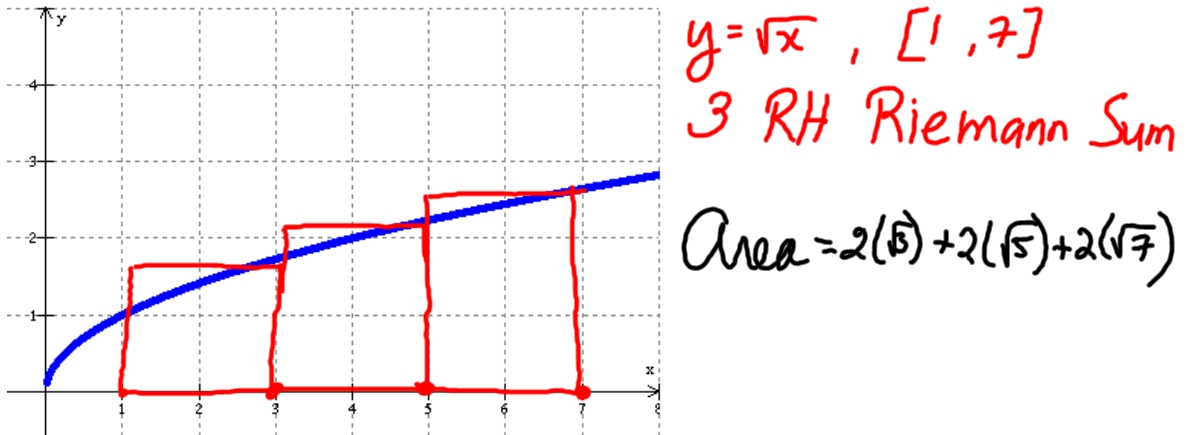
Currently I’m teaching Riemann Sums in Calculus, and I don’t teach it rigorously. My kids don’t need to use summation notation or anything. I’m focusing on the concept. So I have them do a few problems like this (with the picture) by hand:

Many of them struggle with three things: the left handed vs. right handed thing, finding the endpoints of each rectangle, and being able to calculate the Riemann Sum without drawing a picture of the function.

So I created a way for them to represent the Riemann Sum so that they (a) don’t mix up the Left Handed and the Right Handed sums, and (b) they can still sort of “see” the picture. It also helps them if the interval isn’t totally nice.

Before I show it, I want to say that it isn’t innovative or ground breaking. I almost expect people to say how stupid and obvious it is in the comments — or that everyone does something similar. But heck, I don’t care. It does help my kids who have trouble organize all the information.

Note, when you’re watching the video, the difference in how I set up the left and right handed sums…

Vodpod videos no longer available.
more about “Riemann Sum Set Up“, posted with vodpod

So that’s that… If you didn’t catch it, I put little tabbie things on either the left hand side or the right hand side of each rectangle base, to show which one we’re doing. That tabbie thing is there to remind students (a) that’s the side we’re looking at and (b) we’re concerned with the height of the rectangle. That’s also why I write it vertically, instead of horizontally. To show we’re talking height.

I also will probably use this setup when showing them functions that go below the x-axis. (And I will probably write the height of the rectangle under the rectangle base to highlight that the function itself is going below the x-axis.) And use that to parlay into a discussion of “signed areas.”

I can easily see this being extended in a more rigorous course to dividing the interval into n pieces. And discussions of where the most area is coming from, and what that means (e.g. when talking about velocity, that means an object traveled further in that period of time).

Hook, line, and sinker: Calculus bait

I was reading — as I think we all were — that New York Times article “Building a Better Teacher.” In that article, a number of ideas and sentences and thoughts leaped out at me, especially concerning Doug Lemov’s taxonomy. (Yes, like you, I’ve already pre-ordered the book and cannot wait for it to arrive.) One of Doug’s points is:

The J-Factor, No. 46, is a list of ways to inject a classroom with joy, from giving students nicknames to handing out vocabulary words in sealed envelopes to build suspense.

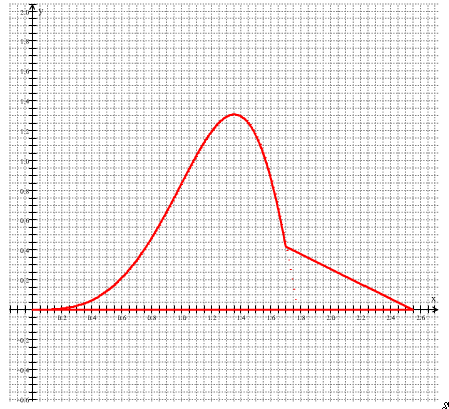
I love the idea of sealing things up and unveiling them. So in my calculus class, right after we finished anti-derivatives but before we embarked on integrals, I gave my kids 15 or 20 minutes and this picture.

I showed them a Chinese take out container which I shook (and it rattled), and I said it had very special prizes inside. I showed them a fancy envelope and gave them each a notecard that they would place in the envelope. With their name, and their area estimate.

Each kid worked individually — using anything they had on them like rulers, straightedges, calculators. One student asked if he could use a scale from the physics lab (I said no, mainly because of the time issue.) I did this in two classes. Both seemed into it, but one was definitely more into it than the other.

What was interesting to me was how hard it was for them. Not the estimating, or the making of triangles and rectangles and other smaller pieces. What was hard for them was being asked to do something that they didn’t know how to do. It happened multiple times that kids were sheepishly telling me that they didn’t know how to start (they had already drawn auxiliary lines and broke the figure up into smaller pieces — um… you DID start, darlin’), that they were doing it wrong (um, didn’t I say there was no wrong way to do this?), that they didn’t know the right way (um, see my last um). They were telling me this to assuage some part of their psyche that was telling them that they had to be right. I told them to STOP BEING CONCERNED ABOUT KNOWING THE RIGHT WAY and just TRY SOMETHING! Then they did.

I also mentioned that last year someone got the answer right to TWO decimal places — setting the bar high.[1]

At the end of the allotted time, I collected the notecards, put them in the envelope, and sealed it with a flourish.

I told them it would take a week or so before we could unveil the envelope (“but Mr. Shaaaaaaaaaaah”) and find out who came the closest to the real answer. And how would we find the real answer?

Calculus.

This was their hook for integrals. The next day (today) I introduced the idea of area under the curve being related to that anti-derivative thingamajig that they had been working on. I got at least 4 questions whining about needing to know who got the closest answer. I stoically responded “you’re going to find out when you figure out the true answer… soon.” The hook worked, and the bait is waiting to be won. For them, the bait is getting the surprise inside that dang Chinese take out box. For me, well, they are now curious.

[1] That was technically true, but slightly a lie. The exercise we did last year was different. I gave various pairs of students the same graph with different gridlines… and I had them estimate. So, for example, one pair of students got:

So clearly their estimation was going to be better — and it is unsurprising they could get an estimation to 2 decimal places. And last year we talked about how the more gridlines you have, the better your estimate can be.

The Unfolding of a Non-Intuitive Problem

Below is a problem that one of my calculus classes tried solving (unsuccessfully) so we banded together and walked through a solution. The problem is this (from here):

If you have two flies on a deflated spherical balloon — one on the equator and one on the north pole — and the balloon inflating at a rate of 5 cubic centimeters a second, how fast are they moving apart from each other at some time t_o?

What I like about the problem is that it is looks as simple as all the other related rates problems they’ve done, but it actually gets pretty complex. And it gets tricky figuring out what you’re trying to solve for, unless you keep yourself organized. What I love most is that you’re given almost nothing, but you end up with an answer I’d call beautiful because it is so ugly. You start out with practically nothing and can get something so ugly out as answer? Awesome. Welcome to math, neophyes!

So we walked through the solution together — after they had a good amount of time a couple weeks ago to try to solve it. I gently asked a few questions prodding them and kept the information organized. What you see below is how the problem unfolded on the whiteboard.

Vodpod videos no longer available.

more about “The Unfolding of a Non-Intuitive Problem“, posted with vodpod


Ideas for my 2009/2010 Calculus Project

Two years ago in calculus, when I only had one section and only 7 students were in that section, I had each student work on an individual project during the 4th quarter.  I helped each student choose a project based on their own interests and then they had a few weeks to work on them, and I would sometimes give them classtime to work on them.

Last year, I was given two calculus sections with many, many more students in it — and I couldn’t come up with a feasible way to ramp up this project idea. That year was devoted to trying to figure out how I could effectively teach to so many more students, who were all so varied in ability. (I did, however, had my kids do some amazing multivariable calculus projects.)

This year I still am teaching two calculus sections, but I feel like I have the course content way more codified. And my algebra boot camps are really working! [1] So I’m already contemplating what a final project would look like for my kids.

I think I will have students pick a partner and work on the project in a pair. And unless they come to me with a specific topic they are dying to investigate, I am going to give them a list of 3 or 4 projects they can choose from. I’ve been wondering what these projects might be, and I am leaning towards a few things that might appeal to those who are more artsy farsy. (Okay, who knows, I might give them 15 project ideas and have them make their own rubric.)

Some ideas that have popped in my mind (clearly they need to be really fleshed out):

1a. Write and illustrate a children’s book explaining calculus to someone in lower school (or, if you want, middle school). You then will present/read your story to actual lower school or middle school students

1b. Write and illustrate an “ABC”s of calculus book (e.g. L=Leibniz! Limit! L’Hopital!), explaining each term graphically or visually.

1c. Write a cogent response (with graphics) to this metafilter post. Be literary.

2. Research the uses of calculus in (architecture, physics, electrical engineering, chemistry, statistics, etc.). Interview someone who uses calculus in their work. Present your findings.

3a. Knowing what you know about calculus now, re-design the course. Explain what order you would teach things in, how you would introduce each unit, what sorts of assessments you would have and why, would you would expand upon, what you would reduce, etc.

3b. Rewrite a 3 day unit from the course. Make the smartboards, handouts, and assessments.

4. Create a visual map tracing the course from our origins (limits) to the end (surface area of revolutions). Explain in your map how various ideas and skills connect.

5. Now that you know more about calculus, revisit the ideas you briefly encountered studying the history of calculus. Do a more thorough and scholarly investigation of Newton and Leibniz and write a short paper explaining the similarities and differences in their philosophical approach to calculus.

6. Create video tutorials for 5 topics you found the most challenging in the course. You may use the SmartBoard. (This harks back to my Algebra II video project from two years ago.)

The point of this blog is for me to jot down ideas. (Some of them are terrible! But that’s brainstorming!) Let’s hope I can get a calculus project actually happening this year!

[1] How I know this first semester of calculus has been a success? I gave my kids their midterm last week, and the grades were way higher than expected. I was shocked that so many students were getting As. Good job kids! Good job!

Teachers Say (and do) the Darndest Things

We all have catch phrases. Things we say, purposefully or accidentally, enough times that the kids have taken note. You know, these are things kids probably mimic when doing impressions of us. Which I know they do. I mean, don’t they?

I bet someone doing an impression of me teaching any of my classes would say “ooooh, CRUST!” as an expletive a lot. That’s my curseword in class, whenever I lose track of time or make a mistake. I also often deny mistakes, jokingly. A brave student will note “you forgot the negative sign there.” I’ll carefully add it in and say “Um, hell-O, no, I DIDN’T. I have no idea what you’re talking about.”

We also have catch phrases related to math. In calculus, you all know my motto, which gets said at least once a week if not two or three or four times a week:

turn what you don’t know into what you do know

And in Algebra 2, I have one class rule for safety. Which I pull out of my pocket a lot:

don’t divide by zero! if you do, the world BURSTS INTO FLAMES!

[And then I take the red smartboard marker and draw flames around the thing that would have a zero in the denominator.]

Kate Nowak’s recent post talked about the changing of traditional teaching phrases in her class[1]:

Today in Algebra 2 we reviewed negative exponents and the children acted like they had never seen it before. I told them about the phrase “move it, lose it” for dealing with a negative exponent, as in, move the term to the other side of the fraction, and lose the negative sign. A student who moved here from another state (where, you know, they get to spend enough time on things to actually learn them) told us about the phrase she learned “cross the line, change the sign.” Which the kids liked better. “You know, because it actually rhymes, Miss Nowak. Unlike yours.” Um, last I checked “it” rhymes with “it.” I’m not an English teacher! You can tell because I’m not wearing cool shoes and I don’t give hugs.

Okay, a big giant *grin* for the best two lines I’ve ever read on a blog (the last tines, obvi). But it got me thinking more about these techniques we use to teach kids to remember things. Yes, I think kids should know the reason why particular algebraic manipulations / formulas work. But once they show me that they “get” it I have no problem with them using phrases and shortcuts to help them remember things.

I mean, how many of you always rederive the quotient rule when taking a derivative of a rational function in calculus? Or do you sing a little sea shanty like:

low de-high less high de-low
and down below
denominator squared goes

Or for the quadratic formula? In your mind you’re definitely saying the formula in a very specific way each time. Think about it.

THINK, I said.

Yup, I thought so. So inspired by Kate, I thought it would be a neat exercise to chronicle three of the ways I get kids to remember things or do hard things.

(1)

The “pop it out” rule for logarithms. When we are learning how to expand \log(x^3) to get 3\log(x), I always say “POP IT OUT!” and do a raise the roof hand gesture. I don’t know why I do that. I don’t know how it started. Maybe the raising of the roof is popping out of the exponent. Then when students are working and get stuck, I sometimes help ’em out by quickly doing a mini raise the roof. Then they always exclaim “Oh! Pop!”

(2)

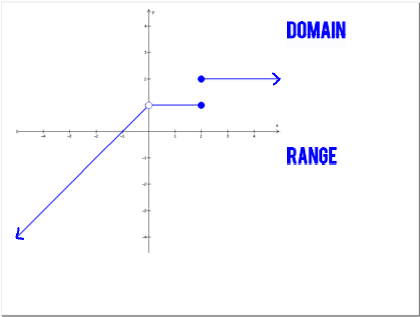
[Note: I am pretty sure I stole this from someone from a couple of years ago.] When teaching how to visually find the domain and range of a function, I tell students: “Guess what? You don’t know this but besides your calculators you have another a highly sensitive and powerful mathematical instrument. It’s kind of awesome. It’s called a domain meter.” I throw a relation on the board:

I tell them to hold out their index finger way to the left of the graph. Then slowly move it rightward across the graph. As they do it, I do it with them, and as soon as my finger hits x=-2 I start annoyingly sounding “BEEEEEEEEEEEP” while continuing to move my finger. Finally when my finger reaches x=2, I stop beeping and I silently continue to move my finger. I tell them: “my domain meter only beeps when it hits the graph. What’s the domain?” (They get it.)

Then I say “Believe it or not, you have another amazing mathematical instrument. You guessed it, a range meter.” I then hold up my vertical index finger (“domain meter!” I exclaim) and turn it horizontal (“range meter!” I exclaim). Then I take my horizontal finger and start at the bottom of the graph and move it upwards. I only start beeping at y=0 and continue until y=2. They all can state the range at this point.

I’ll end up finally throwing something more complicated on the board:

and they’ll get it, first try.

(3)

In calculus, I want my kids to be able to see derivatives quickly. My first year teaching it, I focused a lot on u-substitution to take the derivative of \cos^4(x). Why? Because my kids just couldn’t get the hang of “seeing” the answer. So I came up with the “box method” of teaching the chain rule, which works great. (And yes, of course, I always teach u-substitution first and we talk about why this “box method” works.)

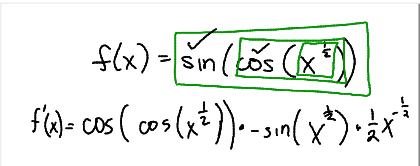
I have my kids first rewrite the function so that they can see “inner” and “outer” functions. So for example, they have to rewrite \cos^4(x) as (\cos(x))^4. That way they can see the “inner function” easily. Similarly, they need to rewrite \sqrt{\cos(x)} for the same reason. I then ask them to put a box around the inner and outer functions respectively. If there are more than two (functions within functions), they should make all the boxes.

So let me show you with a simple example from class today:

I have students write the functions in terms of “outer,” “inner,” “more inner,” etc. until they get to the gooey center of a composition of functions. Then I tell them to look at the outermost function, ignoring everything from the boxes inside (in our example above, they’d say “sine of blah”). I asked them “what’s the derivative of sine of blah?” and they all say “COSINE!” So I write

\cos(stuff)

and ask “what do I put in here?” They say “don’t touch the innards!” So I fill it in:

\cos(\cos(x^{1/2})).

Then I put a check next to the outermost function and say “we’ve dealt with you, so we’re done with you.” I then go to the middle function and say: “What’s the derivative of cosine of blah?” and they all say “NEGATIVE SINE!” So I go to the board and add

\cos(\cos(x^{1/2}))*-\sin(stuff)

and ask “what do I put in here?” They say “don’t touch the innards!” So I fill it in:

\cos(\cos(x^{1/2}))*-\sin(x^{1/2})

Then I put a check next to the cosine function and say “we’ve dealt with you, so we’re done with you.” I then go to the middle function and say: “What’s the derivative of x^{1/2}?” and they all say “\frac{1}{2}x^{-1/2}. So I stick that on at the end.

\cos(\cos(x^{1/2}))*-\sin(x^{1/2})*\frac{1}{2}x^{-1/2}.

And fin, we’re done. It goes pretty fast once they get the hang of it. And they actually secretly love having equations that are scrawled across a whole page.

[1] Kate, forgive me for cribbing so much wholesale. But I needed to have the last sentence in there!

Genesis

I am exhilarated. The past two days in my calculus classes have taught me more about teaching (and more about student learning) than any other days this year. I am so engrossed in what’s going on that I feel like I might be at the brink of something big for my teaching… Maybe not, maybe this is just a passing thought, and I might grow bored of this, but right now it feels big. It could be a genesis for me-as-teacher.

As you know, I’m interested in the questions of how to teach problem solving, how to hone intuition, and how to build independence and tolerance for frustration for students. But on a whim, last week, I decided to temporarily throw all those huge questions out the window and just do something, anything, to get students to problem solve. My kids had just had a test on basic derivatives, so it was the perfect time to digress before Thanksgiving break.

So you know where we are… my calculus students had learned how to find derivatives of basic functions, they had learned the product and quotient rules, and they had a bunch of the conceptual ideas down. (For example, they could explain why the power rule works and where the formal definition of the derivative comes from.) But that was it. We focused on finding the derivatives of function after function after function.

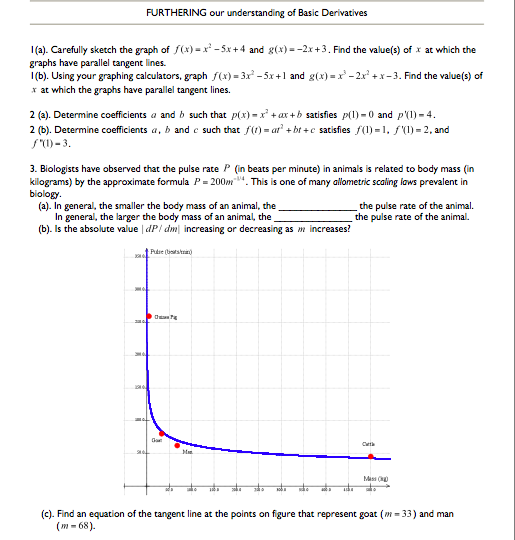
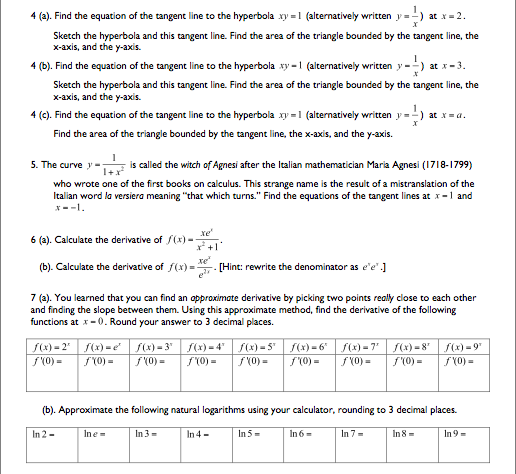
So I gave myself 3 days to do something. I crafted a worksheet with 7 questions. Many just taken wholesale from our textbook, or slightly modified/scaffolded. I didn’t try to find hard problems. I have no interest in throwing my kids into the deep end of the pool [1]. Instead of “hard,” I tried to find problems that were different than any problems they had seen before.

You might look at this sheet and say “yeah, any calculus student who knows how to do derivatives ought to be able to do these questions.” But the first thing I learned in these two days is that that would be a huge mistake. In fact, it was a mistake I made for the past two years. I would assign one of these sorts of problems for homework, and the next day students would come in asking questions, and we would go over how to solve it in class. And by “we” I mean “I” would explain the solution asking students questions along the way. Then my kids would ostensibly know how to solve the problems. And I would move on, knowing they had “learned more calculus” and mastered “one more type of problem they might confront.” And although it may be true, my kids never really had to flex any of their intellectual muscles. They learned another algorithm. They didn’t ever have to struggle, minus a few minutes (seconds?) at home before giving up.

Here’s how these days went.

DAY ONE

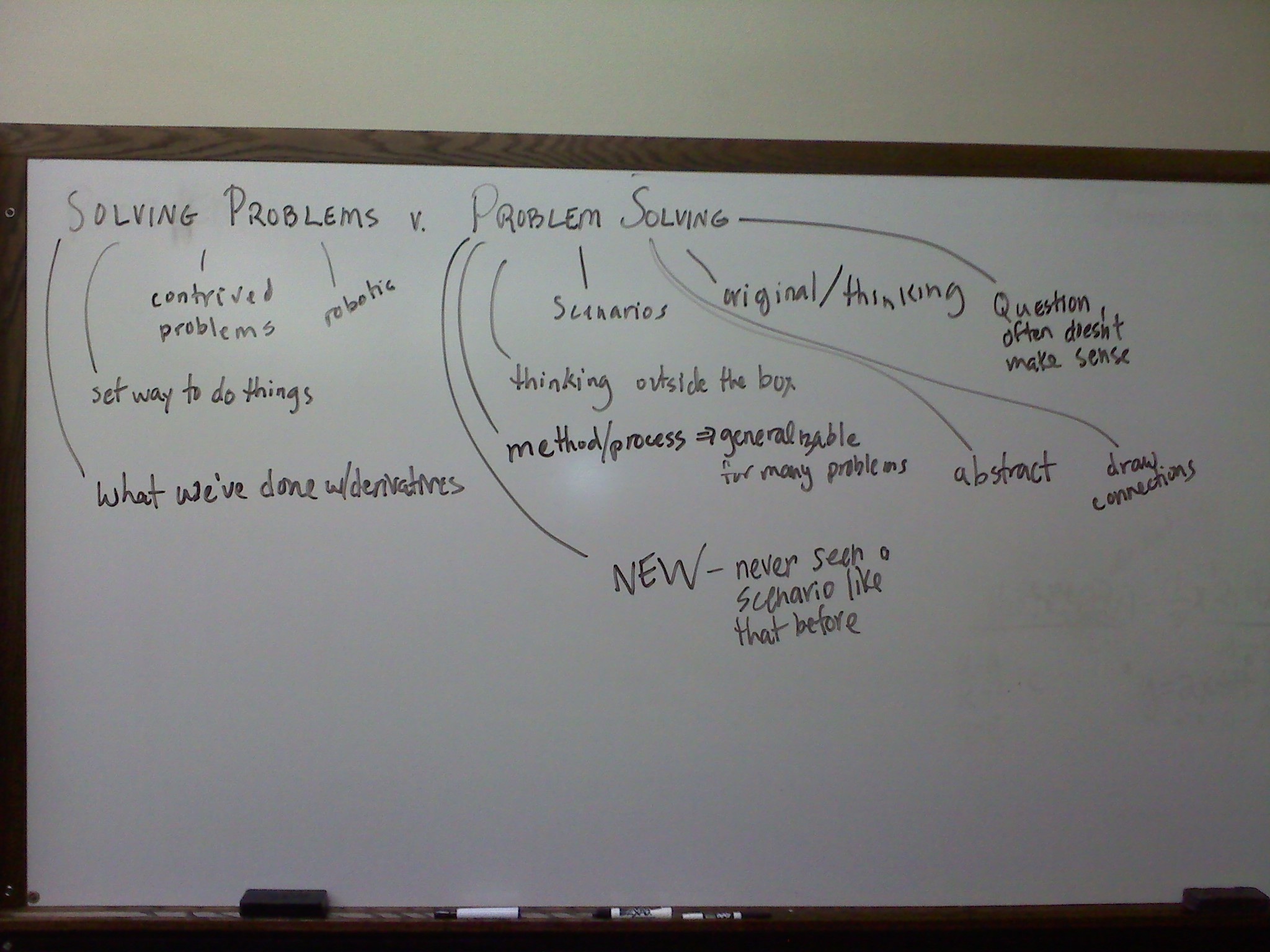
I start out with “SOLVING PROBLEMS v. PROBLEM SOLVING” on the board. I tell students what we’ve been doing in this unit is solving problems. I ask them what they think the difference between the two things are. This is what we come up with:
I put them in pairs. I tell some of the groups to work on problems 1, 3, 5, and 7, and the other groups to work on 2, 4, 6, and 7 — starting with whichever question strikes their fancy. I tell them that I won’t be of much use to them. That they are going to have to use their wit and wiles to do these problems. That they should ask their partners their questions, that if they really get stuck they should go to another group, and if they really, really get stuck, they can talk to me. Although I won’t be of much use to them.

They start working. For the remaining 40 minutes. They are totally on task. They are struggling to understand the questions, and they are trying to explain their ideas to each other. For example, for question 1, some groups just couldn’t understand what the question was asking.

Me: “Did you graph the two functions like the problem said?”
Them: “No.”
Me: “Maybe that will help you understand the question.”
[I come back later]
Me: “Do you understand the question now?”

Or sometimes I would get some student needing affirmation:

Them: “Mr. Shah, for this problem I first took the derivatives of the functions and set them equal to each other and then I solved and got this quadratic and then since I couldn’t factor it I used the quadratic formula.”
Me: “That sounds like a statement. Do you have a question?”
Them: “Well, I guess I’m asking you if I’m on the right track.”
Me: “You know I won’t answer that. Do you think you’re on the right track?”
Them: “I think so.”
Me: “So go with it. Stop worrying about being right at every step. Have confidence. Talk things out. Make mistakes. Whatever. Now stop bothering me.”

I have to encourage a couple of people to work as a team instead of independently, but other than that, my students are killing it. It is amazing. I can’t understand what it is, but my kids are really into this!

One of the groups which is working on problem 4 says “Mr. Shah, now that we’ve done part (a) and part (b) for this question, we’re not problem solving anymore. We’re just solving problems when we’re doing part (c).” I almost cry. My kids are starting to recognize on their own that once they problem solve and get a technique down, they are then only solving problems. They have another tool in their toolbelt with which to problem solve.

At the end of the class, I say “Stop.” Most have only solved 2 or 2.5 questions. I smile and tell them that’s alright, and that they are doing so amazingly that I am not going to assign any homework.

Lessons from DAY ONE:

  • The “easy” questions I chose aren’t so easy, since my kids have never seen questions of that particular form before. As I suspected, this is problem solving for them.
  • The kids who are afflicted by “learned helplessness” (read: who always raise their hand at the first sign of trouble) can think for themselves. In other words, my kids can be independent thinkers if forced to.
  • Kids need time to struggle and grapple and do basic things like draw parabolas and hyperbolas. I assume they can do these things quickly. They can’t.
  • My kids are not to be underestimated. I realized that I regularly underestimate the ability of my kids to think for themselves. Which is one of the biggest reasons it has been hard for me to let go of my teacher-centered class, and lead more of a student-directed class.
  • Many of my kids actually found math fun/interesting! Without the stress of grades and time pressure, they got to enjoy the puzzle aspect of math!

I sent out a survey to my students asking them about this first day of problem solving.

Some of their positive responses (and see this teaser post for my favorite response):

It’s exciting to think that we are finally able to combine a lot of the formulas and other material we learned previously to solve a single problem.

I think it went well. It was tough, but rewarding to get an answer, even though we still weren’t sure if it was correct.

I found the class really interesting because I often find myself neglecting my brain and just accepting what teachers tell me. It’s a nice change of pace to think for myself for once and truly try to understand it.What makes me excited about doing more of this is that I feel the more we do, the more comfortable we will be with doing them.

I think it went really well, actually. I liked the problem solving.

I liked doing problem solving because it was different from what we’re usually doing. It’s also a good way to work on a different way of thinking about things, which I’m always appreciative of.

I think it went well. It’s hard to start out a problem, but then at a certain point things start to click.

It wasn’t bad, it was good working in groups so that we can bounce ideas off of each other. It was good applying the things we learned previously.

Im excited to be able to do harder problems, and it makes the easier problems look and feel alot easier.

It’s really interesting and challenging. Solving these problems is like solving puzzles because you already have the pieces, but you need to find a way to piece them together so they form a whole.

I like working with a partner on problems. i think that these problems feel very comprehensive which is fun.

There were no negative responses. There were anxieties though. All of their anxieties about problem solving boiled down to two things: grades and their ability to actually do the problems since there is no set method to solving them.

DAY TWO

I start out the class reminding the kids about problem solving. I talk about their survey responses, and the anxiety about grades. I tell them to mitigate their fears, whenever we problem solve I will always give them a choice of problems to work on, I will let them work in pairs (at least for now) so they can bounce around ideas, and that I will grade them on more than just answers. I will grade them on their formal writeups and the clarity with which they explain their approaches to the problems, even if none of their approaches succeeded. My kids seemed to feel those addressed their concerns.

I set them off to work with their same partners. If they worked on the even problems, they should work on the odd problems (regardless of whether they solved all their even problems). If they worked on the odd problems, they should work on the even problems (regardless of whether they solved all their odd problems). The students work. I wasn’t sure if they’d still be into it, but they are.

Five minutes before class ends, I stop everyone. Most groups had gotten 3 more problems done. I tell everyone their homework. Each student must pick two problems and do a formal writeup for those two problems. No one in the group can do a formal writeup of the same problems, though. I ask them  how day two went. They agreed that it was (on the whole) much easier the second day, now that they knew what they were doing and how to work with their partners.

Lessons from Day Two

  • I suspect that two days of problem solving is enough. I think more time will make what we’re doing into a chore instead of something new and exciting.
  • My kids really, really want to know if their answers are right. I refuse to tell them. That bothers them. I tell them that’s part of problem solving. And then I asked them if they have a way to check their answers themselves?

Where am I going from here?

1. Tomorrow, I’m going to have each student exchange their writeups with their partners. They are going to read through the writeups, and come up with comments and suggestions for clarity. Diagram here? Explanation there?  After 15 minutes of discussion, I’m going to tell them that the remainder of their classtime will be spent writing up a better version of their partner’s solutions. Their final draft. Which will be graded.

2. Now that my kids have struggled with some easier problems, and know they are capable of working them, I created a bunch of harder problems. I am going to distribute these problems to my classes, partner them up, and give them one week and two weekends to solve 2 of the problems. I will give them 20 minutes to work together in class in the middle of the week. The problems are here, if you want to see them.

3. I’m going to photocopy each classes’ writeups and distribute them. We’ll talk about what makes a good writeup and what makes a bad writeup.

4. I think I might spend two days after each unit doing this.

And with that, I’m out.

[1] One thing I want to avoid at all costs is being one of those teachers who says “I teach problem solving” while actually just giving hard problems to kids and then watching them struggle. I want to teach problem solving. That’s tough.