I had a thought that just occurred to me and I wanted to archive it before I forgot it. I’ll probably forget that it is even here at all, and nothing will come of it, but I had a thought about developing a new one-semester course for juniors and seniors at my school.
It would be called something like “Reading and Writing about Mathematics.”
I’ve always been obsessed with reading books that aren’t textbooks about mathematics. I have almost half a bookshelf filled with these books. I love (when I have time) reading articles about modern mathematics in Quanta magazine. I’ve sometimes formally incorporated reading books about math in my classes in the distant past (a variety of books and articles in multivariable calculus; a book called Weaponized Lies: How to Think Critically in the Post Truth Era in my Algebra 2 class). And for many years, I’ve reached out to kids and set up many math book clubs, where we meet over lunch for a few different times to read books about math. I even was once interviewed about this, and wrote an article about this.
So why not formalize this into a class?
The biggest benefit I can see for the class would be introducing students to what modern mathematics is, so they don’t leave thinking mathematicians are just doing precalculus or calculating integrals in their ivory towers. Just like kids in physics will learn that the physical world is weird and wild when they are introduced to the ideas of quantum mechanics and relativity (even though they aren’t delving into the nitty gritty) in high school, I’d like a way for kids taking this class to learn that the mathematical world is weird and wild… and most importantly: human. A course like this will humanize math for students.
Right now I’m reading Jordan Ellenberg’s book Shape: The Hidden Geometry of Information, Biology, Strategy, Democracy, and Everything Else [here], with 5 students and 2 other teachers. As we’re reading it, there are parts that intrigue students but we need to parse it out together for it to fully make sense. One example was in this book, Ellenberg talked about the question “How many holes does a straw have?” and he brings us into topology and understanding how holes can have various dimensions. As we parsed this, I thought: oh, reading this and then also doing some mini-problem sets on the math could help kids understand things at a deeper level, or confirm their understanding of what they read. We could do our own simulations of random walks, in the section involving that idea. We could parse out the idea of the “necklace problem” which we’re going to talk about at our next meeting, which I’m sure the kids won’t understand because they aren’t drawing things out but more passively reading. In other words, we’d be able upgrade a passive reading of the book to an active reading of the book with a mini-problem set that brings ideas that might not fully make sense to life.
Additionally, there are books or articles that we could read that would help students understand the social construction of mathematics (hello anything on the controversy of the ABC conjecture and Mochizuki’s “proof”).
We could learn about the origin of ideas that seem to have existed forever or that we take for granted, but actually had to be developed (e.g. the idea of “0” or the controversy over calculus being on firm footing). And mind-blowing ideas like how all of mathematics almost fell down with the work of one mathematician, Godel. And we can learn about marginalized and overlooked people. There are some really great children’s books on mathematics, so we could read some of those as we begin the class! Maybe complement that with some excerpts from Douglas Hofstader’s Godel, Escher, Bach, a newspaper article about a modern mathematical breakthrough, some math poetry, a formal mathematical paper that has come out in the past 10 years and is hailed as one of the most important discoveries, and one more piece that’s maybe more traditional, so kids can see the wide variety of ways people write about mathematics.
And kids would think about how the writing that they’re reading is effective to reaching their intended audiences, or how it isn’t effective and what would make it better.
And kids could pick ideas or people to learn about, do their own research, and write their own popular mathematics writing. We can workshop it and publish a little journal at the end of class with our pieces.
I could reach out to English teachers to learn how they facilitate conversations about books so that it doesn’t go stale (we aren’t doing the same thing every time we discuss some of the reading). I’m sure there are universities that offer similar classes, so I could see what else is out there. And I know MIT has a graduate program in science writing that I could draw ideas from.
Okay, I’m done brainstorming for now. I just wanted to get all these ideas out before I forget them. I might update this post with additional ideas as my mind percolates. As I said… most likely nothing will come of this. But I could see having a really fun summer trying to put this course together.
NOTE: The deadline has passed to propose this course for next year. But it would take me a long time to develop the course outline anyway, so I could try to design it this upcoming summer and submit it for the following year.
I’m not sure this is comprehensive, but this is a list of books I’ve worked with kids/faculty in various capacities on [but it is not all the popular math books I’ve read]
*=I’ve done this for a student (or student and faculty) book club
**=I’ve led/organized a book group with just teachers on this
***=I’ve had students individually read this (to discuss with me in an independent study or for a math project)
*Anna Weltman, Supermath [here]
*Edwin Abbott, Flatland [here]
**G. Polya, How to Solve It [here]
*Amir Alexander, Infinitesimal [here]
***Charles Seife, Zero: The Biography of a Dangerous Idea [here]
*G.H. Hardy, A Mathematician’s Apology [here]
***David Leavitt, The Indian Clerk [here]
*Steven Strogatz, The Calculus of Friendship [here]
**Steven Strogatz, Infinite Powers [here]
*Edward Frenkel, Love and Math [here]
*Robert Kanigel, The Man Who Knew Infinity [here]
***James Gleick, Chaos [here]
***Yoko Ogawa, The Housekeeper and the Professor [here]
*Margot Lee Shetterly, Hidden Figures: The American Dream and the Untold Story of the Black Women Mathematicians Who Helped Win the Space Race [here]
***Hiroshi Yuki, Math Girls talk about Integers [here]
***Hiroshi Yuki, Math Girls [here]
*Jordan Ellenberg, How Not To Be Wrong: The Power of Mathematical Thinking [here]
*Jordan Ellenberg, Shape: The Hidden Geometry of Information, Biology, Strategy, Democracy, and Everything Else [here]
*Daniel Levitin,Weaponized Lies: How to Think Critically in the Post-Truth Era [here] — the first third
***Ben Orlin, Math With Bad Drawings [here]
*Ben Orlin, Math Games with Bad Drawings [here]
***Paul Lockhart, A Mathematician’s Lament [here]
***Cathy O’Neil, Weapons of Math Destruction: How Big Data Increases Inequality and Threatens Democracy [here]
*Hannah Fry, Hello World: Being Human in the Age of Algorithms [here]
***Allison K. Henrich, Emille D. Lawrence, Matthew A. Pons, and David G. Taylor, eds, Living Proof: Stories of Resilience Along the Mathematical Journey [here]
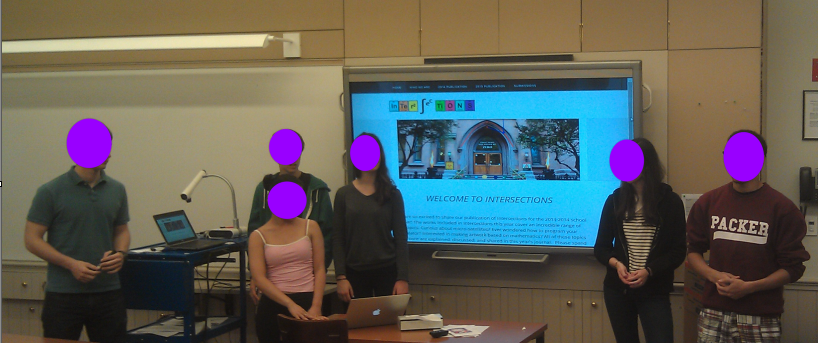
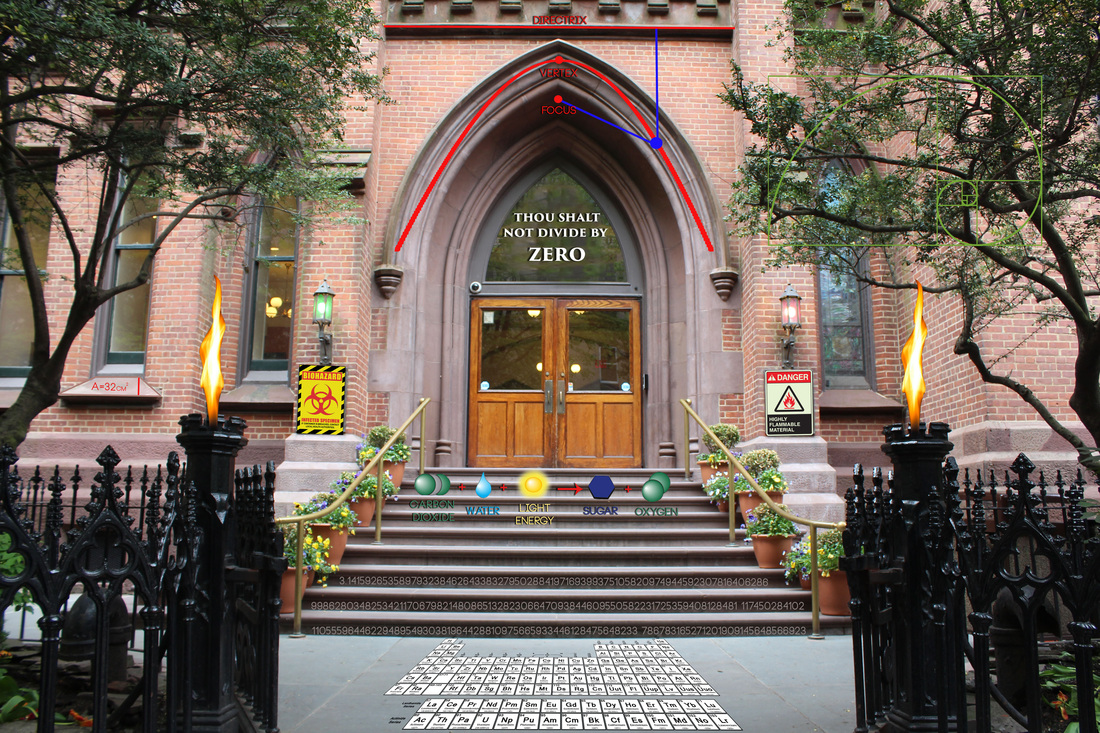
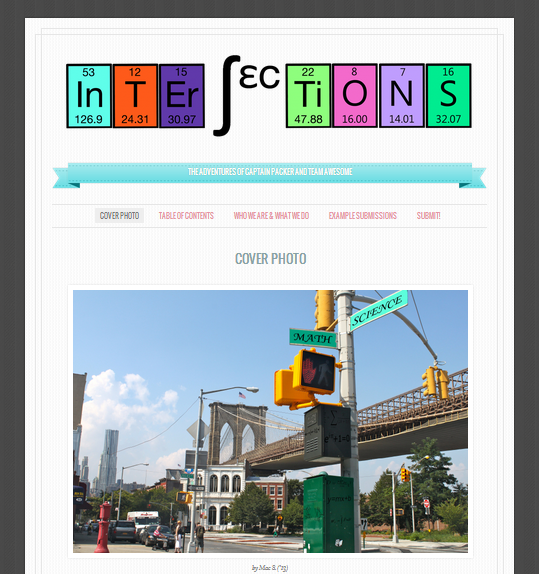

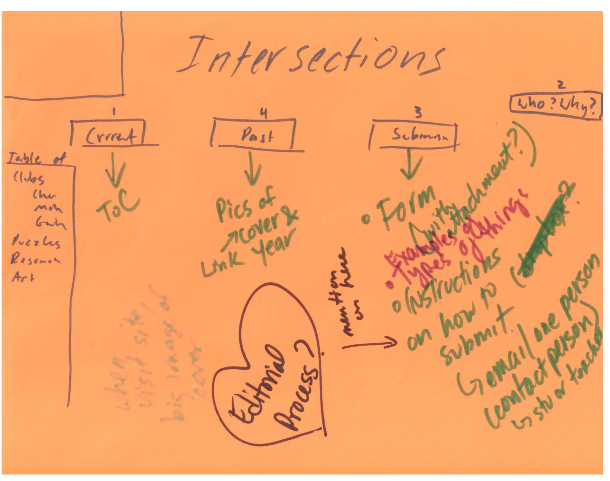
 . Or whatever. Knowing there is a publication you can direct the student to, as a way to say “hey, you’re doing something awesome… seriously… so awesome I think you kind of have to share it with others!” is going to be so cool for teachers. (As a random aside, I was thinking I could enlist the help of the art and photography teachers, because of the overlap between math and art… They might make an assignment based around something mathematical/geometrical, which students can submit…)
 , I would bet my Algebra II kids would be able to. But if I showed them the question and the solution, and ask them to explain what the solution to that question means, I would expect that only half or two thirds of the class would get it right. (Hint: The solution is the set of all points (x,y) which make the inequality a true statement.) They can do the procedure, but they don’t know what the solution means? That’s what I’ve found. And you know what? Before asking students to write in the classroom, I had deceived myself into conflating students being able to answer
 . Sure, they can get
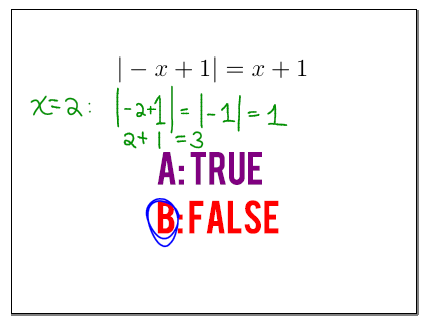
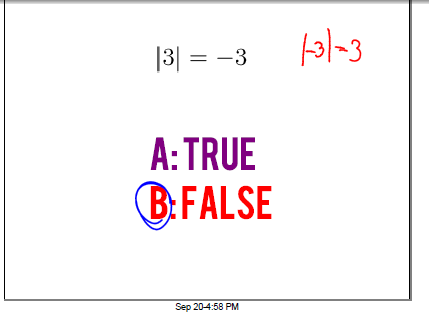
  . But does doing that really mean they understand that whole “if you divide by a negative in an inequality, you switch the direction of the inequality” rule that has been pounded in them since seventh grade? Nope. The traditional questions don’t tend to check if the kids know why they’re doing what they’re doing.
 or
or  , I asked kids to solve things like
  or something similar. Many students said on their home enjoyment:
 or
or  .
.


 Continuous Everywhere but Differentiable Nowhere