Multivariable Calculus

A Super Specific Multivariable Calculus Question

Hi all,

I have a question about multivariable calculus, that I need some help with. My kids and I are both slightly stumped about this.

The question we are asked — in a section thrillingly titled, replete with semicolon, “Parametric Surfaces; Surface Area” — is to find the surface area of “The portion of the sphere x^2+y^2+z^2=16 between the planes z=1 and z=2.”

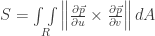
In class, the formula we derived for surface area for any parametric surface \vec{p}(u,v) is

S=\underset{R}{\int\int} \left\Vert \frac {\partial\vec{p}}{\partial u}\times\frac{\partial \vec{p}}{\partial v}\right\Vert dA.

We solved this by converting the (top part) of the sphere to a parametric surface:

x=r\cos(\theta)
y=r\sin(\theta)
z=(16-r^2)^{1/2}

Then we defined \vec{p}=<r\cos(\theta),r\sin(\theta),(16-r^2)^{1/2}> (where \theta ranged between 0 and 2\pi and r ranged between \sqrt{12} and \sqrt{15}. (Those limits for r come from the fact that we want the surface area of the sphere between z=1 and z=2 — which correspond to r=\sqrt{15} and r=\sqrt{12} respectively.) [1]

So I calculate \frac{\partial \vec{p}}{\partial r}=<\cos \theta, \sin \theta, -r(16-r^2)^{-1/2}> and \frac{\partial \vec{p}}{\partial \theta}=<-r\sin \theta, r\cos \theta, 0>.

So to use our surface area formula above, we need to find \left\Vert \frac {\partial\vec{p}}{\partial r}\times\frac{\partial \vec{p}}{\partial \theta}\right\Vert. Calculating that out, we get it to equal \frac{4r}{\sqrt{16-r^2}}. Phew, now we have something we can plug into the surface area formula for that “norm of the cross product” thingie.

Here’s where the question comes in. We know

S=\underset{R}{\int\int} \left\Vert \frac {\partial\vec{p}}{\partial r}\times\frac{\partial \vec{p}}{\partial \theta}\right\Vert dA=\underset{R}{\int\int} \frac{4r}{\sqrt{16-r^2}} dA.

Why is it that when we finally evaluate this beast, dA is not equal to our normal area element for polar, namely r dr d\theta? For the answer to come out right, we need to let dA equal to simply d r d\theta.

WHY? Why don’t we plug in the normal polar area element?

Here’s my thinking. Even though we usually use dA to represent an area element, in this particular surface area formula, it doesn’t represent anything more than du dv (for whatever parametrization gets made). The reason I think this? When I look at the derivation of the formula, it defines du dv to be dA. Simple as that.

I used to think that dA had a fixed meaning: the area element in a particular coordinate system. However, I’m now thinking that it might mean different things in different equations? Either that or our book is being sloppy.

If anyone can follow what I’ve written here and has any help to proffer, I would be much obliged. It’s a small point — one that won’t really matter in the long run for this course — but both my kids and I would like to have this resolved once and for all.

[1] If you don’t see that, imagine you have this sphere and you make a slice at z=1 and another slice at z=2. You want the surface area of that little curved “ring” — and if you find the shadow of that ring on the x-y plane, you’ll get two concentric circles with radius \sqrt{12} and \sqrt{15}. That’s the region R that you will be integrating over.

My 2009-2010 Course Expectations

Below are working drafts of my course expectations for next year. Most things — in terms of wording and text — haven’t changed, although the grading breakdowns have. In case it wasn’t glaringly obvious, I’m all about having super clear expectations for my students. Anyway, you can see that aspect of my teaching come through in these.

Algebra II Course Expectations, 2009-2010

Calculus, Course Expectations, 2009-2010

Multivariable Calculus, Course Expectations, 2009-2010

Feel free to steal anything, if you like anything.

The MV Calculus Final Projects

Last week my multivariable calculus class turned in their final projects, and made presentations. Of all my classes this year, by any metric, this course was my most successful. I loved seeing their final projects, and the amount of work and dedication they devoted to them. The best part: they were super proud of their projects too.

I made a post about coming up a list of fourth quarter final projects a while back. My big fear with these projects was senioritis. The projects are designed to be largely self-directed, and if a student got lazy, well, …, that would spell disaster. Luckily, none of the students in the class fell prey to that dreaded disease. My kids are great kids, so that helped. But also I let them pretty much have free reign on their projects and kept emphasizing they should pick something they WANTED to have FUN with. Lastly I met with them weekly to help them out and keep tabs on their progress — prodding them a bit here and there.

Without further ado, the four projects:

1. One student actually created a harmonograph (a device which draws damped Lissajous curves).

Yes, that is his video of his harmonograph.

2. One student researched Maxwell’s Equations and read A Student’s Guide to Maxwell’s Equations (Fleisch). He produced a written paper explaining the integral and differential forms of Maxwell’s equations.

3. One student created a giant wooden and wire sculpture (titled “The Visualizer”) which illustrated a lot of what we’ve learned about curves in 3-space. Namely, he illustrated arc length, vector equations for curves, curvature, and the tangent, normal, and binormal vector with his sculpture. He also wrote an associated paper which is to be used with the sculpture to examine these ideas in more detail.

4. One student took foam board and cut a whole bunch of figures (from the simple square to weird and complex shapes). He then calculated the center of gravity of these figures theoretically, and tested to see if the figures would balance at that point. Then he extended this by making figures with non-homogeneous density, calculated the center of gravity of these figures theoretically, and tested to see if the figures would balance at that point.

I mean, seriously, look at that. Amazing. These kids got into it, because it was their own thing. Because they weren’t really worried about their final grades. (I let them grade themselves.) I am going to miss these miscreants a lot next year.

Multivariable Calculus Projects

Monday is the start of the 4th — and final — quarter at my school. I desperately want my Multivariable Calculus students to really love the end of the course. In the same spirit as the rest of the course (focusing on basic concepts and applying them to very difficult problems), I have decided to assign half as much homework and have students spend their time really investigating a hard problem, researching an interesting topic, or creating something based on what we’ve learned. Their choice.

I whipped up a draft of my expectations for their end of year project, which I’m embedding below (Go Scribd! I’ve been waiting for this feature to be WordPress.com compatible for eons!). I know this is not an ideal set of expectations. I need to clean up the redundant language, provide examples of good and bad prospectuses, as well as have on hand sample rubrics for students to use as guides when creating their own. (As an aside, if you know of any prospectuses/rubrics for me to show them, I’d very much appreciate you throwing the link down in the comments!) But my thought now is that I’ll see what happens this year, and then tweak it for future years:


I also spent a number of hours coming up with possible Multivariable Calculus projects, posted at my Multivariable Calculus resource site. I hope to add to it as ideas strike me. I’ll copy the projects that I have as of April 11, 2009, below the fold. But click the link above for a list that will hopefully be updated.

(more…)

A fun double integral

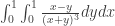
On my multivariable calculus class’s current problem set, I put a number of really challenging problems. One of them — from both the Exeter Math 5 course (here) and also in Anton — has students evaluate the following double integral, and then has students change the order of integration and then evaluate the double integral.

\int_0^1 \int_0^1 \frac{x-y}{(x+y)^3}dydx

Students expect the answers to be the same, but it turns out they are not. (Do you see why?)

Anyway, I have to say that I’m not a master integrator; it usually takes me a little longer than desired to figure out the best method to integrating. But I enjoyed the roads I took, so I thought I’d share the integral with you if you wanted a challenge.

And for those of you who know calculus, but forgot or never learned multivariable calculus, the problem reduces to you solving the following single integral: \int_0^1 \frac{a-y}{(a+y)^3}dy, where a is just a constant.

Have fun. And for what the double integrals turn out to equal, go below the jump.

(more…)

Ennui

I don’t really have the energy to give a true update, and I don’t want to complain. I just feel like in the past few days, I’ve been struck with a sense of lingering ennui, and I’m hoping that Spring Break rejuvinates me. It appears that students are really stressed out this week, and it’s being reflected in the way they’re acting. And honestly, it’s a bit of a cycle, because the way the students are feeling is affecting the way I’m feeling, which is affecting the way that students react to me, and so on and so forth.

For short updates on my three preps, read on.

1. In Multivariable Calculus, we’ve been working very slowly on our current chapter. I thought we’d be able to finish it before the quarter ends, but now I’m skeptical. We’re going to have to work pretty darn hard. The current problem set that I’ve given them is pretty tough, but we’re doing this one even more collaboratively than the others, so I’m glad about that. Recently, in class, we had to solve \int \cos^4(x) dx and I forgot how to even go about it. We found a nice, but convoluted solution, because we were working with nice limits of integration. But I have to tell you… I forgot how to do a lot of these less straightforward integrals. The good news is that we came up with ideas and found the solution using symmetry arguments and trig identities. Awesome. At first I feared this was a waste a time, but then I realized: this is what this course is about. Problem solving. You have something you don’t know, and you don’t have a formula for it. Work it out.

2. In Algebra II, I’m a bit behind the other teacher. We’re teaching function transformations, after a pretty arduous — but I’d say successful — unit on inequalities and quadratics. I don’t have a great way to introduce function translations, other than students doing some graphing by hand and noticing some patterns. (“Oh! The graph is the same as the other graph, but moved up one unit!” or “Oh, why is the graph the same as the other one, but moved to the left?”) I’m repressing the name now, but some math blogger posted a Logarithm Bingo game. I think that once I finish the functions transformations unit, I’m going to design and play Function Transformation Bingo!

3. In Calculus, we’ve been working more on the anti-derivative. It’s funny how different my students are. Some have the intuition like *that* while others are struggling to figure out what’s going on. But honestly the only way to do these problems is to really struggle through them. My favorite problem from last night’s homework was to find the antiderivative of x^{1/3}(2-x)^2. Almost all students got it wrong, because they didn’t see that if you expand everything out, the problem reduces to something much easier: finding the antiderivative of 4x^{1/3}-4x^{4/3}+x^{7/3}. Well, them not seeing that it is easily expanded causes me less chagrin than a student saying, “so you must first multiply the x^{1/3} by each term in the 2-x expression, and then square it?” YEARGH!

That’s all folks.

Convenient Order of Integration

I’m teaching double integrals, and there was this really great problem:

\underset{R}{\int\int}x\cos(xy)\cos^{2}(\pi x)dA

over the region R=[0,1/2]\times[0,\pi].

The problem is supposed to show that changing the order of integration can make the problem really easy or really hard.

\int_{0}^{1/2}\int_{0}^{\pi}x\cos(xy)\cos^{2}(\pi x)dydx is easy to solve.

\int_{0}^{\pi}\int_{0}^{1/2}x\cos(xy)\cos^{2}(\pi x)dxdy is hard to solve.

However, I don’t think the second integral should be impossible to solve. It’s been so long since I’ve really dug into integration, and we tried in class and couldn’t find a quick way to solve the second integral. Any ideas?

For those who know calculus but not Multivariable Calculus, the hard part of the second integral is simply being asked to solve: \int_{0}^{1/2}x\cos(cx)\cos^{2}(\pi x)dx, where c is simply a constant.