Monthly Archives: June 2010

Blogotwitterversphere

I’m currently at PCMI in Utah (that’s the Park City Math Institute) for three weeks. There are about 50 middle and high school math teachers, all geeking out about teaching. Tomorrow I’m supposed to give a 5 minute talk about blogs and twitter. Little do they know it will be 7.5 minutes. Mwa hahaha. Talking about this stuff is not a big deal, and given a microphone and an internet enabled laptop, I could probably talk for a good hour. But to whittle away at my thoughts until I hit some core ideas that I can collapse into 5 minutes — that sounded like a fun challenge.

I decided to create a pecha kucha (20 powerpoint slides, 20 seconds per slide; see my favorite one here). Making one was new to me. And dang, it was hard. I failed. It turns out I didn’t get to 20 slides, and most have a little over 20 seconds of talking. So below you can watch the presentation that resulted out of the failed pecha kucha. Or, alternatively, the new style of presenting I like to call pechaka kuchaka.

Before diving right in and watching, I need you to watch one 18 second video. We couldn’t play it in the session for technological reasons.  So watch it. More enticement: there’s a BABY in it. The baby may or may not fly using magic.

Now for the presentation. Sorry about my voice. You’re not the only one who hates it.

Note this isn’t a post about how to blog or twitter. Or how to separate the wheat from the chaff when reading tweets and blog posts. Or how to not get overwhelmed with all the info out there in the blogotwitterversphere. This are just some of my current thoughts on some reasons why I do it.

I just want to share again Dan’s contribution to my presentation one last time, since it captures so much.

For those of you who are interested in these ideas and want to learn more about blogs and twitter, I’ve compiled a few links for you to explore more:

(0) My twitter page

(1) How to start your own blog (my thoughts, Kate’s thoughts, Elissa’s thoughts, Riley’s thoughts)

(2) My “Why Twitter” post.

(3) I made special note of The Moment when I started thinking of my tweeps (twitter buddies) as friends. Even though I don’t know them IRL [in real life].

(4) I save my favorite bits of twitter conversation, and aperiodically post them. I save more of the witty banter than the math substance stuff (which tends to get codified on peoples’s blogs). But you can see that we honestly do like each other a lot. Even though, again, I don’t know them IRL. To see these conversations, just look at the “FAVORITE TWEETS” page at the top of this blog. Or click here. If you’re looking to find some good peeps to follow, read these and pick the funniest ones. They’ll keep you going for days.

(5) If you want to see the blogs I read, just look on the right, at my blogroll. Some of them are defunct now, but I can’t quite delete them yet. The two most famous blogs are by far are Dan Meyer’s dy/dan and Kate Nowak’s f(t). (Apparently having mathematical notation in the title of your blog makes you an instant winner.) Our very own PCMIer Jesse Johnson has a blog (Math Be Brave) and Cal Armstrong does too (Things I Do).

(6) You can see all the blog posts that I find amazing here. It updates as I find more and more awesomeness.

(7) Some lists that people have made of math teachers on twitter are here and here.

Using a Cannon to Kill a Fly

Dan Meyer, in one of his recent WCYDWT, posted a picture of a roll of tickets (among other annuli).

So obvious is the question: how many tickets?

Of course more questions come tumbling out immediately, questions we need to ask to figure it out. What’s the inner and outer radius? What’s the length of one ticket? What’s the “thickness” of a ticket?

Dan sent me the information:

Inner Diameter: 27.77 mm
Outer Diameter: 168.65 mm
Length of a Ticket: 51.21 mm
Thickness of a Ticket*: 0.22 mm

The easy way to solve this is to find the area of the Annulus (the green area) and divide it by the area of the side of one ticket.

Of course the area of the red ticket is the “thickness” of the ticket multiplied by the length of the ticket.

I put the ticket on the side, lying flat on a table. So the height of that rectangle is the thickness of the ticket (exaggerated for dramatic effect) and the width of that rectangle is the length of the ticket. And you can see how that rectangle becomes curved when it is part of the roll.

Clearly if we want to find how many tickets can be curved to form the entire green roll, we’ll simply have to find the area of the green roll (the annulus) and divide it by the area of a single ticket.

Using Dan Meyer’s numbers, we get the number of tickets to be:

N=\frac{\pi(168.65/2)^2-\pi(27.77/2)^2}{51.21*0.22}

This comes out to be about 1929.07 tickets.

(The true answer is 2000 tickets).

But sometimes you want to kill a fly with something more powerful than a fly swatter. Something that will be slightly more challenging. Chopsticks? Been done. A cannon? Hard to find them lying around. Calculus? OF COURSE!

(Also, Dan asked if there was a way to solve this with Calculus.)

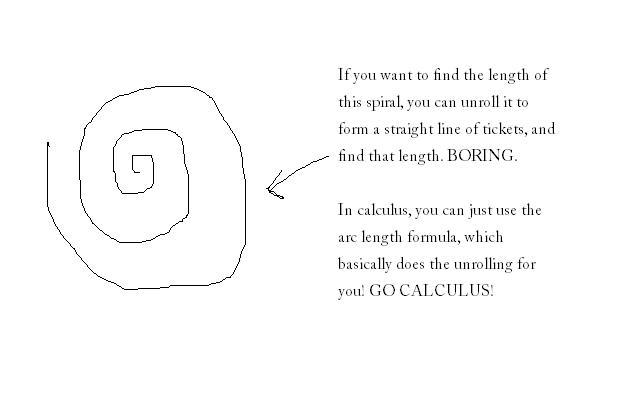
I had a couple ideas, but the most interesting for me was to try to come up with a function to model the tickets being rolled around a tube.** If I could find an equation which twists around like a roll of tickets, I could then use calculus’ arc length formula. If you don’t know what that is, it is pretty darn powerful. Given any normal function — curvy, straight, you name it — you can find how long the function is!

The idea behind it is the idea behind most calculus ideas. Break up the function into a bunch of pieces, and approximate the pieces with lines segments. Then add the lengths of those line segments together. You have an approximation for the true length of the function. If you break the function into more and more pieces, your approximation gets better. And if you start breaking the function into an almost infinite number of pieces and adding those line segments together, you’re going to get an almost perfect length. That’s calculus, and I’m not going to go into how you add an infinite number of line segments together here, but don’t be daunted. It sounds much more difficult than it is in reality.

Regardless, the whole point here is if we can find a function to model the tickets being wound around and around and around, we can just apply the calculus arc length formula and find the length of all the tickets if they were rolled out!

So the hard part about this problem is coming up with the equation to model the rolled up tickets. But it’s just a spiral. In particular, an Archimedean spiral.
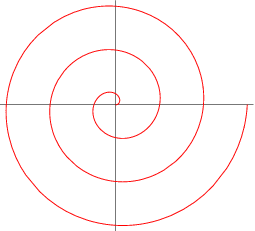
In polar coordinates, the equation to get this spiral is the SUPER simple: r(\theta)=k\theta. You can’t get much simpler than that. It obviously takes 2\pi radians to make one full circle (to start and end at the same angle). And in that 2\pi radians, the spiral moves out from it’s previous location 2\pi k. That’s all we need. Seriously.

So first we’re going to model the ticket roll as if it does not have that hole in the center. It’ll first just be a spiral that will go on and on forever. We’ll then find where to start and stop this spiral to create the roll of tickets which starts at some inner radius and ends at some outer radius.

Look at that Archimedean spiral one more time. For our purposes, I want the distance between the red lines above to be the thickness of a single ticket. Does that make sense? That way the ticket’s are getting wound around and around and around, laying on top of one another.***

Remember that for each total revolution (2\pi), the spiral moves outwards 2\pi k  from it’s previous location. We want that distance it moves outwards to be the thickness of the ticket. So we simply set the thickness (0.22 mm) equal to 2\pi k to find that k \approx 0.035014.

HOLLA! We now have the function we’re using to model the tickets:

r(\theta)=0.035014\theta.

Dude, graph that on your TI-whatever and you’ll see a nice tight spiral.

Now to start and stop the spiral so it matches our roll of tickets. To do this, we need to graph it for only certain \theta values — so that we can get the spiral to start at the inner radius and stop at the outer radius. That’s just simple algebra, boys and girls! We’ll call the starting angle value \theta_{start} and the ending angle value \theta_{end}.

Since r(\theta)=0.035014\theta, we want to know what \theta is that will bring the spiral out to the inner circle. That will be our starting angle! So 27.77/2=0.035014\theta_{start}. Similarly we can set 168.65/2=0.035014\theta_{end}. The starting and ending angles are easily solved for, to get \theta_{start}=396.55566 and \theta_{end}=2408.32239.

Graphing the spiral with these endpoints looks like:
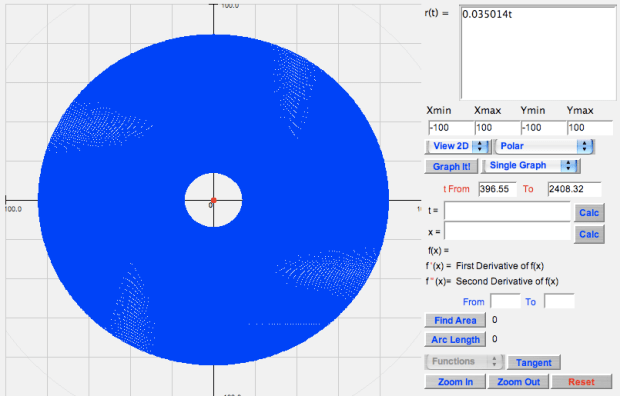
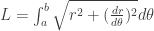
We’ve done all the hard parts! Now we simply use the arc length formula in calculus (for polar equations) to find the length of the spiral! Again, I’m not going to explain the derivation, but the equation for arc length is:
L=\int_{a}^{b} \sqrt{r^2+(\frac{dr}{d\theta})^2} d\theta

This gives us the length of a function, from one endpoint to another. Applying our equation for r(\theta) into this, we get:

L=\int_{396.55566}^{2408.32239} \sqrt{(0.035014\theta)^2+0.035014^2} d\theta.

Using the calculator to solve this, we get L=98787.8359  mm. That’s the whole length of the roll of tickets, if it the tickets were laid out flat instead of rolled up. So by simply dividing this by the length of a ticket (51.21 mm), we get the number of tickets.

This comes out to be 1929.07 tickets. That’s what we got with calculus.

It seemed a bit crazy to me that the answer without calculus would be identical to the answer with calculus. It took a few minutes of thinking, but then it dawned on me that it would be crazy if they were not identical.

I wrote to Dan Meyer, explaining that I got the same answer using calculus that he did without, and that ex post facto, of course it made sense. I said:

Once I saw that we got the same answer, it dawned on me that they SHOULD be the same answer. (Isn’t that always the way in math?) Why wouldn’t they be the same? We’re both using the same initial data (inner radius, outer radius, thickness, and ticket length), and we’re not approximating anywhere in our calculations (we’re being exact).****

So there you go.

I just love that this simple algebra solution and this calculus solution turn out to be the same. Instead of showing me how useless calculus is (why do we need it if we can do it without?), I can’t help but cogitate on how amazing calculus is! These two methods are completely different! One is geometry. The other is based in functions. But both solutions are reducible to the same thing. They are really the same thing.

Now if you’re a calculete and you’re really interested in finding an exact — and non-calculator based solution — to the arc length integral, I suggest you look at the bottom of this page. It’s not hard, but also not the point of this post. I wanted to make the general process clear to someone who might not know calculus, but interested in the idea of how we can use it to solve the same problem. Of course, it’s a bit silly, way more firepower than you need. But it really gets you thinking about the ideas undergirding calculus, and there’s where I see the value in doing explorations like these.

PS. If you’re wondering why we’re not getting 2000 tickets, I think the answer is simple. In the initial data (the inner radius, the outer radius, the length of a ticket, and the thickness of a ticket), there was probably some error. I suspect it was with the thickness of the ticket — the hardest thing to actually measure. If the thickness of aticket was found to be 0.2124 mm (instead of 0.22 mm), then we would get precisely 2000 tickets! So if Dan were able to measure to the hundredths or thousandths accurately, I bet we would get something way closer to 2000 tickets.

*I seem to recall that Kate Nowak Jason Dyer suggested removing a bunch of tickets (50?) from the roll, stack them up, and measure the height. Use that to get the approximate thickness.

**Of course concentric circles would be possible, but then you’d get a summation, and blah blah blah. It all seems more precalculus than calculus.

***If that doesn’t make sense, try looking at this horrible picture of a shrimp. I mean ticket roll.

**** If you say I rounded to 5 or 6 decimal places a few times, guilty. However, I actually calculated it without any rounding, and it comes out to be the same value. So there. Pfft. The rounding didn’t affect the answer to the hundredths place.

I’ll be in and out this summer

The title says it all. Since school has let out, I’ve wanted to do very little thinking about teaching. I’m in my time-to-vegetate-and-watch-tv-and-read phase. I don’t really want to think about planning for next year … yet. That’ll come, though, once I get sick of vegetating, which happens.

I will, however, at the end of this week be traveling to Utah for a three week math workshop thingie. I’m sure it’ll be fun and I’ll have lots to talk about on here. One of the things I’m doing there is taking a workshop on Japanese Lesson Study, which I’ve been intrigued by since I first heard about them a couple years ago.

So I’m not dead yet, but I’m not going to posting super regularly this summer. I’ll do it when I’m inspired, have thought of something, or whatever.

Always,

Sam

Join in the 4 photos fun

So Kate Nowak and I created a site where we are going to post the 4 photos idea. You know, the idea that by seeing someone’s fridge, wallet, bookshelves, and computer desktop, you can decide whether you want to date ‘em. Or hang out with ‘em. Because, we aver, you probably can tell so much about a person, their interests, their personalities, their habits, they’re style, from these pics.

My embarrassing photos are here. (Click each photo.) Clearly you know I’m totes awesome. You know…  those take out rice containers in the fridge, the red plastic lobster on the bookshelf… WINNER!

So yeah, if you want to be included in this little adventure, just email your four (or more) photos to 4photos4photos@gmail.com. Then Kate or I will put them on a page. More likely Kate.

Graduation

Today is graduation for our kids. It’s also officially going to be three years under my belt. You know, as much as I’m feeling very little nostalgia about the year ending, I’m also finally feeling pretty solid with the year. My despair has lessened. I think I did some good for some great kids, and you know what, I’m very okay with that. I implemented an organizational system in Algebra II, I got some pretty spectacular final projects in multivariable calculus, I did the algebra bootcamps in calculus. I also finished my 2 year term on the Faculty and Staff Advisory Committee and finished off my second year as faculty representative on the Student-Faculty Judiciary Committee. I agreed to take over that committee next year. I got the number of students taking the American Math Competition from around 15 to over 100. It’s been pretty good. I’m not nostalgic, but after taking stock, I now don’t feel like this year was wasted — that I should have done more and better.

Happy graduation to me.

4 photographs

At my department end of year party, hosted by my department head, I slowly made my way to the bookshelves. Lined with books. I love looking at other peoples’ book shelves. There is something so voyeuristic intimate revealing about what people read. I do this a lot — spend time examining a bookshelf, sometimes talking with my friend about the books, judging. I started thinking — you know, one or two Americanos in me and my mind wanders a bit much — of how certain things like bookshelves are so telling about us.

So I came up with an idea to make a blog where people (anonymously) submit pictures of 4 things:

1. Their bookshelves

2. The inside of their refrigerator

3. Their wallet, with the contents removed and lined up near the wallet [personal details blurred out]

4. Their computer desktop screenshot [1]

Then other people could comment on these things, conjecturing about the people behind the photos. What do the objects tell about the photographer?

This could be adapted for us teachers. Photographs of:

1. our desk

2. our gradebook

3. one of our tests

4. our computer desktop

(Are there other things that you think say more about you? I would say “our classroom” but I taught in 4 different rooms, none of which ever felt like my own.)

When I posted this idea on twitter, @vtdeacon suggested adapting it to be a “get to know you” start of the year activity for kids, and/or an end of year activity for kids too. (Where @vtdeacon suggests photos of their lockers, and I add in the idea of photos of their backpack: packed and unpacked — like the wallet.)

So heck, I think I’m going to try out the first idea (bookshelf, fridge, wallet, and computer desktop). I’ll post them of myself soon.

[1] I originally said 1 day internet history. However, that wouldn’t be a photograph.

A Benefit and Peril of a Laptop School

Tomorrow my Algebra II students are going to take their final exam. The year has come to a close. I’ve taken stock of the year in a number of ways. Here’s another summary of my year (a la my SmartBoard notes data).

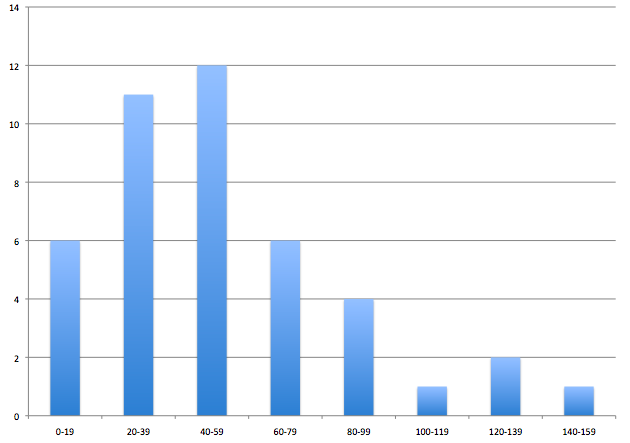
In order to keep myself organized throughout the year, I make a separate email folder for each student. All emails to, from, or about that student (e.g. with parents, with deans, with their adviser) get archived in this folder. I compiled the data and saw that I’ve done a lot of individualized emailing. To be precise, 2,270 individual emails. I teach only 43 students, so this comes to about 53 emails per student. Most aren’t extensive emails — sometimes it’s just them asking me a quick question, or trying to schedule a time to meet, or me asking them if anything was up. The picture of how these 2,270 emails were distributed is below.

The number of students is on the left, the email range is on the bottom.

I don’t really have many conclusions.  I just wanted to see what the data would look like. The students on the right — who I emailed a lot lot lot with — were the ones I was trying to reach the most. So it’s nice that there was a correspondence between this data and that.

I do spend a lot of my time on email. As for whether it is worth it, well, that’s still up in the air. I think it is.

Histograms, Standard Deviations, and Digital Cameras

Our last unit in Algebra II was statistics — and it was a hurried unit. (As last units always are.)

One of the topics I was covering was histogram basics. And I wanted to make it somewhat interesting. So I went online, and came across a page which explained how to understand histograms that your digital camera produces. You know what I’m talking about, right?

That’s the one. How do you get it on your camera? Heck if I know. I just pushed a lot of buttons and eventually the histogram appeared.

Because I had about 20 minutes, I just lectured my kids on how this histogram worked.The histogram has 256 columns (numbers 0 to 255). Each pixel on your camera is assigned a number from 0 (representing pure darkness) to 255 (representing pure lightness). Then the height of each bar represents the number of pixels with that particular level of darkness/lightness.

By that one little piece of information, you can start telling a lot about a photo. Such as when it is over-exposed and under-exposed, and when there is too much or too little contrast. You might wonder how photo editing software can increase the contrast or correct for a photo being over/under-exposed. One you learn about this, the answer is pretty simple. The program reassigns each pixel with a different brightness.

See examples that I cribbed from the website on my smartboard. Pay special attention to how the over-under exposed histograms differ from the “ideal” histogram (and similarly for the too high/too little contrast):

I really enjoyed learning about this, and sharing what I learned with my students. But next year, I want to do something more. I want students to take photos and play with them in some image editing software — and see what happens to the data as they modify the image in certain ways. What does brightness mean? Will things change if the image goes from color to black and white? What does sharpening the image do to the histogram? I want them to talk about mean, median, and mode — and how they change. I want them to talk about standard deviation — and how it changes. I want them to talk about range and shape — and how they change. I want them to make a short writeup explaining their findings.

Look at what Picasa (free) offers:

You get the histogram (bottom left)! You also get all these ways to modify the picture!

And the histogram changes as you modify it! In REAL TIME as you slide sliders!

I don’t know quite yet how to make this rigorous or ways to ensure they’re learning. It’s kinda bad, because I just want to play around with this and discover what all these things do myself, not knowing what I want them to get out of it. I just want to explore. I’m not thinking backwards. But I suspect a good short bit on the shape of data can be made from this. (Alternative reading: I wouldn’t begrudge any of you if you, say, went out and made a short unit based on this and sent it to me.)

Follow

Get every new post delivered to your Inbox.

Join 82 other followers