Month: July 2008

MMM10 Solution

THE PROBLEM IS HERE!

In the Quach family, there is an age-old tradition that has been intact since the 1500s. In this tradition, every member of the Quach family receives one lottery ticket for his/her first 25 birthdays.

Based on empirical data collected over the years, it was determined by the family Mathematician that the probability of a Quach family member winning the lottery at least once during that 25 year stretch is 211/243.

Assuming the above statement is true, what is the probability of a Quach family member winning the lottery at least once during any 5 year interval? (Assume that lottery wins are completely independent of each other).

So the probability that a member of the Quach family does not win the lottery in 25 years is 32/243. Since winning each year is independent of any other year, we know:

P(not winning any year)=P(not winning 1st year)*P(not winning 2nd year)*…*P(not winning 25th year)

And since the probability of not winning each year is the same, we get:

P(not winning any year)=P(not winning in nth year)^25
32/243=P(not winning in nth year)^25
P(not winning in nth year)=(32/243)^(1/25)

Now we need to find the probability of winning at least once in a five year interval, which is actually 1-P(not winning in 5 year interval).

P(not winning in 5 year interval)=P(not winning in 1st year)*P(not winning in 2nd year)*…*P(not winning in 5th year)

P(not winning in 5 year interval)=P(not winning in nth year)^5

P(not winning in 5 year interval)=(32/243)^(1/5)=2/3

Since we want to find P(winning at least once in 5 year interval), we know that that will have to be 1/3.

I want me some of them odds.

Because you need to laugh so you don’t scream!

I can’t help it… I have to post about this… jd2718 led me to a blog which is so awesomely captivating that I just spent the last hour reading like a zillion postings…

It’s not all flowers and sausages

It chronicles all the funny, frustrating, quotidian things teachers go through… you know what I’m talking about… there are those things which we go through and are funny to everyone

excerpt from blog: “Well you need to get them to stop. We don’t need children standing there having orgasms. The next thing you know they will all be shivering and shaking and oooooohhhhhhhhh”

… and then there are those things that you only want to tell to other teachers because your friends wouldn’t get it

excerpt from blog: And as the cherry on my sundae, I ended my day with a doctor’s appointment. If that wasn’t sweet enough, I was correcting papers in the waiting room when my name was called. And she had the balls to say, “Oh look, you’re correcting papers, isn’t that cute!” I wonder if it would also be “cute” if Friday I run screaming from the building and bury myself face down in a cocktail?

1001 Books

Out of this list of 1001 books that one ought to read (from this book I guess), here are the ones I have read… about 5.1%. My favorites are marked with a *.

  1. The Curious Incident of the Dog in the Night-Time – Mark Haddon
  2. Middlesex – Jeffrey Eugenides
  3. Choke – Chuck Palahniuk
  4. Blonde – Joyce Carol Oates*
  5. Memoirs of a Geisha – Arthur Golden
  6. The Secret History – Donna Tartt*
  7. The Hitchhiker’s Guide to the Galaxy – Douglas Adams
  8. Them – Joyce Carol Oates*
  9. In Watermelon Sugar – Richard Brautigan
  10. The Crying of Lot 49 – Thomas Pynchon
  11. The Bell Jar – Sylvia Plath
  12. One Day in the Life of Ivan Denisovich – Aleksandr Isayevich Solzhenitsyn
  13. Franny and Zooey – J.D. Salinger
  14. To Kill a Mockingbird – Harper Lee
  15. Pnin – Vladimir Nabokov*
  16. Lolita – Vladimir Nabokov
  17. Lord of the Flies – William Golding
  18. Invisible Man – Ralph Ellison*
  19. The Old Man and the Sea – Ernest Hemingway
  20. The Catcher in the Rye – J.D. Salinger*
  21. Nineteen Eighty-Four – George Orwell*
  22. The Little Prince – Antoine de Saint-Exupéry
  23. Their Eyes Were Watching God – Zora Neale Hurston
  24. The Hobbit – J.R.R. Tolkien
  25. Brave New World – Aldous Huxley*
  26. A Farewell to Arms – Ernest Hemingway
  27. The Sound and the Fury – William Faulkner
  28. To The Lighthouse – Virginia Woolf
  29. The Sun Also Rises – Ernest Hemingway
  30. The Great Gatsby – F. Scott Fitzgerald
  31. Siddhartha – Herman Hesse
  32. A Portrait of the Artist as a Young Man – James Joyce
  33. Ethan Frome – Edith Wharton
  34. Heart of Darkness – Joseph Conrad
  35. The Hound of the Baskervilles – Sir Arthur Conan Doyle
  36. Jude the Obscure – Thomas Hardy*
  37. The Adventures of Sherlock Holmes – Sir Arthur Conan Doyle
  38. The Picture of Dorian Gray – Oscar Wilde
  39. The Adventures of Huckleberry Finn – Mark Twain
  40. Treasure Island – Robert Louis Stevenson
  41. Alice’s Adventures in Wonderland – Lewis Carroll
  42. Walden – Henry David Thoreau
  43. The Scarlet Letter – Nathaniel Hawthorne*
  44. Wuthering Heights – Emily Brontë
  45. Jane Eyre – Charlotte Brontë*
  46. The Purloined Letter – Edgar Allan Poe
  47. The Pit and the Pendulum – Edgar Allan Poe
  48. A Christmas Carol – Charles Dickens
  49. The Fall of the House of Usher – Edgar Allan Poe
  50. Pride and Prejudice – Jane Austen
  51. A Modest Proposal – Jonathan Swift

The Video Verdict: Check Plus!

PREAMBLE

One of my friends is in Paris, helping set up an art installation by Ryoji Ikeda on the number “e”. And I received a frantic email from her asking for help understanding set theory, e, and infinity.

I sent her information on set theory and e via an email and links, but not on infinity. There are a number of good books and articles on it, making it accessible to a layperson. But I found this youtube video which is directed to the hoi polloi.

There are bits of the presentation that could be improved (the jokes are not really played well, I see quick and easy ways to make it more “mathy”). But these small things don’t take away from the fact that it is a darn good presentation. And darn it, now I want to give a presentation on infinity! Oh well.

THE CRUX

Interestingly, making the decision to email my friend the video instead of articles gets at the heart of the problem that dy/dan and others are grappling with: when is video an appropriate teaching tool – and is it better?

There are two poles outlined by dy/dan:

  1. Video is personable and injects human qualities that can’t be gotten from a text. These human qualities help enhance the learning process, by improving understanding.
  2. It takes a heck of a lot more time to watch a video on math than it does to read a paper which goes through the same math (efficiency argument). Reading also allows students to learn at their own pace, go back to sections they didn’t get, and active.

I thought these poles were meant to be generally taken for video in classroom instruction, even though the examples used were videos from leaving comments in blogs…

So let’s get this out of the way: context is everything, and there isn’t a single answer. Nor is anyone really looking for “an answer.”

With this said I strongly believe the second point is a red herring, and the first is really crucial. I evidence it with a counter-example-question:

Why do I even need to be in the classroom? If students-at-large can learn the content we want them to learn by reading the textbook, do I even need to be there? What am I doing at the board? What am I doing walking around the classroom? I hope (pray!) that it’s not only to answer questions that the book doesn’t address or when they get stuck… because otherwise, why bother showing up?

Teaching with talking, with dynamic visuals (instead of static pictures), with caveats and asides that aren’t easily worked into a text, with auditory and kinesthetic elements… many, many students respond to that. They engage with that.

(Not that I’m saying students can’t read actively or can’t learn from books… but there is something that books can’t capture that we teachers can.)

I guess what I’m saying is this: I see a defense of the need for good teachers in the classroom to also be a defense of video. (If well chosen/done.)

And I honestly think that almost everyone would agree with that.

NOTE AND CONFESSION: A PLEA

I suspect (but can’t be sure) that most of the discussion about video in the edblogosphere is not talking about videos of a lecture or solution to a problem… but I think that my thoughts about this may still hold. I’m honestly wondering though if those blogging about videos in the classroom have a firm sense of what videos they are talking about? I’m sure they aren’t trying to kick a dead horse by arguing against this type of valueless video:

But if they aren’t talking about these terrible videos, or videos about teaching, or lecture videos, or videos of how to solve a math problem, or small video clips to motivate a class discussion, I’m a bit clueless about what videos they’re talking about. I just don’t know. Am I missing something? (I think I must be…)

1,2,3,4

How much do I love Feist? From the first song I heard of hers (Mushaboom) to the myriad others that followed, I was drawn to her haunting voice and her upbeat beat down sound.

And then, then, she comes out with this:

which is a take on this:

which is a feat almost surpassed by this:

and again, I could hear this song a million times and still not be sick of it. I’m in love.

PS. If you haven’t heard the Jack Penate cover of the song, go here or here and press the little play button. Addictive. Do I love it more than the original? Quite possibly. Another really good cover is by Bikini. And still another. Other amateur and not terrible covers: 1 2 3 4 (though I am thoroughly sickened by the t-shirt on the singer of cover 3).

The Supreme Court, Linear and Exponential Growth, and Racial Segregation

I just started reading Closed Chambers: The Rise, Fall, and Future of the Modern Supreme Court — and I came to an interesting case which could turn into a good problem dealing with exponential math.

A paraphrasing of the case

The case, originating in 1980, was filed by the U.S. Department of Justice and joined by the NAACP against the city of Yonkers, New York. The charge: violating the 1968 Fair Housing Act by purposely placing public housing in such a way as to perpetutation residential segregation. Finally, in 1985, the federal district court judge ruled in favor of the Department of Justice. However, with the ruling needed to come some sort of remedy — how could this wrong be righted?

The judge, Leonard Sand, ordered the city of Yonkers to build 200 public housing units spread throughout Yonkers, and to plan for subsidized housing in previously segregated neighborhoods. The city initially balked, but in January 1988, the city council formally agreed to the order. However, two weeks later, four of seven members of the city council decided to go back on their agreement, in defiance of the court.

Here’s where it gets interesting.

“Judge Sand first cajoled, then demanded, and finally threatened the city and its recalcitrant officials with contempt of course. As a last resort, Sand ruled that if the council did not adopt the necessary legislation by August 1, he would fine the city $100 a day, doubling every day until the legislation passed… In addition, he would fine each council member voting against the legislation $500 a day, with the possibility of incarceration after Day 10″ (page 40-41).

It wasn’t clear to me whether the fines would be cumulative or not (so if the fine after day 2 would be $200 or $200+$100), but from this New York Times article and others, I can say with a high degree of certainty that it was cumulative!

The fines were to start on August 2nd. However, they were suspended from August 9th to September 2th, while the case was waiting to be being heard by the appeals court and the supreme court.

The appeals court ruled that the exponentially increasing fine was excessive and unconstitutional. The ruling reads:

The City contends that the amount of the coercive fines imposed as a remedial sanction for civil contempt is excessive and a violation of the Due Process Clause of the Fifth Amendment and the Excessive Fines Clause of the Eighth Amendment. The fines start at $100 a day and double each day of continued noncompliance. As a result of doubling, the fine exceeds $100,000 for day 15, exceeds $1 million for day 21, and exceeds $1 billion for day 25.

Um… me thinks that even though it is a true statement that on day 15, the fine is more than $100,000, the justices probably meant day 11. Well, anyway, let’s continue:

The Court acted well within its discretion in starting the fine schedule at $100 a day. The Court also was entitled within reasonable limits to double the amount of the fine for each day of continued defiance. At that rate the cumulative fine after seven days, when we issued our stay, was $12,700. At some point, however, the doubling reaches unreasonable proportions. Under the current schedule the fine for day 25 is more than $1 billion; the fine for day 30 is more than $50 billion.

We believe that the doubling exceeds the bounds of the District Court’s discretion when the level of each day’s fine exceeds $1 million. The present schedule calls for a fine of more than $800,000 on day 14. We will therefore modify the contempt sanction against the City to provide that the fine shall be $1 million per day on day 15 and $1 million per day for every subsequent day of noncompliance.

So instead of having the fines double each day, after the doubling reached $1 million, each subsequent day, the fine would be another million bucks. The U.S. Supreme Court got the case in 1988 and decided not to grant a stay (meaning they didn’t want to put the Court of Appeals ruling on hold). In other words, the fines imposed by the Court of Appeals were constitutional and enforceable!

Even with the “reduced” fine, the city of Yonkers started to feel the pinch…

Mr. DeLuca [the city manager] has estimated that the city could pay fines through day 79, when the total would exceed the $66 million the city has in available resources… [NYT article].

On September 8, the New York Times ran an article about the drastic measures that Yonkers was about to be forced to take, since the contempt fines were nearing $1 million. By November 5th, the city would have to layoff 1,605 employees, leaving only 348 critical employees needed for minimal public safety and health! The article, rightly titled “‘Doomsday’ Layoffs Plan Adopted for Yonkers” continues:

According to the city schedule, ”all city services would be phased out after 12 weeks, on Thanksgiving Day, Nov. 24, 1988.” Under the state plan, the city would be operating under an emergency austerity program by Nov. 5, with the money saved available to ”retain a small work force” that would provide ”minimal public health and safety.”

Mr. DeLuca circulated a notice this evening to all employees, saying that they would be ”informed in writing as to your scheduled layoff date with as much notice as possible.” Employees would also be informed of their rights regarding unemployment insurance and options to continue benefit plans at their own cost.

”A final ‘Doomsday Plan’ will be in effect by Thursday morning,” Mr. DeLuca wrote. ”I regret to inform you this is not a rumor.”

Two days later, two of the four city council members who were defying the court order relented. The vote had switched, from 3-4 to 5-2. The first round of layoffs, scheduled in a matter of days, was averted.

Approval of the housing plan means an end to the fines that threatened to bankrupt the city, with the last assessment recorded on Thursday. The money already paid, $1.6 million in checks made out to the U.S. Treasury, will not be returned.

The case was not officially closed until May 2007 — twenty seven years after it began — when Judge Sand finally ruled that the court order had been followed through.

SOME MATH ANALYSIS

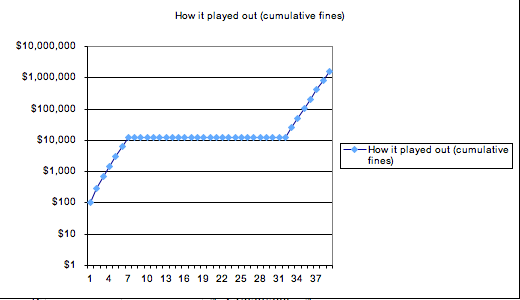
I made a graph of how much Yonkers owed the government each day starting on August 2nd until they agreed to the court order on September 9th:
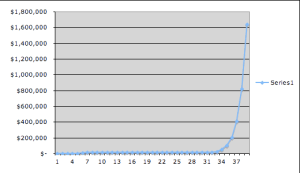
However, you can’t quite tell what’s going on for the first 30 days, because the scale is so large… And in general, when you’re plotting three or more orders of magnitude, you should plot on a log scale. So…
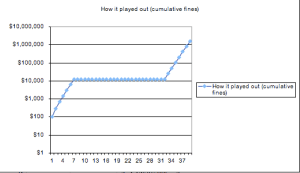
Notice the new scale (see the numbers on the left increase by an order of magnitude). It allows you to see more information. Like what’s that really long straight segment in the middle? Well, remember the fines were put on hold from August 9th to September 2nd, so the amount of money owed by Yonkers was kept constant for those days. That sort of “detail” got lost in the first graph, because the scale was so large!

And the first third of the graph looks linear, while it looked totally flat on the original non-log-scale graph. Why linear? Well, because remember the fines were doubling for all of those days, and when you plot exponential growth on a log scale, you get a line! But be careful! It isn’t exactly a line… We aren’t plotting $100, $200, $400, $800, etc., which would be perfectly exponential data. We are plotting the cumulative totals, which are $100, $300, $700, $1500, etc. These numbers don’t form a perfect exponential growth, though they are super duper close to being perfectly exponential! So for all intents and purposes, we can call it exponential, and hence, the first third of the graph is pretty darn linear.  Since the last third of the graph still has the fines doubling and being added to the cumulative total, that section too is linear.

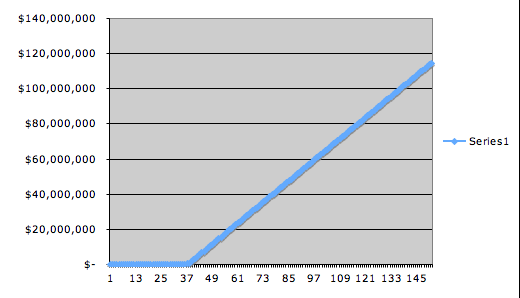
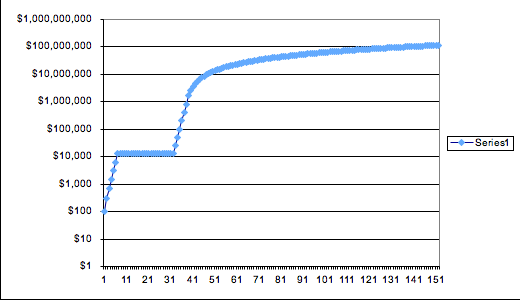
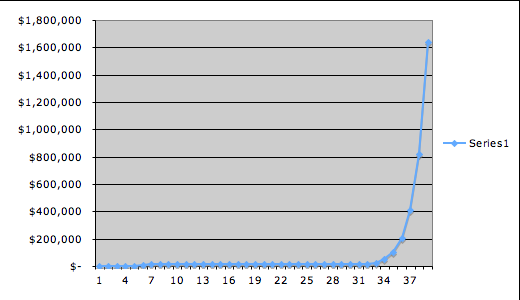
I also was really curious what would have happened if Yonkers didn’t pay up when they did… What if they let the fines accumulate until December 31st? Well, I also plotted that without and with a log scale…
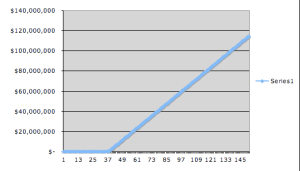
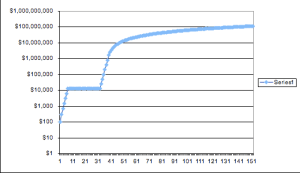
Looking at the first graph, we see that starting around day 37, we get a linear increase. Recall that’s because the Court of Appeals ruled that after the fines reached $1 million/day, they would stay $1 million/day. So each subsequent day, the fine just grows by the constant amount of $1 million.

(On the second graph, the log scale graph, we see the data go from linear to constant to linear — just like in our graph of what the town actually owed — but then the graph starts “slowing down” right at the same time the first graph becomes linear. That curve is actually logarithmic. Can you see why?)

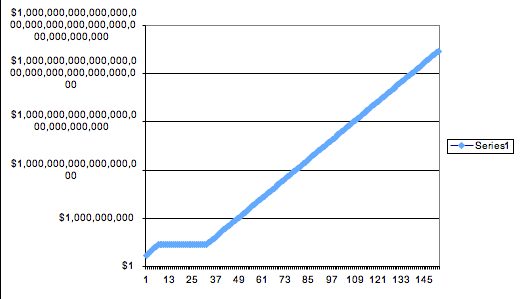
My last hypothetical is: what if the Court of Appeals and the Supreme Court didn’t find the doubling fine unconstitutional. What would that graph look like if extended to December 31st? Plotted on a log scale, we get:
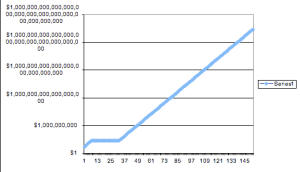
On December 31st, Yonkers would have owed the federal government: $17,014,118,346,046,900,000,000,000,000,000,000,000,000.

And as of the writing of this post, the national debt is only about $9,500,000,000,000.

YIKES! Good for the paying off the national deficit, bad for Yonkers.

A timeline for the case’s initial unfolding was published in the NYT here:

  • Dec. 1, 1980: Justice Department sues Board of Education, City of Yonkers and Yonkers Community Development Agency, charging that the city racially discriminated in education and public housing.
  • Dec. 1, 1980: Justice Department sues Board of Education, City of Yonkers and Yonkers Community Development Agency, charging that the city racially discriminated in education and public housing.
  • Nov. 20, 1985: Judge Leonard B. Sand of Federal District Court in Manhattan rules that Yonkers’s housing and schools were intentionally segregated by race. A housing remedy order directs the city to build 200 units of public housing and to plan additional subsidized housing.
  • Jan. 28, 1988: City Council approves consent decree that sets timetable for building 200 units of public housing and commits city to an additional 800 subsidized units.
  • July 26: Court sets Aug. 1 deadline for Council to adopt zoning amendment needed to build the 800 units.
  • Aug. 1: Council rejects amendment in a 4-to-3 vote.
  • Aug. 2: Judge Sand finds city and the four Councilmen who voted against the amendment in contempt of court and imposes fines. The city’s fines start at $100 and double every day. The Councilmen are fined $500 a day.
  • Aug. 9: The fines are suspended by a Federal appeals panel while the contempt ruling is appealed.
  • Aug. 26: An appeals panel upholds contempt ruling and fines, but fines against the city are capped at $1 million a day. The fines remain suspended so the city can appeal to the United States Supreme Court. Sept. 1: The Supreme Court refuses to grant the city a further suspension of fines but does continue the stay of fines against the Councilmen so they can seek the High Court’s review of their contempt rulings.
  • Sept. 2: Judge Sand reinstates the fines against the city.
  • Sept. 5: Mayor Nicholas C. Wasicsko meets for 7 1/2 hours with the City Council in an effort to end the impasse, but no compromise is reached.
  • Sept. 6: The Westchester District Attorney decides not to prosecute the four Councilmen who voted against the plan.
  • Sept. 7: As contempt fines continue to build up, a state panel adopts a ”doomsday” plan to cut city services.
  • Sept. 8: Fines pass the $1 million mark. As Yonkers residents confront layoffs and cuts in city services, pressure grows on the Mayor and the City Council to resolve the crisis. A City Council meeting over a transfer of funds to finance the fines erupts into a shouting match.
  • Sept. 9: The City Council votes to accept the plan.
It’s Alive! Multivariable Calculus or Bust

As you might recall, I’m spending a chunk of this summer designing a multivariable calc course. The oft repeated phrase of the moment: GACK! This is a mini-challenge, because not only am I trying to plan out the curriculum, but I have to refresh my poor, atrophied brain which hasn’t touched “multi” (as I fondly nicknamed it) in forever. (Well, erm, 9 years, anyway.)

I spent yesterday searching the net for resources to have at my fingertips when designing the course. And to keep them all organized — in one place — I created a website to house it all. 

My Multivariable Calculus Resource Webpage: multivariablecalculus.wordpress.com

I’m actually really proud of it, even though it’s still a work in progress. So if you have any interest, hop on by. Things of notice:

  • Nine different free multivariable calc textbooks (!) are available online
  • There are loads of great applets to visualize things like div, grad, curl, line and surface integrals, etc.
  • There isn’t a set of free videos that I could find that go through major concepts in multivariable calc
  • gnuplot is an incredibly powerful graphing utility
Have fun!