Month: May 2009

Just some good books about Math, for those who like Math

The math department, every year, gives awards to four students (some with some monetary compensation for college, some not). I was put in charge of thinking of some books to give with these awards. I sent my initial thoughts to my department head:

For the Math/Science award, I suggest:

*D’Arcy Thompson’s On Growth and Form is full of beautiful prose, and relates the sciences to mathematics. The actual science is wrong, but it is considered a classic piece of literature.
*Anthony Zee’s Fearful Symmetry about the important — crucial — role that mathematical symmetry plays in modern physics. A super-well written book for the layman.

For all other awards, I put out there:

*Silvanus P. Thompson’s Calculus Made Easy has a deceptive title. And it was written in 1910. But almost all accounts agree it is one of the best textbooks around. Even for those who might have thought they understood the conceptual undergirdings of calculus, this book will illuminate them further, without any obtuseness.
*Douglas Hofstadter’s Godel, Escher, Bach is standard reading for all math lovers everywhere.
*Calvin C. Clawson’s Mathematical Mysteries is one of the best and most accessible popular math books I’ve read.
*G.H. Hardy’s A Mathematician’s Apology is quite good at explaining what a mathematician actually does philosophically when he works, written by one of the most important mathematicians of modern times.

My final recommendation differed slightly:

Award 1: Timothy Gowers’ The Princeton Companion to Mathematics

Award 2: Douglas Hofstadter’s Godel, Escher, Bach; Thomas Kuhn’s The Structure of Scientific Revolutions; Bruce Hunt’s The Maxwellians; Silvanus P. Thompson’s Calculus Made Easy

Award 3 & 4: G.H. Hardy’s A Mathematician’s Apology

I really enjoyed thinking through which books might be appropriate. Also I didn’t want to give something I hadn’t read. But this process reminded me of all those books about math out there that I haven’t read (yet), but have really want to. Like Polya’s How to Solve It and David Foster Wallace’s Everything and More.

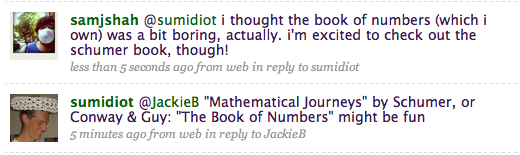
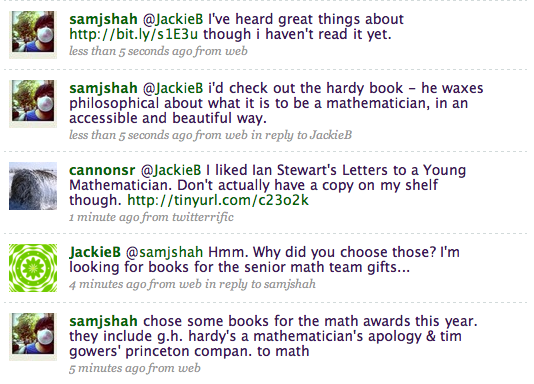
I posted this book award stuff on twitter, and got some great reactions. (Read from the bottom upwards.)
picture-4

picture-1

And then I thought: hey, you all must have a favorite math or math-y book that you’d want to have your favorite students read. I’d love to know your favorites! (Plus this list could help inspire me to do some quality reading this summer!)

My Exponential Function Unit

My Exponential Function Unit for Algebra II

Basic Context: This unit is coming right on the heels of function transformations. Students are familiar with translating functions up, down, left, and right; reflecting functions over the x- and y-axes; and vertically and horizontally stretching and shrinking functions.

Structure: The work on exponential functions is broken into four parts.

Part 0: Preliminary Diversion into Inverse Functions
Part I: Graphing exponential functions
Part II: Solving basic exponential function equations
Part III: Applications of exponential functions (carbon dating and compound interest)

Time: This took a total of 13 days — including an introductory activity day, a review day, a day where we did an exponential decay simulation as an entre to carbon dating, and two assessment days.

Nature of Class: I teach 15 students in a non-accelerated Algebra II class. The ability level of the students range the gamut. Many have a hard time thinking abstractly. All have graphing calculators and know how to use them at the basic to intermediate level. We meet 4 days a week for 50 minutes each day.

Broad Goal: The goal for this unit was to really drive home the concept of exponential functions.

Major Failures: I see two major failures. One is not seriously talking about how fast exponential functions grow. This would have been a really fun day, working on a problem like: “Would you rather have (A) $1,000,000 a day for the month of May, or (B) $1 on the first day, $2 on the second day, $4 on the third day, $8 on the fourth day, etc.” The second is just not having a lot of fun with this. The exponential decay simulation we did could have been so much more powerful, and changed in so many fun and really great ways. We could also have done an activity for exponential growth, using real data — population growth, Moore’s Law, or something to do with the Supreme Court. It would have been nice to finish off with a nice 2 day research activity. If for nothing else, to let my students produce something they could be proud of.

Major Strengths: In terms of getting students to understand exponential functions conceptually, I think I’ve done a pretty good job. My students can relate tables, graphs, and equations. They understand why the functions look the way they look. By the time we finished the exponential application days, students were coming up with the formula for the depreciated value of an object without any help.

Materials [NOTE: If you are opening these docs on a Mac, “Select All” and change the font to “Gill Sans.”]

Part 0: Preliminary Excursion into Inverse Functions
PDFs of My Smartboards before class: 1, 2, 3.

Part I: Graphing Exponential Functions
1. Introductory exercise introducing students to exponential growth and decay (.doc)
2. Introduction to exponential functions, and graphing basic exponential functions (.doc); HW (.doc)

Part II: Solving Basic Exponential Equations
1. PDF of My Smartboard before class: 1

Review Sheet on Part 0, Part I, and Part II to prepare students for the assessment (.doc)

Part III: Applications of Exponential Functions
1. Coin Drop Simulation for Exponential Decay (.doc); HW (.doc)
2. Carbon Dating (.doc); HW (.doc)
3. Compound Interest (.doc)

What I Want You To Know: Looking at just the stark documents, this whole unit seems like it might be a bit formulaic. However, particular moments of the guided notes, or the SmartBoards, or during the activities, were actually designed to be places where we have classroom discussions. For example, when one of the worksheets reads:

exponentialdefinition
we actually had a great 5-7 minutes talking about the answers! So I’m afraid these resources make it seem like we might not have really interrogated exponential functions. But we did.

You can really see what I mean because… during this unit, my friend came to observe my class. (It was an assignment for a class she was taking for her Masters.) It happened to be the class where we first talked about exponential decay. While I was teaching, she decided to make a (partial) transcript of the entire class. The transcript is very rough and partial, and you can’t really tell what’s going on exactly, but you can get a sense of what the class was like:

Transcription (with student names redacted) after the Jump

(more…)