First things first:
Now… for the actual physical explanation, you can read it here. And for the historical precedent, you can read about it here. (via Kottke)
UPDATE: An applet here.
First things first:
Now… for the actual physical explanation, you can read it here. And for the historical precedent, you can read about it here. (via Kottke)
UPDATE: An applet here.
Even though I don’t mince words when I proclaim my dislike of geometry, there are times when its simplicity and elegance strike me. Today the geometry teacher at my school was talking about Cavalieri’s Principle. Coincidentally, in my 7th grade math class, we are learning about volumes of prisms, cones, pyramids, and maybe spheres.
It got me thinking: without calculus, where do we get the formula for spheres? I mean, with calculus, it’s cake, but let’s assume we don’t have calculus.
These two things in mind led me to this great blog post on Cavalieri. It’s pretty much a proof without words, so I’m going to crib the picture from the post,
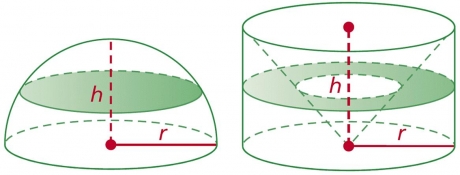
but the post has words explaining the picture. So click on the link and check it out if you are still scratching your head.
On the blog On The Tenure Track, Benjamin Baxter asks in a recent post:
Why the hell would you want a SmartBoard in a classroom? What ways could you use a SmartBoard in ways that don’t make it an expensive distraction?
But, in fact, I agree with most of what Baxter says about technology:
Who cares about LCD projectors if students have just as much trouble remembering how the Balkan Wars and The Great War are related, or have just as much trouble remembering why the powderkeg that was Europe at the turn of the 20th century is important historically, and in our own lives?
Technology adds many desirable things, but these benefits will only be felt once it’s in good hands. That should be our priority
I certainly am not on the “let’s explore new technologies in the classroom and then figure out what we’re doing with them” cart-before-the-horse bandwagon. I also don’t think that foisting technology on teachers works well. (You shouldn’t force a teacher who has been successfully teaching with a chalkboard and worksheets to switch to SmartBoard just “because it’s technology.” That’s doing students and the teacher a grave disservice.)
My opinion — surely held and written by others — is to support teachers who want to pick up technology and figure out an effective way to use it. Then other teachers get others on board because they want to be, because they’re inspired by the possibilities of applying it to their own teaching, because they see how it can enhance their students’ understanding. [1] That’s the way to have a technological culture shift at a school. Don’t force, do inspire.
When I say effective above, I will be explicit: it will have to enhance student understanding in some way. (We get the horse before the cart.) So students would have to come away knowing how the Balkan Wars and the Great War are related better than if they had learned it without the technology.
Now onto to my paean to the Smartboard in my classroom, at my school. (Where every classroom has a SmartBoard, and every student has a laptop.)
At worst, the Smartboard in my classroom is a replacement for a whiteboard, but a whiteboard where the markers are multicolored and never stolen or dry. At best, the smartboard provides me the opportunity to create better lesson plans by making me think more carefully about flow, allows me to have a design aesthetic and put up graphics up that I never would be able to draw by hand, gives me a lot of time in class where my back isn’t to my students writing a problem or definition down, and provides an archive of notes for students who need that extra help at home.
I’ll elaborate. (I’ve been anticipating counterarguments to each of these [how one could achieve these same effects with an overhead projector, scanner, more experience as a teacher, etc.], but in the spirit of being non-defensive, I’ll just write.)
When I started designing lesson plans before SmartBoard, I did an okay job. I had the general topic I wanted to present, some sample problems, and I would go in and talk. But using the SmartBoard did something great for my lesson planning skills: it got me to think like a student. A good presentation won’t have 18 ideas on a slide. In my math class, I try to keep it limited to 1 math idea per screen. But being forced to break down every idea into it’s most basic components led me to think in depth about each step of what I was showing them. (And doing this let me realize: oh, here’s where a student will make a mistake. And then I’ll make a big text slide saying: DON’T DO THIS!) The flow and thoughtfulness of my lessons has improved, big time.
In my math classes, also, we do a lot of graphing. Having SmartBoard, with the ability to have blank graph paper up there, or to show a virtual TI-83+ calculator, helps a bunch. Also, I like to throw up some random images to keep things fresh and keep their attention piqued. So they’ll see a picture of Sanjaya (from American Idol) every so often. A 5 second Sanjaya distraction will get them back to the task at hand. Continuing on with the idea of the visual aspect of it: if the slides are designed right, the student can be presented with the information in a way that’s infinitely more effective than if I were up there writing on the whiteboard.
Because of the SmartBoard, I’m spending a lot less time writing at the board. I’ll often throw an easy problem up there and have students solve it as a quick way for me to see if they’re getting it. I don’t need to spend time drawing a graph or writing out an equation.
Lastly, the ability to save SmartBoard files is a godsend in terms of archiving. I save a blank copy of my lesson, for me to draw from next year. But I also post a copy of the SmartBoard that we marked up in class for the students to access online. This is useful for kids who are absent, obviously. But it’s also useful for kids who didn’t quite get it all the first time around, or who missed something, or who spaced out. They just open the pdf and look at the steps we went through. It’s a good resource for me. In one of my classes, I have 16 students. About 5-6 of them look at the smartboard each night. (Often times not the same 5-6.)
How do I know it’s working for my students? I asked them for an anonymous narrative evaluation about my teaching at the end of the first semester. I wanted to know about my teaching, but I also asked them to write a paragraph about SmartBoard. I honestly wanted to know, because I spend a lot of time creating the SmartBoard presentations for class, and if my students weren’t getting a lot out of it, I would have stopped using it and cut my lesson planning time in half. (I remember thinking that if they weren’t positively glowing about SmartBoard, if they were “it’s okay,” I would have stopped.) But my students did have glowing things to say about it.
So yeah, I’ll be the first to praise SmartBoard. I’ll also be the first to admit that if I didn’t have SmartBoard handed to me on a silver platter at my school, I probably would have found ways to do things just as well as I do them now. But when it comes down to it, SmartBoard is helping me become a better teacher, and it’s helped my students with the material. So for me it’s definitely not an “expensive distraction.”
PDFs of some of my Algebra II Smartboards here:
[1] Recently I presented a project I had my Algebra II students work on (to be blogged about in a future post) to the other tenth grade advisers. A few came up to me afterwards and told me that they were really excited by the project and saw how it could fit in with their curricula — whether it be art or English — with some adaptation.
UPDATE: Turned off comments. For some reason this page was getting a lot of spam comments, everyday. Yeesh.
Recently the other 7th grade teacher told me she wanted to do a day of origami math. We had been learning the relationship between the sides of special right triangles (30-60-90 and 45-45-90). We had also started talking about the volumes of prisms.
With that in mind, my co-teacher showed me a project she was going to do. She was going to have her students build an origami cube, and then use their knowledge of these special right triangles to determine the volume of the cube.

We said that the side of the original unfolded sheet of origami paper was “x” and then using that, they needed to find the volume of the cube in terms of “x.”
Although I’m never quite convinced that these sort of hands-on activities really bring about understanding (see recent NYT article questioning the relationship between the concrete v. abstract in math), we had a day to spare and so I decided to do it in my class too.
I made a website with the step-by-step instructions to project on the SmartBoard so my students could follow along. I also had a giant square which I folded in front of them. I had each student do only one step at a time.
Since the day, I found a number of videos on YouTube explaining how to make the origami shapes. Here’s one:
Overall the students seemed to have an okay time with it. They really liked the cube itself. When it came to solving the problem, I let them float on their own. (This is an advanced class, so I wanted to see where they would go.) Many got to the point where they unfolded their origami sheet and saw the creases which formed the side of the square. And it was this point — where they had to notice a relationship between the side of the original origami sheet (“x”) and the diagonal of the square (“x/2”) that was key to the solution. With a little prompting, they got there.
We still needed an extra 5 or 10 minutes for this lesson to go more smoothly and to give students time to mull and go astray. Two of the four groups working on it got the answer, or very close to it. I stopped the investigation 7 minutes before class ended and we went through the solution as a group.
I’m a newbie to teaching. When meeting new people, it quickly comes up in conversation. I’ve noticed that a lot of people — not teachers — like to share with me their opinion of teaching. Their responses almost always fall into one of two categories:
I could never be a teacher. It’s so hard, to have to deal with all those kids all the time.
or
You are doing something so noble day in and day out. Thanks.
When they say those things, I disabuse them of the notion that I’m working harder than people in other professions (I have friends in med school, lawyers, professors) or that I’m a self-sacrificing hero working day in and day out for the betterment of mankind.
Not to say that I don’t work hard, or that I don’t think I’m impacting my students.
But those aren’t the reasons I went into teaching, or that I continue to work hard at it.
When it comes down to it, I teach for two reasons. First, I love love love my subject matter and I want to show others why it’s so great. As reasons go, it’s mundane and expected. Also, it’s selfish. I get a rush from the thought that I could be setting my students’ brains on fire, like my math teachers did to my brain when I was their age. Second, I love the challenges that teaching presents. I like creating projects for myself, learning new things, trying something or another thing out. It feels good to have something that I can say “I did” whether it be creating a paint chip wallet or have student X successfully learn to apply the law of cosines. These are small mountains I like to conquer.
I don’t do it for others. It’s nice that others might benefit, but — at least for me, now — I do it for myself.
Recently in the edusphere, there has been a conversation about the nobility of the teaching profession, partially prompted by the US News and World Report that stated teaching was “overrated.” (See here and here to get familiar with the arguments.) Much of the writing deals with tenure, the concept of “profession,” merit, and salary.
As I’m teaching in a private school which doesn’t have many of the problems that many of those blogging write about, I don’t have much of substance to add to the conversation above. But I’m still going to throw out a few cents.
In my experience, teachers don’t rely on the rhetoric of “nobility” when they talk with each other. (Mainly I’ve found non-teachers speak in those terms.) We commiserate with each other on the problems that adolescents pose for us, we complain about the late nights, we gripe about the higher salaries our friends in the financial sector are making [1], but at least among my young teacher friends (even those in the NY Teaching Fellows), we don’t ever talk about the nobility of what we do.
I’m not saying that my teacher friends went into teaching for the same reasons that I did, or even think of it in a similar way to me. They might even see themselves as working in the “greatest calling of all.” But I think when it comes to our actions from 7:30 – 3:10 (and after), nobility has very little to do with the task at hand.
[1] I too gripe about wanting more money (living in NYC, one always needs more money). But I don’t wrap myself in the clothing of a martyr, seeing myself as sacrificing the money in the financial sector for the more modestly paid teaching work. I chose teaching.
Sometimes I forget that my students are people. Not like I treat them badly, or anything. That’s not what I mean. And I do try to think of them as more than only students. But there are times that I get so wrapped up in lesson planning and grading that I forget. Today I got reminded in two very striking ways that my students are not just math students.
First, we had advising conferences, and just looking at the schedules of my advisees jolted me back into reality. These students are taking a lot more classes than just math, and when I mentally think “why didn’t you just learn the material the night I presented it?”, I sometimes forget that these students are juggling with a lot of teachers all of whom are probably saying the same thing. Not that what we assign them is unmanagable. But it’s not an easy life for them. It’s much easier from our side of the teacher’s desk, looking through the spectacles on the edge of our noses, muttering “when I was your age…”
But it was hard for us then too. We just have had the luxury of forgetting.
Second, today was opening night for the school musical. It was HAIR and it was risque and long and clearly took a lot of preparation to stage. The students in it have worked their tails off to pull off another successful production. And a fair number of my students are involved with the musical. I was impressed by the amount of effort that the kids put into the production, yes, but it was also great to see students outside of the math room context. And outside of the hallway context. And in the theater. For many, the stage is their context, and I’m on their turf. It’s nice to see a student who generally struggles in my class get out on stage, grab the microphone, and belt out a tune.
My students are people.
We really do know it. We just need to remember not to forget it.
We left off in our quest for an explicit formula for the nth Fibonacci number having created this amazing generating function: 
To do what we’re about to do, I need to remind you of two precalculus things:
First, that
. If you don’t know why, I suggest doing long division!
Second, partial fractions.
I’m going to go through this explanation assuming you know these two things.
So let’s look at the denominator of our 



We’ve made good headway, but what we don’t know are 

.
Rewriting this as a simple polynomial, we get:
Now we’re almost done! We use the initial conditions to find out
Since we know 


So the nth Fibonacci number is:
which simplifies to: 
Which is what we set out to show! Huzzah! What’s also nice about this (besides the fact that it’s an integer, which is surprising) is that it shows that the Fibonacci sequence grows exponentially!



 Continuous Everywhere but Differentiable Nowhere